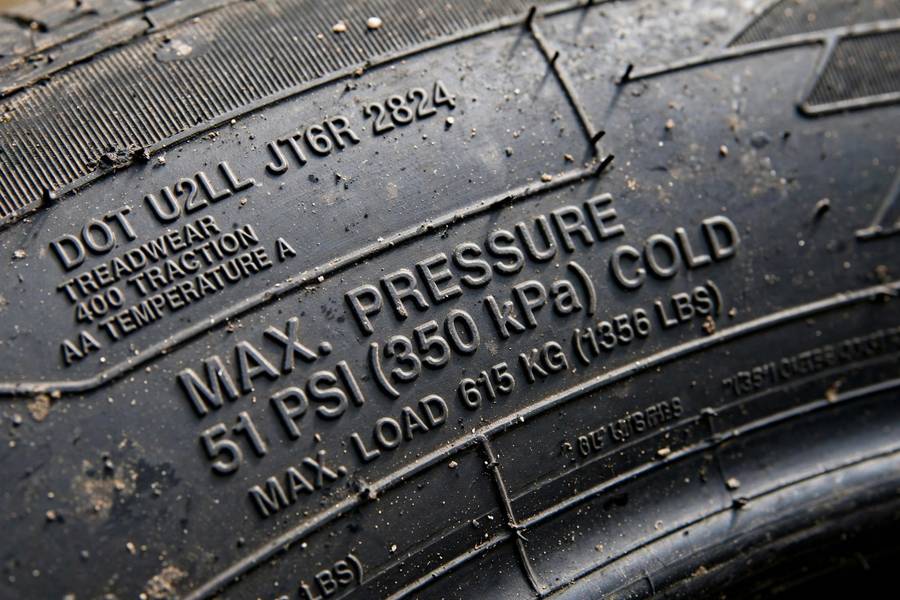
Here’s the single most common tire mistake I see, and it takes ten seconds to fix: people read the number on the tire’s sidewall and inflate to that. That number is the tire’s maximum pressure — not your car’s correct pressure. They’re different numbers for different purposes, and mixing them up is how you get harsh rides, uneven wear, and in hot weather, genuinely dangerous over-inflation. Your car’s correct pressure is on a sticker you’ve probably never read. Let’s fix that. The tire-change guide is at how to change a tire.
Table of Contents
- The 60-Second Answer: Where Your Number Lives
- Sidewall Number vs. Door Sticker: Know the Difference
- Typical PSI Ranges by Vehicle
- Why Correct Pressure Matters So Much
- What Under-Inflation Does
- What Over-Inflation Does
- When to Adjust From the Sticker Number
- How Often to Check
- Frequently Asked Questions
The 60-Second Answer: Where Your Number Lives
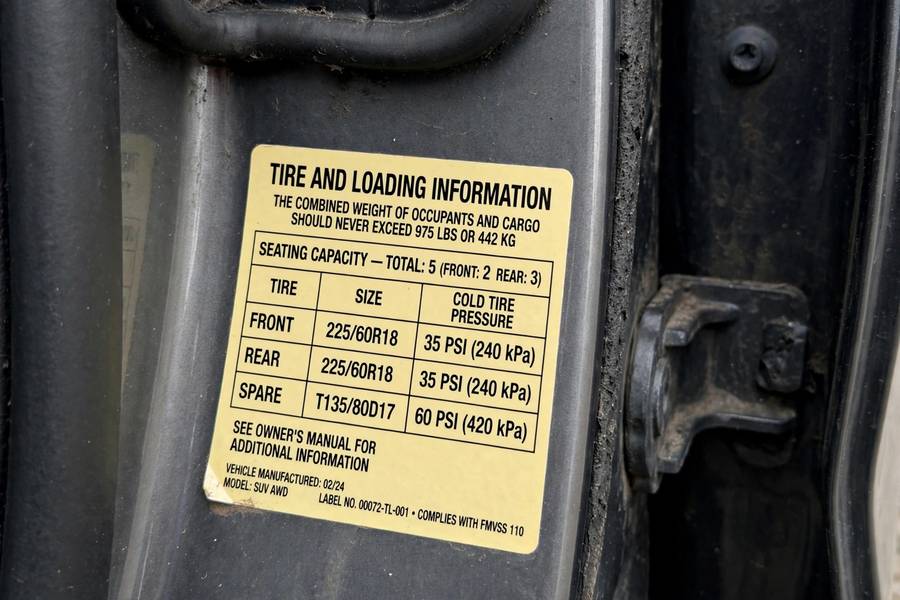
Open the driver’s door and look at the door jamb — the frame area the door closes against. There’s a sticker (the tire placard) listing the correct cold inflation pressure for front and rear tires, sometimes different for each axle. That’s your number. It takes sixty seconds to find and it’s the single most useful tire fact about your car.
Backup locations if the sticker’s missing or unreadable: the owner’s manual (tire section), the inside of the fuel filler door (some European cars), or the glovebox lid (older vehicles). If all else fails, the manual’s spec plus a call to the dealer parts department with your VIN gets you the factory number.
The placard lists cold pressure — measured when the tires haven’t been driven for at least three hours. Driving heats tires and raises pressure 3-5 PSI, which is why gas-station checks after highway driving read high. Check cold, in the morning, before driving — that’s the number the engineers specified.
Sidewall Number vs. Door Sticker: Know the Difference
This confusion deserves its own section because it’s so widespread:
- Door jamb sticker: the vehicle manufacturer’s recommended pressure for your car with its original tire size. This accounts for the car’s weight, handling balance, and ride tuning. This is the number to use.
- Tire sidewall (“MAX PRESS 51 PSI”): the tire manufacturer’s maximum safe pressure for the tire itself at maximum load. It’s a safety ceiling, not a target. Inflating to the max because “more must be better” is how you get a rock-hard ride, a shrunken contact patch, and center-tread wear.
Think of it this way: the sidewall number belongs to the tire; the sticker number belongs to the car. You drive the car, so you use the car’s number. The only time the sidewall max matters to you is as a limit never to exceed.
If you’ve changed to a different tire size than stock, the sticker number is a starting point, not gospel — a good tire shop can calculate the equivalent pressure for the new size (it changes with load capacity). But for stock sizes, the sticker is the answer, full stop.
Typical PSI Ranges by Vehicle
Your sticker is the authority, but these ranges tell you what’s normal — useful for spotting when something’s off:
- Compact/midsize cars: 30-35 PSI (most land at 32-33)
- Larger sedans, small SUVs: 32-36 PSI
- Full-size SUVs and trucks: 35-40 PSI (some rear axles spec higher for load carrying)
- Heavy-duty trucks: 50-80 PSI depending on load rating (these run LT tires with much higher pressures — check the sticker carefully)
Front and rear often differ — many cars spec 1-3 PSI more in front (engine weight) or in rear (trucks carrying loads). Use each axle’s number, not an average. And if your placard lists different pressures for normal vs. full load, use the one matching how you actually drive — most daily driving is “normal load.”
Why Correct Pressure Matters So Much
Tire pressure is the cheapest performance, safety, and economy adjustment on the car, because pressure determines the contact patch — the palm-sized area of rubber actually touching the road. Everything the tire does (grip, braking, steering response, wear, fuel economy) flows through that patch.
At correct pressure, the patch is flat and even: full tread width engaged, load distributed, grip maximized. It’s a precisely engineered shape, and pressure is what holds it. A few PSI off in either direction distorts it — and the consequences below are why I check pressures monthly without fail.
This is also why pressure matters more than most “upgrades.” A $1,000 set of tires at the wrong pressure performs worse than a $500 set at the right pressure. The air is free; the performance is in the air.
What Under-Inflation Does
Under-inflation is the more common and more dangerous error — most neglected tires are low, not high:
- Overheating. An under-inflated tire flexes excessively in the sidewall, and flexing generates heat. Sustained highway driving on significantly under-inflated tires builds enough heat to break down the structure — this is the mechanism behind most heat-related blowouts.
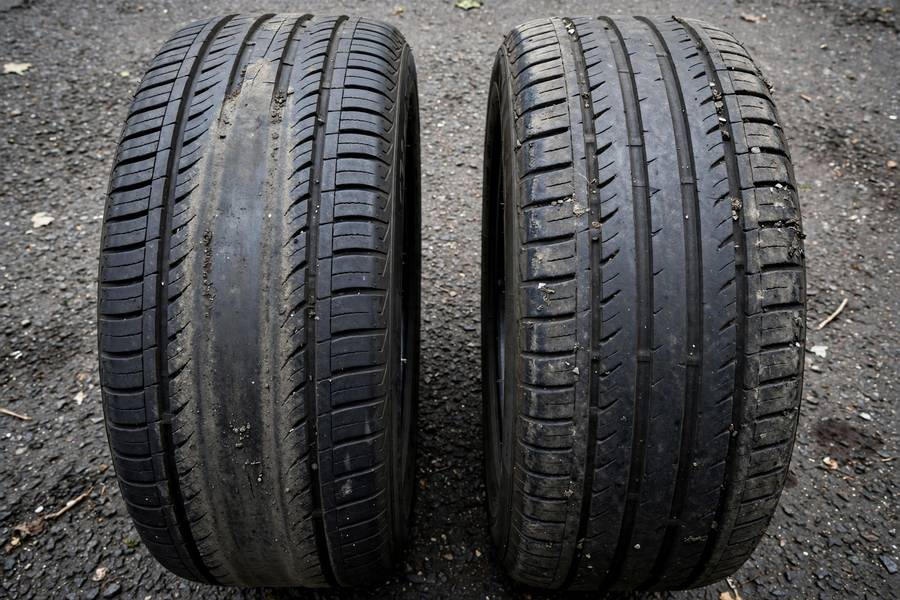
- Edge wear. The contact patch collapses inward, riding on the shoulders. You’ll see both outer edges wearing faster than the center — the classic under-inflation wear pattern.
- Worse fuel economy. More rolling resistance from the distorted patch. Roughly 0.2% worse fuel economy per 1 PSI low across all four tires — 10 PSI low costs you real money every fill-up.
- Sloppy handling. Soft sidewalls roll over in corners; steering feels vague; emergency maneuvers get mushy. The car’s handling was tuned at correct pressure — everything degrades from there.
- Longer braking distances. Less effective contact patch means less grip when you need it most.
The insidious part: a tire can be 10 PSI low and look fine. Modern radial sidewalls don’t visibly sag until they’re seriously under-inflated. You cannot eyeball this — you need a gauge.
What Over-Inflation Does
Less common, less dangerous than under-inflation, but still wrong:
- Center wear. The patch bulges outward, riding on the center tread. You’ll see the middle wearing faster than the edges — the mirror image of under-inflation wear.
- Harsh ride. Less sidewall compliance means every bump transmits directly. Your suspension was tuned expecting the tire to absorb its share.
- Reduced grip. A shrunken, domed contact patch means less rubber on the road — worse braking and cornering, especially in the wet.
- Impact vulnerability. An over-inflated tire can’t deform around potholes; instead of absorbing the hit, it transmits it — increasing the risk of impact breaks and bent wheels.
The classic cause: inflating to the sidewall max, or adding “a little extra for the highway” based on folk wisdom. The engineers already accounted for highway heat in the cold spec — trust the sticker.
When to Adjust From the Sticker Number
The sticker covers normal use. Adjust thoughtfully for special cases:
- Heavy loads/towing: use the placard’s full-load pressure if listed; if not, adding 2-4 PSI rear (within the tire’s max) for a loaded trip is standard practice. Return to normal after.
- Sustained high-speed driving: some manufacturers list a higher highway pressure — use it if specified, otherwise the standard cold pressure already accounts for heat buildup.
- Winter: cold air contracts — pressure drops about 1 PSI per 10°F temperature drop. A tire correct at 70°F is 4 PSI low at 30°F. Check more often in winter; don’t “set and forget” across seasons. (Don’t over-inflate for snow either — the “narrow tire cuts through snow” logic is about tire width, not pressure.)
- Track/autocross: enthusiasts run adjusted pressures for handling balance — that’s a whole discipline beyond this guide’s scope. For the street, the sticker rules.
- Aftermarket tire sizes: as noted, get the equivalent pressure calculated — don’t just carry the old number over to a different load rating.
The principle: the sticker is the default; deviations are deliberate, temporary, and documented — not vibes.
How Often to Check
- Monthly. Tires lose 1-2 PSI per month naturally through the rubber (it’s permeable — normal, not a leak). Monthly checks catch the drift before it matters.
- Seasonally. Temperature swings move pressure significantly — check when seasons change, especially into winter.
- Before long trips. Highway miles at wrong pressures are where under-inflation does its worst damage. Two minutes before you leave.
- When the TPMS light comes on. Your tire pressure monitoring system warns at ~25% below spec — which means by the time it lights up, you’re already well into the problem zone. TPMS is a last resort, not a maintenance plan.
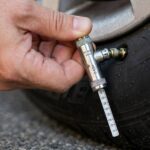
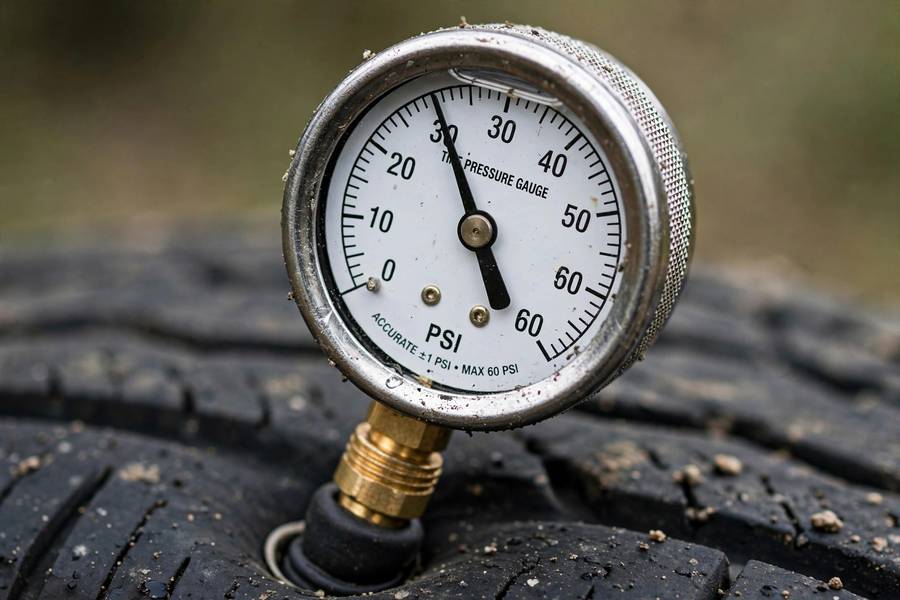
Keep a gauge in the car (pencil gauges are $10 and live in the glovebox forever) and check cold — morning, before driving. Five minutes a month is the entire maintenance burden for the single most impactful tire habit there is. While you’re at it, knowing how long car batteries last and how to buy a used car (tire condition is a negotiation point) round out the basics.
Frequently Asked Questions
Check the tire placard on the driver’s door jamb — it lists the manufacturer’s recommended cold pressure for front and rear tires. That’s your number. The sidewall’s “MAX PRESS” is a safety ceiling, not the target.
No. The sidewall number is the tire’s maximum safe pressure, not the recommended pressure. Inflate to the door-jamb sticker spec — over-inflation causes center tread wear, harsh ride, reduced grip, and impact damage.
Under-inflation causes sidewall overheating (the main cause of blowouts), edge tread wear, worse fuel economy, vague handling, and longer braking distances. Check monthly — tires lose 1-2 PSI per month naturally and low tires often look fine.
Yes — pressure drops about 1 PSI for every 10°F temperature decrease. A tire at correct pressure at 70°F will be about 4 PSI low at 30°F. Check pressures more often in cold weather and always measure cold.
Cold pressure means measured when the tires haven’t been driven for at least three hours — typically first thing in the morning. Driving heats tires and raises pressure 3-5 PSI, so warm readings don’t reflect the spec. Always check cold.