The tool you need most is the one that’s actually in your trunk when the tire goes flat. I’ve rescued drivers who owned every tool on this list — sitting in their garage, twenty miles away. So this guide has two jobs: tell you what to carry, and convince you to check that it’s all there today, in the car, not in theory. The tire-changing procedure itself is at how to change a tire — this is the equipment briefing.
Table of Contents
- The Non-Negotiable Four
- The Spare: Full-Size, Donut, or Nothing?
- Upgrades Worth Buying
- Safety Gear for the Roadside
- The “While You’re At It” Extras
- What About Cars With No Spare?
- The Twice-a-Year Trunk Audit
- Frequently Asked Questions
The Non-Negotiable Four
To change a tire you need exactly four things. Everything else is improvement.
1. A usable spare tire. Inflated, undamaged, with legal tread. A spare with 15 PSI in it is a paperweight. Check the pressure twice a year — I’ll keep saying it until everyone does it.
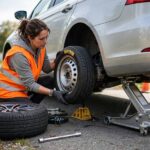
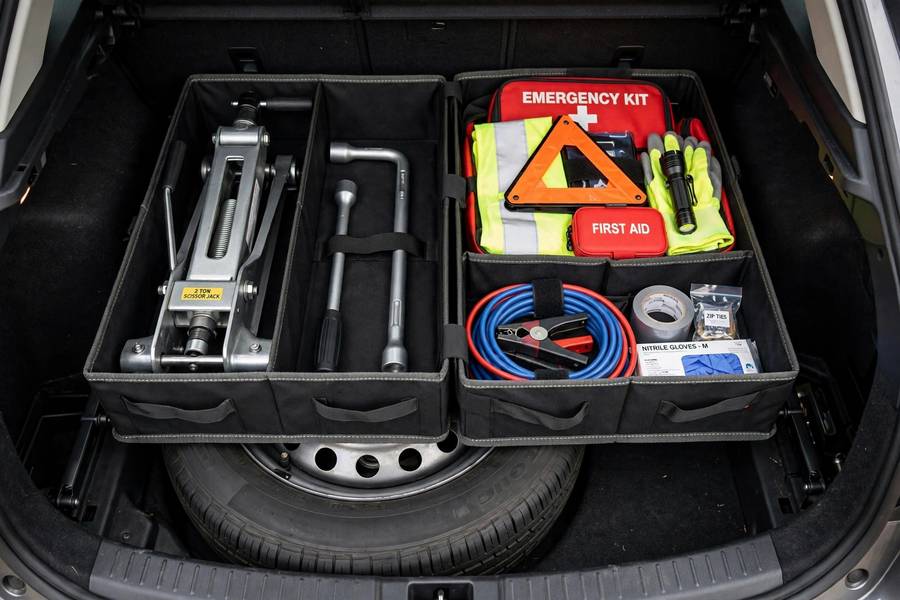
2. A jack. Your car’s scissor jack works fine for tire changes. It’s slow and demands good setup (flat ground, correct jack point), but it lifts the car, which is the job. If you do your own tire rotations at home, a floor jack is the upgrade — but for the trunk kit, the scissor jack is the standard.
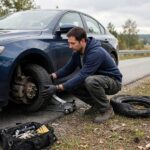
3. A lug wrench. The L-bar or cross wrench from the factory kit fits your lug nuts — that’s its whole qualification. Test-fit it on your actual lug nuts once, in the driveway. Some aftermarket wheels need a thin-wall socket the factory wrench doesn’t have, and discovering that on the shoulder is miserable.
4. Your owner’s manual. Jack points, lug nut torque spec, spare tire speed/distance limits, and where everything is stored in your car. Keep it in the glovebox. In the age of the smartphone, a PDF on your phone works too — but the paper manual doesn’t need a charge.
That’s the kit. Four items. If any one is missing or unusable, you don’t have a tire-change capability — you have three-quarters of one, which is the same as none at that midnight on the shoulder.
The Spare: Full-Size, Donut, or Nothing?
Full-size spare. A real tire on a real wheel, matching your others. Best option by far: no speed limits, no distance limits, no handling compromises. Costs trunk space and weight, which is why manufacturers moved away — but if your car has one, you’re lucky. Treat it like a fifth tire: include it in rotations if it’s the same spec, and check its pressure with the others.
Compact “donut” spare. Smaller, lighter, thinner — the industry standard compromise. Gets you home within its limits (usually 50 mph max, 50-70 miles — check the sidewall). Handling and braking are degraded, especially in rain. Perfectly respectable emergency tool; terrible long-term plan. I’ve seen donuts with thousands of miles on them, and every one was a blowout waiting for a pothole.
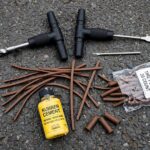
Inflator/sealant kit (no spare). A compressor plus a can of tire sealant. Handles small tread punctures — a nail hole, basically. Useless for sidewall damage, blowouts, large gashes, or bead leaks. If your car came with this instead of a spare, understand its limits now: it’s a “maybe get to the tire shop” kit, not a “definitely get home” kit.
Run-flat tires. Stiff sidewalls that support the car with no air pressure — typically 50 miles at 50 mph. No spare needed, no roadside change required. The tradeoff: harsher ride, higher replacement cost, and you still need to get to a shop promptly.
Know which system your car has. “I assumed there was a spare” is something I hear from stranded drivers with sealant kits and no idea how to use them.
Upgrades Worth Buying
The factory kit works. These upgrades make it work better — ranked by value:
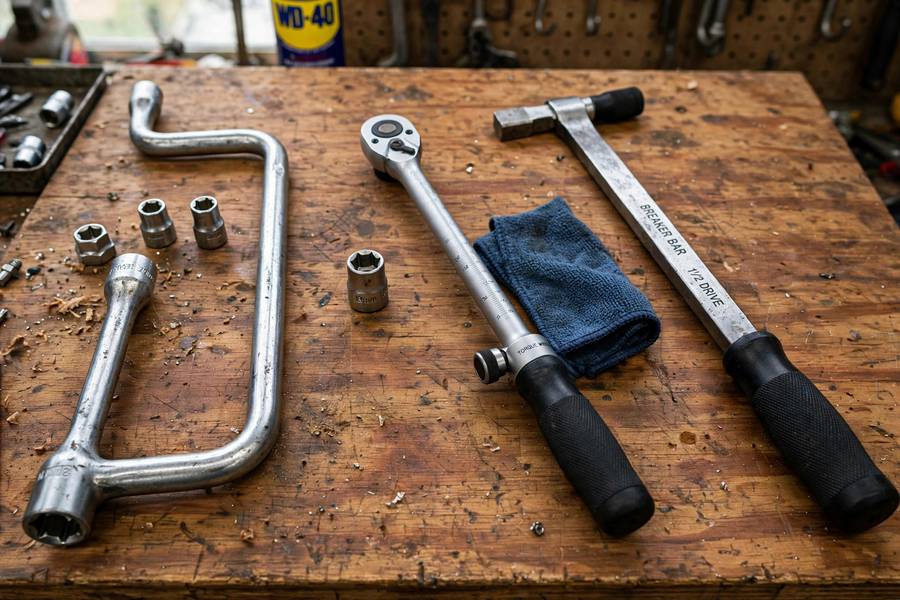
Torque wrench ($30-60). The single best upgrade. Lug nuts need a specific tightness (your manual’s spec, typically 80-100 ft-lbs for cars), and guessing causes the two classic failures: too loose (wheel loosens) or too tight (stretched studs, warped rotors, seized nuts). A torque wrench removes the guesswork. Non-negotiable in my book.
Breaker bar ($20-30). A long-handled bar that multiplies your force for breaking loose stubborn lug nuts — far more effective (and safer) than standing on the little factory wrench. Especially valuable if your wheels were last tightened by an impact-happy shop.
Cross-type lug wrench ($15-25). Replaces the factory L-bar with four sockets and much better leverage. Faster, more comfortable, and the cross shape lets you spin nuts quickly. The factory L-bar works; this works pleasantly.
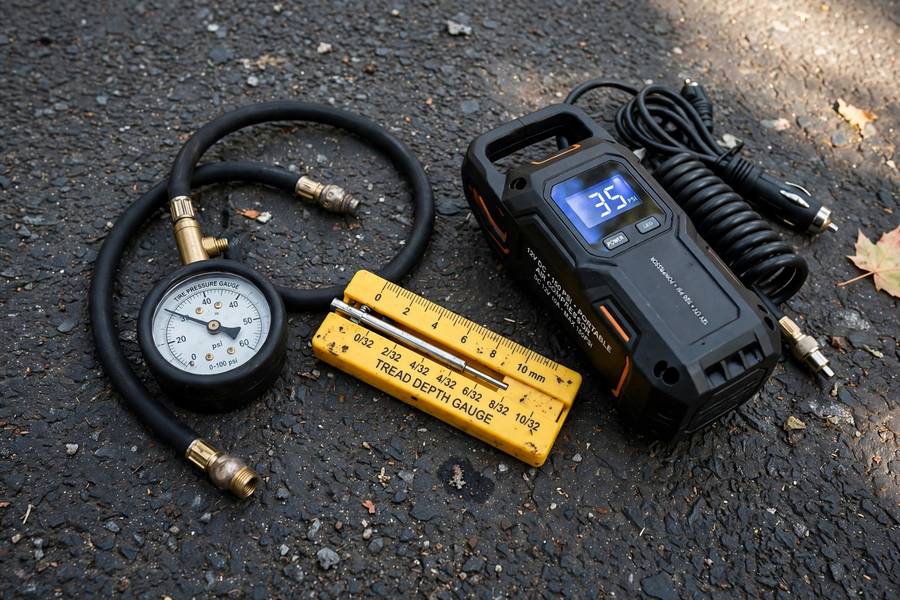
Portable 12V air compressor ($30-50). Plugs into your cigarette lighter or battery terminals. Tops up a slow leak enough to drive to the shop, re-inflates the spare that’s been sitting for two years, handles the “tire’s low but not flat” situations that don’t need a full change. One of the highest usefulness-per-dollar tools in existence.
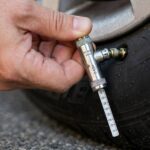
Tire pressure gauge ($10-15). Pencil-type is fine; digital is easier to read. The gas-station air hose gauge is often wrong — your own gauge is the truth. Check pressures monthly; it takes five minutes and it’s the cheapest tire-life extender there is.
Hydraulic bottle jack ($40-70). If your scissor jack is old, stiff, or missing, a compact bottle jack is a worthy trunk replacement — faster and more stable than a tired scissor jack. (Still needs the same careful setup.)
Total for the meaningful upgrades: roughly $150-250. Less than one tow, less than one ruined wheel from a botched roadside job.
Safety Gear for the Roadside
Changing the tire is the mechanical job. Surviving the roadside is the safety job — and it needs its own kit:
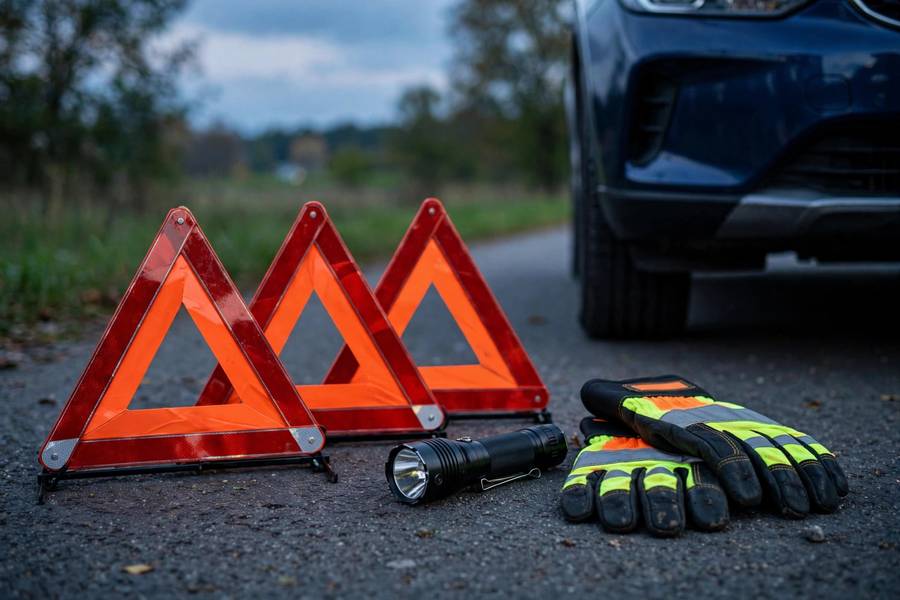
- Reflective triangles or flares. Set them 50-100 feet behind the car (further on fast roads). Your hazards blink; triangles warn. At night they’re the difference between visible and invisible.
- High-visibility vest. A $10 vest makes you visible to drivers at night. Cheap protection for the person crouched by the road — you.
- Flashlight (plus spare batteries). Your phone light works until your phone dies. A real flashlight with a magnetic base or headlamp keeps both hands free.
- Work gloves. Lug nuts are dirty, wheels are heavy, and roadside asphalt hides sharp things. Gloves also grip better.
- Rain poncho. Changing a tire in the rain without one is miserable enough to make people rush — and rushing causes mistakes. A $3 poncho buys patience.
- Kneeling pad or old towel. Asphalt knees at midnight. Enough said.
None of this is expensive. All of it lives in the trunk permanently. The theme: roadside tire changes happen in bad conditions by definition — equip for the worst version, not the driveway version.
The “While You’re At It” Extras
Beyond the tire kit, the trunk deserves a small emergency core:
- Jumper cables or a jump pack. Dead batteries strand more drivers than flats. A lithium jump pack ($60-100) starts a car with no second vehicle needed — genuinely one of the best car investments. (How to jump start a car covers the procedure; how long car batteries last tells you when yours is due.)
- Basic first-aid kit. Not tire-related, but if you’re building a trunk emergency kit, build it once and build it right.
- Water and a snack. A flat at 2 AM forty miles from anywhere is a waiting situation if the spare’s bad too. Water matters.
- Phone charger (car adapter). Your phone is your lifeline — rescue calls, flashlight, manual PDF. Keep it charged.
- Pen and paper. For exchanging info if the flat involved an incident, or leaving a note. Low-tech never runs out of battery.
What About Cars With No Spare?
More new cars skip the spare every year — weight savings, fuel economy, trunk space. If that’s you, your strategy changes:
- Learn the sealant kit now. Read its instructions in the driveway. Know that it only handles small tread punctures, that it ruins the TPMS sensor it coats (budget for that), and that many tire shops won’t repair a sealant-filled tire — you’ll be buying a new one.
- Consider buying a spare anyway. Compact spare kits (wheel + tire + jack + wrench) are available aftermarket for many models, often under $200. If you drive rural roads or at night, it’s cheap peace of mind. Check that it fits your trunk and your bolt pattern before buying.
- Roadside assistance membership. If you carry no spare, a tow plan isn’t optional — it’s your spare tire. Know the number, keep it in your phone, and know your policy’s towing radius.
- Run-flats need a plan too. They get you 50 miles — know where the tire shops are along your regular routes, because 50 miles runs out fast in the wrong direction.
“No spare” isn’t a problem if it’s a decision with a backup plan. It’s only a problem as a surprise.
The Twice-a-Year Trunk Audit
Here’s the habit that makes all of this real: twice a year — when you check smoke detector batteries, or when the clocks change — open the trunk and verify:
- [ ] Spare tire present and inflated to spec (check with your gauge, not by kicking it)
- [ ] Jack present and functional (crank it once — smooth, not grinding)
- [ ] Lug wrench present and fits your lug nuts (test-fit, especially with aftermarket wheels)
- [ ] Locking lug nut key present (if applicable — find it now)
- [ ] Owner’s manual in the car
- [ ] Flashlight works, safety triangles present, vest present
- [ ] Jumper cables or jump pack charged
- [ ] Sealant kit not expired (if that’s your system — the sealant has a shelf life)
Ten minutes, twice a year. Every stranded driver I’ve ever rescued would trade a lot for those ten minutes back. Put it on the calendar next to something you already do — that’s how habits survive.
Frequently Asked Questions
Four essentials: a usable (inflated) spare tire, a jack, a lug wrench that fits your lug nuts, and your owner’s manual for jack points and torque specs. Add safety gear — triangles, vest, flashlight, gloves — for roadside work.
A torque wrench ($30-60). Lug nuts need a specific tightness from your manual, and guessing causes under-tightening (wheels loosen) or over-tightening (damaged studs and rotors). It removes all guesswork.
Learn your sealant kit’s limits now (small tread punctures only), consider buying an aftermarket compact spare kit, and keep roadside assistance — without a spare, a tow plan is mandatory, not optional.
Check the spare’s pressure twice a year with a gauge — spares lose air over time just sitting in the trunk. A flat spare is one of the most common and most avoidable roadside surprises.
If your car has locking lug nuts, yes — absolutely. Without the key, the wheel cannot come off. Find where yours is stored (glovebox, console, trunk kit) before you need it, because roadside discovery is too late.