
Every year produces a fresh crop of AI success stories, and every year most of them turn out to be pilot programs wearing a press release. So I applied a filter to this list: no announcements, no “plans to deploy,” no vendor case studies that read like ad copy. These AI business examples from 2026 are deployments that survived contact with reality — real companies, real workflows, real results.
What you’ll notice is how unglamorous the winners are. Nobody here built a robot CEO. They automated the boring, the repetitive, and the error-prone, and the savings compounded. That’s the pattern worth copying. For the conceptual background, my overview of how AI is used in business covers the landscape; this article is the proof it’s real.
Table of Contents
- 1. Support Ticket Triage at a Telecom
- 2. Contract Review at a Mid-Size Law Firm
- 3. Demand Forecasting at a Grocery Chain
- 4. Visual Quality Control in Manufacturing
- 5. Resume Screening — Done Carefully This Time
- 6. Marketing Content Pipelines
- 7. Fraud Review at a Payments Company
- 8. Predictive Maintenance in Logistics Fleets
- 9. Sales Call Coaching
- The Pattern Across All Nine
- 10. AI Meeting Intelligence at a Consultancy
- What Didn’t Work in 2026
- Frequently Asked Questions
1. Support Ticket Triage at a Telecom
A European telecom was drowning: 40,000 tickets a month, agents spending the first five minutes of every call just figuring out what the problem was. Their 2026 deployment classifies incoming tickets by issue type, urgency, and required expertise, then routes them — with an AI-drafted summary attached — to the right team.
Resolution time dropped by roughly a third, not because the AI solved anything, but because it killed the routing overhead. The lesson: triage is the perfect AI job — high volume, clear categories, and the cost of a misclassification is low (a human re-routes it). See more patterns like this in AI agent examples in real life.
2. Contract Review at a Mid-Size Law Firm
A 60-lawyer firm now runs every incoming NDA and vendor agreement through AI first-pass review: flagging non-standard clauses, missing terms, and deviations from their playbook. Junior associates verify the flags instead of reading every page from scratch.
Review time per standard contract fell from hours to under thirty minutes. The partners were initially skeptical — lawyers are paid to be skeptical — until they realized the AI catches the boring inconsistencies humans glaze over on page 47. The humans still make every judgment call. The machine just does the reading.
3. Demand Forecasting at a Grocery Chain
Perishables are the cruelest forecasting problem in retail: overstock rots, understock loses sales, and there’s no warehouse to hide in. A grocery chain’s 2026 system blends sales history, weather forecasts, local events, and promotions to predict daily demand per store per SKU category.
Waste dropped measurably while availability improved — the rare win-win. What made it work: they started with produce (highest pain), had years of clean POS data, and let store managers override the forecasts, which built trust and improved the training data. Human override isn’t a bug in these systems; it’s a feature.
4. Visual Quality Control in Manufacturing
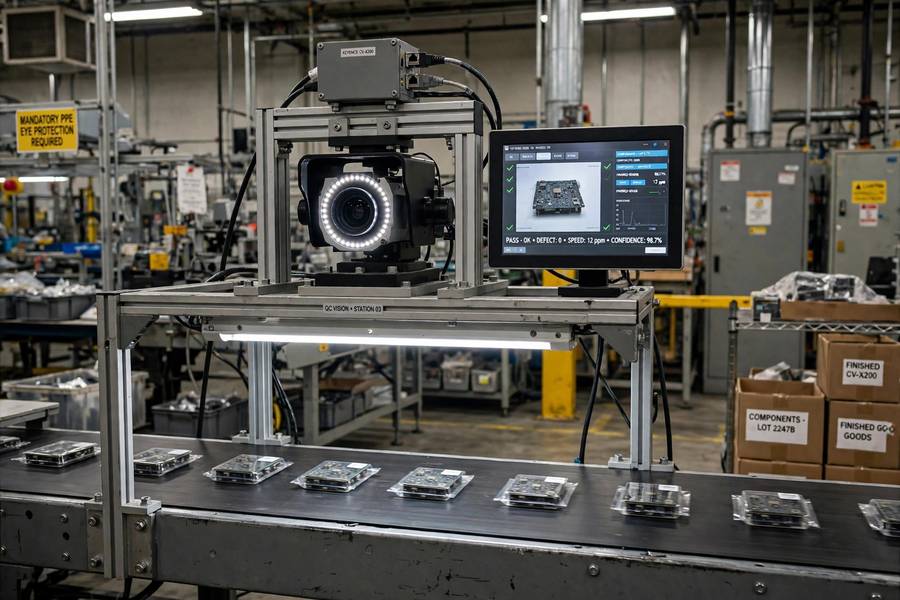
An electronics manufacturer replaced spot-checking with camera-based inspection on every unit: AI vision models flag soldering defects, misaligned components, and cosmetic flaws at line speed. Defect escape rates fell sharply, and — this surprised them — the data revealed which production shifts and machines produced the most defects.
The honest footnote: setup was the hard part. Training the models required thousands of labeled defect images, which meant months of humans photographing and tagging bad units. AI vision is powerful but hungry; the labeling effort is the price of admission, and vendors who skip mentioning it are being economical with the truth.
5. Resume Screening — Done Carefully This Time
Hiring AI has a checkered history — the infamous Amazon AI recruiting bias case taught the industry what happens when you train on biased history. The 2026 version that works: a company using AI only to match stated job requirements against resume content, with the model’s criteria audited quarterly and final decisions entirely human.
Their time-to-shortlist halved, and because the criteria are explicit and audited, they can actually defend the process — unlike the black-box systems of the past. The example matters because it shows the mature pattern: AI as a transparent assistant with guardrails, not an autonomous decider.
6. Marketing Content Pipelines
A B2B software company now produces its blog drafts, ad variations, and email sequences through an AI pipeline with human editors at every gate. Output volume tripled; the editors’ job shifted from writing to directing — briefing, reviewing, refining.
The interesting detail: their best-performing pieces are still the ones where a human had a strong opinion the AI couldn’t generate. The machine is excellent at competent and fast; it’s terrible at interesting. Companies that understand this distinction get the volume benefits without the blandness penalty.

7. Fraud Review at a Payments Company
A mid-size payments processor handles millions of transactions daily — far beyond manual review. Their AI scores every transaction, auto-approves the obviously legitimate, auto-declines the obviously fraudulent, and routes the gray middle to human analysts with an explanation of what looked suspicious.
Analyst productivity roughly doubled because they’re no longer wading through obvious cases. The system’s explanations matter as much as its accuracy: analysts trust and correct the AI, which keeps it improving. Black-box fraud scores that nobody understands get ignored; explainable ones get used.
8. Predictive Maintenance in Logistics Fleets
A delivery fleet operator put sensors and AI models on several hundred vehicles to predict component failures — brakes, batteries, transmissions — before they strand a driver. Unplanned downtime fell significantly in the first year.
The economics are what make this a 2026 story: sensor costs finally dropped low enough that the math works for mid-size fleets, not just airlines. A single avoided breakdown during peak season can pay for the whole system. The catch is data volume — you need months of sensor history before predictions get trustworthy, so the ROI curve starts flat.
9. Sales Call Coaching
A sales organization records calls (with consent) and uses AI to analyze them: talk-to-listen ratios, question quality, objection handling, follow-up consistency. Managers get coaching briefs instead of listening to hours of recordings.
Top performers initially hated being “graded by a robot” — until the data showed the AI was surfacing coaching points managers had missed. Adoption flipped when the tool was positioned as the rep’s personal coach rather than surveillance. Framing, it turns out, is half the implementation.
The Pattern Across All Nine
Look across these AI business examples from 2026 and the pattern is unmistakable: narrow scope, human in the loop, measurable baseline, and honest framing with staff. None of these companies “transformed with AI.” They each fixed one expensive problem with a well-scoped tool — and the practical habits in how to use AI at work are essentially this pattern applied to daily tasks. Boring wins, compounded, beat visionary announcements every time.
10. AI Meeting Intelligence at a Consultancy
One more for the list, because it’s the most relatable: a mid-size consultancy deployed AI meeting intelligence across its teams — automatic transcription, action-item extraction, and commitment tracking across hundreds of client meetings monthly. The headline result wasn’t the time saved on notes, though that was real. It was the accountability: commitments made in meetings stopped evaporating, because the AI logged them, assigned them, and followed up.
Partners initially worried about a “surveillance culture,” so the firm made a smart rule: the AI works for the meeting participants, not management — individuals control their own action lists, and no one reviews transcripts without consent. Adoption soared once people trusted the tool was their assistant, not their overseer. The lesson generalizes beautifully: the same AI capability succeeds or fails on framing and trust, regardless of industry.
What Didn’t Work in 2026
Honesty requires the failures too. The pattern in 2026’s AI flops: fully autonomous customer-facing agents deployed without human oversight — several high-profile incidents of bots making promises, quoting wrong prices, or arguing with customers. The technology wasn’t the problem; the absence of guardrails was.
Also struggling: generic “AI transformation” programs with no specific use case — the corporate equivalent of buying a gym membership in January. And AI-generated content farms, which discovered that search engines and audiences both punish volume without value. The common thread in every failure: skipping the unglamorous fundamentals — clear scope, human oversight, honest measurement. The winners from the list above all did the boring work. The losers all tried to skip it. There’s a lesson there that will still be true in 2030.
Frequently Asked Questions
The strongest real deployments include support ticket triage, AI-assisted contract review, grocery demand forecasting, visual quality control in manufacturing, audited resume screening, marketing content pipelines, fraud review, predictive fleet maintenance, and sales call coaching.
Industries with high-volume repetitive work benefit most: telecom support, legal document review, retail forecasting, manufacturing quality control, payments fraud detection, and logistics. The common thread is measurable, repetitive tasks — not industry prestige.
By baselining before deployment: resolution time, review hours, waste percentages, defect rates, downtime hours. Successful companies define the metric first, then measure the same thing after — concrete numbers, not vague “insights.”
In the successful deployments, AI handles triage, first drafts, and detection while humans make judgments, verify outputs, and handle exceptions. The pattern is augmentation — removing drudgery — rather than replacement.
Vague scope, no baseline measurement, skipping data preparation, black-box systems nobody trusts, and positioning AI as surveillance rather than assistance. The failures are almost always organizational, not technical.
Keep reading: