Here’s a sentence I read in a vendor brochure: “Our AI dreams up designs.” No, it doesn’t. It doesn’t dream, it doesn’t imagine, and it doesn’t have taste. What it does is far more interesting and far less mystical: it searches enormous spaces of possibilities using methods borrowed from evolution, statistics, and — increasingly — machine learning, and it does it with a thoroughness no human can match. The AI in generative design is a search engine, not an artist. Understanding what it actually computes is the difference between using it well and being used by the marketing. For the overall concept, see what generative design is.
Table of Contents
- The Misleading Name Problem
- Evolutionary Algorithms: Design by Natural Selection
- Topology Optimization: The Mathematical Core
- Surrogate Models: AI That Predicts Instead of Simulating
- Generative Adversarial Thinking: The New Arrival
- Where Machine Learning Actually Changed Things
- What the AI Cannot Do
- The Human in the Loop Is Not Optional
- Frequently Asked Questions
The Misleading Name Problem
“AI in generative design” suggests something like how Midjourney works — a neural network conjuring images from text. The engineering reality is different and older. Most of what runs inside generative design software predates the deep learning boom: evolutionary algorithms from the 1970s, topology optimization from the 1980s, gradient-based solvers from engineering mathematics. The “AI” label got attached when the field became fashionable, not when the methods changed.
This isn’t a complaint — labels evolve — but it matters because the wrong mental model leads to wrong expectations. If you think the software “imagines” designs, you’ll trust its creativity and neglect your constraints. If you understand it searches a space you defined, you’ll invest your effort where it belongs: defining the space correctly. The machine is a magnificent searcher. The searching is the whole story. Everything else is interface.
Evolutionary Algorithms: Design by Natural Selection
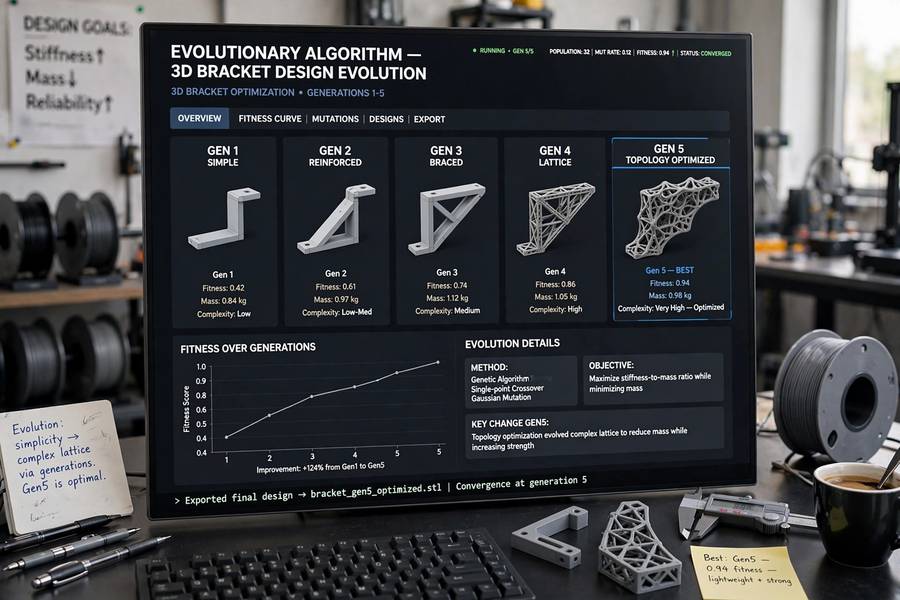
The workhorse of generative design is the evolutionary algorithm, and it works exactly like the name suggests. You start with a population of random designs — say, a hundred bracket shapes. You evaluate each one against your objectives (weight, stiffness, cost). You keep the best performers, combine and mutate them to produce a new generation, and repeat. Over dozens or hundreds of generations, the population evolves toward better designs.
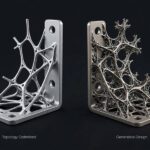
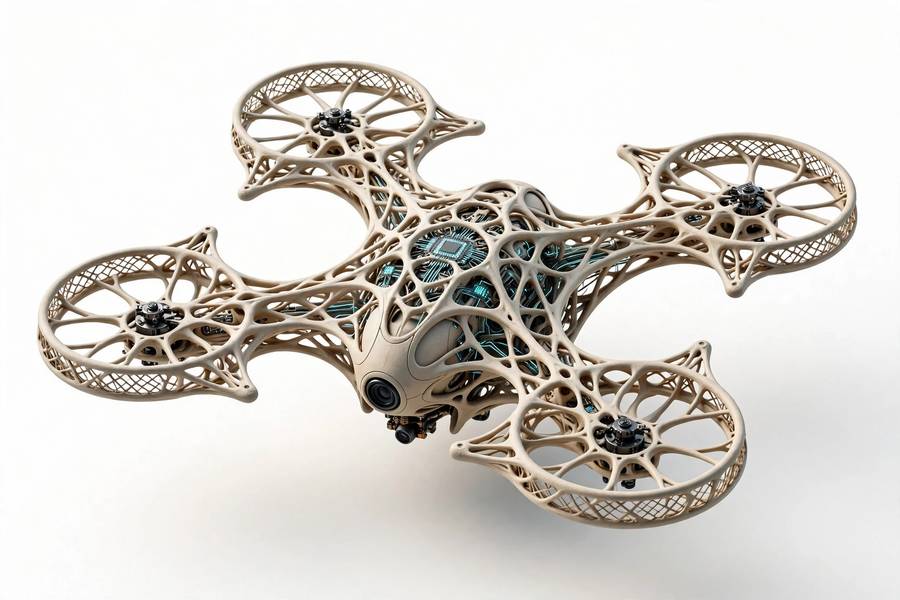
Why this works for design: the search space of possible forms is vast, non-convex, and full of local optima — exactly the kind of landscape where gradient methods get stuck and evolutionary methods thrive. The algorithm doesn’t need to understand structures; it needs to evaluate them. Given a fast enough evaluator (simulation), evolution will find forms that surprise experienced engineers. The famous bone-like structures aren’t the algorithm being artistic; they’re what selection pressure produces when the fitness function rewards stiffness per unit mass.
The cost is compute. Evaluating thousands of designs across hundreds of generations means millions of simulations. This is why generative design waited for cloud computing: the algorithm existed for decades, but running it at useful scale was prohibitively expensive until compute got cheap. The method is old; the economics are new.
Topology Optimization: The Mathematical Core
Alongside evolution sits topology optimization — the more mathematically rigorous sibling. Where evolutionary algorithms search by trial and error, topology optimization uses gradients: it computes how the objective changes with each bit of material and follows the mathematics downhill to an optimum. It’s faster, more principled, and produces the single best structure for the defined problem rather than a population of good ones.
The AI connection here is thinner than the marketing suggests. Classical topology optimization is applied mathematics, not machine learning — it predates the current AI era by decades. But it keeps getting better, and modern implementations borrow from ML: learned preconditioners that speed convergence, neural representations of geometry, hybrid methods that combine gradient descent with learned heuristics. The line between “optimization” and “AI” is blurring from the optimization side, which is the opposite direction from what most people assume.
I keep these two methods distinct because they behave differently in practice: evolution explores broadly and surprises you; topology optimization converges precisely and satisfies you. Good generative software uses both, and knowing which engine produced a candidate tells you how to interpret it.
Surrogate Models: AI That Predicts Instead of Simulating
Here’s where machine learning genuinely transformed generative design: surrogate models. The bottleneck in any generative study is evaluation — each candidate design must be simulated (structural analysis, fluid dynamics, thermal), and each simulation costs time. A study that needs a million evaluations at a minute each is dead on arrival.
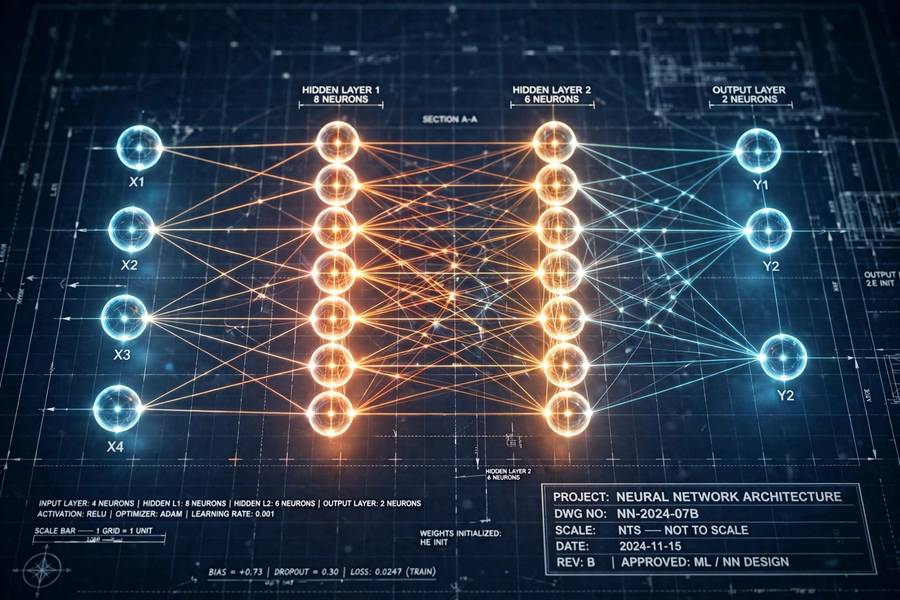
Surrogate models are neural networks trained to predict simulation results without running the simulation. Train the network on a few thousand real simulations, and it can estimate the performance of new designs in milliseconds instead of minutes. The generative search then runs against the surrogate — millions of evaluations, nearly free — and only the most promising candidates get full simulation for verification.
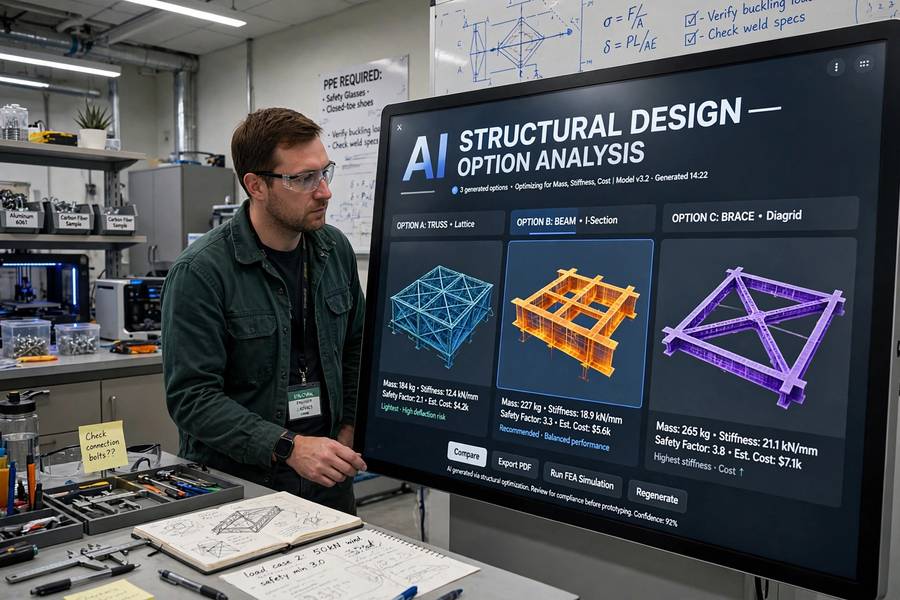
This is the real ML story in generative design: not creativity, but speed. Surrogates compress the evaluation bottleneck by orders of magnitude, which expands the searchable space by orders of magnitude. The designs didn’t get more imaginative; the search got deeper. And the verification step matters — surrogates are approximations, and the final candidates must be validated with real physics. Trust but verify, at machine speed.
Generative Adversarial Thinking: The New Arrival
The newest methods borrow from the GAN playbook: train one network to generate designs and another to evaluate them, and let them improve each other. In practice, this shows up as learned design priors — networks trained on thousands of existing parts that can propose plausible starting points, complete partial designs, or suggest variations in the style of successful precedents.
The honest assessment: this is promising but young. Learned priors can accelerate search dramatically by starting from good guesses instead of random ones. But they also import the biases of their training data — a network trained on conventional brackets will propose conventional brackets, which defeats the purpose of generative exploration. The tension between “learn from precedent” and “discover the unprecedented” is unresolved, and it’s the most interesting research question in the field right now.
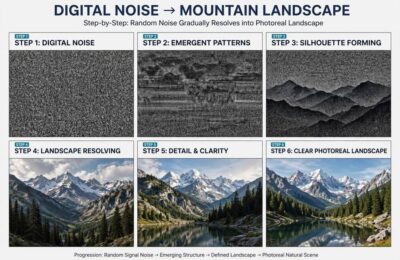
There’s also the diffusion-model angle — the same class of models behind image generation, adapted to 3D geometry. Early results are intriguing: text or sketch to 3D concept. But the gap between a plausible-looking 3D form and a structurally valid, manufacturable part remains enormous. The image generators won by optimizing for looks; engineering optimization has to optimize for physics. Different game, different difficulty.
Where Machine Learning Actually Changed Things
Let me be precise about what ML changed, because the vague version (“AI made it better”) is useless:
First, evaluation speed. Surrogate models made million-candidate studies practical. This is the single biggest ML contribution, and it’s about throughput, not intelligence.
Second, search initialization. Learned priors give the search better starting points, cutting the generations needed to reach good designs. This is about efficiency, not creativity.
Third, multi-physics coupling. ML models can approximate interactions between structural, thermal, and fluid behavior that would be prohibitively expensive to co-simulate directly. This expands what “the problem” can include.
Fourth, manufacturability prediction. Networks trained on manufacturing outcomes can estimate whether a generated form will print cleanly or cast well, bringing downstream reality into the upstream search.
Notice what’s missing from this list: defining the problem, choosing the objectives, judging the results, deciding what to build. The ML changed the machinery of search. The judgment stayed human. Anyone telling you otherwise is selling something.
What the AI Cannot Do
The list of incapacities is as important as the list of capabilities. The AI cannot tell you whether your load cases represent reality. It cannot notice that your “minimize weight” objective will produce a part that fails in fatigue after ten thousand cycles. It cannot know that the beautiful lattice is uninspectable and therefore uncertifiable. It cannot weigh the business risk of a novel manufacturing process. It cannot talk to the supplier who will actually make the thing.
Every one of these is a human judgment, and every generative design failure I’ve seen traces back to one of them being skipped. The technology’s failure mode is not that the AI is stupid — it’s that the AI is diligently, thoroughly, confidently optimizing the wrong problem. The more powerful the search, the more expensive the wrong problem becomes. This is the central risk of the entire field, and no amount of ML sophistication removes it. It can only be managed by human rigor at the problem-definition stage.
The Human in the Loop Is Not Optional
So where does this leave the human? Everywhere that matters. The human defines the problem — and problem definition is the highest-leverage activity in the entire workflow. The human curates the results, applying judgment the fitness function can’t encode: manufacturability nuance, aesthetic standards, strategic considerations, the thousand things that aren’t in the objective function. The human validates, running the real simulations and tests that confirm the candidates. And the human decides, taking responsibility for what gets built.
The history of artificial intelligence keeps teaching the same lesson: the systems that work are the ones with humans in the right places, not the ones that remove humans. Generative design is no exception. The AI searches; the human directs, judges, and answers for the result. That’s not a limitation of the technology — it’s the correct division of labor, and it’s not going away.
Frequently Asked Questions
The main techniques are evolutionary algorithms (design by natural selection), topology optimization (gradient-based material distribution), and increasingly machine learning surrogate models that predict simulation results. Newer methods include learned design priors and diffusion models adapted to 3D geometry.
No. AI image generators like Midjourney create images optimized for visual appeal. Generative design uses search and optimization methods to create engineering solutions optimized for physical performance like weight, strength, and cost. The goals and methods are fundamentally different.
A surrogate model is a neural network trained to predict simulation results without running full simulations. It estimates a design’s performance in milliseconds instead of minutes, allowing generative studies to evaluate millions of candidates. Final results are always verified with real simulation.
No. The AI searches a design space, but humans must define the problem, set objectives and constraints, curate results, validate with real physics, and decide what to manufacture. Skipping human judgment leads to confidently optimized wrong answers.
The core methods are decades old: evolutionary algorithms date to the 1970s and topology optimization to the 1980s. What changed recently is cheaper cloud computing making large-scale studies affordable, plus machine learning accelerating the evaluation step.
Keep reading: