I have a rule about technology demos: show me the shipped thing. Not the render, not the conference slide — the object that exists in the world, doing a job. Generative design has survived a decade of hype partly because it kept producing shipped things: parts in cars, chairs people sit on, buildings people walk through. This is a tour of the ones that actually worked, and what each one proved. If you’re new to the concept, start with what generative design is.
Table of Contents
- The Car Seat Bracket That Started the Conversation
- The Chair That Looks Grown, Not Made
- The Airbus Partition: 45 Kilograms Lighter
- The MX3D Bridge in Amsterdam
- The Under Armour Shoe Sole
- The Autodesk Toronto Office
- The Heat Exchangers Nobody Could Machine
- The Buildings That Optimize Themselves
- What the Winners Have in Common
- Frequently Asked Questions

The Car Seat Bracket That Started the Conversation
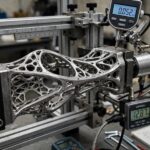
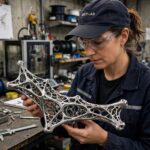
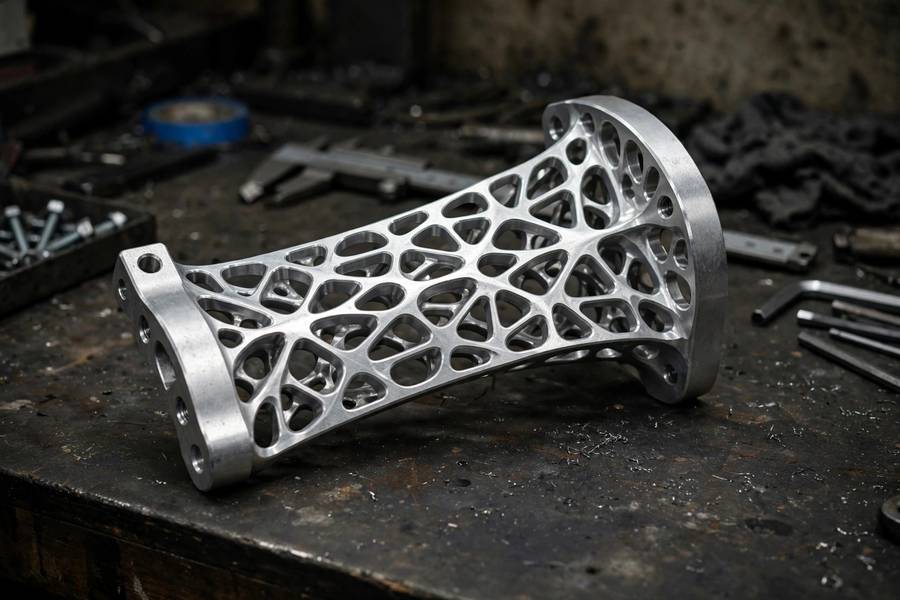
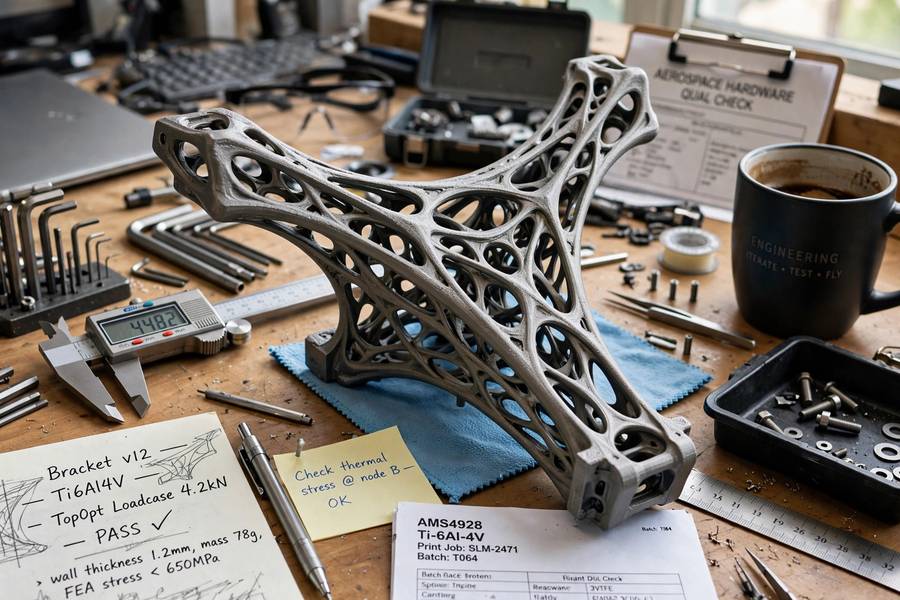
The canonical example — the one that appears in nearly every generative design talk — is a car seat bracket redesigned by Autodesk and General Motors. The original bracket was a solid hunk of metal: heavy, simple, expensive to ship at scale. The generative study was given the loads, the attachment points, the keep-out zones, and the manufacturing methods (including 3D printing and casting). The algorithm produced a design 40 percent lighter and 20 percent stronger, with an organic, bone-like structure that no engineer would have drawn.
Why this example matters: it was the first widely publicized case where the headline numbers were both dramatic and verifiable. Forty percent lighter is a number you can weigh. Twenty percent stronger is a number you can test. The bracket became the proof that generative design wasn’t academic — it produced parts a major automaker took seriously enough to talk about publicly. Every generative design pitch deck since has owed it a debt.
The Chair That Looks Grown, Not Made
Autodesk’s “Elbo” chair, designed with generative methods, looks like something that grew rather than something that was manufactured. The frame is a single organic structure optimized for a seated human’s load paths, printed and assembled into a piece of furniture that weighs a fraction of a conventionally designed chair.
Furniture is a smart proving ground for generative design because the constraints are honest: it must hold a person, not tip over, be comfortable, and be manufacturable. The Elbo chair proved that generative methods could satisfy ergonomic and aesthetic judgment, not just raw engineering. It’s also the example that makes the can AI make art question concrete — when a chair’s form comes from an algorithm chasing structural efficiency, and it ends up beautiful, who gets the design credit?
The Airbus Partition: 45 Kilograms Lighter
Airbus applied generative design to the partition wall between the passenger cabin and the crew rest area of the A320. The redesign shed 45 kilograms per aircraft — a number that translates directly into fuel savings across a fleet over decades of flights. In aviation, weight is money burned continuously, so every kilogram has a dollar value, and generative design’s weight savings are directly monetizable.
This example proved the business case, not just the engineering one. The partition met all safety and regulatory requirements — this is an aircraft, so the certification bar is about as high as it gets — and still delivered the savings. When people ask whether generative design is ready for regulated industries, the answer is sitting in the sidewall of an airliner.
The MX3D Bridge in Amsterdam
In Amsterdam, a fully functional pedestrian bridge was 3D printed by robots, with its form derived from generative and computational design methods. The bridge spans a canal, carries real foot traffic, and is instrumented with sensors that stream structural data — making it both a bridge and a long-term experiment in how generative structures age.
The bridge matters because it attacked the hardest constraints simultaneously: public safety, real weather, real loads, and public scrutiny. A bracket in a car is invisible. A bridge over a canal in a major city is the opposite of invisible. That it stands there, in daily use, is the strongest possible rebuttal to “generative design is just for demos.” It’s also a genuinely striking object — the kind of thing that makes passersby stop and photograph it, which no conventionally designed canal bridge manages.
The Under Armour Shoe Sole
Under Armour used generative design to develop lattice-structured shoe soles — complex internal geometries tuned for cushioning, energy return, and weight across different zones of the foot. The resulting structures can’t be made by conventional molding; they’re produced with 3D printing, which is the recurring theme of these examples: generative forms and additive manufacturing enable each other.
Footwear is an interesting case because the design problem is genuinely multi-objective. The heel needs cushioning, the forefoot needs responsiveness, the whole thing needs to weigh almost nothing, and it has to look good. Human designers handle this with experience and iteration. The generative approach explored thousands of lattice configurations against biomechanical data — a search space no human could cover. The result is shoes whose soles look like engineering diagrams and perform like them too. What I like about this example is its honesty: nobody claims the algorithm designed the shoe. It designed the lattice, inside a shoe, around a foot, against data. The human decisions — the last, the upper, the brand identity — stayed human.
The Autodesk Toronto Office
Generative design isn’t only for objects — it works for layouts too. Autodesk used generative methods to design the office layout of its Toronto workspace: given the floor plan, the number of employees, team adjacencies, daylight access, noise levels, and a dozen other factors, the algorithm generated thousands of layout options and ranked them against the objectives.
This is the example I show skeptics who think generative design is only about weird-looking brackets. Office layout is a problem everyone has an opinion about and nobody can solve optimally by hand — too many constraints, too many trade-offs. The generative approach surfaced layouts that balanced daylight, collaboration, and quiet zones in ways the human designers admitted they wouldn’t have tried. It reframed the technology: not a shape generator, but a trade-off explorer. Any problem with competing objectives and a large search space is fair game.
The Heat Exchangers Nobody Could Machine
General Electric and others have used generative design for heat exchangers and fluid components — parts where internal channels must maximize surface area and flow efficiency within tight volumes. The resulting geometries are labyrinthine, organic, and completely unmanufacturable by milling or casting. They exist because additive manufacturing exists.
These are my favorite examples because they’re the least photogenic and the most technically impressive. Nobody buys a heat exchanger for its looks. The generative versions deliver measurable efficiency gains — better heat transfer per unit volume — in parts where a few percent of improvement is worth real money at industrial scale. When the part’s value is pure performance and the geometry is invisible, generative design wins on the merits alone, no aesthetics required. There’s a quiet lesson here for anyone evaluating the technology: the flashy examples get the press, but the boring industrial components are where the economic case is hardest to argue against.
The Buildings That Optimize Themselves
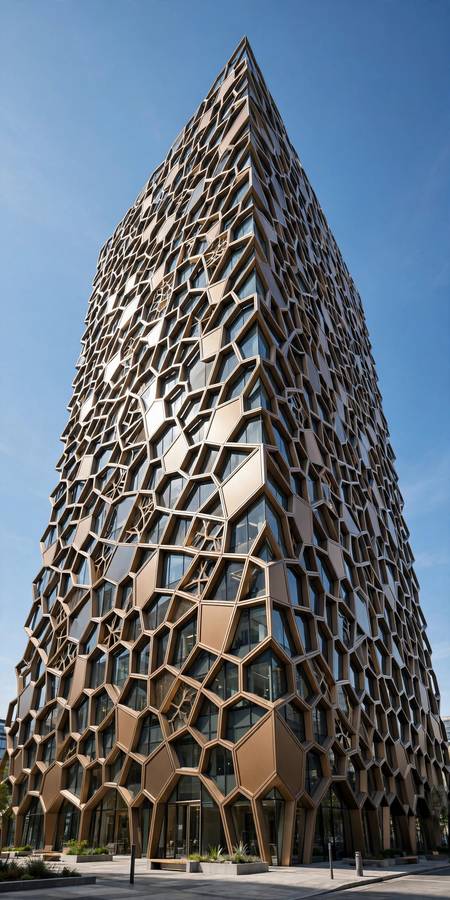
At building scale, generative design has produced facade systems, structural layouts, and massing studies optimized for daylight, energy performance, and structural efficiency. Firms have used it to generate thousands of tower massing options against solar and wind criteria, or to design shading systems that respond to sun paths across the year.
The scale changes the economics. A generative study for a single bracket costs some compute time; a generative study for a building’s energy performance can influence millions in construction and decades of operating costs. The examples at this scale are fewer and more custom — buildings are one-offs, not products — but the logic is identical: define the performance goals, let the algorithm search the space, curate the results. Architecture was actually early to computational design culture, which is why some of the most sophisticated generative workflows live in architecture firms, not factories.
What the Winners Have in Common
Looking across all these examples, the pattern is consistent. Every successful generative design project had: a well-defined problem (loads, constraints, materials — the boring stuff done right), a manufacturing method that could realize complex geometry (usually additive), a measurable objective (lighter, stronger, cheaper, more efficient), and a human team doing serious curation and validation.
The failures — and there have been plenty, mostly unpublished — share the inverse: vague objectives, no manufacturing plan, nobody willing to do the curation work. The technology’s success rate correlates almost perfectly with the quality of the problem definition. That’s the throughline of this entire field: generative design is a mirror that reflects the clarity of your thinking back at you, in the form of parts. The projects above are what clear thinking looks like, cast in metal and printed in titanium.
Frequently Asked Questions
Famous examples include the GM car seat bracket (40% lighter), the Airbus A320 cabin partition (45kg lighter), the MX3D 3D-printed bridge in Amsterdam, Autodesk’s Elbo chair, Under Armour’s lattice shoe soles, and GE’s generative heat exchangers.
General Motors, Airbus, Under Armour, General Electric, and Autodesk are among the well-known adopters. Architecture firms and aerospace suppliers also use generative methods for structural and performance optimization.
Yes. Generative-designed parts fly in aircraft, drive in cars, and are sold as consumer products like shoes and chairs. The MX3D bridge in Amsterdam carries real daily foot traffic, and the Airbus partition is certified for commercial aircraft.
They look organic because the algorithms optimize for the same things nature optimizes for: maximum strength with minimum material. The resulting bone-like structures are what efficient load paths actually look like when no human preconceptions constrain the form.
Good projects have a well-defined problem (clear loads, constraints, and materials), a manufacturing method that can produce complex geometry like 3D printing, measurable objectives, and a team willing to do serious curation and validation of the results.