Every tap-to-pay transaction, every card saved in an app, every “buy now” button — behind most of them, payment tokens are doing the quiet work of keeping real card numbers out of harm’s way. The technology is elegant: replace the sensitive number with a surrogate that works for payments but reveals nothing, and build the entire flow so the real number appears in as few places as possible. You’ve used it hundreds of times; here’s what’s actually happening.
This guide explains payment tokens technically — the flows, the cryptography, the ecosystem. For the general principle, see how tokenization works.
Table of Contents
- Payment Tokens in One Paragraph
- The Cast: Who’s Involved
- Provisioning: How Tokens Are Born
- The Transaction Flow: Tap to Approval
- The Cryptogram: Each Transaction’s Fingerprint
- Token Types: Device, Merchant, and More
- What Merchants See (and Don’t)
- When Things Go Wrong: Token Lifecycle Events
- Offline and Degraded-Mode Transactions
- Frequently Asked Questions
Payment Tokens in One Paragraph
Payment tokens are surrogate values — typically 13–19 digit numbers resembling card numbers — issued by card networks to replace actual card numbers (PANs) in digital transactions. When you pay with a phone or a stored card online, the token (not your PAN) travels through the payment system; only the card network can map it back to your real account. Tokens are bound to specific contexts (a device, a merchant), include per-transaction cryptographic proof, and can be managed (suspended, deleted, updated) without affecting the underlying card.
The Cast: Who’s Involved
The cardholder (you). Initiates everything; authenticates during provisioning.
The issuer (your bank). Owns the real account, verifies your identity, authorizes transactions. The ultimate authority on whether a payment succeeds.
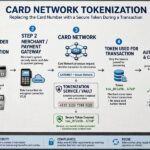
The card network (Visa, Mastercard, etc.). Operates the tokenization system — issues tokens, maps them to PANs, validates cryptograms. The trusted intermediary.
The token requestor. The wallet provider (Apple, Google) or merchant requesting tokens on your behalf. They hold tokens, never PANs.
The merchant/acquirer. Accepts the payment, routes it through the system. Sees tokens and approvals, never PANs (in tokenized flows).
The token vault. The network’s secured mapping database — the only place tokens connect to PANs.
Each party has limited visibility by design — the architecture distributes function while concentrating sensitive data minimally.
Provisioning: How Tokens Are Born
Before any payment, the token must be created and bound:
-
Enrollment. You add your card to a wallet or merchant. The token requestor sends a provisioning request to the network, including card details (this initial transmission is heavily secured — often through the issuer’s own channels).
-
Identity verification. The issuer verifies you’re the legitimate cardholder. Methods vary: bank app approval (strongest), SMS one-time code, email verification, or — for lower-risk cases — passive verification. This step binds the token to verified identity.
-
Eligibility checks. The issuer and network check: is this card eligible for tokenization? Is the device/requestor trustworthy? Risk scoring happens here.
-
Token generation. The network creates the token — a unique number, formatted like a PAN (so existing payment infrastructure processes it), cryptographically linked to the PAN in the vault.
-
Domain binding. The token is bound to its context: this specific device (via secure element attestation), this specific merchant, this channel. The binding is what makes stolen tokens useless elsewhere.
-
Delivery and storage. The token is delivered to the requestor through secured channels and stored in the device’s secure element (hardware-isolated storage) or the merchant’s token store.
-
Activation. The token becomes usable — often requiring a final confirmation. From here, transactions flow.
The whole process typically takes seconds from the user’s perspective. Behind it: identity verification, risk assessment, cryptographic generation, and secure delivery — substantial infrastructure made invisible.
The Transaction Flow: Tap to Approval
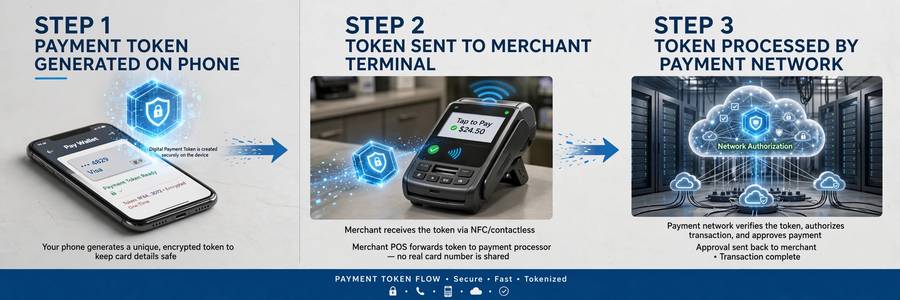
What happens when you tap (simplified but accurate):
- Token retrieval. Your device retrieves the provisioned token from its secure element.
- Cryptogram generation. The device generates a one-time cryptogram — cryptographic proof that this transaction comes from the legitimate token holder, incorporating transaction details (amount, merchant, timestamp).
- Transmission. Token + cryptogram + transaction data travel to the merchant terminal, then through the acquirer to the network. Your PAN is nowhere in this flow.
- Token validation. The network validates: is this token active? Is it being used in its bound domain? Does the cryptogram check out?
- Detokenization. The network maps the token to your PAN in its vault.
- Authorization. The authorization request (now with real PAN) goes to your issuer, which approves or declines based on funds, fraud checks, etc.
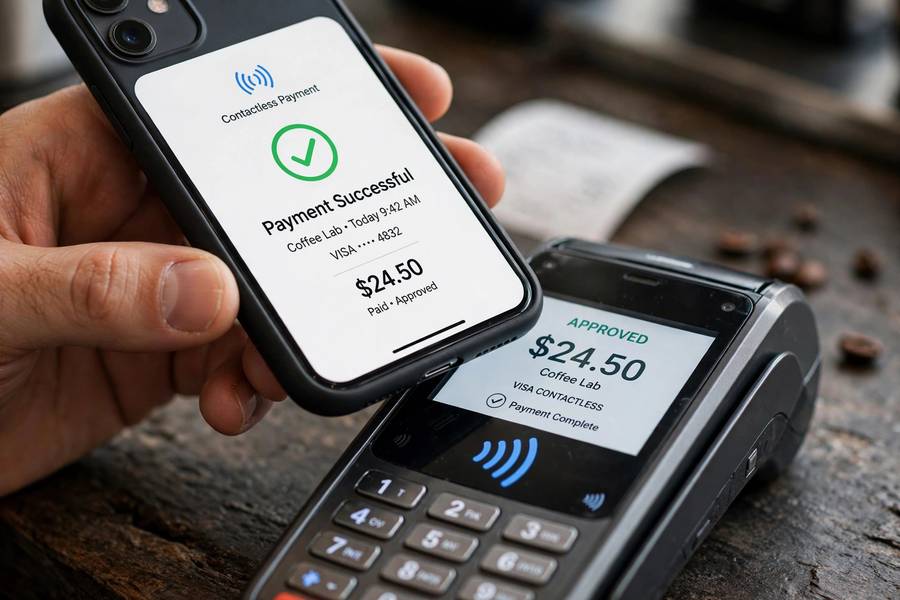
- Response. Approval flows back through the chain. The merchant sees “approved” — never your PAN.
Total time: typically 1–2 seconds. The security machinery — token validation, cryptogram verification, vault lookup — happens in milliseconds within the network’s infrastructure.

The Cryptogram: Each Transaction’s Fingerprint
The cryptogram deserves special attention — it’s what makes tokens unstealable in practice:
What it is: a cryptographic value generated per transaction using keys stored in the device’s secure element, incorporating transaction-specific data (amount, merchant ID, timestamp, counter).
Why it matters: even if an attacker intercepts the token number, they can’t generate valid cryptograms — the keys never leave the secure element. The token alone is insufficient; the proof of legitimate possession is required.
Replay protection: because the cryptogram incorporates transaction details and a counter, captured transaction data can’t be replayed for a different purchase. Each cryptogram is single-use and context-bound.
The analogy: the token is your username (identifies the account); the cryptogram is a one-time password proving you’re really you, right now, for this transaction. Usernames can be copied; one-time proofs can’t be reused.
This is why “token theft” isn’t the threat it sounds like — stealing the number without the cryptogram machinery gets attackers nothing usable.
Token Types: Device, Merchant, and More
Not all payment tokens are identical:
Device tokens. Bound to a specific device’s secure element (phone wallets). Highest security — hardware-backed, biometric-gated. The gold standard.
Merchant tokens. Bound to a specific merchant — your stored card at an online store. The token works only with that merchant. If breached, useless elsewhere.
Card-on-file tokens. Similar to merchant tokens, for recurring/subscription payments. Bound to the merchant relationship.
E-commerce tokens. For browser-based checkout — bound to the session or merchant, often with additional authentication (3D Secure). They’re the workhorse of what e-commerce is in practice: the invisible machinery that makes online checkout both seamless and safe.
The common thread: domain binding. Every token type restricts where the token works. The restrictions vary in strength (hardware binding > merchant binding > session binding), but the principle is universal — tokens are not bearer instruments; they’re context-bound credentials.
What Merchants See (and Don’t)
In a tokenized transaction, the merchant’s view:
They see: the token (looks like a card number), the transaction amount, approval/decline, truncated receipt data, their own order information.
They don’t see: your actual PAN, your CVV, your full billing details (beyond what you provide separately for shipping etc.).
Why this matters: merchant breaches — historically a massive source of card fraud — now yield tokens, not PANs. The tokens are domain-bound (useless elsewhere) and cryptogram-protected (can’t be replayed). The breach’s value to attackers collapses.
The operational benefit: merchants handling only tokens face dramatically reduced compliance scope (see PCI DSS tokenization). Less sensitive data = less security burden = lower costs. Tokenization aligns everyone’s incentives — security improves AND compliance gets cheaper.
When Things Go Wrong: Token Lifecycle Events
Tokens are managed dynamically:
Device lost/stolen: tokens on the device suspended or deleted remotely. Your physical card and other devices unaffected. Compare to the old world: lose your wallet, cancel everything.
Suspicious activity: issuer or network suspends tokens pending verification. Granular — only the affected token, not your entire account.
Card reissued: new PAN issued, tokens automatically updated (account updater). Your stored credentials keep working — no manual updating across merchants. The UX magic of tokenization.
Merchant relationship ends: merchant’s tokens deleted. Clean revocation — no lingering credentials.
Token compromise suspected: individual token killed and reprovisioned. Surgical response instead of nuclear (canceling the whole card).
This lifecycle management — impossible with raw PANs, where the only control was canceling the card — is tokenization’s underappreciated superpower. Fine-grained, reversible, user-friendly security operations.
Offline and Degraded-Mode Transactions
Not every transaction has a live network connection — airplanes, subway tunnels, rural terminals. Payment tokens handle degraded connectivity through careful pre-provisioning, and the mechanism is worth understanding.
How offline token payments work. The device’s secure element holds the token plus a set of pre-generated cryptogram ingredients — counters and keys that let it produce valid one-time cryptograms without contacting the network. The terminal accepts the transaction based on the cryptogram’s local verifiability (the terminal can validate the cryptographic structure even if it can’t reach the issuer), and the transaction is stored for later settlement — “store and forward.” When connectivity returns, the stored transactions upload and the issuer authorizes (or declines) retroactively.
The risk controls. Offline acceptance is bounded by design: cumulative offline spend limits (a cap on how much can go through without going online), transaction counters (the issuer knows how many offline transactions are outstanding), and velocity checks at settlement. The device can’t generate unlimited valid cryptograms — the pre-provisioned material is finite and the limits are enforced by the secure element itself.
Why tokens make offline safer than PANs. A stolen physical card used offline is a static credential — every offline transaction looks identical. A token device used offline produces unique cryptograms per transaction, bound to counters the issuer tracks. Even offline, replay is impossible and the exposure is capped. The token model degrades gracefully where the PAN model degrades catastrophically.
The honest limit. Offline mode trades real-time authorization for availability — the issuer accepts the risk of authorizing-after-the-fact in exchange for transactions that work everywhere. It’s a calculated risk, bounded by the limits above, and it’s why your phone pays on airplanes while your risk team’s dashboards stay calm.

Frequently Asked Questions
Card networks replace your card number with a surrogate token bound to a specific device or merchant. When you pay, the token (not your real number) travels through the system with a one-time cryptogram proving legitimacy. Only the network can map the token back to your account.
A one-time cryptographic value generated per transaction using keys in the device’s secure element, incorporating amount, merchant, and timestamp. It proves the transaction comes from the legitimate token holder — intercepted tokens can’t be reused without it.
With network tokenization, merchants store tokens bound to them specifically — not your PAN. If breached, the tokens are useless elsewhere. Your real card number stays within the network/issuer boundary. This is significantly safer than merchants storing actual card numbers.
The device-bound tokens can be suspended or deleted remotely without affecting your physical card or other devices. This granular control — killing one device’s credentials while everything else works — is a key advantage over traditional card numbers.
Yes — card-on-file tokens are designed for this, bound to the merchant relationship. They even survive card reissuance through automatic account updating, so subscriptions continue working when you get a new card number.