Tokenization gets the attention — replacing sensitive data with meaningless surrogates is the clever part. But the reverse operation, detokenization, is where the real security engineering lives. Anyone can hand out random tokens; the hard part is ensuring that only the right systems, for the right reasons, with the right authorization, can ever turn those tokens back into real data. Detokenization is the guarded gate at the heart of every tokenization system.
This guide explains detokenization: what it is, when it’s needed, how it’s secured, and why its design determines whether tokenization actually protects anything. For the forward process, see how tokenization works.
Table of Contents
- Detokenization in One Paragraph
- Why Reverse Tokens at All?
- How Detokenization Works Technically
- The Authorization Layer: Who Gets to Reverse
- Detokenization in Payment Flows
- Audit and Accountability
- The Security Boundaries
- Detokenization Failures: What Goes Wrong
- Engineering the Latency Budget
- Frequently Asked Questions
Detokenization in One Paragraph
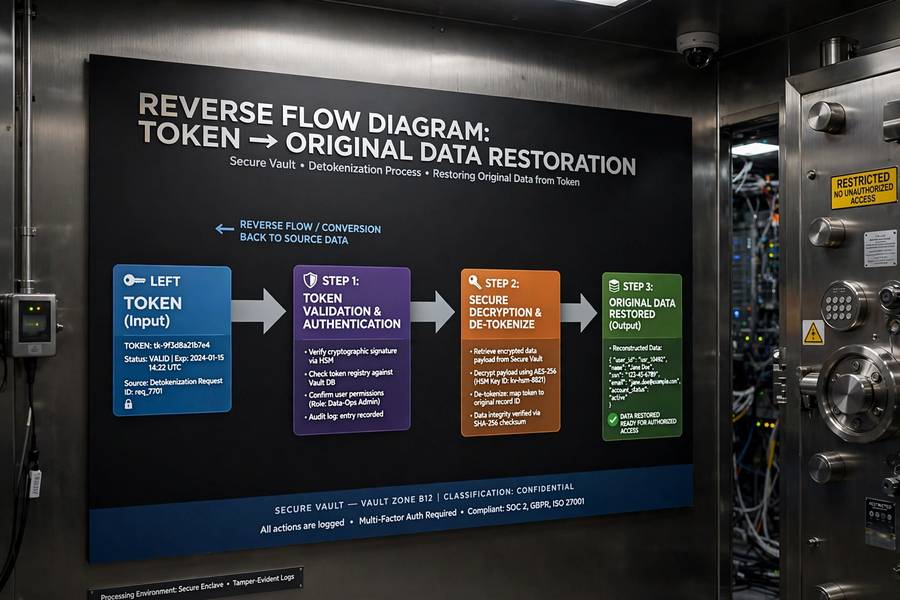
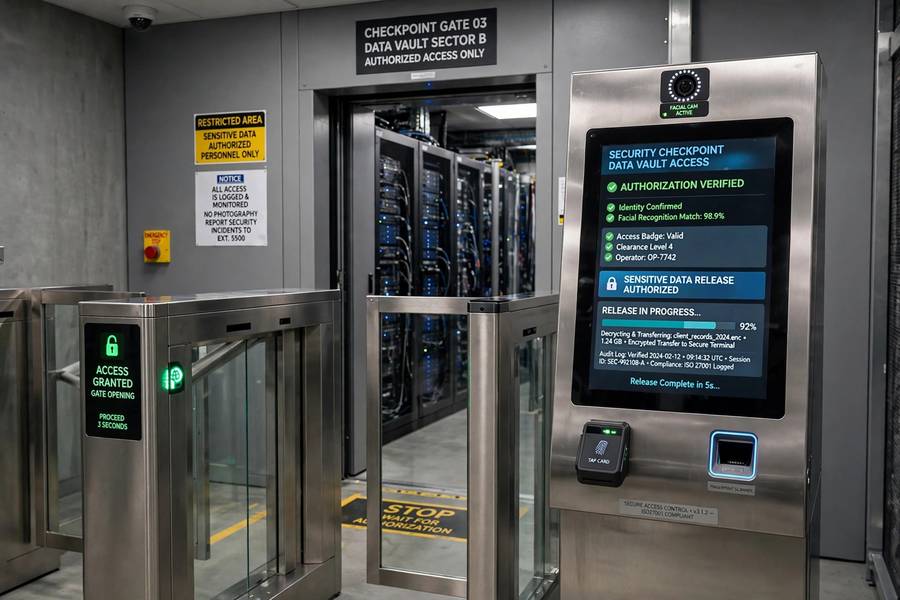
Detokenization is the controlled process of converting a token back to its original sensitive value — the reverse of tokenization. It happens in the token vault (the secured mapping database), only in response to authorized requests, through authenticated channels, with every access logged. While tokenization can happen broadly, detokenization is deliberately narrow: few systems can request it, fewer are approved, and each reversal is an audited security event.
Why Reverse Tokens at All?
If tokens are so great, why ever go back? Because the real data is needed at specific points:
Transaction authorization. The payment network must map the token to the real account to authorize with the issuer. The merchant never sees it; the network must.
Legitimate display. Showing a user their own masked data (“your card ending in 1234”) or full data in authorized contexts (account management). The user owns the data; systems serving the user need controlled access.
Processing requirements. Certain operations fundamentally need the real value — settlement, chargebacks, regulatory reporting. The token is a stand-in; some processes need the original.
Customer service. Support agents verifying identity or resolving issues may need controlled detokenization — with strict access limits and monitoring.
The principle: detokenize only when necessary, only as much as necessary, only by authorized parties. Every detokenization is a moment where sensitive data exists outside the vault — minimize those moments.
How Detokenization Works Technically
The mechanics:
- Authorized request. A system with detokenization privileges sends a request: “resolve token X,” authenticated (mutual TLS, API credentials, etc.) and authorized (this system is permitted this operation).
- Policy check. The vault verifies: is this requestor allowed to detokenize? This token type? In this context? At this volume? Policy enforcement happens before any data moves.
- Lookup. The vault queries its encrypted mapping database for the token.
- Secure return. The original value travels back through the authenticated encrypted channel — never logged, never cached beyond necessity, never exposed to unauthorized components.
- Audit record. The access is logged: who, what token, when, stated purpose. Immutable audit trail.
The critical design point: detokenization is a vault operation, not a client operation. The requestor never holds the mapping logic, the keys, or the database — it asks, and the vault decides. This centralization is what makes the authorization enforceable.
Performance note: detokenization is in the critical path for transactions — milliseconds matter. Vaults are engineered for high-throughput, low-latency lookups under full security. This performance-security balance is the core engineering challenge.
The Authorization Layer: Who Gets to Reverse
Not everyone with a token can reverse it. The authorization model:
Privilege separation. Tokenization (creating tokens) and detokenization (reversing them) are separate privileges. Many systems can tokenize; few can detokenize. This is deliberate — the dangerous direction is restricted.
Least privilege. Each system gets only the detokenization access its function requires. A fraud analysis system might detokenize for investigation; a marketing analytics system never detokenizes at all.
Contextual authorization. Not just WHO but WHEN and WHY — detokenization approved for transaction processing might be denied for bulk export. The purpose matters.
Rate limiting. Unusual detokenization volumes trigger alerts or blocks. A system suddenly reversing thousands of tokens is either compromised or malfunctioning — either way, stop it first.
Time-bounding. Some authorizations expire — detokenization rights granted for a specific investigation window, then revoked. Temporary privilege for temporary needs.
The philosophy: detokenization authorization is deny-by-default. No system reverses tokens unless explicitly permitted, for explicitly defined purposes, under monitoring. This is the opposite of convenience — and that’s the point.

Detokenization in Payment Flows
The concrete example — a tap-to-pay transaction:
- Your phone sends the token + cryptogram.
- The merchant routes it to the network.
- The network detokenizes — vault lookup, token → PAN, inside the network’s secured infrastructure.
- Authorization proceeds with the real PAN to the issuer.
- Approval returns; the merchant sees approval, never the PAN.
Notice the boundary: detokenization happened exactly once, inside the network’s vault, for the authorization purpose. The merchant, acquirer, and all intermediaries handled only the token. The sensitive data existed outside the vault for the minimal necessary moment, in the minimal necessary place.
The elegance: this is detokenization done right — narrow, purposeful, contained. Contrast with systems where detokenization happens broadly (“the app needs the real data for display, analytics, support…”) — each additional detokenization point is additional exposure.
Audit and Accountability
Every detokenization is a security-relevant event, treated as such:
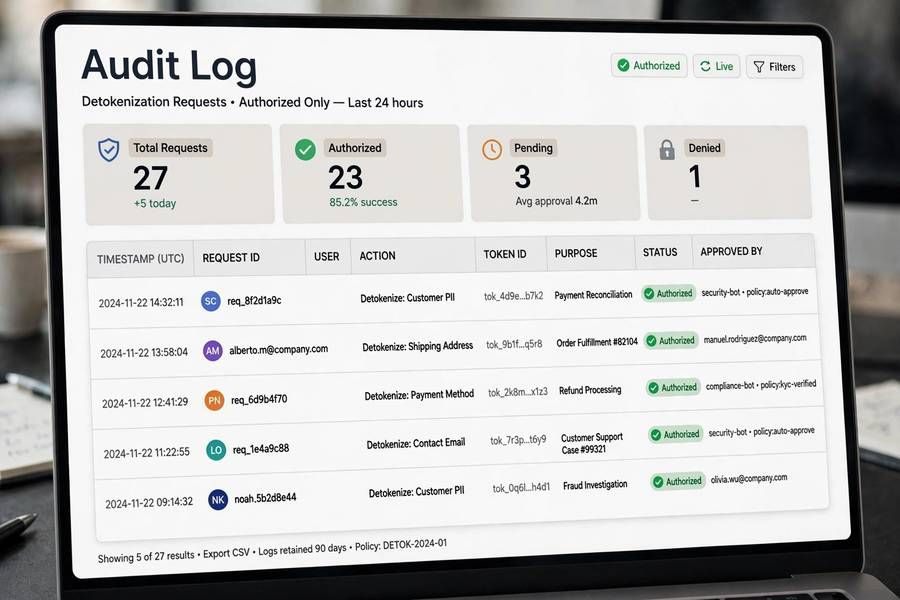
What’s logged: requestor identity, token(s) accessed, timestamp, stated purpose, approval reference, result. Enough to reconstruct exactly what happened.
Log protection: audit logs are append-only and tamper-evident — an attacker who compromises detokenization shouldn’t be able to erase the evidence. Separate the audit trail from the operational systems.
Monitoring: automated analysis for anomalies — volume spikes, unusual hours, new requestors, patterns suggesting bulk extraction. The vault is the most monitored system in the architecture.
Review cadence: periodic human review of detokenization patterns, access recertification (does this system still need this privilege?), and incident investigation procedures.
Compliance mapping: audit trails serve regulatory needs — demonstrating who accessed what data when is a common AI compliance requirement, and detokenization logs are the authoritative source.
The audit discipline reflects the stakes: detokenization is where the protection is weakest (data exposed, even briefly), so it’s where oversight is strongest.
The Security Boundaries
Where detokenization is and isn’t allowed — the architectural lines:
Inside the vault boundary: detokenization logic, mapping database, keys — the trusted core. Heavily defended, minimal attack surface.
At the API boundary: authorized requests enter, original values exit — through authenticated, encrypted, monitored channels. The controlled gate.
Beyond the boundary: tokens only. Systems outside never receive mapping capability, keys, or algorithms that would let them reverse independently.
The critical invariant: no system outside the vault can detokenize on its own. If a token-holding system is compromised, the attacker gets tokens — not the ability to reverse them. This invariant is what makes the architecture sound; violating it (shared keys, local mapping caches with real data) breaks the model.
Defense in depth: even within the vault boundary, layers — network segmentation, HSM-backed keys, separated duties. The vault isn’t one wall; it’s a fortress with inner keeps.
Detokenization Failures: What Goes Wrong
Over-broad authorization. Too many systems with detokenization rights — the privilege sprawls until the restriction is meaningless. Regular recertification prevents this.
Insufficient monitoring. Detokenization happening without adequate logging or anomaly detection — blind spots where abuse goes unnoticed.
Cache leakage. Performance-motivated caching of detokenized values outside the vault — the cache becomes a shadow vault with weaker protection. If you must cache, treat the cache as part of the vault’s security boundary.
Error message exposure. Detokenized values leaking into error logs, debug output, or exception messages. The classic side-channel — the main flow is secured, the error path isn’t.
Insider abuse. Authorized users detokenizing beyond their legitimate needs — the hardest threat, addressed through monitoring, separation of duties, and the principle that authorization is specific, not blanket.
The pattern: failures come from widening the detokenization aperture — more systems, more purposes, less oversight. The secure posture is narrow, monitored, and constantly re-justified. Vigilance, not just architecture.
Engineering the Latency Budget
Detokenization sits in the transaction critical path, which means its performance is a product requirement, not just an engineering nicety. Here’s how the latency budget actually gets built.
The total envelope. A tap-to-pay transaction typically completes in 1–2 seconds end to end. Within that, the detokenization lookup — vault query, policy check, audit write — must complete in tens of milliseconds. There’s no room for a slow database: if the vault takes 200ms, the user feels the terminal hang, and at transit-gate scale, the queue backs up visibly.
Where the milliseconds go. The lookup itself is fast (indexed token → encrypted blob, typically single-digit milliseconds). The expensive parts are everything around it: the policy evaluation (is this requestor authorized for this token type in this context?), the HSM round-trip (decrypting the mapping requires the hardware module, which has its own latency floor), and the audit write (which must complete — or at least be durably queued — before the response returns, because an unaudited detokenization is a compliance failure).
The engineering trade-offs. Caching detokenized mappings would slash latency — and create a shadow vault with weaker protection, which is why it’s usually rejected or confined to memory-only, short-TTL caches inside the vault boundary. Read replicas help throughput but complicate the audit trail (which replica served which request must be reconstructable). HSM clustering reduces the crypto bottleneck but multiplies the key-management surface.
The honest engineering position. Every millisecond of detokenization latency is bought with architectural complexity somewhere else. The teams that do this well treat the latency budget like a financial budget — allocated deliberately, tracked continuously, with alerts when any component starts overspending. Vault performance isn’t a tuning exercise; it’s a design discipline.
Frequently Asked Questions
The controlled process of converting a token back to its original sensitive value. It happens in the token vault in response to authorized requests, through authenticated channels, with every access logged. It’s deliberately narrow — few systems can request it, each reversal is an audited event.
When the real data is actually needed: transaction authorization (network mapping token to account), legitimate user display, settlement and chargeback processing, regulatory reporting, and authorized customer service. The principle is minimal: detokenize only when necessary, only as much as necessary.
Only explicitly authorized systems, under least-privilege principles — separate from tokenization rights, contextual (specific purposes), often rate-limited and time-bounded. Detokenization authorization is deny-by-default; no system reverses tokens without explicit permission for defined purposes.
It’s the moment of maximum exposure — sensitive data exists outside the vault, however briefly. That’s why it’s so controlled: vault-only operation, strict authorization, comprehensive audit, anomaly monitoring. The risk is managed through narrowness and oversight, not eliminated.
Tokenization replaces sensitive data with surrogates (broad, relatively permissive); detokenization reverses surrogates to originals (narrow, heavily restricted). The asymmetry is deliberate — creating tokens is safe, reversing them is sensitive. The dangerous direction gets the controls.