


Here’s the truth nobody in fitness wants to tell you: as a beginner, almost any sensible routine works. Your body is so unadapted to training that the specific program matters far less than showing up consistently for six months. The people who fail aren’t the ones who picked the wrong routine — they’re the ones who picked an impressive routine, got crushed by it, and quit by week three.
I’ve coached beginners for over a decade. The ones who succeed follow simple workout routines for beginners built on a few non-negotiable principles. Here’s the whole playbook — what to do, how often, and what to ignore.
Table of Contents
- The Principles Before the Program
- How Often Should a Beginner Train?
- The Beginner Full-Body Routine (3 Days a Week)
- The 2-Day Minimalist Option
- Bodyweight-Only Starter Routine
- Form First: The Non-Negotiable
- Progression in Workout Routines for Beginners
- Mistakes That Stall Every Beginner
- Frequently Asked Questions
The Principles Before the Program
Before a single rep, understand why beginner routines look the way they do:
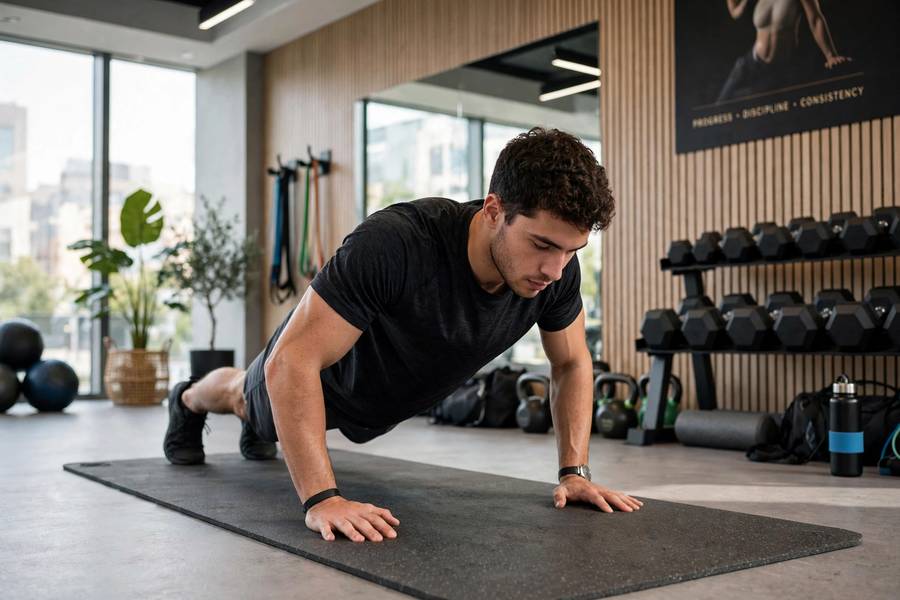
Full-body beats splits for beginners. An advanced lifter might train chest on Monday and back on Tuesday. You shouldn’t. Training each muscle 2–3 times per week with moderate volume produces faster beginner gains than hammering one muscle once a week. Your recovery capacity is high; use it.
Compound movements first. Squats, hinges, pushes, pulls, carries. These multi-joint movements build the most muscle and strength per minute of training. Isolation work (curls, lateral raises) is dessert — fine to add, terrible as the main course.
Simple and repeatable. The best beginner routine is boring. Same movements, same structure, week after week, with small increases. Novelty is the enemy of progress at this stage — you don’t need “muscle confusion,” you need practice.
Leave the gym feeling like you could do more. Beginners who train to failure every session burn out or get hurt. Stop 1–3 reps short of failure on most sets. You’ll progress faster because you’ll actually recover and come back.
How Often Should a Beginner Train?
Three days a week is the sweet spot for most beginners — Monday/Wednesday/Friday or similar, with rest days between. This gives each muscle group 48+ hours to recover while keeping frequency high.
Two days a week still works. You’ll progress more slowly, but two consistent sessions beat four sporadic ones. If your schedule only allows two days, train full-body both days and don’t apologize for it.
Four or more days is unnecessary for a true beginner and usually counterproductive. More training days means less recovery and more complexity — neither of which you need yet. When three full-body days stop producing progress (typically after 6–12 months), then you graduate to more advanced structures.
As for timing, train whenever you’ll actually show up consistently. If you want the full breakdown of morning versus evening trade-offs, our guide on the best time to exercise covers it — but honestly, the best time is the time you’ll stick with.
The Beginner Full-Body Routine (3 Days a Week)
This is the routine I give nearly every new client. Alternate Workout A and Workout B across your three weekly sessions (Week 1: A-B-A, Week 2: B-A-B). Rest 60–90 seconds between sets.
Workout A
– Goblet squat — 3 sets of 8–12 reps
– Push-up (or dumbbell bench press) — 3 sets of 8–12 reps
– One-arm dumbbell row — 3 sets of 10–12 reps per arm
– Glute bridge — 2 sets of 12–15 reps
– Plank — 2 sets, hold 20–40 seconds
Workout B
– Romanian deadlift (dumbbells) — 3 sets of 8–12 reps
– Overhead dumbbell press — 3 sets of 8–12 reps
– Lat pulldown or assisted pull-up — 3 sets of 8–12 reps
– Walking lunge — 2 sets of 10 steps per leg
– Dead bug — 2 sets of 8 reps per side
That’s it. Ten movements total across the week, covering every major muscle group multiple times. If you’re unsure about any of these, learn how to do push-ups and how to do a plank correctly first — they’re the foundation everything else builds on.
Warm up for five minutes before each session: brisk walking, arm circles, leg swings, and one light set of the first exercise. Skip the 20-minute warm-up routines influencers sell. Five minutes, then lift.
The 2-Day Minimalist Option
Short on time? This covers everything in two sessions per week:
- Goblet squat — 3×8–12
- Dumbbell Romanian deadlift — 3×8–12
- Push-up or dumbbell bench press — 3×8–12
- One-arm dumbbell row — 3×10–12 per arm
- Overhead press — 2×8–12
- Plank — 2×20–40 seconds
Same exercises both days. Forty-five minutes, twice a week, and you’ll be stronger in three months than 90% of people who “work out.” Consistency with a simple plan beats complexity every single time.
Bodyweight-Only Starter Routine
No gym, no equipment, no excuses. Do this 3 days a week:
- Bodyweight squat — 3 sets of 12–20 reps
- Push-up (elevate hands on a counter if full push-ups are too hard) — 3 sets to 2 reps shy of failure
- Reverse lunge — 2 sets of 10 per leg
- Superman hold — 2 sets of 20–30 seconds
- Plank — 2 sets of 20–40 seconds
- Glute bridge — 2 sets of 15–20 reps
Our bodyweight exercises guide has progressions for when these get easy — and they will get easy, which is the point. When you can do 3×20 clean push-ups and 3×20 squats, you’ve earned the right to add weight or join a gym. Until then, this is plenty.
Form First: The Non-Negotiable
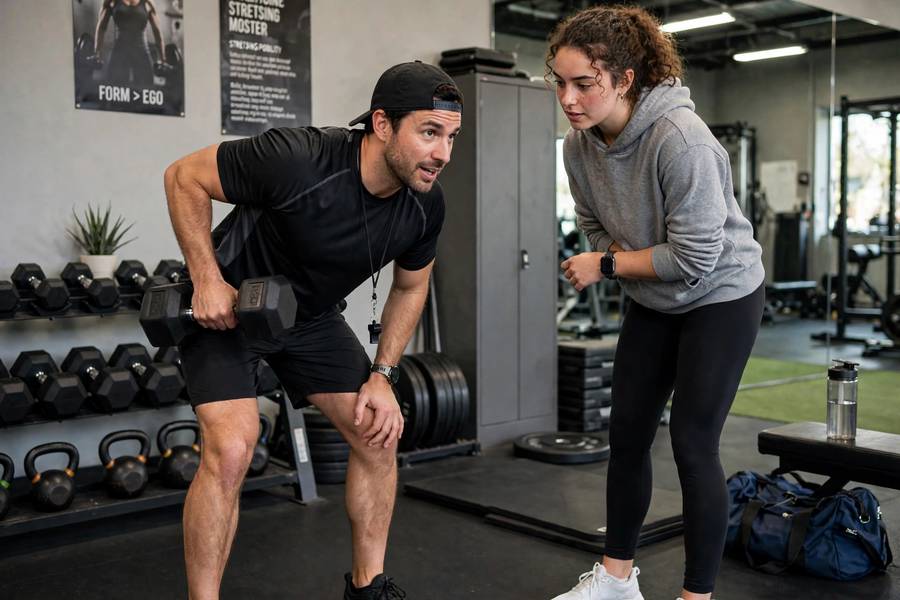
I’m going to be blunt: most beginners get hurt or stall because their form is garbage and nobody told them. Five rules that prevent 90% of problems:
- Learn each movement with light weight first. If you can’t do it perfectly with a broomstick or light dumbbells, you have no business loading it heavy.
- Film yourself. Prop your phone up and record your squats and deadlifts from the side. What you feel and what you’re actually doing are two different things — video closes the gap.
- Back flat on hinges and rows. Rounding your lower back under load is how people get injured. Chest up, brace your core like someone’s about to punch your stomach.
- Full range of motion. Half-rep squats build half results and full egos. Go as deep as your mobility allows with control.
- Pain is information. Muscle burn is fine. Sharp, stabbing, or joint pain is not — stop the exercise, not the workout. (This is general training guidance, not medical advice — if something hurts persistently, get it checked by a professional.)
One session with a qualified trainer to check your form on the big lifts is the best $50–$100 a beginner can spend. One session. That’s all it takes to catch the major issues.
Progression in Workout Routines for Beginners
Here’s the beautiful thing about being a beginner: you get stronger almost every week if you follow one rule — add a little bit, regularly. This is called progressive overload, and for beginners it’s dead simple:
- When you can complete all sets and reps of an exercise with good form, add weight next session (the smallest increment available — 2.5 to 5 lbs).
- If you can’t add weight, add a rep. If you did 3×8 last time, do 3×9.
- When you stall on an exercise for 2–3 weeks, drop the weight 10% and build back up.
That’s the entire system. No periodization spreadsheets, no fancy techniques. Beginners don’t need complexity — they need the discipline to add 2.5 pounds and come back next time. This linear progression typically lasts 6–12 months, and it’s the fastest progress you’ll ever make. Enjoy it.
Track your workouts. A notes app is fine. “Squat 3×10 @ 40 lbs” written down is what turns random exercise into training.
Mistakes That Stall Every Beginner
I’ve watched hundreds of beginners. The failure patterns are always the same:
Program hopping. Switching routines every three weeks because a new YouTube video looked exciting. Pick one routine and run it for at least 12 weeks. The program works if you work the program.
Too much, too soon. Five-day splits, two-hour sessions, training to failure daily. Your enthusiasm is great; your recovery capacity is finite. Start with less than you think you need.
Ignoring the boring stuff. Sleep 7–9 hours. Eat enough protein (roughly a palm-sized portion at each meal is a fine beginner target). Drink water. These unsexy basics determine whether your training works. No supplement or routine overcomes sleeping five hours a night.
Comparing to others. The person next to you has been training for five years. You have been training for five days. Compare yourself to yourself last month — that’s the only comparison that matters.
Skipping legs. Everyone laughs about it because everyone does it. Don’t be everyone. Your legs are half your body — train them.
Waiting for motivation. Motivation is unreliable. Systems are reliable. Put your sessions in your calendar like appointments. Lay out your gym clothes the night before. Make showing up the default, not the decision.
Start simple, stay consistent, add weight slowly, and give it six months. That’s the whole secret. There isn’t another one.
Frequently Asked Questions
A full-body routine done 2–3 days per week, built on compound movements (squats, pushes, pulls, hinges). Beginners progress fastest training each muscle group multiple times per week with simple, repeatable workouts.
45–60 minutes including a 5-minute warm-up is plenty. Beginners don’t need marathon sessions — shorter, consistent workouts with good form produce better results than long, exhausting ones.
Full-body. Training each muscle 2–3 times per week beats training it once, and beginners recover fast enough to handle the frequency. Split routines are for intermediate and advanced lifters.
Strength improves within weeks; visible changes typically take 8–12 weeks of consistent training. Beginners progress faster than at any other stage — linear progress for 6–12 months is normal with proper progression.
Absolutely. A bodyweight routine of squats, push-ups, lunges, planks, and glute bridges done 3 days a week builds real strength. Add weight or join a gym once bodyweight work gets easy.
Program hopping and doing too much too soon. Pick one simple routine, run it for at least 12 weeks, progress gradually, and prioritize sleep and consistency over any advanced technique.