
How to Take Better Notes in Class: 11 Smart Tips


Most students take notes the same way: try to write down everything the teacher says, end up with pages of frantic transcription, and never look at them again. Then exam week arrives, and those pages might as well be in another language.
Here’s the mindset shift that fixes it: your notes are not a transcript of the class. They’re a gift from present-you to future-you — the version of you studying at 10 PM the night before the exam, desperate for clarity.

The Mindset Shift: Notes Are a Gift to Future-You
Before any technique, get the purpose right. Notes have two jobs: keep you engaged during class, and give you study material afterward. Transcription does neither well — copying words verbatim keeps your hand busy while your brain idles, and produces pages you’ll never revisit because they’re exhausting to read.
The alternative: capture ideas, don’t transcribe sentences. Listen for the point, then write it in your own words. This forces the one thing that makes notes valuable — understanding in the moment. If you can paraphrase it now, future-you can learn from it later. If you can’t, that’s a signal to ask a question, not to write faster.
Before Class: Prep Materials, Label, Leave Space
Good notes start before the teacher speaks. Ten minutes of prep changes the whole class:
Skim the material. Five minutes on the chapter headings or lecture slides gives your brain a framework to hang new information on — you’ll recognize the important points instead of discovering them afterward.
Label everything. Date, class, topic at the top of every page. It sounds fussy until you’re shuffling through forty unlabeled pages looking for the thermodynamics notes.
Leave space. Don’t pack the page edge to edge. Leave wide margins and blank lines between ideas — that space is where the real learning happens later: questions, connections, corrections. Notes with no white space have no room to grow.
If you use a system like Cornell (below), rule up the page before class starts so you’re not formatting while the teacher is talking.
During Class: Listen for Emphasis Cues
Teachers tell you what’s important — constantly. You just have to listen for the signals instead of treating every sentence equally:
- Repetition. Said twice? It’s on the exam. Teachers repeat what matters.
- The board. If they write it down, you write it down. Board content is pre-filtered importance.
- Verbal flags. “The key point here is…”, “In summary…”, “What you need to remember is…” — these are neon signs. When you hear one, your pen should move.
- Tone and pace changes. Slowing down, pausing, speaking more deliberately — the teacher is giving weight to those words. Match it with your attention.
- Stories and examples. Teachers use examples to illustrate the ideas that matter. Capture the example and label which idea it illustrates — examples are what you’ll actually remember at exam time.
Not everything deserves equal ink. Your job is triage: emphasis cues mark the importance, and your notes should reflect that hierarchy.
Paraphrase and Condense in Your Own Words
This is the single highest-value habit in note-taking. When the teacher makes a point, don’t copy the sentence — restate the idea briefly in your own words.
Why it works: paraphrasing forces comprehension. You can’t restate what you don’t understand, so the act of paraphrasing tests your understanding in real time. Copying tests nothing — your hand can transcribe a sentence your brain never processed.
It also compresses. Your version should be shorter than the original: “The mitochondria convert glucose into ATP through cellular respiration, which powers cellular functions” becomes “mitochondria → make ATP (energy) from glucose.” Same idea, a third of the words, in a form your brain already owns.
Use [brackets] for your own reactions and questions — [why does this matter for the lab?] or [connects to last week’s topic]. Brackets separate your thinking from the teacher’s content, and those margin conversations with yourself are often the most valuable lines on the page when you review.
Abbreviations, Symbols, and Structured White Space
Speed matters — the teacher won’t slow down for your handwriting. Build a personal shorthand and use it relentlessly:
- Standard abbreviations: w/ (with), w/o (without), b/c (because), → (leads to / causes), ↑ (increase), ↓ (decrease), ∴ (therefore), e.g., i.e., etc.
- Course-specific: invent short forms for terms that repeat — “psyn” for photosynthesis, “govt” for government. Keep a key at the front of your notebook so future-you can decode them.
- Symbols for structure: ★ for “likely on exam,” ? for “don’t understand — ask,” ! for “surprising/important.” A page scanned later should show its priorities at a glance.
And protect your white space: indent sub-points under main ideas, skip lines between topics, keep margins clear for later additions. A dense wall of text is unreadable twice — once when you write it, once when you study it. Structure is what turns writing into notes.
The Cornell Method, Step by Step
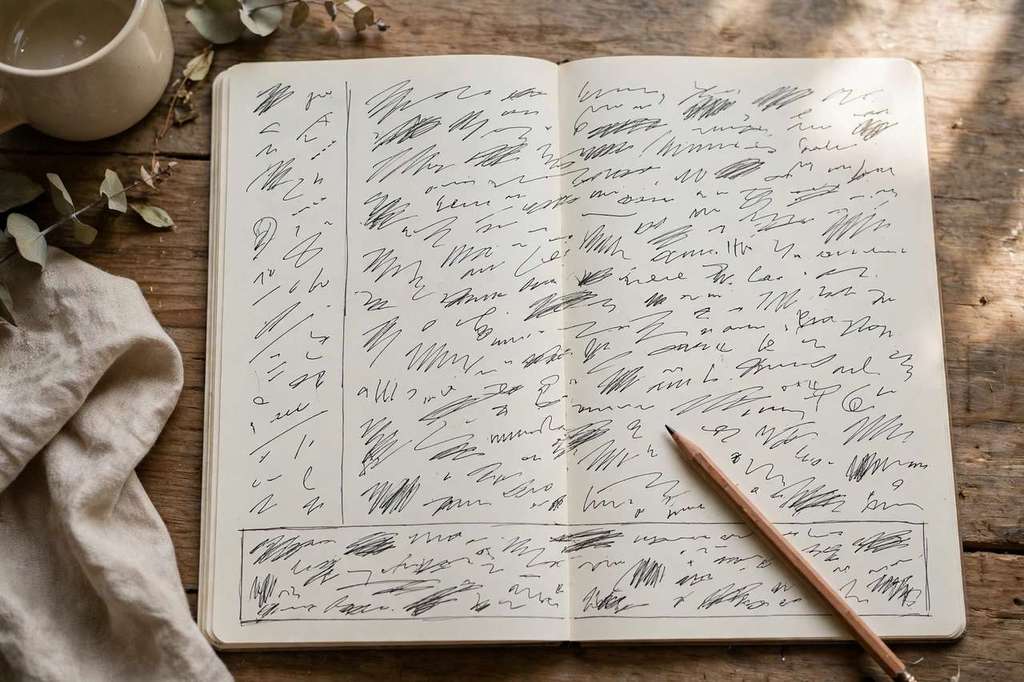
The Cornell method is the most taught note-taking system for a reason: its layout builds review into the page itself. Here’s the setup:
Divide the page into three zones. Draw a vertical line about a third of the way from the left — the narrow left column is the cue column, the wide right column is where your class notes go. Leave the bottom few inches of the page empty for the summary. Rule this up before class.
During class: notes go in the wide right column. Paraphrase, abbreviate, capture ideas. The cue column stays empty for now.
After class: fill the cue column. Write key terms and questions in the narrow left column — one per idea. “What are the three stages of cellular respiration?” next to the paragraph that answers it. You’re converting notes into a self-quiz.
Write the summary. At the bottom, in 2–3 sentences, summarize the page in your own words. If you can compress a page to three sentences, you understand it. If you can’t, you’ve found exactly what to study.
The magic: come exam time, cover the right column and quiz yourself from the cues alone. The page is already a flashcard deck. For the deep dive, this Cornell notes method guide covers the system in full — this article is the broad hub; that’s the specialist.
Mind Maps and Outlining: When Each Works Best
Cornell isn’t the only system. Pick the method that fits the material:
Outlining (I., A., 1., a.) suits hierarchical content — history timelines, legal frameworks, anything with clear main points and sub-points. If the lecture is organized, mirror it.
Mind maps suit brainstorming, connections-heavy topics, and visual thinkers. Central concept, branches, links between branches. Biology processes, literature themes — anything where relationships matter more than sequence.
The picker: structured lecture with clear hierarchy → outline. Web of connected ideas → mind map. General-purpose class where you want built-in review → Cornell. Most students end up hybrid — Cornell for most classes, mind maps for the messy ones. The best system is the one you’ll actually use, not the prettiest one.
Handwriting vs Typing
The eternal debate, settled pragmatically:
Handwriting wins for learning. It’s slower, and that’s the feature — the speed limit forces you to paraphrase and prioritize instead of transcribing. For most classes, pen and paper is the better choice.
Typing wins for speed and volume. Fast-talking lecturers, code-heavy classes, subjects where you genuinely need near-verbatim capture — a laptop keeps up where a pen can’t. Typed notes are also searchable and easier to reorganize later.
The practical rule: handwrite by default; type when the class demands speed. If you type, fight the transcription trap deliberately — paraphrase anyway, or you’ll end up with beautiful, useless verbatim pages. And whichever you choose, the review habits below matter more than the input method. If you’re going digital, these note-taking app comparisons and organizing apps will help you pick tools that support the system instead of fighting it.
After Class: Review Within 24 Hours, Fill Gaps, Compare
This is the highest-return habit in all of note-taking, and almost nobody does it: review your notes within 24 hours of class. It takes 5–10 minutes. That’s it.
Why it matters: memory decays fastest in the first day. A five-minute review the same evening — clarifying abbreviations, filling the cue column, writing the summary — locks in far more than the same review a week later. You’re catching the material while it’s still warm.
Make it a ritual: after your last class, 5–10 minutes per class. Fill in what you missed — classmate or textbook. Star what you still don’t understand and bring it as a question next class.
The buddy system multiplies it: pair up with a reliable classmate and compare notes weekly. You’ll each catch things the other missed, and explaining your notes to someone else is active recall in disguise.

Turn Notes into Questions and Flashcards (Active Recall)
Notes you only reread are decoration. The upgrade: convert them into questions and test yourself.
Notes → questions. Go through a page and write a question for every key idea — in the Cornell cue column if you use that system, or on a separate sheet. Then answer them with the notes covered. The questions you can’t answer are your real study list; everything else you already know.
Questions → flashcards. The hardest questions become flashcards — physical or digital. Short prompt on the front, answer on the back, reviewed with spacing over days. This is active recall: forcing retrieval instead of recognizing familiar text.
Study from questions, not pages. When exam prep starts, your primary material should be your question sets and flashcards, not the original notes. The notes are the raw material; the questions are the tool. If you built the questions well during the semester, exam week becomes review instead of panic. This flashcard study guide covers the spacing and technique that make flashcards actually stick.
Common Questions: Teacher Too Fast? Need a Fancy System?
“My teacher talks too fast — I can’t keep up.” Focus on emphasis cues (above) and get the main ideas — details can be filled from the textbook within 24 hours. Abbreviate aggressively, leave gaps with a “?” mark, and borrow a classmate’s notes for the gaps. Ask the teacher if slides can be shared beforehand — pre-reading makes fast lectures followable.
“Do I need a fancy system to get good grades?” No. Paraphrasing, reviewing within 24 hours, and turning notes into questions beat any elaborate system that’s never reviewed. Systems help, but habits decide.
“What if I miss a class?” Get notes from your buddy-system partner the same day and review them within 24 hours like your own.
“Should I rewrite my notes neatly?” Only if the rewriting involves thinking — condensing, reorganizing, questioning. Copying them over neatly is transcription with extra steps. Your 24-hour review pass is the rewrite that counts.
Frequently Asked Questions
Should I handwrite or type my notes in class?
Handwrite by default — the slower pace forces you to paraphrase and prioritize, which builds better understanding. Type when the class demands speed (fast lecturers, code-heavy subjects), but fight the transcription trap by paraphrasing deliberately. Whichever you choose, reviewing within 24 hours matters more than the input method.
What is the Cornell note-taking method?
Divide the page into three zones: a narrow left cue column, a wide right notes column, and a summary area at the bottom. Take class notes in the wide column, then after class fill the cue column with key terms and questions, and write a 2–3 sentence summary at the bottom. Covering the notes column turns the page into a self-quiz using just the cues.
How do I take notes when the teacher talks too fast?
Stop trying to capture everything — listen for emphasis cues (repetition, board content, “the key point is…”) and get the main ideas. Abbreviate aggressively, mark gaps with “?” and fill them from the textbook or a classmate’s notes within 24 hours. Pre-reading the material before class makes fast lectures much easier to follow.
How soon after class should I review my notes?
Within 24 hours — this is the highest-return habit in note-taking. A 5–10 minute same-day review (clarifying abbreviations, filling gaps, writing your summary) locks in far more than the same review done a week later, because memory decays fastest in the first day. Make it a daily ritual after your last class.
Do I need a fancy note-taking system to get good grades?
No. Paraphrasing in your own words, reviewing within 24 hours, and turning notes into self-quiz questions beat any elaborate system that’s never reviewed. Pick the simplest method you’ll use consistently — Cornell, outlining, or mind maps — and invest your energy in the habits, not the stationery.
How do I study from my notes instead of just rereading them?
Convert notes into questions — one per key idea — and answer them with the notes covered. Turn the hardest ones into flashcards and review them with spacing over days. Your primary exam-prep material should be these questions and flashcards, not the original pages; the notes are raw material, the questions are the tool.