Who Was Marie Curie? The Life of a Two-Time Nobel Winner

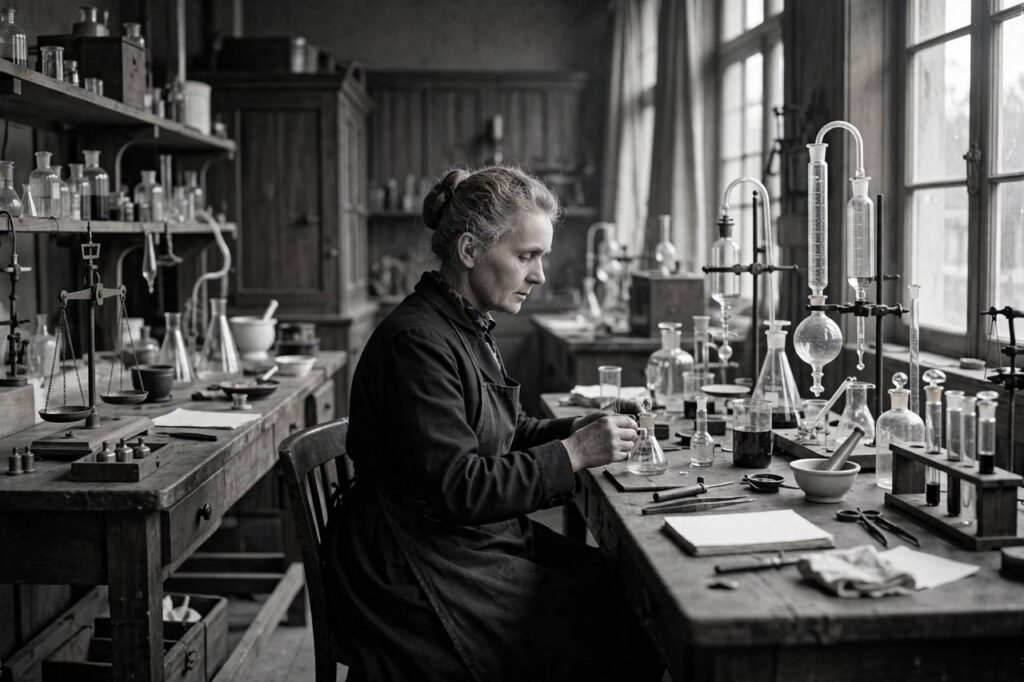
Marie Curie is one of the most famous scientists who ever lived — and one of the most mythologized. Her story gets told as a simple legend: brilliant woman, discovered radium, won two Nobels, died from radiation. The legend is true in outline, but the outline leaves out the parts that make her extraordinary: the 1890s Paris where a woman in a laboratory was an anomaly, the years of backbreaking lab work that produced a few milligrams of pure radium, and the price she paid for knowledge nobody yet understood was dangerous.
I check my sources twice on figures like Curie, because fame attracts invented details. Every claim below comes from the Nobel Prize biography or Britannica — and where the record is thin, I’ll say so.
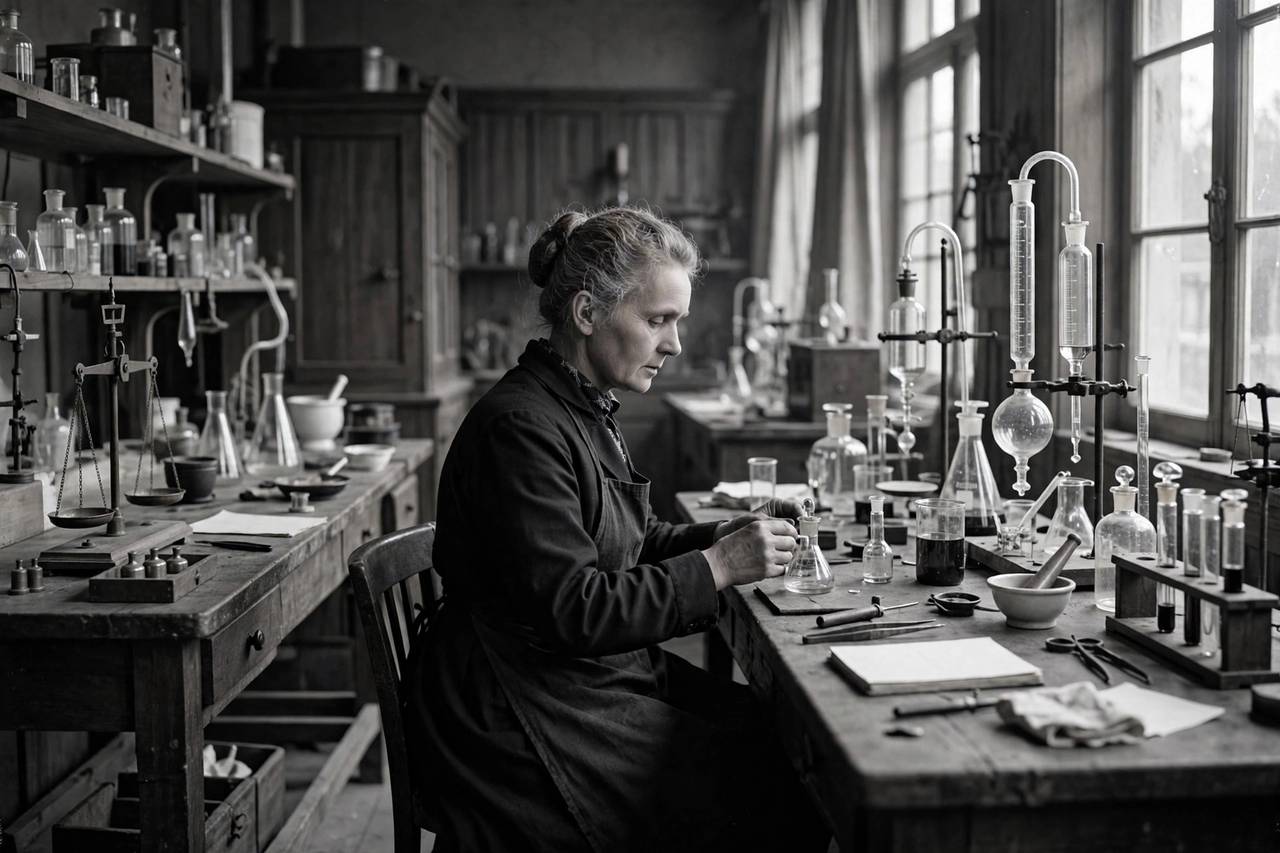
Who Was Marie Curie? (The 30-Second Answer)
Maria Skłodowska — known to the world as Marie Curie — was a Polish-born French physicist and chemist who won the Nobel Prize twice, in two different sciences: Physics in 1903 and Chemistry in 1911. She discovered the elements polonium and radium, pioneered research on radioactivity, and became the first woman to win a Nobel Prize — and remains the only woman to win in two different fields.
Born in Warsaw on 7 November 1867. Died in France on 4 July 1934, of an illness linked to the radiation she had spent her life studying.
From Warsaw to Paris: The Beginning
Marie was born Maria Skłodowska in Warsaw, then part of the Russian Empire. She was a prodigy: she finished her secondary education with a gold medal at 16 — a detail that tells you the discipline was there from the start.
But a woman in Russian-occupied Poland couldn’t easily get a university science education. So she worked as a governess, saved her money, and helped pay for her older sister Bronisława’s medical studies in Paris — with the understanding that Bronisława would later help her. In 1891, Marie finally made the move herself: Paris, and the Sorbonne, where she earned degrees in physics and mathematics (1893 and 1894).
On 25 July 1895, she married Pierre Curie, a French physicist. It was a partnership in every sense — personal and scientific. Within a few years, they would change physics together.
The Radioactivity Work: The Real Story
The story of Curie’s science begins with another man’s observation. In 1896, Henri Becquerel discovered that uranium salts emitted mysterious rays. Marie chose this as her doctoral thesis topic — and turned it into a revolution.
She coined the word for the phenomenon: radioactivity (the Britannica account describes the radiation “which she later called radioactivity”). She didn’t just name it — she measured it, systematically, with an electrometer, and found that the radiation came from the atom itself, not from any chemical reaction. She also discovered that thorium emitted similar rays.
Then came the breakthrough. Studying pitchblende, a uranium ore, she found it was more radioactive than pure uranium should be — meaning something unknown inside was doing the extra emitting. With Pierre, she isolated it. In 1898, they announced two new elements:
- Polonium — named for her native Poland (Polonia)
- Radium — from the Latin for “ray”
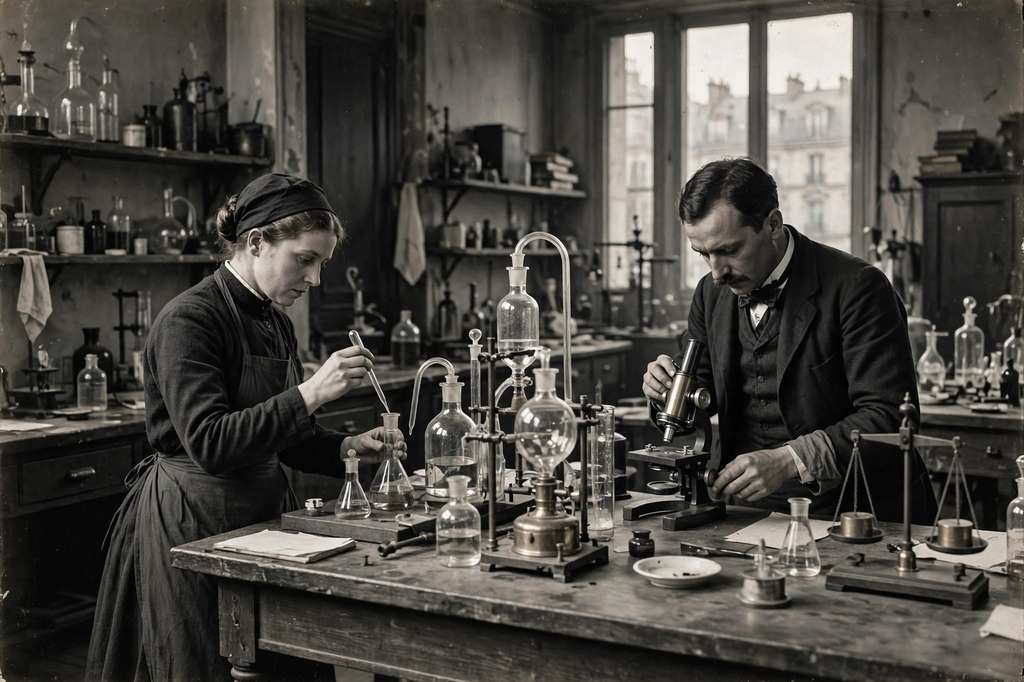
Think about the conditions: a leaking shed of a laboratory, tons of pitchblende processed by hand, years of chemical separations to produce a fraction of a gram of pure radium. In 1903, she earned her Doctor of Science — and that same year, the Nobel Prize in Physics, shared with Pierre Curie and Henri Becquerel.
1903: The Physics Nobel
The 1903 Nobel Prize in Physics went jointly to Antoine Henri Becquerel (for discovering spontaneous radioactivity) and to Pierre and Marie Curie (for their subsequent research on radiation). Marie became the first woman ever to win a Nobel Prize. She was 36.
Pierre’s Death and the Sorbonne Chair
Tragedy struck in 1906: Pierre Curie was killed in a street accident in Paris. Marie, widowed with two young daughters, was offered his chair at the Sorbonne — and accepted, becoming the first woman professor of general physics in the Sorbonne’s history.
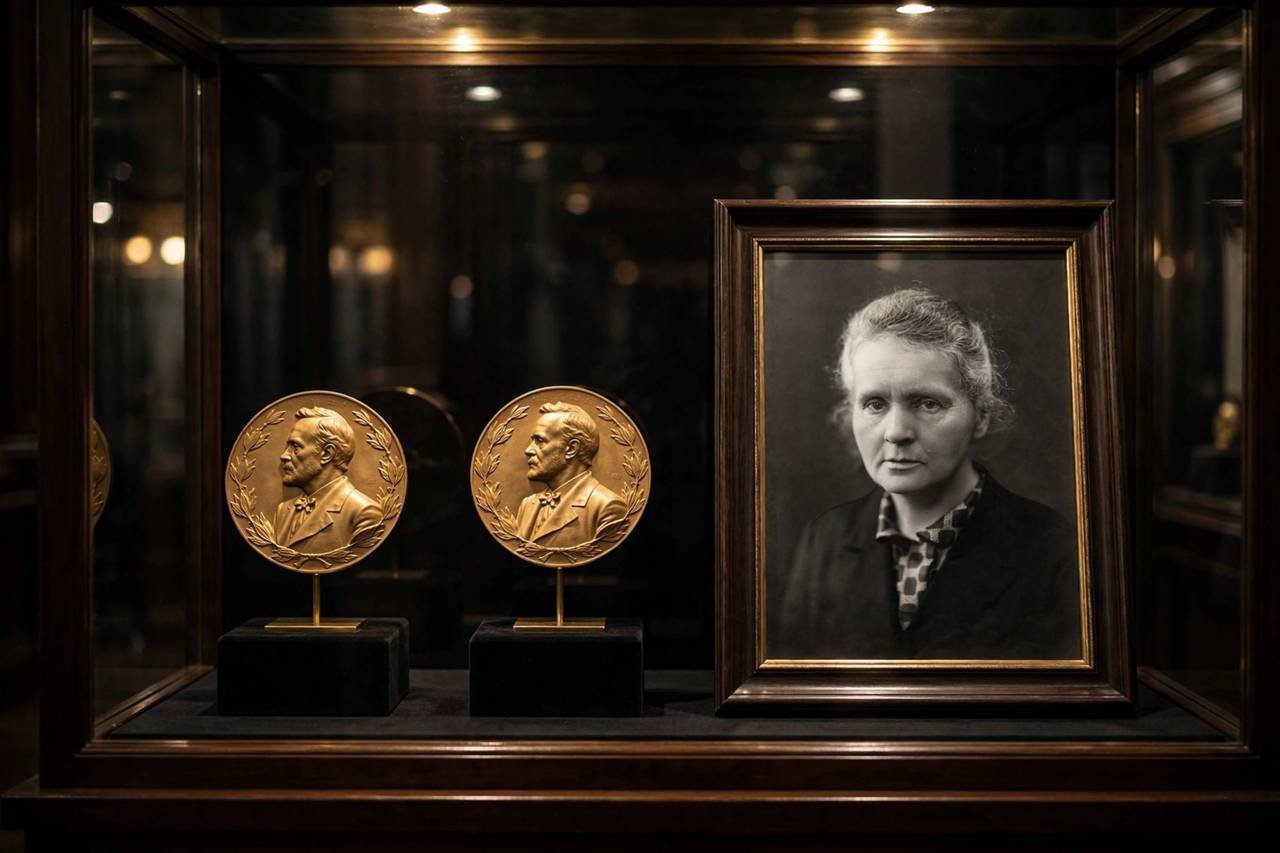
She didn’t retreat into grief or administration. She kept working. In 1911, she won the Nobel Prize in Chemistry — this time as the sole winner, for isolating pure radium and discovering radium and polonium. Two Nobels, two different fields. No woman before or since has done that.
Consider what the 1911 prize meant in context. The 1903 prize had been shared — and shared prizes, fairly or not, invite the question of whose work it really was. The 1911 prize answered it permanently: sole winner, her own discoveries, her own laboratory’s years of grinding chemical separations. The pure radium she isolated wasn’t a theoretical result; it was a physical substance produced by processing tons of pitchblende by hand in a shed. The Nobel committee wasn’t honoring an idea. It was honoring endurance.
The War Years: Mobile X-Ray Units
When World War I broke out, Curie didn’t stay in the lab. She believed X-ray technology could save soldiers’ lives — if it could reach the front. So she built mobile radiography units — vans equipped with X-ray machines — and drove them to the battlefields herself, with her teenage daughter Irène assisting. Picture it: the most famous woman scientist in the world, in her forties, driving a van of X-ray equipment through a war zone, training others to operate it, because the wounded couldn’t come to the machines.
She also raised money for the war effort’s science. In 1929, U.S. President Herbert Hoover presented her with $50,000 to buy radium for a laboratory in Warsaw — her gift back to the Poland she had left nearly forty years earlier. The girl who had worked as a governess to afford her sister’s education was now receiving a presidential gift of radium for her homeland’s science. The arc of that life is almost too neat to be real — except every step of it is documented.
This is the part of the legend people forget: Curie wasn’t just a researcher. She was an organizer, a fundraiser, and — during the war — a field worker under fire. The science mattered to her because it did something.
Death and Legacy
Marie Curie died on 4 July 1934, aged 66. The cause: a radiation-related illness — aplastic anemia, per Britannica — almost certainly the result of decades of unprotected exposure to the rays she had discovered. In her time, nobody knew the danger. She carried radioactive samples in her pockets. Her notebooks are still radioactive today.
She left two daughters: Irène (born 1897) and Ève (born 1904). The Curie family became a scientific dynasty — but that’s a story for another article, because I won’t claim what my sources didn’t open.
The legacy is concrete: two new elements, the founding of radioactivity research, the Curie Institutes, and a proof — delivered in the face of an entire era’s prejudice — that a woman belonged in the laboratory. Not as a symbol. As the best scientist in the room. And every time a student opens a physics textbook and reads the word “radioactivity,” they’re reading her word.
For a very different kind of life story — modern fame told with the same source-checked approach — how MrBeast became famous is the companion read.
5 Myths People Get Wrong About Marie Curie
| Myth | Fact |
|---|---|
| She discovered radiation. | Becquerel discovered the rays in 1896; Curie named the phenomenon radioactivity and explained its atomic nature. |
| She won one Nobel Prize. | She won two — Physics 1903 (shared) and Chemistry 1911 (sole). |
| She worked alone. | Her breakthrough work was done with Pierre Curie; the 1903 Nobel was shared three ways. |
| Her death was unrelated to her work. | She died of aplastic anemia, a radiation-linked illness, after decades of unprotected exposure. |
| She was French. | She was born Maria Skłodowska in Warsaw, Poland; she became a French citizen through marriage and work. |
Frequently Asked Questions
What was Marie Curie’s real name?
She was born Maria Skłodowska in Warsaw, Poland, on 7 November 1867. She became Marie Curie after her marriage to Pierre Curie on 25 July 1895.
Which Nobel Prizes did Marie Curie win?
The 1903 Nobel Prize in Physics (shared with Pierre Curie and Henri Becquerel) and the 1911 Nobel Prize in Chemistry as the sole winner — the first woman to win a Nobel, and the only woman to win in two different fields.
What did Marie Curie discover?
She discovered the elements polonium (1898, named for Poland) and radium, isolated pure radium, and coined the term radioactivity for the phenomenon she explained as coming from the atom itself.
Who coined the word “radioactivity”?
Marie Curie gave the phenomenon its name — Britannica’s account describes the radiation “which she later called radioactivity.” (Primary-source confirmation beyond the Britannica account was not opened for this article.)
How did Marie Curie die?
She died on 4 July 1934 of aplastic anemia, a radiation-related illness almost certainly caused by decades of unprotected exposure to radioactive materials.
Who were Marie Curie’s daughters?
Irène (born 1897) and Ève (born 1904). Irène assisted her mother with the WWI mobile X-ray units as a teenager.