
What Is Natural Language Processing (NLP)? Explained


Every day, you talk to machines that talk back. You ask your phone for directions, type a question into a search box, get an email auto-sorted into spam, watch subtitles appear on a foreign-language video. None of it feels remarkable — until you ask how a machine that thinks in binary could possibly understand English.
That gap — between the rigid precision computers need and the gloriously messy way humans talk — is what natural language processing exists to bridge. One of AI’s oldest dreams, quietly running behind nearly everything you do online. But how did we get from machines that understood nothing to machines that finish our sentences? The story comes in three eras, and it’s a good one.

What Is NLP? (Plain English)
Natural language processing is the branch of artificial intelligence that teaches computers to read, understand, and generate human language. “Natural language” means how people actually talk and write — English, Urdu, Spanish — as opposed to programming languages like JavaScript or Python.
Why It’s Hard: Computers Don’t Speak Human
Here’s the core problem. A programming language is precise: every command means exactly one thing, and ambiguity is a bug. Human language is the opposite: built on ambiguity, and that’s a feature.
Tell a computer “the chicken is ready to eat” and it faces a genuine puzzle — is the chicken the meal, or about to have dinner? You resolve it instantly from context. A computer has no context; it has character strings. Sarcasm, slang, typos, idioms (“raining cats and dogs”), words that shift meaning by sentence (“I saw her duck” — bird or dodge?) — human language is a minefield of exactly what computers handle worst.
So NLP is the science of giving machines enough structure, statistics, and learned pattern to navigate that minefield. Which raises the question: how?
How NLP Works: The Pipeline
Modern NLP processes language in a pipeline — stages that turn messy text into something machine-digestible. Four stages, in order.
1. Text Preprocessing
Raw text is filthy to a computer: capitals, punctuation, filler words, variants. Preprocessing cleans it. Text gets tokenized — split into words or pieces. Everything is lowercased so “Hello” and “hello” match. Stop words — glue words like “the,” “is,” “and” — get filtered. Stemming reduces words to roots, so “running,” “runs,” “ran” collapse toward “run.”
Think mise en place: you don’t cook with muddy vegetables. You wash, peel, chop first. Preprocessing is the washing and chopping of language.
2. Feature Extraction
Cleaned tokens become numbers — machine learning models eat numbers, not words. Each word becomes a numerical representation (a vector) capturing meaning and usage. Words used in similar contexts get similar numbers: how the machine learns “king” and “queen” are related without anyone explaining royalty.
3. Text Analysis
The system analyzes at two levels. Syntactical analysis: structure — grammar, word order, sentence construction. Semantical analysis: meaning — what words refer to, how they relate, what the sentence is about. Both are needed: perfect grammar with nonsense meaning is still nonsense.
4. Model Training
Finally, the model trains on enormous processed text, adjusting internal parameters until it performs its task — sentiment classification, translation, question answering. The apparent magic is just this pipeline at staggering scale, repeated until patterns emerge.
Three Eras of NLP
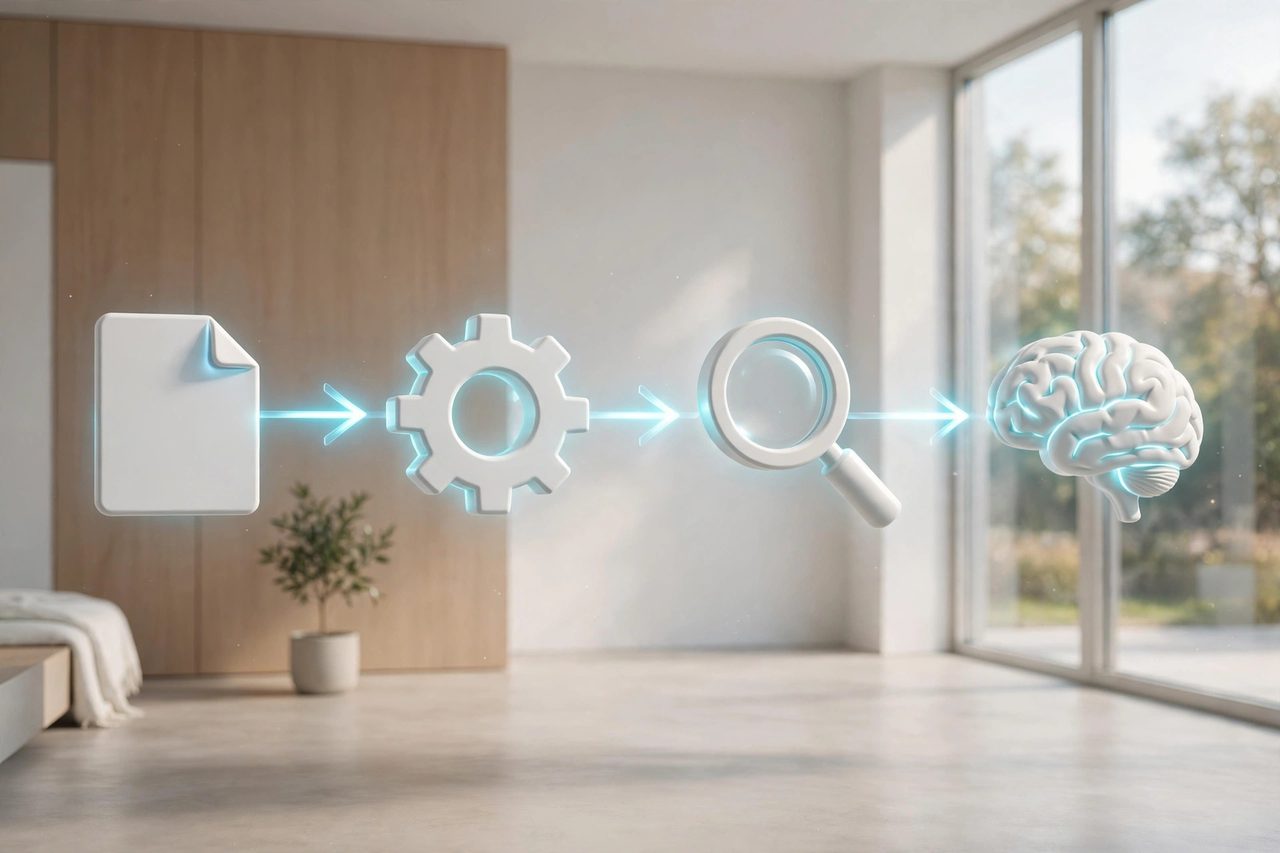
The history of NLP reads like a story of humility — each era thought it had cracked language; each turned out to be a stepping stone.
Era 1: Rules-based systems. Hand-write language rules into the machine: grammar, dictionaries, if-then logic. Worked in narrow domains — collapsed everywhere else, because human language has more exceptions than rules. Linguists spent years encoding rules that real speakers violate before breakfast.
Era 2: Statistical NLP. The great pivot: stop telling the machine the rules; let it learn them from data. Feed it millions of sentences; statistics reveal the patterns. Less elegant than hand-crafted rules, far more effective — it learned language as it actually is, not as grammarians wish it were.
Era 3: Deep learning. Neural networks trained on internet-scale text, learning rich layered representations of meaning. The landmark: models like BERT, which Google applied to search — suddenly engines understood queries, not just keywords. Ask a real question, get a real answer, because the model grasped what you meant.
Three approaches, each less hand-built than the last. The trajectory is unmistakable: we stopped teaching machines language and started letting them absorb it. And notice the pattern — every era’s “solution” became the next era’s baseline. Rules-based systems still handle narrow, predictable corners; statistical methods power the workhorses; deep learning takes the frontier. Nothing was wasted; everything just got a smaller, better-fitting job.
Core NLP Tasks, Explained Simply
“NLP” is an umbrella of specific tasks — sub-problems of understanding language.
Named entity recognition (NER) finds the “proper nouns”: people, places, organizations, dates. “Apple announced a new store in Berlin on Tuesday” → Apple (organization), Berlin (place), Tuesday (date). How news apps know what a text is about.
Part-of-speech tagging labels each word’s grammatical role — noun, verb, adjective. Foundational: you can’t parse structure without knowing which words do what.
Word-sense disambiguation resolves the “saw her duck” problem — which meaning applies. Bank (river or money?), bat (animal or sport?), lead (metal or guide?). Humans do it unconsciously; machines work at it.
Coreference resolution tracks who “he” is: “Sarah met John, and he gave her the report” → “he” is John, “her” is Sarah. Simple for you; tricky for machines across long documents.
Sentiment analysis reads emotional tone — positive, negative, neutral. How companies gauge reaction at scale, and how email spots angry messages.
Stack enough of these, and you start getting something that looks like comprehension.
Everyday Examples of NLP
Voice assistants. Ask Siri for the weather: NLP converts speech to text, detects intent (weather + location), generates a spoken answer. The round trip is NLP end to end.
Search engines. Modern search interprets your question, not just keywords. BERT-era improvements mean Google reads “best pizza open now near me” as a local query with urgency — not a request for pizza history.
Machine translation. Real-time translation between languages: parse the source, capture meaning, regenerate in the target grammar. Imperfect, improving fast.
Spam filters and moderation. Email deciding what’s junk, platforms flagging abuse — NLP classifying text by intent and tone at inhuman scale.
Autocomplete and predictive text. Your keyboard’s next-word suggestions: a tiny language model running NLP on everything you type — trained, in a sense, on you.
Customer-service chatbots. The “how can I help” box classifies your question and routes or answers it. Quality varies; the mechanism is the pipeline above.
Six examples, one technology. And a telling detail about learning: to teach a model what an “orange” is, you don’t write a definition — you show thousands of examples in context, and meaning emerges from the pattern. The deep-learning era in miniature: meaning from exposure, not instruction.
Where is this heading? Generative AI is the sequel — NLP systems powerful enough to create language, not just understand it. Under the hood sits machine learning, the discipline that taught machines to learn from data.

NLP vs NLU vs NLG vs LLMs
The acronym soup confuses everyone.
NLP is the big umbrella: the entire field of machines working with human language. Everything in this article lives under it.
NLU (Natural Language Understanding) is the comprehension slice: parsing meaning, intent, context. Your assistant recognizing “book a table for two” as a restaurant request — that’s NLU.
NLG (Natural Language Generation) is the production slice: data into human-readable text. Auto-written weather reports, sports recaps from game stats — that’s NLG.
LLMs (Large Language Models) are the engines: massive neural networks trained on enormous text datasets, the current best tool within NLP. “NLP vs LLM” is the difference between aviation and an airplane — discipline versus machine.
Challenges and Limits
For all its progress, NLP still stumbles — instructively, because the stumbles reveal what understanding requires. And the failures aren’t random: they cluster exactly where human language leans hardest on being human — shared experience, unspoken context, the things we never say out loud because every listener just knows.
Ambiguity never fully leaves. “I saw her duck” needs context no sentence contains. Humans use world knowledge — how ducks and dodging both work. Machines approximate with statistics, and approximation fails at the edges.
Sarcasm and tone are brutal. “Oh, great job” means its opposite; the signal lives in delivery — vocal tone, expression, shared history. Text-only NLP misses most of it, which is why sentiment analysis confidently misreads sarcastic reviews.
Context and common sense remain the frontier. “The trophy didn’t fit in the suitcase because it was too big” — you know “it” is the trophy, which requires knowing how objects work, not just sentences. Current systems fake this well with patterns; genuine common-sense reasoning is still open.
Honest summary: NLP has mastered language’s form far better than the substance behind it — exactly the tension at the heart of the Turing test.
Curious about the speech side — machines turning text into voice? Our explainer on how AI text-to-speech works covers the reverse journey. And context windows in LLMs explains the memory behind the magic.
Frequently Asked Questions
What is NLP in simple terms?
The AI technology that lets computers read, understand, and generate human language — powering voice assistants, search engines, translation apps, spam filters, and autocorrect. It bridges precise machine logic and messy human speech.
How does natural language processing work?
A pipeline: preprocessing (tokenizing, lowercasing, stop-word removal, stemming), feature extraction (words to numbers), text analysis (syntactical structure and semantical meaning), then model training on large datasets until it performs tasks like translation or sentiment analysis.
What are examples of NLP in daily life?
Voice assistants like Siri, Google Search interpreting questions, machine translation, spam filters, autocorrect, content moderation, and customer-service chatbots. Nearly every text interaction with technology involves NLP somewhere.
What is the difference between NLP and a large language model?
NLP is the whole discipline of machines working with human language; an LLM is a tool within it — the massive neural network trained on huge text datasets powering modern NLP. Aviation versus airplane.
What are the main NLP tasks?
Named entity recognition (people, places, dates), part-of-speech tagging (grammar roles), word-sense disambiguation (ambiguous words), coreference resolution (who pronouns refer to), and sentiment analysis (emotional tone).
Why is NLP hard?
Human language is built on ambiguity — sarcasm, slang, idioms, shifting word meanings — while computers need precision. Resolving meaning needs context and common-sense world knowledge that machines only approximate with statistics.