What Is SWOT Analysis: Definition, Examples & Template


You’ve probably sat in a meeting where someone drew a 2×2 grid on a whiteboard and said “let’s do a SWOT.” Fifteen minutes later the board was full of buzzwords, nobody had learned anything, and the grid went straight into a slide deck nobody opened again. That is not a SWOT analysis. That is decoration.
A real SWOT analysis is a decision tool. Done properly, it tells you what to do next — which opportunities to chase, which threats to hedge against, and which weaknesses are actually worth fixing. Done badly, it’s a list of adjectives. Here is how to do it the right way, starting with what it actually is.

What Is SWOT Analysis?
SWOT analysis is a framework used to evaluate a company’s competitive position and develop strategic planning. It assesses internal and external factors — what you control, what you don’t, and what the market is doing around you.
That definition is worth reading twice, because the whole value of the tool lives in it. SWOT forces you to split the world into two piles: internal (your strengths and weaknesses, things you can change) and external (opportunities and threats, things you respond to). Most bad strategy happens when people mix those piles up — writing “strong economy” as a strength, or “we’re bad at marketing” as a threat. Keep the piles clean and the tool works.
What Does SWOT Stand For? — The 4 Quadrants
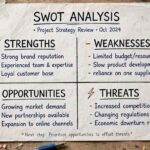
The acronym breaks down into four quadrants, arranged in a 2×2 grid:
Strengths (internal)
What does the business do well? What does it control? Real strengths are verifiable: a recognizable brand, a strong distribution network, a loyal customer base, cash in the bank. “Strong brand” is an adjective line — useless. A verifiable version would name a number (imagine: “95% customer retention for three years”) — that’s a strength.
Weaknesses (internal)
Where are the gaps? What limits the business? Weaknesses are the honest internal problems: limited capital, a thin product line, dependence on one big client, high staff turnover. Same rule — verifiable, not adjectives. “Weak marketing” tells you nothing. A verifiable version would be specific (imagine: “no email list and 100% of traffic from one ad channel”) — that tells you everything.
Opportunities (external)
What favorable conditions exist outside the business? These are things the business doesn’t control but can exploit: a competitor exiting the market, a tariff cut that lowers your costs, a demographic shift, a new sales channel opening up. A drought is a threat to a wheat producer — a sudden price drop in a key raw material is an opportunity.
Threats (external)
What external risks could hurt the business? New competitors, changing regulations, foreign currency swings, a shift in consumer taste toward healthier beverages. Threats exist whether or not you act on them — the only question is whether you see them coming.
Internal vs External: The Only Rule That Matters
Here is the rule that separates a working SWOT from a decorative one:
If you can directly change it, it belongs on the left (Strengths or Weaknesses). If you have to respond to it, it belongs on the right (Opportunities or Threats).
This is the part most teams get wrong. A competitor launching a cheaper product is not a weakness — it’s a threat. Your product being more expensive than the competitor’s is not a threat — it’s a weakness. “Strengths and weaknesses are internal — things the organization controls. Opportunities and threats are external and exist whether or not the organization does.”
Run every line you write through that test. If someone writes “growing market” as a strength, ask: can we directly control the market’s growth? No. It’s an opportunity. If someone writes “we’re understaffed” as a threat, ask: can we hire? Yes. It’s a weakness. This one discipline fixes roughly half of all bad SWOT grids.
Where SWOT Actually Came From
SWOT did not appear overnight in a business textbook. It came out of Stanford Research Institute (SRI) in the 1960s, from a team led by Robert Franklin Stewart. Note that name — Stewart, not the person usually credited.
The popular story says Albert Humphrey invented SWOT. He was a team member, but the research record credits Stewart’s leadership. The framework also wasn’t originally called SWOT. The team’s early version was called SOFT — Satisfactory, Opportunities, Faults, Threats. The acronym SWOT first appeared in print in 1972.
That history matters for a practical reason: SWOT was born in real consulting work with real companies, not in an academic lab. It was designed for managers who needed to make decisions, not for students who needed to pass exams. If you want to dive into the methodology — doing an actual SWOT step by step — the how-to-do-a-swot-analysis guide walks through the process with a practical worksheet angle.

SWOT Analysis Example (Worked, Small Business)
Theory is cheap. Here is a worked example — a fictional illustration (not a real company) showing what verifiable quadrant lines look like. Imagine a small neighborhood coffee roaster that sells beans wholesale and runs one retail cafe:
Strengths (internal, verifiable):
– Direct-trade relationships with several coffee farms; wholesale contracts locking in bean costs below spot-market prices
– Cafe runs near full capacity on weekends; hundreds of strong reviews
– Roaster is paid off — no equipment debt
Weaknesses (internal, verifiable):
– All wholesale revenue depends on 3 clients; the largest is a big share of total revenue
– No online store; all sales are in-person or phone
– One trained roaster — if he quits, roasting stops for months
Opportunities (external):
– Two competitor cafes within walking distance closed this year; foot traffic is redistributing
– Local grocery chain is piloting a local-brands shelf program
– Cold brew demand in the region is growing (third-party category data)
Threats (external):
– Green coffee prices are volatile; a bad harvest season raises everyone’s costs
– Commercial rent renewal is in about a year; the district’s rents have risen sharply in five years
– New national coffee chain announced a location two blocks away
Notice what isn’t on the grid: no “strong brand,” no “great team,” no “growing market.” Every line names something specific. (The numbers in a real grid would be your company’s actual figures — that’s what makes it falsifiable.) When your own grid looks like this — boring, specific, verifiable — you have a real SWOT.
How to Do a SWOT Analysis (5 Steps)
- Gather a diverse team, not a like-minded one. SWOT “works best when diverse groups provide realistic data points rather than prescribed messaging.” Get the salesperson, the accountant, and the warehouse person in the same room. Each sees a different half of the business.
- Collect internal data first. Revenue mix, customer retention, costs, capacity numbers. Opinions are allowed later; numbers come first.
- Fill each quadrant with falsifiable lines. Falsifiable means someone could prove it wrong: “our shipping costs rose 12% last year” is falsifiable; “great logistics” is not.
- Cross-check every line through the internal/external test. Anything you can’t change moves to the right side. Anything the market hands you can’t be on the left.
- Use it as a guide, not a prescription. The tool’s job is to sharpen your thinking, not to hand you an answer. Pairs become strategy in the TOWS step below — but the grid itself doesn’t make decisions; you do.
This process connects directly to the rest of your planning. A finished SWOT feeds naturally into your small-business-marketing-strategies and into how-to-write-a-marketing-plan, because both need the honest picture the SWOT produces.
Common SWOT Mistakes
The failure patterns, documented in the framework’s own research literature:
- Adjective lines. “Strong brand,” “weak presence,” “great team.” Adjectives are opinions. If you can’t falsify it, it doesn’t belong on the grid.
- Perfectly symmetrical boxes. Four items in every quadrant is a sign someone was balancing the grid, not analyzing the business. Real businesses have more threats than strengths sometimes. Let the grid be lopsided.
- Opportunities that are actually strengths. “We have a great product” is not an opportunity. If the business already owns it, it’s internal. This is the internal/external test again.
- Stopping at the grid. A completed grid is a diagnosis, not a treatment plan. The most common real-world outcome of a SWOT session is a photographed whiteboard that changes nothing. The TOWS step below is how you avoid that.
- Only strengths and wish lists. Some teams fill the grid with strengths and opportunities and one lonely “weakness.” That isn’t analysis — it’s a pitch deck.
If you’re comparing approaches to market thinking, the b2b-vs-b2c-marketing-strategies comparison is a useful companion — it shows how the same honest assessment changes when your customer is another business rather than a consumer.
After the Grid: The TOWS Matrix (Turn It Into Strategy)
Here is where the grid becomes a strategy. The TOWS matrix, developed by Heinz Weihrich in 1982, pairs internal and external factors into four action zones:
- S×O (Strengths + Opportunities): How do your strengths let you capture this opportunity? Example: the roaster’s direct-trade relationships (strength) + the local-brands grocery shelf program (opportunity) → pitch the grocery chain with a cost story competitors can’t match.
- W×O (Weaknesses + Opportunities): How do you fix this weakness to capture this opportunity? Example: no online store (weakness) + redistributing foot traffic (opportunity) → launch online ordering now, before competitors settle into the gap.
- S×T (Strengths + Threats): How do your strengths defend against this threat? Example: paid-off equipment and cash reserves (strength) + rising rent (threat) → negotiate a long lease now, funded by the balance sheet.
- W×T (Weaknesses + Threats): What must you fix so this threat doesn’t kill you? Example: 40% revenue dependence on one client (weakness) + volatile coffee prices (threat) → diversify clients and hedge bean costs before a bad season.
Each pairing is a candidate strategy. Evaluate them for cost and impact, pick two or three, and you have a plan built from analysis, not someone’s gut. That’s the whole point.
SWOT vs Other Frameworks (PESTEL, Five Forces)
When is SWOT enough, and when do you need something heavier? The framework literature is clear: SWOT is the starting lens, not the only lens.
PESTEL (Political, Economic, Social, Technological, Environmental, Legal) is the zoom lens for the external side of your grid. If your threats and opportunities sections feel thin, run a PESTEL and you’ll find five or six you missed.
Porter’s Five Forces is the zoom lens for competitive threats specifically — supplier power, buyer power, new entrants, substitutes, and rivalry. If your threat quadrant is just “competitors,” Five Forces will make it precise.
Use SWOT when you need a fast, complete picture of one business. Use the deeper tools when one quadrant — usually the external side — is where the real questions live. And when the external analysis points at customers, make the next cut: what market segmentation is shows how to split that market into distinct layers you can actually act on.
Frequently Asked Questions
What does SWOT stand for?
SWOT stands for Strengths, Weaknesses, Opportunities, and Threats. Strengths and weaknesses are internal factors the organization controls; opportunities and threats are external factors it responds to.
What are the 4 parts of a SWOT analysis?
The four parts are Strengths (internal advantages), Weaknesses (internal gaps), Opportunities (external favorable conditions), and Threats (external risks) — arranged in a 2×2 grid.
What is the difference between internal and external factors in SWOT?
Internal factors are things the organization directly controls and can change (strengths and weaknesses). External factors exist whether or not the organization does — it can only respond to them (opportunities and threats).
Who invented SWOT analysis?
SWOT grew out of research at Stanford Research Institute in the 1960s, from a team led by Robert Franklin Stewart. The framework was originally called SOFT (Satisfactory, Opportunities, Faults, Threats), and the SWOT acronym first appeared in print in 1972.
What is a SWOT analysis example for a small business?
A small coffee roaster might list strengths like paid-off equipment and near-full weekend cafe capacity, weaknesses like depending on 3 wholesale clients, opportunities like closed competitors redistributing foot traffic, and threats like volatile coffee prices and rising rent.
What is the TOWS matrix and how is it different from SWOT?
The TOWS matrix (developed by Heinz Weihrich in 1982) turns a SWOT grid into strategy by pairing factors: Strengths-Opportunities, Weaknesses-Opportunities, Strengths-Threats, and Weaknesses-Threats. SWOT diagnoses; TOWS prescribes.