How to Do a SWOT Analysis That Actually Drives Strategy

Every business decision is a bet, and most bets are placed blind. The SWOT analysis is one of the simplest tools ever created for removing the blindfold: four boxes, honest answers, and suddenly your strategy has a foundation instead of a feeling. I’ve used it with startups, established companies, and solo founders, and it works every time — but only if you do it right. Most people don’t. They fill the boxes with vague fluff and wonder why nothing changes. Here’s how to do a SWOT analysis that actually drives decisions.
What a SWOT Analysis Is (And Isn’t)
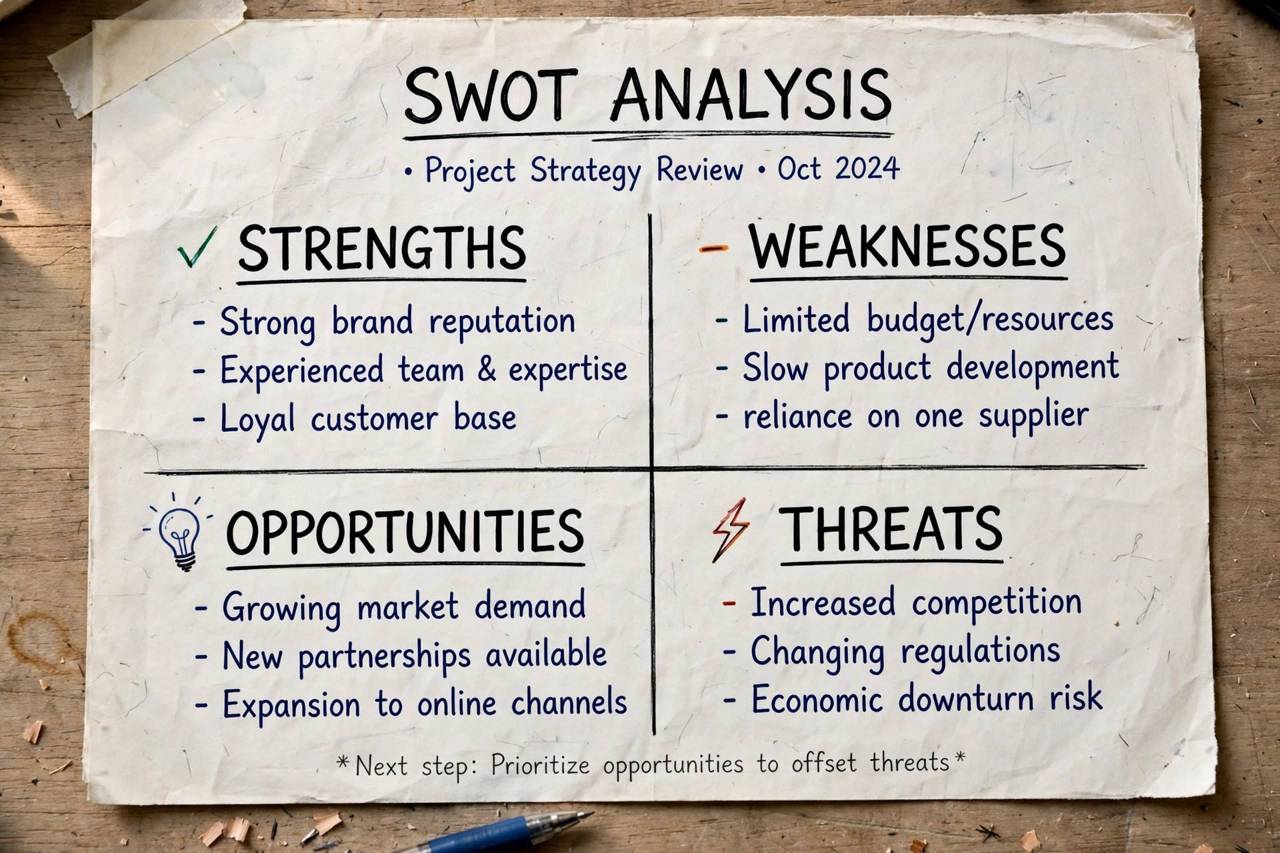
SWOT stands for Strengths, Weaknesses, Opportunities, and Threats. Strengths and weaknesses are internal — things about your business you control. Opportunities and threats are external — market conditions, competitors, trends, regulations — things happening around you that you must respond to.
What it isn’t: a formality to stick in a business plan appendix. A SWOT done properly is a working document that directly feeds your strategy. If your SWOT doesn’t change at least one decision, you did it wrong. The whole point is to convert insight into action: double down on strengths, fix or work around weaknesses, pursue the best opportunities, and defend against the real threats.
It’s also worth knowing what SWOT doesn’t do: it doesn’t prioritize for you, it doesn’t quantify anything, and it won’t make the decision itself. It’s a clarity tool, not an oracle. Pair it with actual strategic thinking — which is exactly what I’ll show you below.
Before You Start: Set Up for Honest Answers
The quality of your SWOT is entirely determined by the honesty of the inputs. A few setup rules:
- Get the right people in the room. Founders see the vision; frontline staff see the reality. Include people who talk to customers daily — they know your weaknesses better than anyone.
- Bring data, not just opinions. Sales figures, customer feedback, competitor pricing, market trends. Opinions are fine, but anchor them in evidence wherever possible.
- Ban vague language. “Good team” is not a strength. “A support team with a 98% satisfaction rating and 2-minute average response time” is. Specificity is what makes the analysis usable.
- Think from the customer’s perspective. Your strengths are only strengths if customers value them. Your weaknesses are only weaknesses if they cost you business.
Step 1: Identify Your Strengths (Internal, Positive)
Strengths are the internal capabilities and resources that give you an edge. Ask:
- What do we do better than competitors?
- What do customers consistently praise us for?
- What unique resources do we have — expertise, technology, relationships, brand, location, patents, processes?
- What’s our unfair advantage — the thing competitors can’t easily copy?
Be ruthless about what’s genuinely distinctive versus what’s merely adequate. “We care about customers” is not a strength — everyone claims that. “We have a 10-year exclusive supply agreement that locks in 30% lower costs than competitors” is a strength. If you’re struggling to find real strengths, that’s itself a critical finding.
Step 2: Identify Your Weaknesses (Internal, Negative)
This is where most SWOTs fail — people soften, hedge, or skip. Don’t. An honest weakness list is the most valuable part of the exercise because weaknesses are the things you can actually fix.
- Where do we consistently lose to competitors, and why?
- What do customers complain about?
- What resources are we missing — skills, capital, technology, capacity?
- Where are our processes slow, expensive, or unreliable?
- What would we fix first with unlimited budget? (That answer is your real weakness list.)
Frame weaknesses as gaps to close, not confessions. “Our website converts at half the industry rate” is a weakness that points directly to an action. Vague self-criticism helps no one; specific gaps create roadmaps.
Step 3: Identify Opportunities (External, Positive)
Opportunities are external trends and conditions you can exploit. Look at:
- Market trends: shifting customer preferences, growing segments, emerging needs.
- Competitor gaps: where rivals are weak, slow, or absent.
- Technology shifts: new tools or platforms that change what’s possible.
- Regulatory changes: new rules that favor your model or hurt competitors’.
- Partnerships and channels: new ways to reach customers you couldn’t access before.
The discipline here: only list opportunities you can realistically pursue given your strengths. An opportunity you can’t execute on isn’t an opportunity — it’s a distraction. The magic of SWOT is matching external openings to internal capabilities, which brings us to the step most people skip.
Step 4: Identify Threats (External, Negative)
Threats are external forces that could hurt you:
- New or aggressive competitors
- Changing customer preferences moving away from what you offer
- Economic downturns affecting your customers’ spending
- Regulatory changes that raise your costs or restrict your model
- Technology that could make your offering obsolete
- Supply chain vulnerabilities
Be specific and probabilistic. “Competition” is not a threat; “a well-funded competitor launching a lower-priced alternative in Q3” is. Rank threats by likelihood and impact — you can’t defend against everything, so focus on the probable and the severe.

How to Do a SWOT Analysis, Step 5: The TOWS Matrix Most People Skip
Here’s where a SWOT becomes a strategy. The TOWS matrix crosses your quadrants to generate actual strategic options:
- Strengths + Opportunities (SO): How can you use your strengths to capture the best opportunities? These are your offensive plays — the highest-priority strategies.
- Weaknesses + Opportunities (WO): Which weaknesses must you fix to pursue key opportunities? These become your improvement priorities.
- Strengths + Threats (ST): How can your strengths defend against the biggest threats? These are your defensive moats.
- Weaknesses + Threats (WT): Where are you doubly exposed — weak internally against a serious external threat? These are your survival priorities; they need contingency plans.
Work through each combination and write down 2-3 concrete actions per quadrant. A SWOT with twelve specific actions is infinitely more valuable than a SWOT with forty vague bullet points. This is the difference between analysis and strategy.
A Worked Example: A Local Coffee Shop
Let me make this concrete with a fictional example — a neighborhood coffee shop I’ll call Corner Brew:
Strengths: prime corner location with foot traffic, a barista team with competition-level skills, a loyal base of 400+ regulars, and the only commercial-grade espresso setup within a mile.
Weaknesses: no online ordering system, limited seating (18 seats), higher prices than the chain two blocks away, and the owner does all the bookkeeping manually.
Opportunities: the new office building opening across the street (200+ potential daily customers), growing demand for specialty beans to brew at home, and a local food-delivery app expanding into the neighborhood.
Threats: the chain store’s aggressive discounting, rising commercial rents in the area, and increasing wholesale coffee prices.
Now the TOWS actions: SO — launch a “new office welcome” corporate catering and subscription program using the skilled barista team. WO — implement online ordering before the office building opens (fix the weakness to capture the opportunity). ST — double down on the specialty experience the chain can’t match: cuppings, single-origin rotations, barista craft. WT — negotiate a longer lease now before rents rise further, and hedge coffee costs with forward contracts.
See how each action is specific, tied to the analysis, and clearly worth doing? That’s a working SWOT — and exactly what happens when you learn how to do a SWOT analysis properly instead of just filling in boxes.
Common SWOT Mistakes That Waste Everyone’s Time
- Listing features instead of strategic factors. “We have a website” is not a strength. Strengths must be relative advantages.
- Confusing internal and external. “Poor management” is a weakness (internal), not a threat. “New competitor” is a threat (external), not a weakness. The distinction matters because you fix weaknesses but adapt to threats.
- Too many items, no priorities. Twenty strengths means you have no idea what your real strengths are. Force-rank: top 3-5 per quadrant, maximum.
- Doing it once and filing it. Markets move. Revisit quarterly, or whenever something significant changes. A stale SWOT is worse than none — it gives false confidence.
- No owners or deadlines on actions. An action without an owner and a date is a wish. Assign both before leaving the room.

Using SWOT in Your Business Plan
A SWOT analysis fits naturally into the market analysis or strategy section of a business plan — it shows lenders and investors that you understand your competitive position honestly, which builds credibility. But keep the plan version concise: the full working analysis stays internal, and the plan gets the sharp summary plus the key strategic actions.
If you’re building or refining your plan, my step-by-step guide on how to write a business plan shows exactly where the SWOT fits and how to present it. And since competitive positioning is half the battle, understanding B2B vs B2C marketing strategies will sharpen the opportunity side of your analysis considerably.
FAQ
How often should a business do a SWOT analysis?
At least annually as part of strategic planning, and quarterly for fast-moving businesses or startups. Also do one whenever something significant changes — a new competitor, a market shift, a major win or loss. A SWOT is a snapshot; retake the photo when the landscape changes.
Who should be involved in a SWOT analysis?
Include leadership plus people close to customers and operations — sales, support, and frontline staff see realities that executives miss. For a solo business, do it yourself but pressure-test it with a mentor or peer who’ll be honest with you.
What’s the difference between SWOT and TOWS?
SWOT identifies the four factors; TOWS crosses them to generate strategies (Strengths-Opportunities, Weaknesses-Opportunities, Strengths-Threats, Weaknesses-Threats). Think of SWOT as the diagnosis and TOWS as the treatment plan. Most people stop at diagnosis — don’t.
Can I do a SWOT analysis for personal career planning?
Absolutely — it’s an excellent personal tool. Your strengths and weaknesses are your skills and gaps; opportunities and threats are market demand, industry trends, and competition for roles. The TOWS combinations then become your career development plan.
What are the limitations of SWOT analysis?
SWOT doesn’t prioritize, quantify, or decide — it organizes. It can also oversimplify complex dynamics and reflect the biases of whoever’s in the room. Use it as a starting framework paired with data and honest debate, not as a substitute for strategic thinking.