

Golf humbled me faster than any sport I’ve ever tried. I walked onto a course as a college athlete who could throw a ball 60 yards and figured the learning curve would be gentle. My first round: 118. My playing partner, a 68-year-old retiree with a swing like a metronome, shot 84 and never broke a sweat. I sat in the cart afterward and did what I always do — opened my notebook.
Fifty rounds later, I shoot in the low 90s, and the notebook is full. Not with swing theory — with the practical stuff that actually moves the needle for beginners. Golf is a weird game: the difference between a 110 and a 95 isn’t talent, it’s about fifteen small decisions. Here are the tips that made the biggest difference, in the order I wish someone had given them to me.
Table of Contents
- Tip 1: Get Lessons Before You Build Bad Habits
- Tip 2: The Grip Is Everything
- Tip 3: Start Every Session With the Short Clubs
- Tip 4: Half Your Practice Time Goes to Putting
- Tip 5: Learn the Scoring System First
- Tip 6: Swing at 70 Percent
- Tip 7: One Swing Thought, Maximum
- Tip 8: Etiquette Isn’t Optional
- Tip 9: Play the Right Tees
- Tip 10: Keep the Ball in Play
- Tip 11: Manage Your Misses
- Tip 12: Track Everything
- Frequently Asked Questions
Tip 1: Get Lessons Before You Build Bad Habits
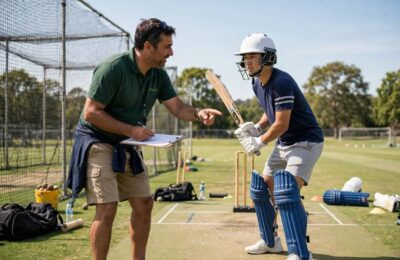
This is the tip I resisted and regret resisting. Three lessons with a local pro cost me less than a new driver, and they were worth ten times more. Here’s why: golf is a sequence of precise movements, and once you groove a bad one, unlearning it takes months.
I spent twenty rounds teaching myself a slice. A pro watched two swings, moved my left hand a quarter inch, and it was gone — four minutes to fix what I’d fought for months.
You don’t need a long-term coaching relationship. Three to five lessons, focused on grip, posture, and the basic swing, will save you a year of frustration. Group clinics at municipal courses are cheap and honestly great for beginners.
Tip 2: The Grip Is Everything
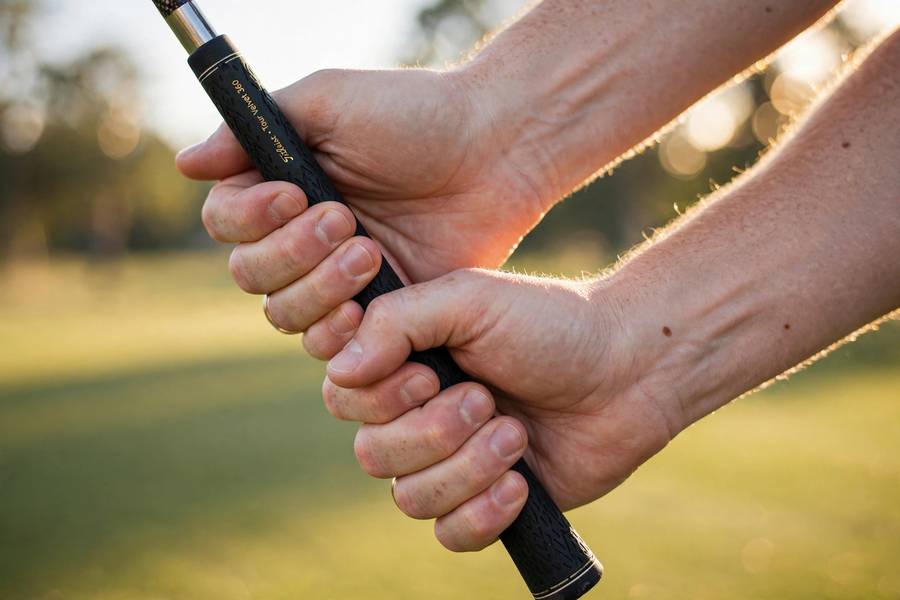
If you remember one technical thing from this article, make it this: 90 percent of beginner swing problems trace back to the grip. Slice? Grip. Hook? Grip. Inconsistent contact? Grip.
The neutral grip: place the club in your fingers (not your palm) of your lead hand, wrap your trail hand over, and you should see two to three knuckles on your lead hand at address. Your thumbs point down the shaft. Squeeze like you’re holding a tube of toothpaste without squeezing any out — firm enough to control, soft enough to feel.
I practiced my grip watching TV for two weeks. My wife thought I’d lost it. My ball striking thought otherwise. It’s the cheapest drill in golf — zero cost, zero range balls, enormous payoff.
Tip 3: Start Every Session With the Short Clubs
The range is full of beginners grabbing the driver and swinging for the fences. It’s fun and it’s useless. Short clubs teach you contact; contact teaches you everything else.
My range routine, stolen from a teaching pro: start with a pitching wedge, hit 20 balls at half swing. Move to a 7-iron, 20 balls at three-quarter swing. Only then touch the long clubs. By the time you get to the driver, your body already knows what solid contact feels like.
The numbers back this up. In my notebook, I tracked my “clean contact percentage” — shots that felt pure off the clubface. Wedge-first warm-ups: 70 percent clean. Driver-first warm-ups: 40 percent. Same golfer, same day, different order.
Tip 4: Half Your Practice Time Goes to Putting
On a par-72 course, 36 of those strokes are allocated to two putts per hole. Half the game is putting. Beginners spend 90 percent of practice on the range and 10 percent on the green. That ratio is backwards.
I started spending half my practice time on the putting green, and my scores dropped faster than at any other point. You don’t need a fancy drill: putt 20 balls from 3 feet (build the confidence), 20 from 10 feet (build the feel), 20 from 25 feet (build the lag). That’s a complete putting session in twenty minutes.
Also: most beginners read greens like they’re reading a mystery novel. Keep it simple. Look at the general slope, pick a target, commit. Indecision putts worse than bad reads.
Tip 5: Learn the Scoring System First
I played my first three rounds without fully understanding scoring, which is embarrassing to admit. Pars, birdies, bogeys, handicaps — if you don’t know what the numbers mean, you can’t set goals or track progress.
Quick version: each hole has a par (usually 3, 4, or 5) — the number of strokes an expert should take. One over par is a bogey, two over is a double bogey, one under is a birdie. Your total score is strokes, plain and simple. Lower wins.
If you want the full breakdown, I wrote a deeper explainer on how golf scoring works — handicaps, stableford, match play, the works. Learn it early; it makes every round more fun because you’ll know exactly what you’re chasing.
Tip 6: Swing at 70 Percent
Every beginner swings too hard. I did. You probably do. Here’s the physics: clubhead speed matters, but centered contact matters more. A smooth 70-percent swing with the ball hitting the sweet spot goes farther and straighter than a violent 100-percent swing that catches the heel.
My pro gave me the best cue I’ve ever heard: “Swing like you’re trying to throw the clubhead at the target, not like you’re trying to kill the ball.” When I swing easy, I carry my 7-iron 150 yards. When I swing hard, I carry it 140 and it’s in the trees. The numbers don’t lie — smooth wins.
Test it yourself: hit ten balls at full effort, ten at 70 percent. Measure which group goes farther on average. I’ll wait.
Tip 7: One Swing Thought, Maximum
Golf instruction is a firehose: keep your head down, shift your weight, don’t bend the elbow, rotate the hips, follow through. Try to think about all of that during a two-second swing and you’ll freeze like a computer with too many tabs open.
Pick one thought per round. “Slow takeaway.” “Finish the swing.” “Head steady.” That’s it. When I limited myself to one cue, my consistency jumped immediately — because a relaxed golfer with one thought beats a tense golfer with eight.
Rotate the thought as things improve. Once “slow takeaway” is automatic, pick the next one. Golf improvement is a queue, not a pile.
Tip 8: Etiquette Isn’t Optional
Golf has more unwritten rules than any sport I know, and beginners who ignore them get the cold shoulder fast. The essentials:
- Pace of play: keep up with the group ahead. If you’re falling behind, let faster players through. Nothing annoys golfers more than a slow group.
- Quiet during swings: when someone’s hitting, you’re a statue. No talking, no moving, phone on silent.
- Repair the course: fix your divots, rake bunkers, repair ball marks on greens. Leave it better than you found it.
- Don’t walk in putting lines: the invisible path between someone’s ball and the hole is sacred ground. Walk around it.
I learned most of this by watching and by one awkward moment on a green that I won’t describe. Learn it from this list instead.
Tip 9: Play the Right Tees
Ego is the most expensive club in the bag. Beginners who play from the back tees turn a fun game into a punishment. A 6,800-yard course is a different sport than a 5,800-yard course.
Rule of thumb: play tees where you can reach most par-4 greens in two good shots. For most beginners, that’s the forward or middle tees. There’s zero shame in it — even good players move up when they want to score.
My scores dropped eight strokes the round I swallowed my pride and moved up a tee box. Eight strokes, one decision, zero practice. Best tip on this list by ROI.
Tip 10: Keep the Ball in Play
Beginners lose strokes to penalties, not to bad swings. Out of bounds, water hazards, lost balls — each one costs at least a stroke, often two. The math is brutal: one penalty per hole turns an 85 into a 103.
Play away from trouble. Aim at the wide part of the fairway, not the flag tucked behind a bunker. Take one more club and swing easy instead of forcing a hero shot. My notebook has a stat I call “penalty strokes per round.” When it’s zero, I break 90. When it’s three or more, I don’t. Boring golf is good golf.
Tip 11: Manage Your Misses
You’re going to miss. Everyone does — pros miss greens, pros miss fairways. The difference is that good players miss in the right places.
Before every shot, ask: “Where’s the bad miss?” If the water is left, aim right. If the bunker guards the front, take enough club to fly it. Golf isn’t about hitting perfect shots; it’s about making your bad shots survivable.
I keep a mental “miss map” for my home course — where I tend to miss on each hole and where it’s safe to miss. It took ten rounds to build and it saves me three to four strokes every round. Course management is free strokes.
Tip 12: Track Everything
Last tip, and the one that ties everything together: you can’t improve what you don’t measure.
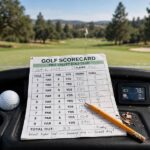
Track these per round: fairways hit, greens in regulation, putts, penalty strokes. That’s four numbers. After ten rounds, patterns scream at you. My data showed I was losing six strokes a round inside 100 yards — so I practiced wedges for a month and dropped five strokes. Without the numbers, I’d have blamed my driver and practiced the wrong thing.
A free scorecard app does this automatically. Five seconds per hole. The return on those five seconds is enormous.
Off the course, a little athletic prep goes a long way: bodyweight exercises for a stronger swing built my rotation strength, and I swear by the best time of day to exercise for planning range sessions around work.

Frequently Asked Questions
Most beginners break 100 within their first year playing regularly (weekly rounds plus some practice), and break 90 in year two or three. Lessons early on compress this dramatically — golfers who take 3 to 5 lessons in their first month improve roughly twice as fast as self-taught players.
A half set is plenty: driver, hybrid, 7-iron, 9-iron, pitching wedge, sand wedge, and putter. You don’t need a full 14-club set — fewer choices mean fewer bad decisions. Buy used; beginners outgrow or upgrade within two years, so don’t overspend early.
Check your grip first — a weak grip (hands rotated too far left for right-handers) causes most slices. Then check your swing path: an over-the-top, outside-to-in path cuts across the ball. A pro can diagnose both in minutes. Short-term fix: aim left and swing easy; long-term fix: lessons before the slice becomes muscle memory.
Both, in roughly a 50-50 split. The range builds the swing; the course builds scoring, course management, and comfort under pressure. Beginners who only hit the range often fall apart on real holes. Play short courses and par-3 courses early — they’re cheaper, faster, and perfect for learning.
Breaking 120 is a solid first milestone, breaking 110 is genuinely good for a first-year player, and breaking 100 puts you ahead of most casual golfers. Don’t compare yourself to the scratch golfer in your group — compare yourself to your own scores from a month ago.
A used half set runs $150 to $300, lessons $40 to $80 each, and municipal course rounds $25 to $60. Budget around $500 to $800 for a solid first season. It’s not a cheap sport, but municipal and twilight rates keep it reasonable while you’re learning.