How to Exercise With Limited Time: The Mini-Workout Strategy


The question of how to exercise with limited time usually comes from someone staring at a calendar with no gaps in it. I hear it constantly: “I know I should work out, but I genuinely have twenty minutes a day, max.” Here is what I tell them: twenty focused minutes beats sixty distracted minutes, and three ten-minute sessions beat one skipped gym trip. The research on exercise “snacking” — short bouts spread through the day — keeps showing that accumulated short sessions deliver real fitness benefits. This guide is the mini-workout strategy I give busy clients: three-minute bursts, compound movements, and daily stacking that turns scraps of time into genuine training.
First, reset the mental model. You do not need an hour, a gym, or a perfect plan. You need consistency with the time you actually have. Ten minutes done daily will change your body more than a heroic two-hour session done twice a month.
The 3-Minute Burst: Your Core Unit
Three minutes is short enough to fit anywhere — between meetings, while dinner cooks, during a TV ad break. And three minutes of real effort is a legitimate training stimulus. The formula:
- Pick one compound movement (squats, push-ups, lunges, rows — more on these below).
- Work 40 seconds, rest 20 seconds, repeat 3 rounds. That is three minutes.
- Go hard enough that the last round is genuinely difficult. Easy three minutes is just fidgeting.
Do two or three of these bursts in a day and you have banked six to nine minutes of quality work. Do it daily and you have a real program.
Compound Movements: Maximum Return Per Minute
When time is scarce, isolation exercises are a luxury you cannot afford. Compound movements work multiple muscle groups at once, which means more stimulus per minute. Your shortlist:
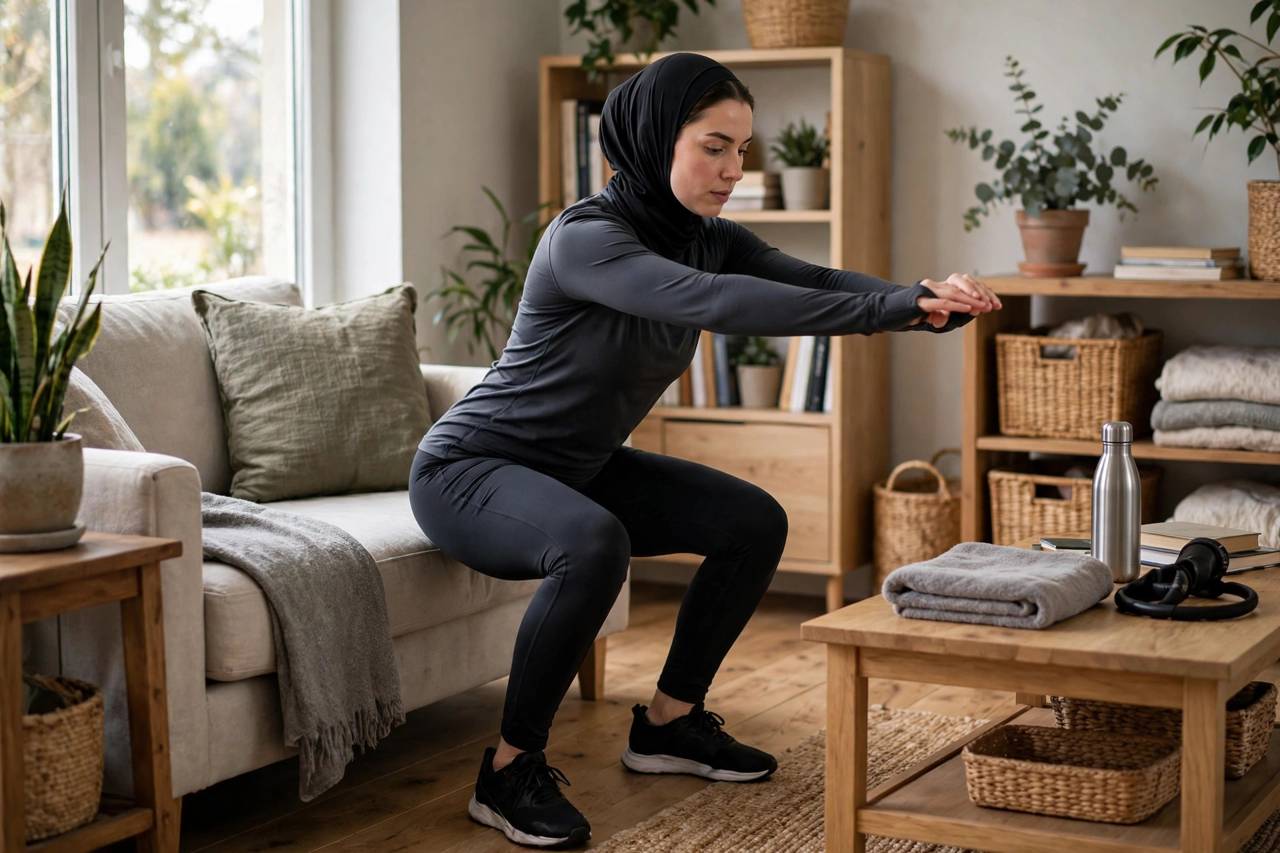
- Goblet squats or bodyweight squats: legs, glutes, core. The king of time-efficient training.
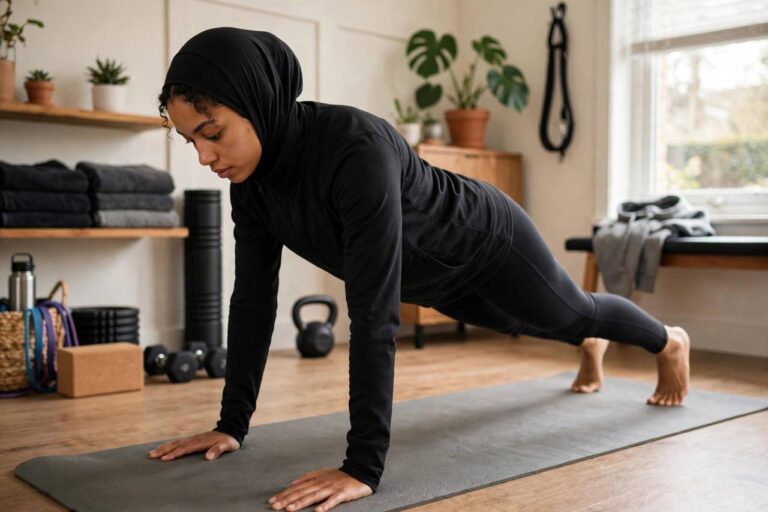
- Push-ups: chest, shoulders, triceps, core. Elevate hands to make them easier, feet to make them harder.
- Dumbbell rows or resistance-band rows: back and biceps — the pulling most home routines miss.
- Reverse lunges: legs and balance, easier on the knees than forward lunges.
- Plank variations: core stability in sixty seconds flat.
- Burpees or squat thrusts: when you want cardio and strength in one miserable, effective package.
With just a pair of dumbbells and your bodyweight, you can rotate through these indefinitely.
Daily Stacking: Attach Exercise to Habits You Already Have
The reason busy people fail is not laziness — it is decision fatigue. Stacking removes the decision by attaching movement to an existing trigger:
- Morning coffee brews → 3-minute squat and push-up burst. The coffee takes four minutes. You have time.
- Lunch break → 10-minute walk. Non-negotiable, like brushing your teeth.
- TV episode starts → plank during the opening credits.
- Kids’ bath time / dinner in the oven → one dumbbell circuit.
- Every bathroom break → 10 bodyweight squats. Sounds silly. Adds up to 50–80 squats a day.
Write your stacks down. “After I [existing habit], I will [3-minute movement]” — that specific format, called an implementation intention, is one of the most reliable behavior-change tools researchers have found.
How to Exercise With Limited Time: A Sample 15-Minute Week
- Monday: 3-min squat burst + 3-min push-up burst + 3-min plank (9 min) + 6-min walk.
- Tuesday: 10-min brisk walk + 5-min lunge and row circuit.
- Wednesday: 3-min burpee ladder + 3-min squat burst, twice through (12 min).
- Thursday: 15-min walk with 5 x 30-second faster intervals.
- Friday: 3-min push-up burst + 3-min row burst + 3-min plank (9 min) + 6-min walk.
- Saturday: one longer session if life allows — 25–30 minutes, anything you enjoy.
- Sunday: easy walk or full rest.
That is roughly 100 minutes of real training across the week — comfortably inside the 150 minutes of moderate activity that public health guidelines recommend, with room to grow. Adjust the days to fit your life; the structure matters more than the calendar.
When You Get a Bigger Window, Use It Well
Some weeks hand you a free Saturday morning. Do not waste it on random exercise — do a full-body circuit: squats, push-ups, rows, lunges, plank, 3 rounds, minimal rest. Thirty minutes, everything covered. For ideas on structuring those bigger sessions, my workout routines for beginners guide has full templates. And timing your sessions around your energy peaks helps too — see the best time to exercise for how to pick your slot.
Mistakes Busy People Make
- All-or-nothing thinking: “I only have ten minutes, so why bother.” Ten minutes bothers. A lot.
- Only doing cardio: short on time, people default to running. Keep at least half your mini-workouts strength-based — muscle is what keeps your metabolism and joints healthy.
- No progression: add a rep, a round, or a harder variation every week or two. Same effort forever means same results forever.
- Skipping warm-up: even ninety seconds of leg swings and arm circles before intense bursts. Cold tendons and burpees are a bad mix.
What the Research Says About Short Workouts
You do not have to take my word for it. Studies on “exercise snacking” — brief bouts of vigorous activity spread through the day — have found meaningful improvements in cardiorespiratory fitness and blood sugar control from sessions as short as a few minutes. Research on high-intensity interval training has repeatedly shown that short, hard efforts can produce cardiovascular adaptations comparable to much longer moderate sessions. And large cohort studies keep finding that total weekly activity volume predicts health outcomes far better than session length. The science is unusually clear on this one: the barrier was never time. It was the belief that short does not count. It counts.
The 10-Minute No-Equipment Full-Body Circuit
When you have exactly ten minutes and zero equipment, run this circuit twice through. Forty seconds of work, twenty seconds of rest, move to the next exercise:
- Bodyweight squats — legs and glutes.
- Push-ups (knees or incline if needed) — chest, shoulders, triceps.
- Reverse lunges, alternating — legs and balance.
- Plank hold — core.
- Glute bridges — posterior chain, the desk-worker antidote.
One round is five minutes; two rounds is ten. Write down your total reps each time and beat it next week — that is progressive overload, and it works with bodyweight just as it does with barbells.
Strength vs. Cardio: How to Split Tiny Windows
With limited time, people usually pick one and neglect the other. Here is the split I recommend:
- If you have 10 minutes, 3x per week: make two sessions strength (the circuit above) and one cardio (brisk walk with intervals, or a burpee/jumping-jack ladder). Strength first, because muscle is harder to build and easier to lose.
- If you have 10 minutes daily: alternate — strength Monday/Wednesday/Friday, brisk walking or intervals Tuesday/Thursday/Saturday, rest Sunday.
- If you only have 5 minutes: strength. A five-minute squat and push-up circuit preserves more long-term health than five minutes of jogging, because muscle mass is the thing that declines fastest with age and inactivity.
Recovery When Your Schedule Is Packed
Short workouts still create fatigue, and busy people are usually under-slept too — a bad combination. Protect the minimums: seven hours of sleep if you can get it, protein at each meal (your muscles cannot rebuild without it), and one genuinely easy day per week. Soreness that lasts more than 72 hours means you did too much; scale the next session back by a third. And take your rest day as seriously as your training days — for time-crunched people, rest is not laziness, it is the other half of the program.
The Weekend Warrior Option
Some busy people have nothing on weekdays and wide-open weekends. If that is you, do not spread thin sessions across days you do not have — concentrate. One 45–60 minute full-body session on Saturday (squats, push-ups, rows, lunges, planks, plus a ten-minute brisk walk warm-up and cool-down) plus a long walk or hike on Sunday covers the weekly guidelines in two days. Research on “weekend warriors” — people who compress their activity into one or two days — finds health benefits remarkably close to those of regular exercisers, as long as total volume is similar. The catch: warm up thoroughly, because jumping into an hour of hard training cold after five sedentary days is exactly how weekend injuries happen.
Frequently Asked Questions (FAQ)
Is 10 minutes of exercise a day enough?
It is enough to be meaningfully healthier than zero — research on short bouts shows real improvements in fitness and metabolic markers. It is not enough to maximize strength or endurance, but “enough to matter” beats “perfect but skipped” every time.
Can I split my workout into several mini sessions?
Yes. Accumulated bouts of at least a few minutes count toward weekly activity totals. Three ten-minute sessions in a day are roughly as effective as one thirty-minute session for general fitness. The one exception is skill-heavy training — if you are learning a complex lift or a sport technique, longer focused sessions help more. For general health and body composition, splitting is completely legitimate.
What is the single best exercise if I only have 5 minutes?
A squat-to-push-up circuit: alternate 30 seconds of squats and 30 seconds of push-ups for five minutes. Full body, no equipment, heart rate up. Hard to beat for pure efficiency.
How do I stay consistent when my schedule is chaotic?
Lower the bar to something un-skippable — even three minutes — and stack it onto a rock-solid daily habit. Consistency at a tiny dose beats sporadic heroics. You can always do more on good days.
Do I need equipment for short workouts?
No, but one pair of adjustable dumbbells or a kettlebell multiplies what you can do in ten minutes. Bodyweight alone is completely viable for the first several months.
Will short workouts build muscle?
Yes, if they include progressive resistance. Muscle growth responds to challenging sets taken close to fatigue, not to session length. Two to three short strength sessions per week with dumbbells or hard bodyweight progressions will build visible muscle in beginners for many months. The key is progression: add a rep, slow the tempo, or move to a harder variation every week or two, and short sessions keep delivering results for a long time.