How to Do Burpees for Beginners: The Regression Ladder

Let me be direct about how to do burpees for beginners: you do not start with burpees. You start with the steps that build up to burpees. A full burpee — squat, kick back, push-up, jump — is one of the most demanding bodyweight exercises there is, and jumping straight into it is why so many beginners either get injured or decide they hate conditioning work. I have coached complete beginners to confident burpees hundreds of times, and the method never changes: a regression ladder. You master each rung, then climb. Here is the ladder.
First, what a burpee actually is, so we are working from the same definition. A full burpee: stand, drop into a squat, place hands on the floor, kick feet back into a plank, do a push-up, jump feet back to the squat, then jump explosively upward. That is one rep. Everything below is a simplified version of that sequence.
How to Do Burpees for Beginners: The Regression Ladder
Start at the rung you can do with good form for ten reps. Stay there for one to two weeks, then move up.
Rung 1: The step-back burpee (no jump, no push-up)
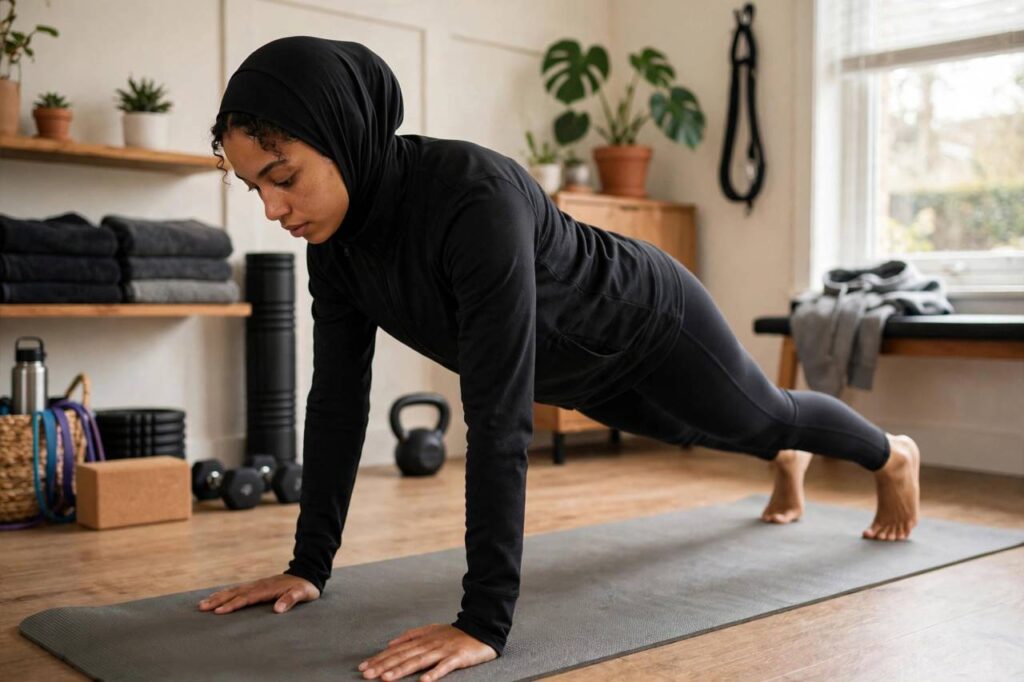
Squat down, place hands on the floor, step one foot back at a time into a plank, step feet back in, stand up. No jumping anywhere. This teaches the sequence safely and is a genuine workout for a true beginner.
Rung 2: Add the jump-back
Same as rung 1, but jump both feet back into the plank instead of stepping. Keep the landing soft with a slight bend in the knees. Still no push-up, still stand up at the end instead of jumping.
Rung 3: Add the push-up (or the incline version)
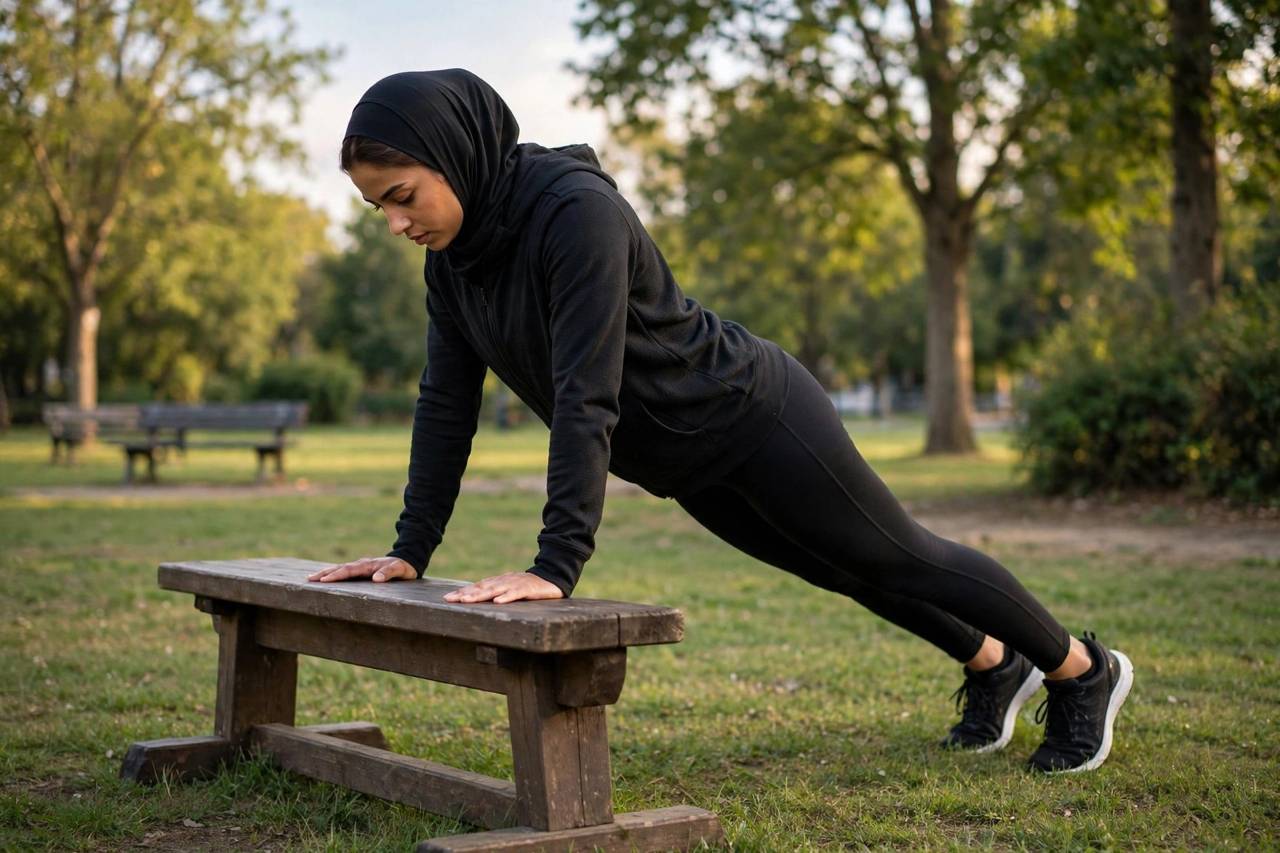
Now add a push-up in the plank position. If a floor push-up is too much, elevate your hands on a bench or sturdy box — the incline burpee. Reduce the incline over weeks until you are on the floor.
Rung 4: Add the final jump
Stand up explosively into a small jump with arms overhead. Land softly. You are now doing full burpees. Congratulations — most people never get here because they skipped the ladder.
Rung 5: The full burpee, done well
Now the work shifts from learning the movement to doing it efficiently: smooth transitions, no pausing in the plank, breathing rhythm locked in.
Form Cues That Prevent Injury
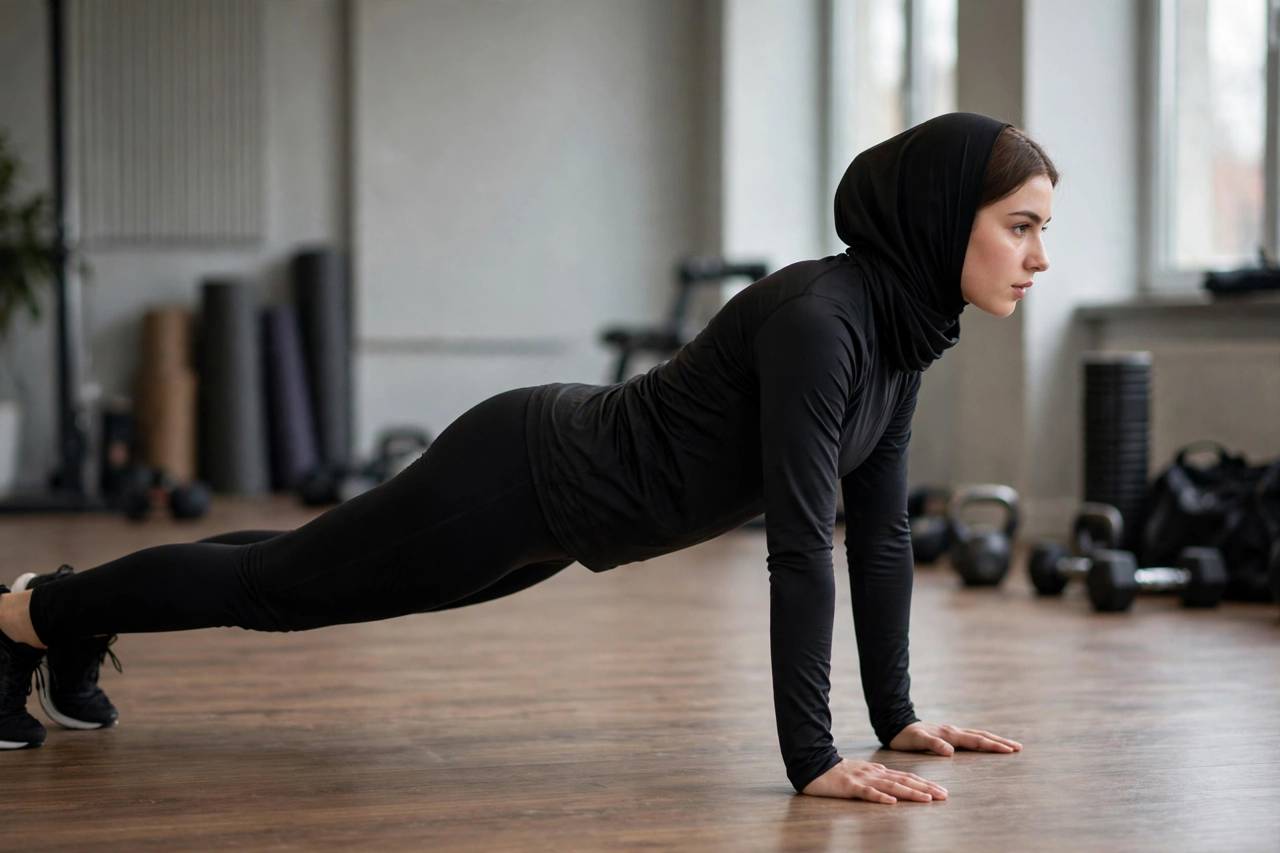
- Flat back in the plank: no sagging hips. A sagging plank under fatigue is how lower backs get hurt. If your hips sag, you are doing too many reps.
- Hands under shoulders: when you kick back, your hands should land directly under your shoulders, not out in front.
- Soft landings: every jump — back and up — lands with bent knees and quiet feet. Loud landings mean your joints are absorbing too much.
- Chest to floor, not face to floor: in the push-up phase, lower your chest with control. Dropping your face first means your core has checked out.
- Stand tall at the top: finish each rep fully upright before starting the next. Half-reps build half-results.
How to Breathe During Burpees
Beginners hold their breath through burpees and wonder why they are gasping after five reps. Use this rhythm: inhale as you drop into the squat, exhale as you kick back, inhale in the plank, exhale on the push-up, inhale as you jump feet in, exhale on the final jump. It will feel mechanical at first. After a few sessions it becomes automatic, and your rep capacity will jump noticeably.
How to Program Burpees as a Beginner
Burpees are conditioning, not a warm-up (despite what some classes do). Program them like this:
- Weeks 1–2: 3 sets of 5 reps at your current rung, 90 seconds rest. Twice per week.
- Weeks 3–4: 4 sets of 6–8 reps, 60–90 seconds rest.
- Weeks 5+: try EMOM sets — every minute on the minute, do 5 burpees, rest the remainder. Ten minutes of this is a serious workout.
Stop the set when your form breaks. Ten perfect burpees beat thirty sloppy ones, every time. Burpees pair naturally with other bodyweight work — my guide to bodyweight exercises gives you the full menu to build around them. And when you are ready to refine the advanced version, see how to do burpees correctly for the details that separate decent burpees from great ones.
Warming Up Before Burpees (Do Not Skip This)
Burpees ask a lot of cold joints. Five minutes of preparation prevents most beginner injuries:
- Two minutes of light cardio: jog in place, jumping jacks, or a brisk walk. Get warm and slightly breathless.
- Leg swings: ten forward-back and ten side-to-side per leg. Opens the hips for the squat and kick-back.
- Arm circles and band pull-aparts: ten each direction. Warms the shoulders for the push-up phase.
- Five slow step-back burpees: rung 1 of the ladder at half speed. Rehearse the sequence before you load it.
This takes five minutes and is non-negotiable. The number of people who get hurt doing burpees cold is far higher than the number who get hurt doing them with tired muscles.
Burpee Variations to Try Once You Are Comfortable
After two to three months of clean full burpees, variety keeps progress moving:
- Burpee to box jump: finish the rep jumping onto a low box or step instead of jumping in place. Adds serious leg power.
- Burpee pull-up: do your burpee under a pull-up bar and finish with a pull-up. The classic CrossFit benchmark “Murph” uses a version of this.
- Single-leg burpee: keep one foot off the floor through the whole rep. Brutal for balance and single-leg strength.
- Broad-jump burpee: instead of jumping up, jump forward as far as you can. Covers distance while it conditions you.
- Devil press: hold light dumbbells through the whole burpee and press them overhead at the top. The graduate-level version.
Master the standard burpee first. Variations multiply whatever foundation you have — including its flaws.
A 4-Week Starter Plan
Here is exactly what I would program for a beginner training twice a week:
- Week 1: 3 x 5 step-back burpees (rung 1). Rest 90 seconds. Focus: smooth sequence, flat back.
- Week 2: 3 x 6 step-back burpees. Add five slow full step-backs as a finisher to practice the jump-back.
- Week 3: 4 x 6 with jump-back (rung 2). Rest 75 seconds. Focus: soft landings.
- Week 4: 4 x 8 at your highest clean rung. Try one set of full burpees if rung 3 feels solid.
Film yourself from the side on week 1 and week 4. The visible difference in your plank position and landing softness will tell you more than any rep count.
Mistakes Beginners Always Make
- Going too fast too soon: speed is earned. Master the sequence slowly first.
- Skipping the push-up to do more reps: that is fine as a regression (rung 2), but be honest about which rung you are on.
- Doing burpees daily: they are high-impact. Two to three times per week is plenty for beginners; your joints need recovery days.
- Worming up from the floor: if you cannot push your whole body up as one unit, your push-up is too advanced — go back to the incline.
- Holding your breath: covered above, and worth repeating. Breathe or bonk.
How Burpees Fit Into a Full Workout
Burpees are a tool, not a program. Here is how I slot them into beginner training:
- As a finisher: after your strength work, do 3 rounds of 30 seconds of burpees with 30 seconds rest. Five minutes, done. This is the most common and most effective placement.
- In a circuit: alternate burpees with squats, push-ups, and rows — 40 seconds each, 20 seconds rest, 3 rounds. Full-body conditioning in fifteen minutes.
- As cardio intervals: 8 rounds of 20 seconds hard burpees, 10 seconds rest (Tabata-style). Four minutes that will humble anyone.
What I do not recommend: making burpees the entire workout. They are too demanding to be the only stimulus and too repetitive to build balanced fitness alone. Pair them with strength work and walking, and they become the engine of a well-rounded routine rather than a punishment ritual.
How to Track Burpee Progress
Burpees improve fast, and tracking keeps you honest about which rung you are really on:
- Log rung, reps, and rest: “Rung 2, 4×6, 75s rest” tells you more than a vague memory of “did burpees.”
- The 2-minute test, monthly: how many clean reps can you do in two minutes at your current rung? Retest monthly — the number climbs fast in the first three months.
- Film quarterly: form degrades silently as reps increase. A side-view video every few months catches the sagging plank before it becomes a habit.
- Advance the rung when: you can do 4 sets of 10 clean reps with full rest. Do not rush it — owning a rung beats surviving the next one.
Frequently Asked Questions (FAQ)
How many burpees should a beginner do?
Start with 3 sets of 5 quality reps, twice a week. Build to 4 sets of 8–10 before worrying about speed or advanced variations. Total reps matter less than clean reps.
Are burpees bad for your knees?
They can be if your form is poor — hard landings and collapsed knees stress the joints. Land softly with knees tracking over toes, and stick to step-back versions if you have knee issues. When in doubt, check with a physiotherapist.
Can burpees help me lose weight?
They are excellent conditioning: full-body, high heart rate, no equipment. But no exercise out-trains diet. Burpees plus sensible eating works; burpees plus unchanged eating mostly just makes you tired.
How long does it take to learn a full burpee?
Most reasonably active beginners reach a clean full burpee in 4–8 weeks following the ladder. If you are starting from zero fitness, give it two to three months. There is no prize for rushing, and the people who rush are the ones who stall with sloppy form.
Should I do burpees every day?
No. They are demanding on joints, the nervous system, and recovery. Two to three sessions per week with rest days between is the sweet spot for beginners.
What muscles do burpees work?
Nearly everything: chest, shoulders, triceps (push-up), core and hip flexors (kick-back), quads and glutes (squat and jump). That is why they are so efficient — and so exhausting.