What Is the Difference Between Civil and Criminal Law?



You hear the terms on the news every day — someone is facing “criminal charges,” someone else filed a “civil lawsuit” — and they start to blur together. But what is the difference between civil and criminal law? It’s one of the most fundamental distinctions in any legal system, and understanding it clears up a surprising amount of confusion about how courts actually work.
Here’s the core difference in one sentence: criminal law deals with offenses against society as a whole, prosecuted by the government and punishable by prison or fines paid to the state. Civil law deals with disputes between private parties — people, businesses, organizations — where the remedy is usually money paid to the harmed party, not punishment by the state. Same courthouse, very different proceedings.
This guide explains how the two systems differ: who brings the case, what has to be proven, what the outcomes look like, and why the same event can sometimes trigger both kinds of cases at once. A quick note: this is general information to help you understand the system, not legal advice for any specific situation.
Who Brings the Case
This is the most important structural difference. In a criminal case, the case is brought by the government — a prosecutor acting on behalf of the state or the people. The victim of a crime doesn’t file the case and can’t drop it; the decision to charge belongs to the prosecutor. That’s why criminal cases have names like “State v. Johnson” or “People v. Martinez” — the government is the party bringing the action.
In a civil case, the case is brought by a private party — the plaintiff — against another private party, the defendant. It might be a person suing a neighbor, a customer suing a company, or one business suing another. The government isn’t involved as a party (though civil cases can involve government agencies as plaintiffs or defendants in certain contexts). The case name reflects this: “Smith v. Jones.”
This difference explains something that confuses people: why a victim can’t “press charges” in the way TV shows suggest. Reporting a crime asks the government to act; the prosecutor decides whether the evidence supports charges. In civil court, by contrast, you’re in the driver’s seat — you decide whether to sue, and you can settle or drop the case whenever you want.
What Is the Difference Between Civil and Criminal Law? The Burden of Proof
Criminal and civil cases also differ in how much proof is required — and this difference is enormous.
In a criminal case, the prosecution must prove guilt “beyond a reasonable doubt.” This is the highest standard in the legal system, deliberately set high because the consequences — loss of liberty — are so severe. If there’s reasonable doubt, the defendant must be acquitted. The defendant doesn’t have to prove innocence; the prosecution has to prove guilt.
In a civil case, the standard is usually “preponderance of the evidence” — meaning it’s more likely than not that the claim is true. Think of it as 51% certainty versus the near-certainty criminal law demands. This lower bar reflects the lower stakes: money changing hands, not someone going to prison.
This is why the same event can produce different outcomes in the two systems. The most famous example: O.J. Simpson was acquitted of murder in criminal court (the prosecution couldn’t prove guilt beyond a reasonable doubt) but found liable in civil court (where the lower standard was met) and ordered to pay damages. Same facts, different standards, different results. Neither verdict was “wrong” — they were answers to different questions under different rules.
What the Outcomes Look Like
Criminal penalties: punishment by the state
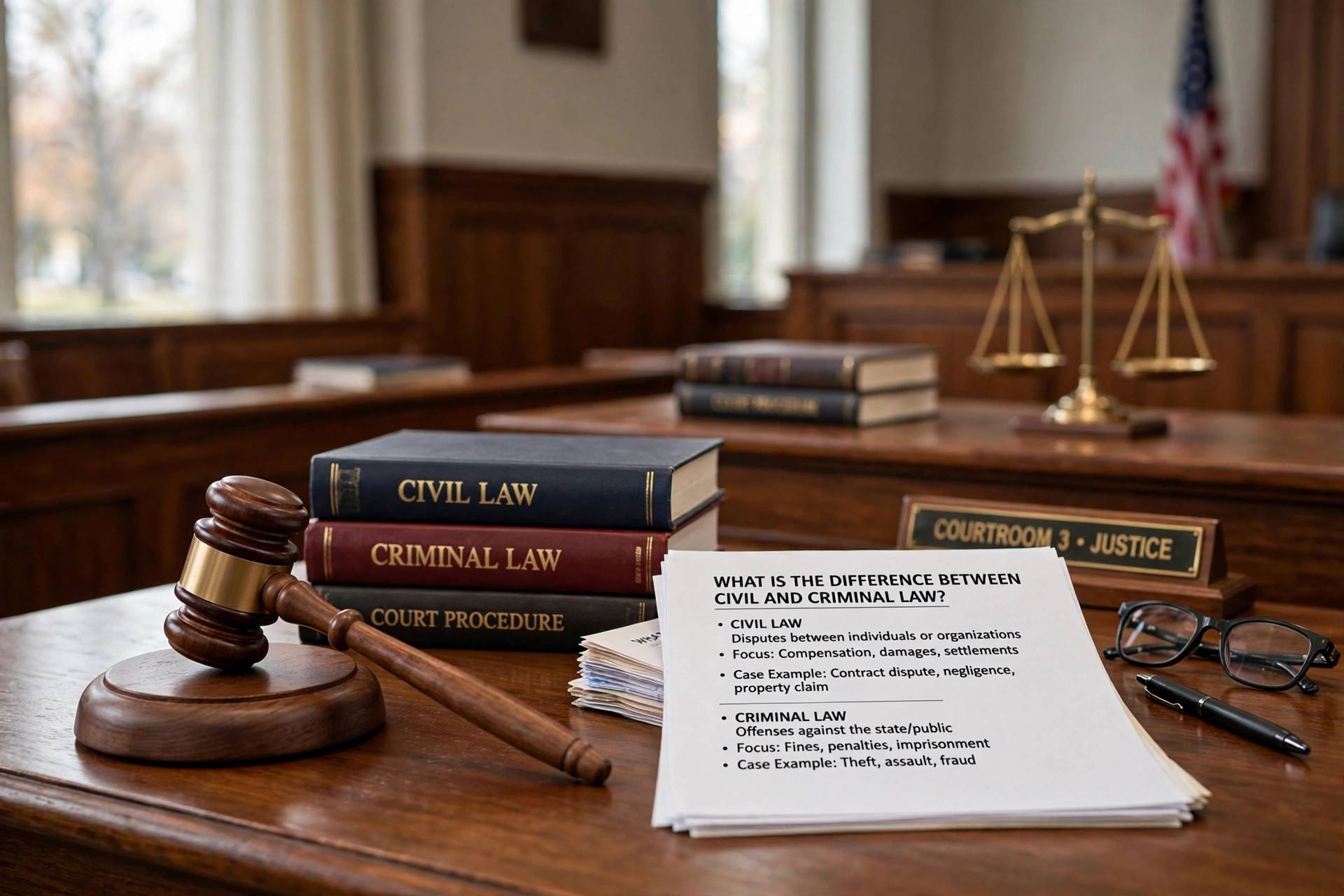
Criminal convictions lead to punishment: imprisonment, probation, fines paid to the government, community service. The point is partly to punish the offender and partly to deter others and protect the public. The outcome is imposed by the state and carried out by the state.
Civil remedies: making the harmed party whole
Civil cases usually end with the defendant paying money to the plaintiff — called damages — to compensate for the harm: medical bills, lost wages, property damage, pain and suffering. Courts can also order someone to do or stop doing something (an injunction), like stopping construction that violates a contract. The goal isn’t punishment; it’s restoration — putting the harmed party as close as possible to where they were before the harm.
Civil cases can include “punitive damages” in some situations — extra money meant to punish especially bad behavior — but even these are paid to the plaintiff, not the state. The line stays clear: civil law compensates, criminal law punishes.
Common Types of Cases in Each System
Criminal cases cover offenses defined by statute: theft, assault, burglary, fraud, drug offenses, homicide, drunk driving. These are acts the legislature has declared harmful to society, and the procedures — arrest, arraignment, trial by jury — come with constitutional protections for the accused, including the right to a lawyer (provided by the state if you can’t afford one) and protection against self-incrimination.
Civil cases cover disputes between parties: breach of contract, personal injury claims (like car accidents), property disputes, divorce and family matters, landlord-tenant issues, employment disputes. There’s no right to a free lawyer in most civil cases — you hire your own or represent yourself — though small claims courts are designed to be navigable without one.
Note the overlap: many events create both kinds of cases. A drunk driver who injures someone faces criminal charges from the state (for the offense) and a civil lawsuit from the injured person (for the medical bills and damages). The two cases proceed independently, on different timelines, with different lawyers and different standards of proof.
How the Process Differs
Criminal procedure has distinctive features: arrest, booking, bail, grand jury or preliminary hearing, arraignment (where the plea is entered), and trial — with the defendant present and the full set of constitutional protections. The defendant can remain silent without it being used against them.
Civil procedure runs differently: it starts with a complaint filed by the plaintiff, the defendant is served and responds, then comes discovery (both sides exchanging evidence), possible settlement negotiations (most civil cases settle — only a small fraction reach trial), and then trial if no settlement is reached. In civil court, unlike criminal court, a party’s silence can sometimes be held against them.
Appeals exist in both systems but work differently. In criminal cases, the prosecution generally cannot appeal an acquittal (double jeopardy protection). In civil cases, either side can typically appeal a judgment they believe was legally wrong.
Why the Distinction Matters to You
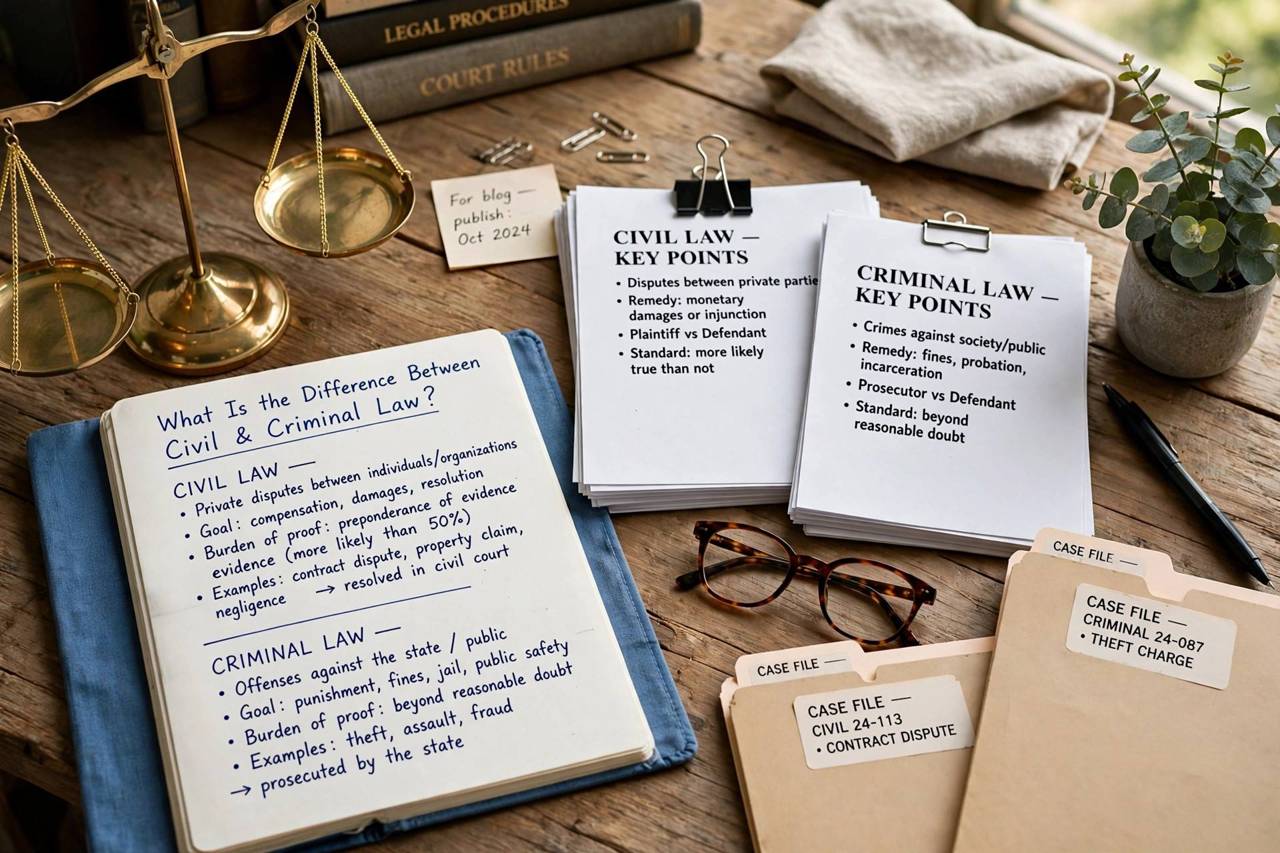
Understanding this distinction helps in practical situations. If someone damages your property, you’re looking at a civil matter — you’d sue for the cost of repair. If someone steals your property, that’s criminal — you’d report it to the police, and you could also sue civilly for any losses. Knowing which system applies tells you who to call, what to expect, and what outcomes are possible.
It also helps you read the news critically. When you hear that someone was “found not guilty” criminally but is being sued civilly, you now know that’s not a contradiction or a loophole — it’s two different systems doing two different jobs. And when a company pays a “settlement” to regulators, you can ask the right question: was this a civil resolution, a criminal plea, or both?
One more practical note: legal questions about new technologies come up constantly — for instance, whether self-driving cars are legal touches both criminal (traffic offenses) and civil (liability for accidents) law, showing how the two systems work side by side in real life.
Civil vs. Criminal Law: Side-by-Side Summary
Here’s the whole distinction on one mental index card:
Who sues: criminal — the government (prosecutor). Civil — a private party (plaintiff).
What’s at stake: criminal — punishment (prison, probation, fines to the state). Civil — compensation (money to the harmed party, or a court order).
Standard of proof: criminal — beyond a reasonable doubt. Civil — preponderance of the evidence (more likely than not).
Purpose: criminal — punish the offender, deter others, protect the public. Civil — make the harmed party whole.
Control: criminal — the victim can’t start or stop the case. Civil — the plaintiff decides whether to sue, settle, or drop it.
Lawyer: criminal — provided by the state if you can’t afford one. Civil — you hire your own (or represent yourself).
Tape that to your mental wall and most legal news will make immediate sense. When a headline says someone was “charged,” that’s criminal. When it says someone “filed suit” or “was sued,” that’s civil. When both happen over the same event, now you know exactly why — and why the outcomes can differ.
Frequently Asked Questions
What is the difference between civil and criminal law in simple terms?
Criminal law involves the government prosecuting someone for an offense against society, with punishment like prison as the outcome. Civil law involves private parties resolving disputes, usually with money paid to the harmed party as the outcome. They use different courts, different standards of proof, and different procedures.
Can the same act lead to both a criminal and civil case?
Yes. A single event — like a car accident caused by reckless driving — can trigger criminal charges from the state and a separate civil lawsuit from the injured person. The cases proceed independently with different lawyers, standards of proof, and possible outcomes.
What is the burden of proof in civil vs criminal cases?
Criminal cases require proof “beyond a reasonable doubt” — the highest legal standard. Civil cases typically require only a “preponderance of the evidence,” meaning the claim is more likely true than not. This is why outcomes can differ between the two systems on the same facts.
Who pays for a lawyer in criminal vs civil cases?
In criminal cases, defendants who can’t afford a lawyer are provided one by the state — it’s a constitutional right. In civil cases, there’s generally no right to a free lawyer; parties hire their own attorneys or represent themselves, though some take cases on contingency (paid from winnings).
Is a lawsuit civil or criminal?
A lawsuit filed by one private party against another is a civil case. Criminal matters aren’t called lawsuits — they’re prosecutions, brought by the government. If you filed it yourself (or hired a lawyer to file it), it’s civil.