Best Bodyweight Exercises at Home: Build Strength With Zero Equipment

No gym? No problem. Seriously — some of the strongest, fittest people I know built their foundation with nothing but their own bodyweight and a living room floor. The best bodyweight exercises at home can build real strength, torch calories, and get you genuinely fit. No membership, no commute, no waiting for the squat rack.
But here’s the thing most people get wrong: they treat bodyweight training as “less than” gym training. Wrong mindset. Bodyweight training done right — with proper form, progressive overload, and consistency — is legitimate strength training. Let me show you the moves that matter and how to program them.
Why Bodyweight Training Works
Your body doesn’t know the difference between a barbell and gravity — it only knows resistance. Bodyweight exercises provide that resistance using, well, your body. And they come with advantages weights can’t match:
- Zero barrier to entry. No equipment, no cost, no commute. The workout starts the moment you decide to start.
- Natural movement patterns. Push-ups, squats, lunges — these are how humans are built to move. They train coordination and stability alongside strength.
- Joint-friendly. Bodyweight moves are generally easier on joints than heavy loaded exercises, making them ideal for beginners and anyone training around old injuries.
- Infinitely scalable. Every exercise has easier and harder versions. Can’t do a push-up? Start on your knees or against a wall. Push-ups too easy? Try archer push-ups or one-arm progressions.
The Best Bodyweight Exercises at Home: Upper Body
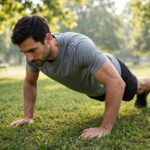
Push-Ups (The King)
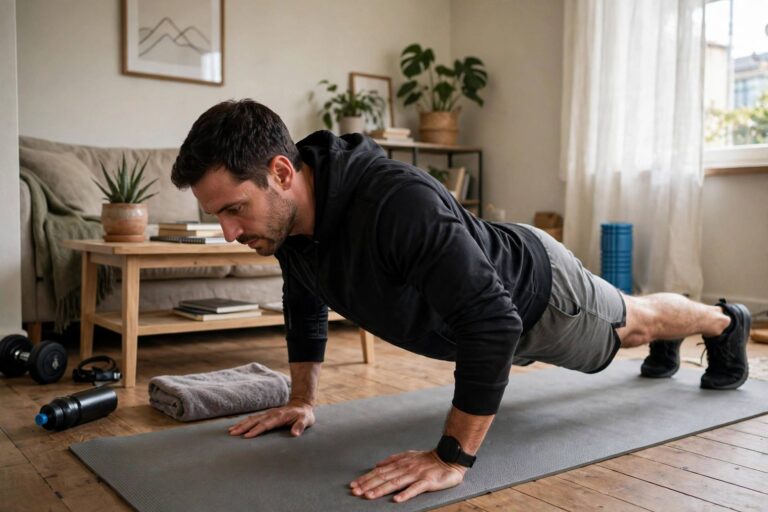
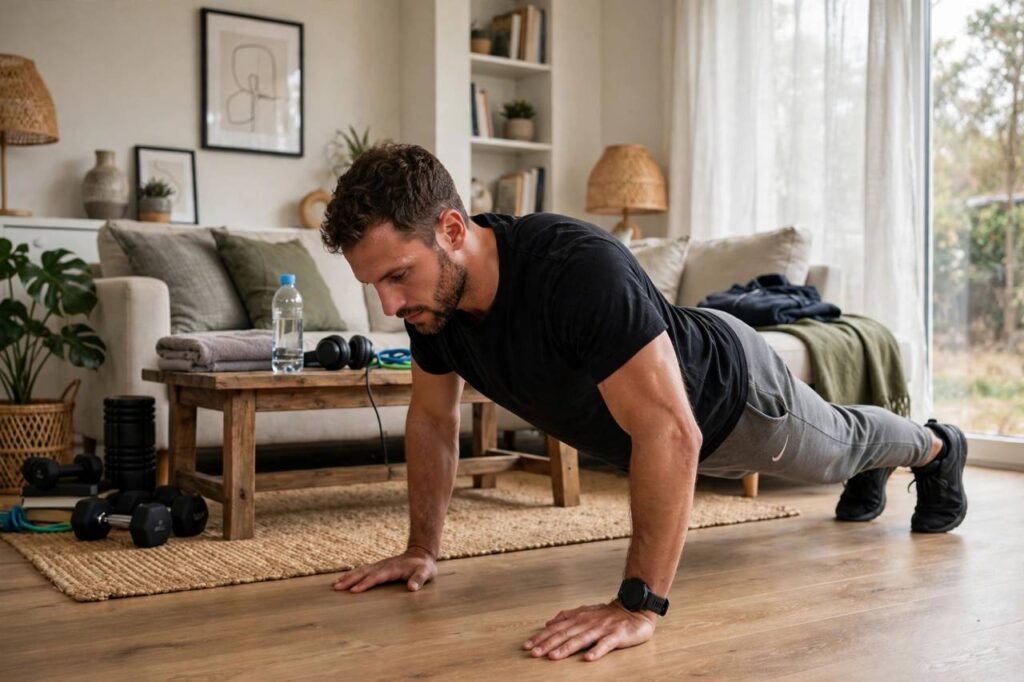
The push-up is the single best upper-body bodyweight exercise, full stop. Chest, shoulders, triceps, core — all working together. Form: hands under shoulders, body in a straight line, chest to the floor, full lockout at the top. Most people do half-reps; don’t be most people. Can’t do full push-ups yet? Start with incline push-ups (hands on a sturdy table or counter) and work down to the floor.
Pike Push-Ups
Hips high, head between your arms — this shifts the emphasis to your shoulders. It’s the bodyweight stepping stone toward handstand push-ups. Start with short ranges of motion and build up.
Tricep Dips (Chair)
Hands on the edge of a sturdy chair behind you, legs extended, lower your body by bending the elbows. This hammers the triceps. Keep your back close to the chair and don’t shrug your shoulders up to your ears.
Superman Pulls / Reverse Snow Angels
Lie face down, lift your chest off the floor, and pull your elbows back like you’re rowing. Your back muscles — the ones push-ups ignore — need love too. This is their exercise.
Best Bodyweight Exercises at Home: Lower Body
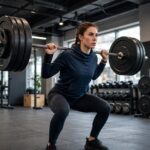
Bodyweight Squats
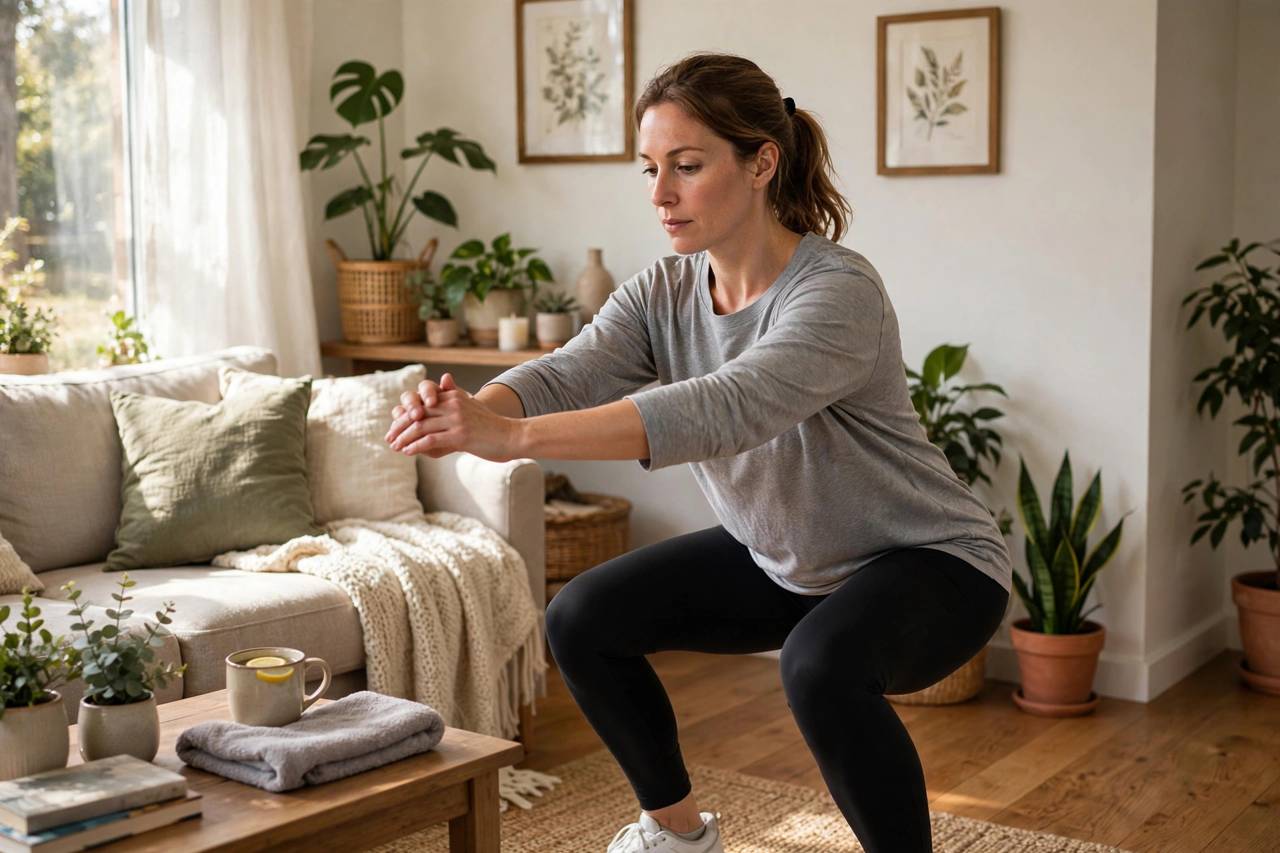
The foundation of lower-body training. Feet shoulder-width apart, chest up, sit back and down until thighs are at least parallel to the floor. Knees track over toes — don’t let them cave inward. Master the basic squat before adding any variations; it’s the movement everything else builds on.
Reverse Lunges
Step backward into a lunge rather than forward — it’s kinder on the knees and easier to balance. Keep your torso upright, lower until both knees are near 90 degrees, drive through the front heel to stand. Alternate legs or do all reps on one side before switching.
Glute Bridges
Lie on your back, knees bent, feet flat. Drive through your heels and lift your hips until your body forms a straight line from shoulders to knees. Squeeze the glutes hard at the top. Your glutes are the biggest muscle in your body — wake them up, especially if you sit all day.
Calf Raises
Stand on the edge of a step, rise up on your toes, lower slowly below the step level. Simple, effective, and easy to forget. Do them while you brush your teeth — habit stacking for the win.
Best Bodyweight Exercises at Home: Core
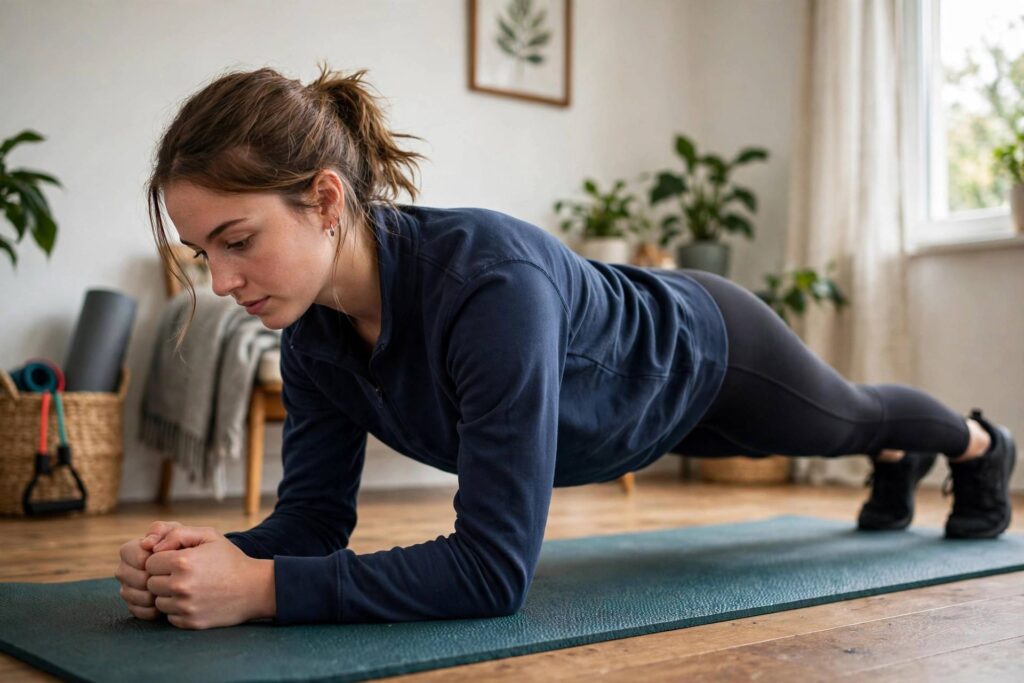
Plank
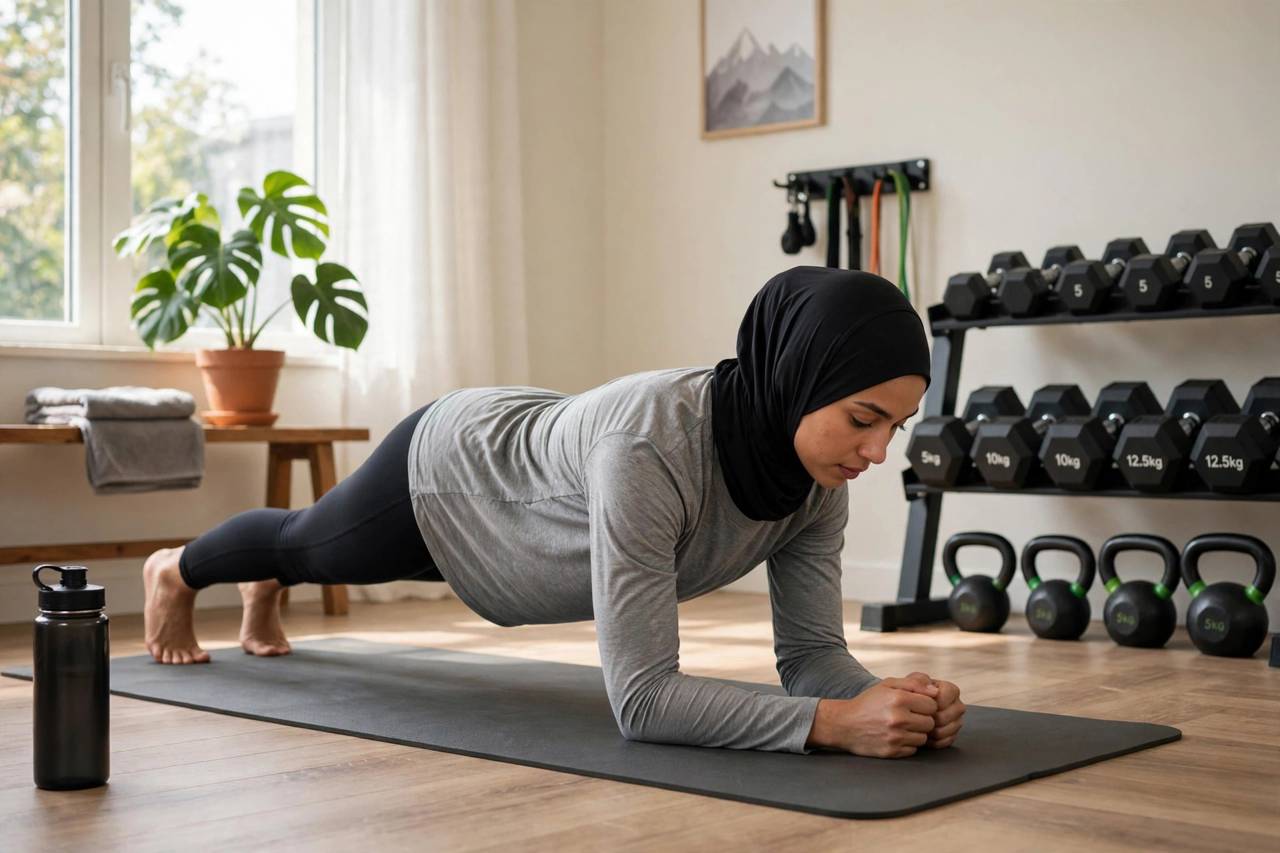
You knew this was coming. The plank trains your entire core to stabilize — which is your core’s actual job. Forearms down, straight line head to heels, glutes squeezed, breathe steadily. Start with 20-30 second holds and build up.
Dead Bugs
Lie on your back, arms toward the ceiling, knees bent at 90 degrees. Slowly extend one arm overhead while extending the opposite leg, keeping your lower back pressed into the floor. This teaches core stability better than almost anything — and it’s much harder than it looks.
Mountain Climbers
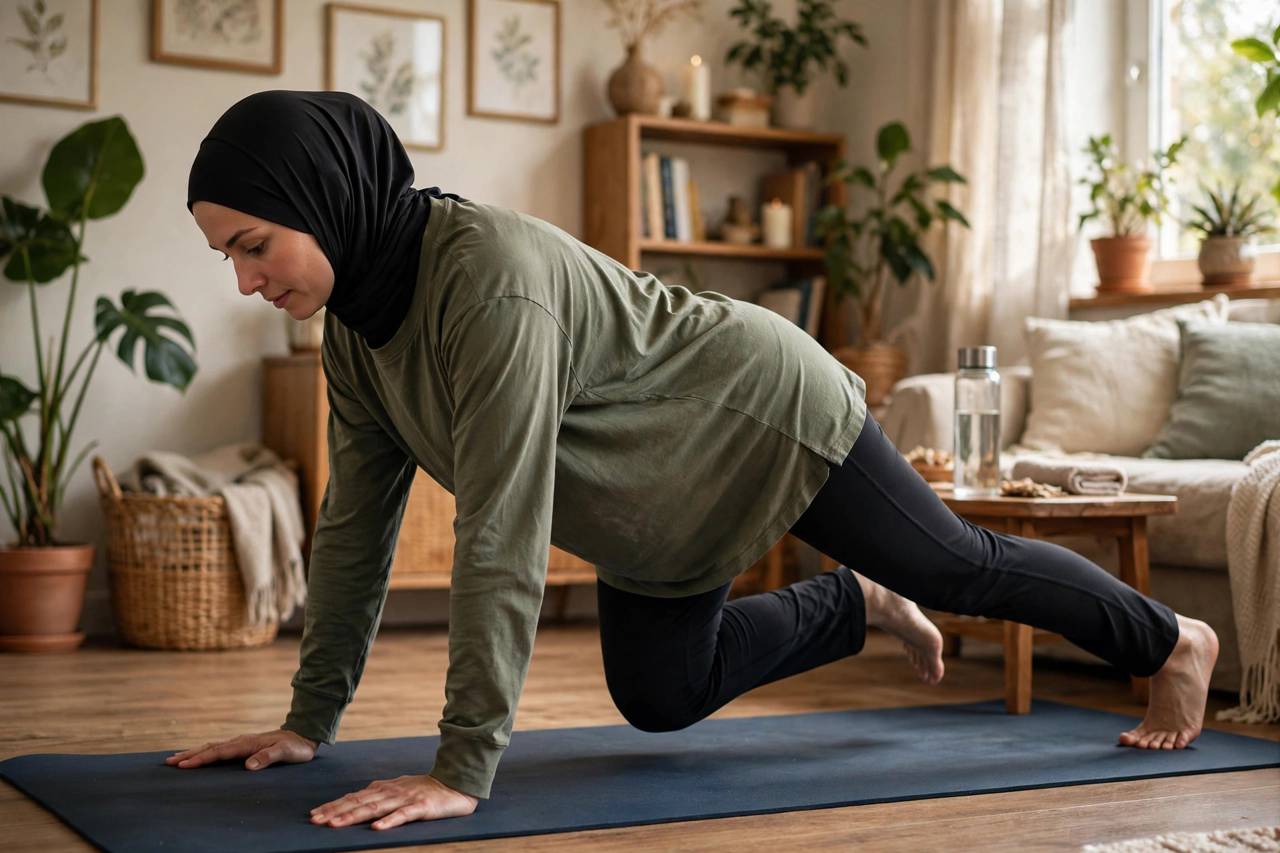
High plank position, drive knees toward your chest alternately at a quick pace. Core plus cardio in one move. Keep your hips level — the moment your butt pikes up, slow down and reset.
Bird Dogs
On all fours, extend one arm forward and the opposite leg back, hold for a few seconds, switch. This builds the deep spinal stabilizers and teaches your core to resist rotation. Slow and controlled wins.
How to Progress: The Secret Sauce
Here’s where most home workouts stall: people do the same 3 sets of 10 forever and wonder why nothing changes. Muscles grow when challenged progressively. With bodyweight training, you progress by:
- Adding reps. The simplest progression. Went from 8 to 12 push-ups? That’s progress.
- Harder variations. Knee push-ups to full push-ups to diamond push-ups to archer push-ups. There’s always a next level.
- Slowing down. A 3-second lowering phase (eccentric) makes any exercise dramatically harder. Tempo is free intensity.
- Adding pauses. Pause for 2 seconds at the bottom of each squat. Feel the burn multiply.
- Reducing rest. Shorter rest periods increase the metabolic demand. Same exercises, harder workout.
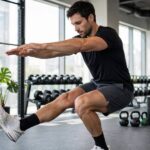
- Unilateral work. One-leg squats (assisted pistol progressions), one-arm push-up progressions — single-limb work doubles the load per limb.
Understanding compound vs. isolation exercises helps here too — the moves in this guide are mostly compound, meaning they work multiple muscle groups at once. That’s why a short bodyweight session can be so effective.
Sample Full-Body Home Workout (30 Minutes)
Do this 3 times per week, resting at least one day between sessions:
- Warm-up (5 min): Jumping jacks, arm circles, leg swings, bodyweight squats — get warm.
- Circuit (20 min), 3 rounds:
- Push-ups: 8-12 reps
- Bodyweight squats: 15-20 reps
- Plank: 30 seconds
- Reverse lunges: 10 per leg
- Superman pulls: 12 reps
- Glute bridges: 15 reps
Rest 60-90 seconds between rounds.
- Cool-down (5 min): Stretch everything you worked — chest doorway stretch, quad stretch, hamstring stretch, child’s pose.
For more ideas on structuring your training, check out this bodyweight exercises guide and these strategies for how to build muscle at home without a gym.
Common Bodyweight Mistakes That Stall Progress
I’ve watched a lot of people do home workouts for months with nothing to show for it. Almost always, one of these culprits is to blame:
- Half reps. The classic. Quarter squats, chest-never-reaches-floor push-ups, planks with sagging hips. Your muscles only adapt to the range you train — so train the full range. Reduce the difficulty (incline push-ups instead of floor) rather than reducing the range of motion.
- No progression plan. Doing the same 3×10 for six months maintains fitness; it doesn’t build it. Pick one progression variable — reps, tempo, variation difficulty, rest periods — and push it slightly every week or two.
- Rushing through reps. Momentum is the enemy of muscle. A controlled 2-3 second lowering phase on every rep roughly doubles the effective difficulty. Slow down and feel the muscles working.
- Skipping the hard stuff. Everyone loves push-ups; nobody loves single-leg work and back exercises. But your body needs balance — neglected muscles become weak links and eventually injuries. Train the back of your body as much as the front.
- Inconsistency. The perfect program done sporadically loses to the decent program done three times a week, every week. Put workouts on your calendar like appointments. Protect them like appointments.
- Ignoring recovery. Training hard six days a week with no rest doesn’t make you tougher — it makes you tired, stale, and eventually injured. Muscles grow during rest. Sleep, eat enough protein, take your rest days seriously.
How to Stay Motivated Training Alone at Home
Let’s be honest about the hardest part of home workouts: there’s no gym buddy, no class instructor, no social pressure. It’s just you and your living room. Motivation will fail you — systems won’t.
- Track everything. A simple notes app log — date, exercises, reps — turns invisible effort into visible progress. Watching your numbers climb is the most reliable motivator there is.
- Shrink the commitment. “I’ll do a 30-minute workout” is easy to skip. “I’ll do one set of push-ups” is almost impossible to refuse — and once you start, you usually keep going.
- Anchor it to a habit. Work out right after your morning coffee, or right before your shower. Existing habits are launch pads for new ones.
- Set process goals, not just outcome goals. “Work out 3x this week” beats “lose 10 pounds” — because you control the process completely. Stack enough good weeks and the outcomes follow.
- Film yourself occasionally. Not for social media — for form checks. What you feel and what you’re actually doing are often different. A quick video reveals the truth.
Remember why you started: you wanted to get stronger, and you didn’t want to wait for a gym membership to do it. That reason is still valid. Lace up — or don’t, it’s bodyweight, you don’t even need shoes — and get after it.
FAQ
Can you build muscle with just bodyweight exercises at home?
Yes — especially as a beginner or intermediate. Muscles respond to progressive overload, and bodyweight training provides it through harder variations, more reps, slower tempo, and shorter rest. Advanced lifters may eventually need added resistance, but most people can build impressive strength with bodyweight alone for years.
How often should I do bodyweight workouts?
Three full-body sessions per week is the sweet spot for most people, with at least one rest day between sessions. Your muscles grow during recovery, not during the workout — the training is just the stimulus.
What are the best bodyweight exercises at home for beginners?
Start with incline push-ups, bodyweight squats, glute bridges, knee planks, and bird dogs. These build foundational strength with minimal injury risk. Progress to full push-ups, lunges, full planks, and dead bugs as you get stronger.
How long should a bodyweight workout be?
Twenty to forty minutes is plenty. A focused 30-minute session with compound movements and short rest periods is more effective than an unfocused hour. Quality and intensity beat duration.
Do I need any equipment for home bodyweight training?
No — that’s the point. A mat or towel for floor work is nice, and a sturdy chair enables dips and incline push-ups, but neither is required. If you later want to add challenge, a pull-up bar is the single best first purchase.