Non-Religious Wedding Ceremony Readings: 25 Beautiful Options

Not religious but want a reading with weight? You’re in good company — most of my couples want secular ceremonies with real emotional depth. The good news: some of the most beautiful wedding readings ever written have nothing to do with religion. Here are 25.
Why Secular Readings Work
Secular readings draw on universal human experience — love, partnership, adventure, home. They resonate with every guest regardless of belief, and they age well — no one cringes at Rumi in 20 years.
Poetry
E.E. Cummings “i carry your heart with me.” Pablo Neruda, Sonnet XVII. Rumi’s “The Essence of Love.” Christina Rossetti “I loved you first.” W.H. Auden’s “Funeral Blues” — no, kidding (please don’t). Mary Oliver’s “The Summer Day” works surprisingly well. Keep excerpts to 8–15 lines.
Literature Excerpts
The Velveteen Rabbit on becoming “real” through love. “Union” by Robert Fulghum. The Little Prince on taming — “You become responsible, forever, for what you have tamed.” Captain Corelli’s Mandolin on love deepening past the initial madness. Winnie the Pooh’s “a hundred minus one day.” Jane Eyre: “I am no bird; and no net ensnares me.”
Modern Prose and Essays
Cheryl Strayed on love and commitment. An excerpt from “The Amber Spyglass” on love as life’s meaning. Modern love essays from the New York Times column. A favorite author’s words on partnership — personal beats famous every time.
Song Lyrics as Poetry
Read aloud, great lyrics become poetry: “All You Need Is Love” (obvious but effective), Iron & Wine’s “Flightless Bird,” The Beatles’ “In My Life.” Choose lyrics that stand alone without melody — read them aloud to test.
How to Choose
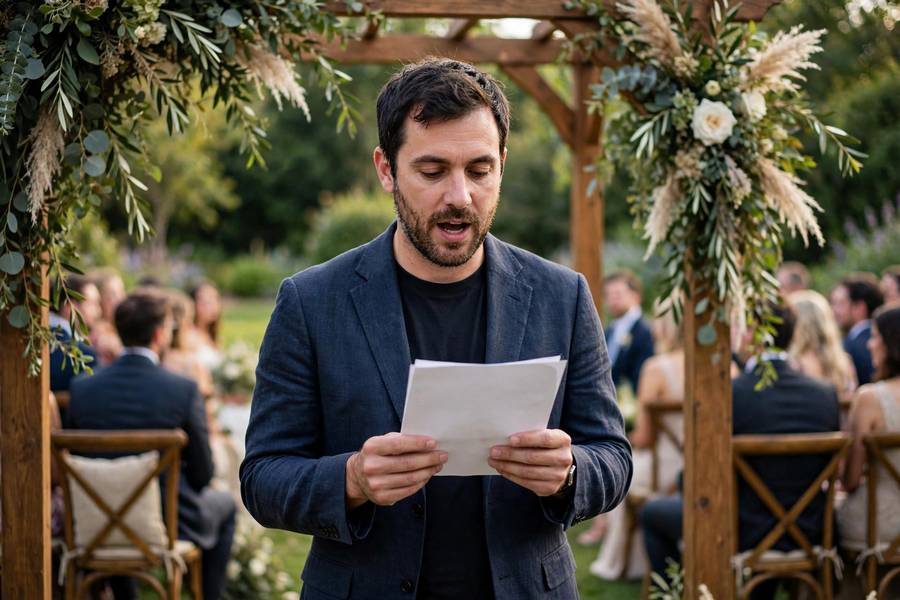
Pick what sounds like YOU. Read candidates aloud — rhythm matters more on the day than on the page. Keep it under 2 minutes. And choose a reader with a strong voice who won’t dissolve (love them, but the crier isn’t your reader).
For shorter options, see wedding planning guides. For the full collection, wedding ceremony readings has every style.
Delivery
Print large (16pt, double-spaced) on cardstock. Practice standing, at volume, 20% slower than feels natural. It’s fine to show emotion — just pause and breathe through it.
Readings About Adventure and Partnership
For the adventurous couple: “The Journey” by Mary Oliver (on leaving the old life for the new). Jack Kerouac on the mad ones who “burn, burn, burn.” The Velveteen Rabbit (on becoming real through love — technically about a toy rabbit, emotionally about everything). Antoine de Saint-Exupéry on love as looking outward together, not at each other.
These work especially well for couples who’ve traveled together, moved cities, or built unconventional lives. The reading should reflect YOUR story — adventurers get adventure readings, homebodies get home readings.
Readings About Home and Belonging
For the nesting couple: Maya Angelou on love liberating. Rumi on the essence of love. “I loved you first: but afterwards your love” — Christina Rossetti. An excerpt from “The Amber Spyglass” on the meaning of life being love. These readings say: we’ve found our place, and it’s each other.
Home-themed readings pair beautifully with unity ceremonies (handfasting, blending sand) — the words and the ritual reinforce each other. Coordinate with your officiant so the reading flows into the ritual naturally.
Writing Your Own Reading
The bravest option: write it yourself. Not vows — a short reading about what love means to you, read by a friend or family member (or read together). 150–200 words. It doesn’t need to be literary; it needs to be true. “Love, to us, is Tuesday takeout and Sunday hikes and the way you always…”
Personal readings are the ones guests remember — because they’ve never heard them before. If writing feels daunting, start with “Love is…” and finish the sentence 10 times. Your reading is hiding in those completions.
Secular Unity Rituals to Pair With Readings
Readings pair beautifully with secular unity rituals. The reading sets the theme; the ritual embodies it:
Handfasting (Celtic tradition, now universal): your hands are bound with cords while the officiant speaks. Pair with a reading about binding, joining, or intertwining. Blending sand or soil: two containers poured into one — pair with readings about merging lives or creating something new. Wine box / time capsule: seal wine, letters, and mementos to open on an anniversary — pair with readings about the future. Tree planting: plant something together — pair with readings about growth and roots.
The coordination: the reading should come BEFORE the ritual (words, then action). The officiant introduces the ritual, the reader reads, then you perform the ritual in reflective silence or soft music. The sequence — speak, then do — is deeply satisfying for guests to witness.
Keep it simple: one ritual maximum. Two rituals feel like a variety show. Choose the one that resonates, pair it with the right reading, and let the moment breathe. For words to accompany your ritual, see wedding vow examples — vows and readings work as a pair.
Readings From Unexpected Sources
Beyond poetry and novels — surprising sources for beautiful readings:
Children’s books: “The Velveteen Rabbit” (on becoming real through love), “Winnie the Pooh” (“If you live to be a hundred, I want to live to be a hundred minus one day”), “The Little Prince” (on taming and responsibility). Don’t dismiss these — they’re profound because they’re simple. Movie dialogue: “The Princess Bride” (“Mawwiage…”), “When Harry Met Sally” (“I love that you get cold when it’s 71 degrees out”). Only if it’s genuinely YOUR movie — not just a famous quote.
Letters: historical love letters (Frida Kahlo, Beethoven’s “Immortal Beloved”) or YOUR OWN old letters/messages to each other. Reading your early texts to each other (edited for appropriateness) is unexpectedly moving. Song lyrics: read aloud, not sung. “In My Life” (Beatles), “All You Need Is Love,” or whatever song is yours. Test: read it without melody. If it still moves you, it works.
Your own words: the bravest choice — write a short reflection on what love means to you (150 words), and have someone read it. It’s not a classic, but it’s the only reading that’s truly yours. And “truly yours” beats “classic” every time.
Bilingual and Multicultural Readings
When two languages or cultures meet in a ceremony:
The dual reading: the same short piece read in two languages (one after the other, or alternating lines). It’s powerful — everyone hears the meaning twice, in two voices. Keep each version under a minute so the ceremony doesn’t double in length.
One reading per culture: a short piece from each tradition, read by someone from each side. It honors both families equally. Choose pieces of similar length and tone — you want harmony, not competition.
Provide translations: in the program, print both versions (or a translation of the non-majority language). Guests who don’t understand the words can follow along — and the effort shows respect.
The emotional wildcard: a reading in a grandmother’s native language — even if most guests don’t understand it — can be the most moving moment of the ceremony. Meaning transcends translation. When the reader’s voice breaks, everyone understands.
Practical tips: brief readers on pronunciation (especially for languages they don’t speak fluently). Keep bilingual segments tight (ceremony length matters). And discuss with your officiant — they’ll help weave the languages together smoothly rather than as separate blocks.
Key Takeaways
Secular doesn’t mean shallow. Rumi, Neruda, Cummings, and children’s books carry profound weight without religion. Read candidates aloud. Rhythm and emotion live in the voice, not on the page. Keep it under 2 minutes. One perfect minute beats three good ones. Choose a confident reader. A strong voice with the text 2 weeks ahead. Not the crier (love them, but no). Make it yours. The reading should reflect YOUR story — adventurers get adventure readings, homebodies get home readings.
Pro tip: the reader rehearsal. Have your reader practice at the actual venue if possible — or at least in a similar-sized space. Outdoor acoustics swallow quiet voices; large halls create echoes. A 10-minute rehearsal teaches them to project, pace, and pause. And give them a glass of water nearby (nerves dry the mouth). A prepared reader transforms a nice reading into a ceremony highlight.

E.E. Cummings, Rumi, Neruda, The Velveteen Rabbit, The Little Prince, Robert Fulghum’s ‘Union,’ and modern love essays all work beautifully.
Under 2 minutes (150–250 words). Short readings hold the room’s attention and leave space for your vows.
Yes — read aloud, great lyrics function as poetry. Test by reading without melody; if it still moves you, it works.
Someone with a clear, steady voice. Give them the text two weeks ahead and have them practice aloud at volume.
No — readings are optional. Some couples skip them entirely for a streamlined ceremony. One good reading beats two mediocre ones.