A customer asked me this last week while I was halfway through his four-cylinder: “You’re doing all four, right? My buddy said you only need to do the bad one.” My buddy the customer, not the buddy — the buddy was wrong, and I told him so, politely, with the old plug in my hand.
Short answer: yes, replace them all at once. It’s one of the most consistent recommendations in the trade, and it’s not a conspiracy to sell you more parts — a set of plugs costs less than the pizza you’ll order while you wait. But there are genuine exceptions, and the reasoning is worth understanding, because “replace them all” without the why sounds like upselling.
Contents
- The Short Answer: Yes
- Why a Full Set: Even Wear, Even Fire
- The Labor Math
- The Single New Plug Problem
- When It’s OK to Replace Fewer
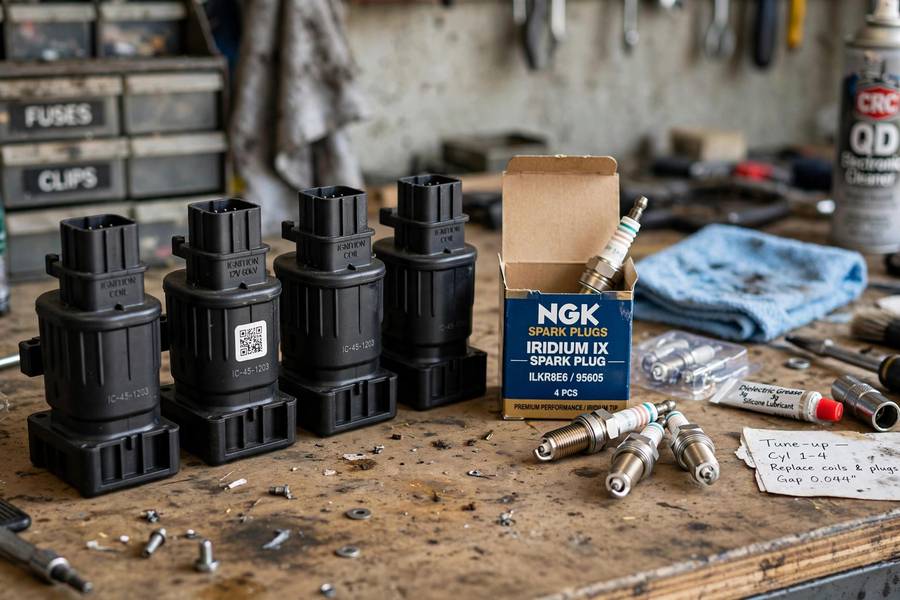
- What About the Coil Packs?
- My Shop Rule
The Short Answer: Yes
Replace all the spark plugs at the same time, with the same brand and part number. Every plug in the engine has lived the same life — same miles, same heat cycles, same fuel. If one is worn out, the rest are right behind it. Changing one is like replacing one tire on a set of four bald ones and calling it good.
The cost argument seals it. On a four-cylinder, the difference between one plug and four is maybe $20–40 in parts. You’re already paying for the labor (or spending your Saturday) to get in there. Doing the job twice — once now for the “bad” plug and again in six months when the next one fails — costs double the labor to save a few dollars in parts. That’s bad math any way you slice it.
Why a Full Set: Even Wear, Even Fire
Here’s the technical case, because it’s real and not just shop folklore.
Spark plugs wear gradually and together. After 80,000 miles, all four (or six, or eight) have eroded electrodes and widened gaps — roughly equally. If you replace just one, you now have one cylinder firing with a crisp new plug and the rest firing with tired ones. The engine computer can compensate for small differences, but you’re introducing uneven combustion across cylinders for no benefit.
More practically: plugs fail in clusters. The failure curve for a set of plugs is steep at the end of life — once the first one starts misfiring, the others are weeks or months behind, not years. I’ve lost count of the cars that came in for “one misfiring plug,” got one plug replaced elsewhere, and came back two months later for another. Each visit meant another diagnostic fee, another round of labor. The full set the first time would have been cheaper than the two single-plug visits combined.
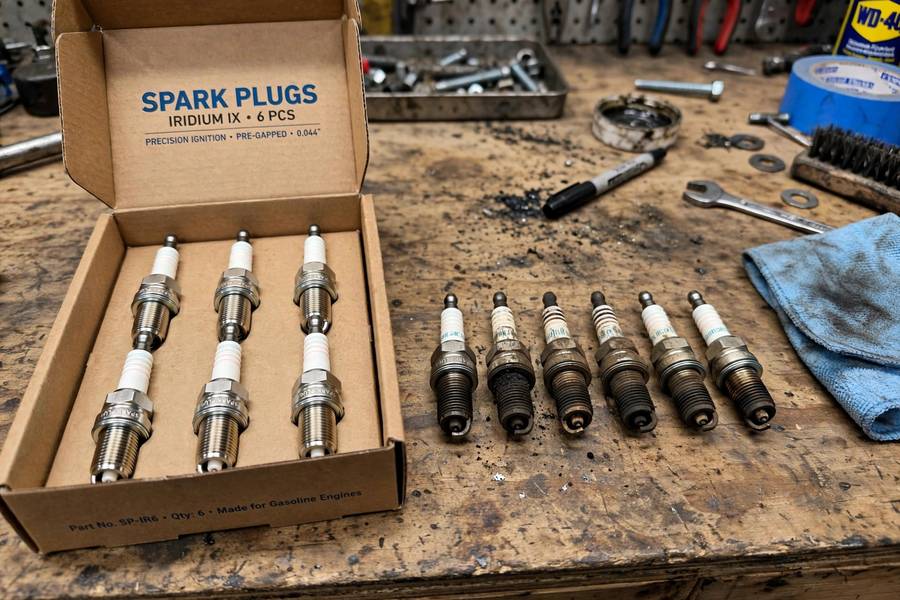
There’s also a diagnostic angle. When I pull a full set and lay them out in order, I can compare cylinders — the odd one out tells me about that cylinder’s health. A mixed set of old and new plugs destroys that comparison. Uniform parts give you clean diagnostics next time.
The Labor Math
This is the argument that convinces the skeptics, so let me spell it out.
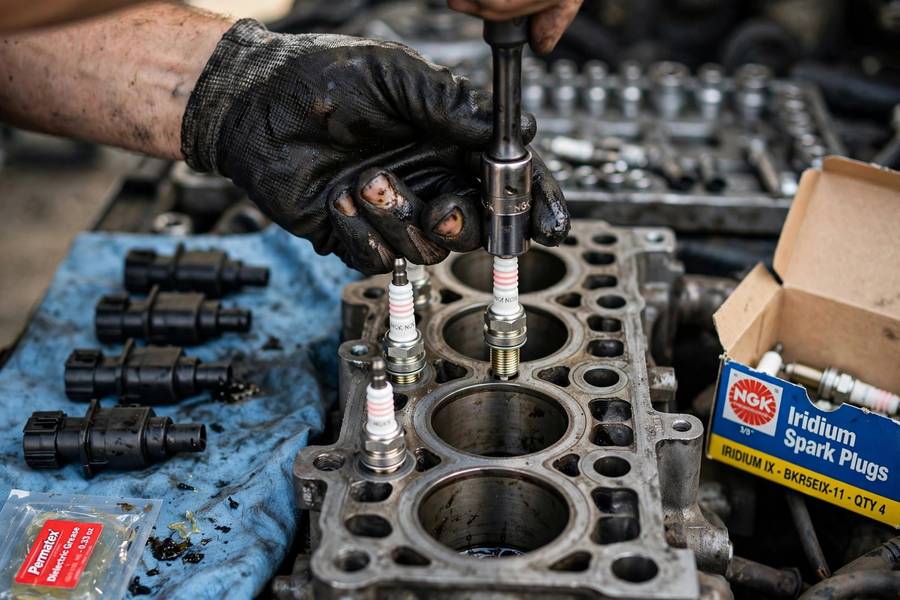
On an easy-access four-cylinder, the labor to change one plug versus four is nearly identical — you’re removing the engine cover and coil packs either way. The incremental cost of plugs two, three, and four is just parts: $10–30. Refusing that is like paying for a plane ticket and then refusing the free checked bag.
On difficult-access engines, the math gets even more lopsided. Transverse V6 with the intake manifold coming off? You’re paying 2–3 hours of labor to reach the plugs. Doing three now and three later means paying that labor twice. I once quoted a customer for all six on his V6; he asked for just the rear three (the hard ones, already exposed during another repair — smart), and we did the front three at the next service since they’re a ten-minute job. That’s the exception that proves the rule: he still did all six, just staged intelligently around access.
The same logic applies to your own Saturday. You’re already dirty, the tools are already out, and the engine is already cool. Plugs two through eight are pure momentum. Stopping after one is just… why?
The Single New Plug Problem
Let me describe what actually happens with a single new plug among old ones, because I’ve seen the scan data.
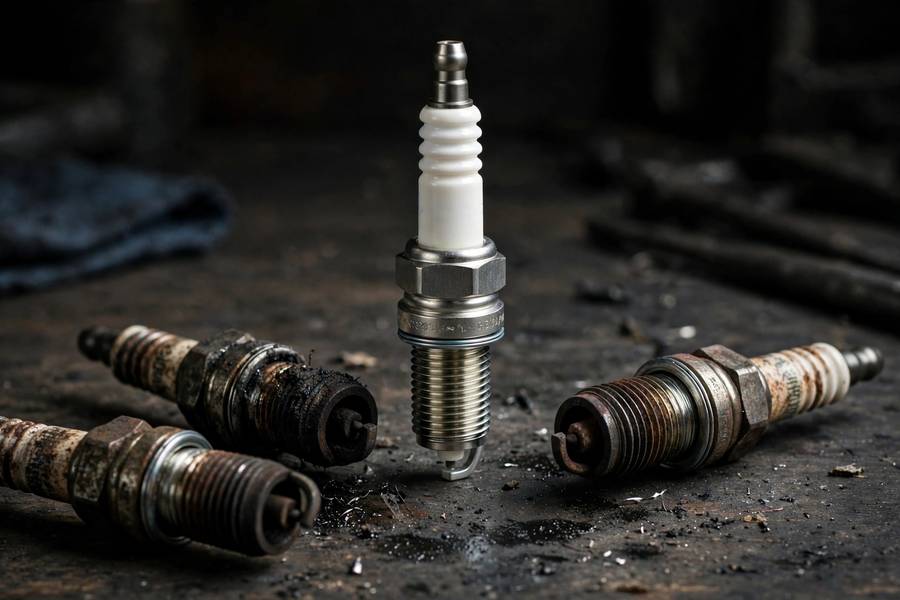
The new plug fires crisply at low voltage. The old plugs need higher voltage to jump their eroded gaps. The coils are all the same age, putting out the same energy — so the old-plug cylinders are working their coils harder. You’ve created an imbalance: one cylinder coasting, the rest straining. The engine runs, and it might even feel better than before (one good cylinder beats zero), but it’s a half-fix.
Worse, the underlying wear continues. Those old plugs keep eroding. In a few months, you’re back where you started, except now your plugs are different ages and you can’t remember which is which. I’ve opened engines to find three different plug brands of three different ages — the archaeological record of someone’s “just the bad one” strategy. Every one of those cars ran worse than a car with a uniform worn set.
There’s one more subtle issue: some engines are picky about plug characteristics, and mixing brands or heat ranges across cylinders can cause real drivability quirks. A uniform set eliminates an entire category of variables.
When It’s OK to Replace Fewer
Honest exceptions, because they exist:
You just did the full set recently. If all plugs were replaced 10,000 miles ago and one fails early (defective plug, cracked insulator from installation, oil fouling from a new leak), replace just the failed one — with the identical part number. The rest have nearly full life left. This is the most common legitimate exception.
Staged by access, finishing the job. Like the V6 example above: do the hard ones when they’re exposed, the easy ones soon after. The key is that you actually finish — “soon after” means weeks, not years. Put it on the calendar.
You’re diagnosing, not repairing. Sometimes I’ll install one new plug in a suspect cylinder as a test — if the misfire moves or clears, I’ve confirmed the plug was the issue. But that’s a diagnostic step, and the repair that follows is still a full set.
Money is genuinely tight right now. I’d rather see a customer replace the two worst plugs today and the rest next month than drive on misfiring plugs indefinitely. A misfiring engine damages the catalytic converter, and that’s a four-figure repair. Partial now beats perfect never — just don’t mistake it for done.
What doesn’t count as an exception: “the other plugs look fine.” Looks don’t measure electrode erosion or gap growth. If they’re at the mileage interval, they’re done — pretty tan insulators and all.
What About the Coil Packs?
This comes up every time, so let’s settle it: coils are not plugs, and they don’t follow the same rule.
Coil packs (or coil-on-plug units) typically outlast plugs by a wide margin and fail individually rather than as a set. A healthy coil at 100,000 miles is usually fine to keep. I test coils — resistance checks, or simply watching for misfire codes — and replace only the failures. Preemptively replacing all coils with every plug change is a $300–600 upsell that most cars don’t need.
The parallel I do endorse: like plugs, some wear items are genuinely better done as a set. Batteries, for instance — if your car has how long car batteries last on your mind because yours is aging, the same “they’ve all lived the same life” logic applies to dual-battery setups. But coils? Test, don’t guess. If a shop insists on all new coils with no test data and no codes, ask them to show you what your check engine light means on your specific car first — a healthy engine with no misfire codes doesn’t need $500 in coils.
My Shop Rule
Here’s what I tell every customer, and what I’d tell you: plugs are a set, coils are individuals. Replace all the plugs, every time, with identical parts. Test the coils and replace only what fails. Write the mileage on the receipt or in your phone so you know when they’re due next.
The full set costs little more, takes little longer, runs better, diagnoses cleaner, and keeps you out of the shop for the full interval. It’s one of those rare cases where the thorough option and the cheap option are the same option. Take it.
And when you do the job — yourself or at a shop — the procedure that makes it last is in my guide to how to change spark plugs: cold engine, hand-thread, gap check, torque to spec. A full set installed right is good for 100,000 miles of not thinking about it. That’s the real payoff.
Frequently Asked Questions
Yes. All plugs have lived the same life and wear out together — if one has failed, the rest are close behind. Replacing the full set costs little more in parts, avoids repeat labor, keeps combustion even across cylinders, and gives clean diagnostics next time.
You can, and it’s acceptable when the rest of the set was replaced recently and one fails early — use the identical part number. But as a general practice, single-plug replacement leads to repeat visits, since the remaining old plugs fail soon after. Partial replacement is a stopgap, not a strategy.
Not automatically. Coils typically outlast plugs and fail individually. Have them tested and replace only failures — preemptive full-set coil replacement without test data or misfire codes is usually an upsell. Plugs are a set; coils are individuals.
It’s not ideal. Different brands can have slightly different spark characteristics and heat ranges even when “equivalent,” which can cause uneven running in sensitive engines. Always use identical plugs — same brand, same part number — across all cylinders.
Copper: 20,000–30,000 miles; platinum: 60,000–100,000 miles; iridium: 80,000–120,000 miles. Always follow your owner’s manual interval, and replace the full set at the same time regardless of type.