How to Write a Mission Statement for a Business: Template + 10 Examples

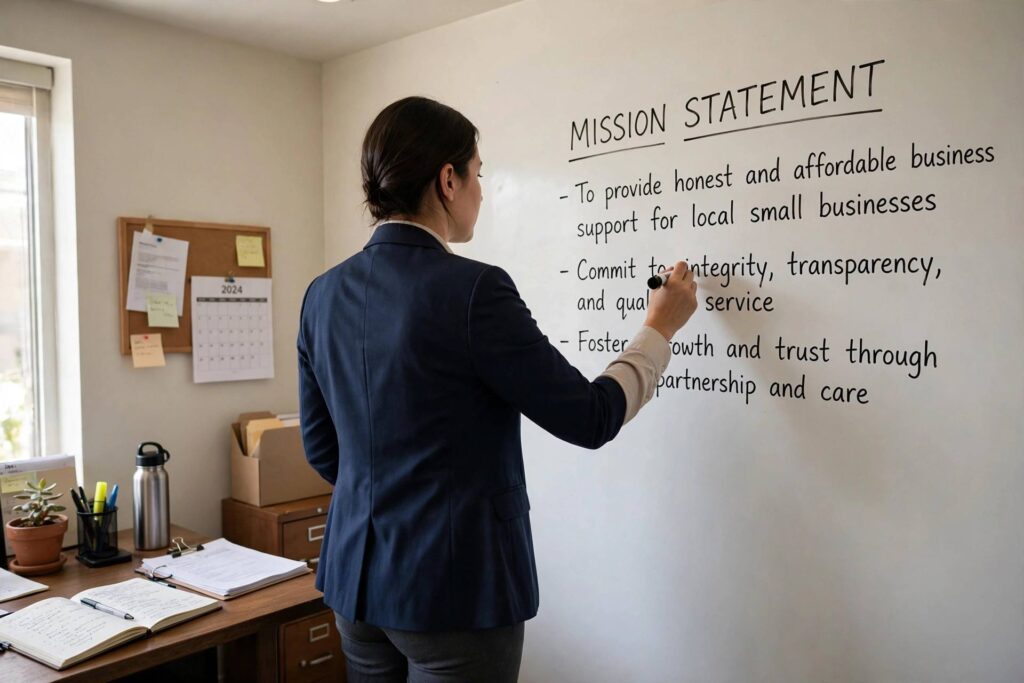
Most mission statements are either so vague they’re meaningless (“we strive for excellence”) or so long nobody can remember them. After helping dozens of small businesses sharpen theirs, I’ve learned that how to write a mission statement for a business isn’t really a writing problem — it’s a clarity problem. If you can’t say what you do, for whom, and why it matters in one breath, no amount of wordsmithing will save you. This guide gives you a fill-in template that forces that clarity, a test that exposes generic fluff, and ten annotated examples showing what good looks like across industries.
A mission statement has one job: to tell anyone — employee, customer, investor — what your business exists to do, in language they can repeat. It’s not a slogan (that’s marketing) and it’s not a vision statement (that’s the future). It’s not a slogan (that’s marketing — see tagline vs mission statement) and it’s not a vision statement (that’s the future). It’s the present-tense purpose, stated plainly.
The 15–30 Word Fill-in Template
Here’s the template. Fill in the brackets, then trim until it reads like a human said it:
We help [specific audience] [achieve what outcome] by [what you actually do], so that [why it matters].
Four slots, each doing real work. The audience forces you to name who you serve — “small retailers,” not “customers.” The outcome is the change you create, in the customer’s words. The what you do is your actual mechanism, stated concretely. The why it matters is the deeper reason — the part that makes employees care on a hard Tuesday.
Example, filled in: “We help independent bookstores stay profitable by handling their online orders and marketing, so that neighborhood book culture survives.” Twenty words. Anyone can repeat it. Now try yours — and be ruthless about specificity. Every generic word (“solutions,” “excellence,” “world-class”) is a place where meaning leaked out.
The Competitor-Name-Swap Test
Here’s the test that kills bad mission statements: swap your company’s name with your biggest competitor’s. If the statement still works, it’s generic and you need to start over.
“We deliver innovative solutions that exceed customer expectations” — works for literally any company on earth. Fail. “We help first-time homebuyers in Denver navigate bidding wars without overpaying, through flat-fee buyer representation” — swap in a competitor and it still names the same audience and mechanism, but at least it’s specific; the version that passes fully is one where the mechanism or audience is distinctively yours.
Run every draft through this test. It’s uncomfortable and it works. The statements that survive are the ones with a real point of view — and a point of view is exactly what makes a mission statement useful for decisions. When a new opportunity comes up, the team should be able to ask “does this fit our mission?” and get an answer. Generic statements never produce an answer.

10 Annotated Examples Across Industries
Study these not to copy, but to see the pattern — specific audience, concrete mechanism, memorable phrasing:
- Patagonia: “We’re in business to save our home planet.” Nine words. The “why it matters” IS the statement — and it genuinely drives decisions, including their famous “don’t buy this jacket” campaign.
- Tesla: “To accelerate the world’s transition to sustainable energy.” Audience implied (the world), mechanism named (acceleration through products). Ambitious but concrete.
- Southwest Airlines: “To connect people to what’s important in their lives through friendly, reliable, and low-cost air travel.” Longer, but every clause earns its place — especially “low-cost,” which is a strategic commitment, not fluff.
- Warby Parker: “To offer designer eyewear at a revolutionary price, while leading the way for socially conscious businesses.” Mechanism (price disruption) plus values (social consciousness) — matches their buy-a-pair-give-a-pair model.
- Starbucks: “To inspire and nurture the human spirit — one person, one cup and one neighborhood at a time.” The most poetic on this list; works because the company actually trains to it.
- LinkedIn: “To connect the world’s professionals to make them more productive and successful.” Audience + outcome, cleanly stated. Passes the name-swap test because “professionals” + “productive” is distinctively LinkedIn.
- Airbnb: “To create a world where anyone can belong anywhere.” Pure “why it matters” — and it directly shapes product decisions around belonging and trust.
- American Express: “To become essential to our customers by providing differentiated products and services to help them achieve their aspirations.” Corporate, but note “essential” and “aspirations” — it names a relationship, not just transactions.
- A local bakery (hypothetical): “We bake slow-fermented bread for our neighborhood, so busy families can eat well without thinking about it.” Small-business version: audience, mechanism, and care, in plain language.
- A freelance designer (hypothetical): “I help early-stage founders look fundable by designing pitch decks and brand systems that make investors take them seriously.” One person, total clarity — proof the template scales down.
Common Mistakes (and the Fix for Each)
- Mistake: Writing it by committee word-by-word. Committees produce mush. Fix: one person drafts, the group reacts and revises — never drafts together.
- Mistake: Confusing mission with vision. “To be the world’s leading…” is a vision (future state). Mission is what you do now. Fix: write in present tense.
- Mistake: Listing everything you do. A mission isn’t a services page. Fix: name the outcome, not the inventory.
- Mistake: Never testing it on a stranger. If a stranger can’t repeat it back after hearing it once, it’s too complex. Fix: the hallway test — say it to someone outside the business.
- Mistake: Filing it away. A mission statement in a drawer is decoration. Fix: put it where decisions happen — onboarding docs, the about page, the wall.
How to Write a Mission Statement for a Business in One Sitting
You don’t need a retreat or a consultant. Here’s the 60-minute workshop I run with clients:
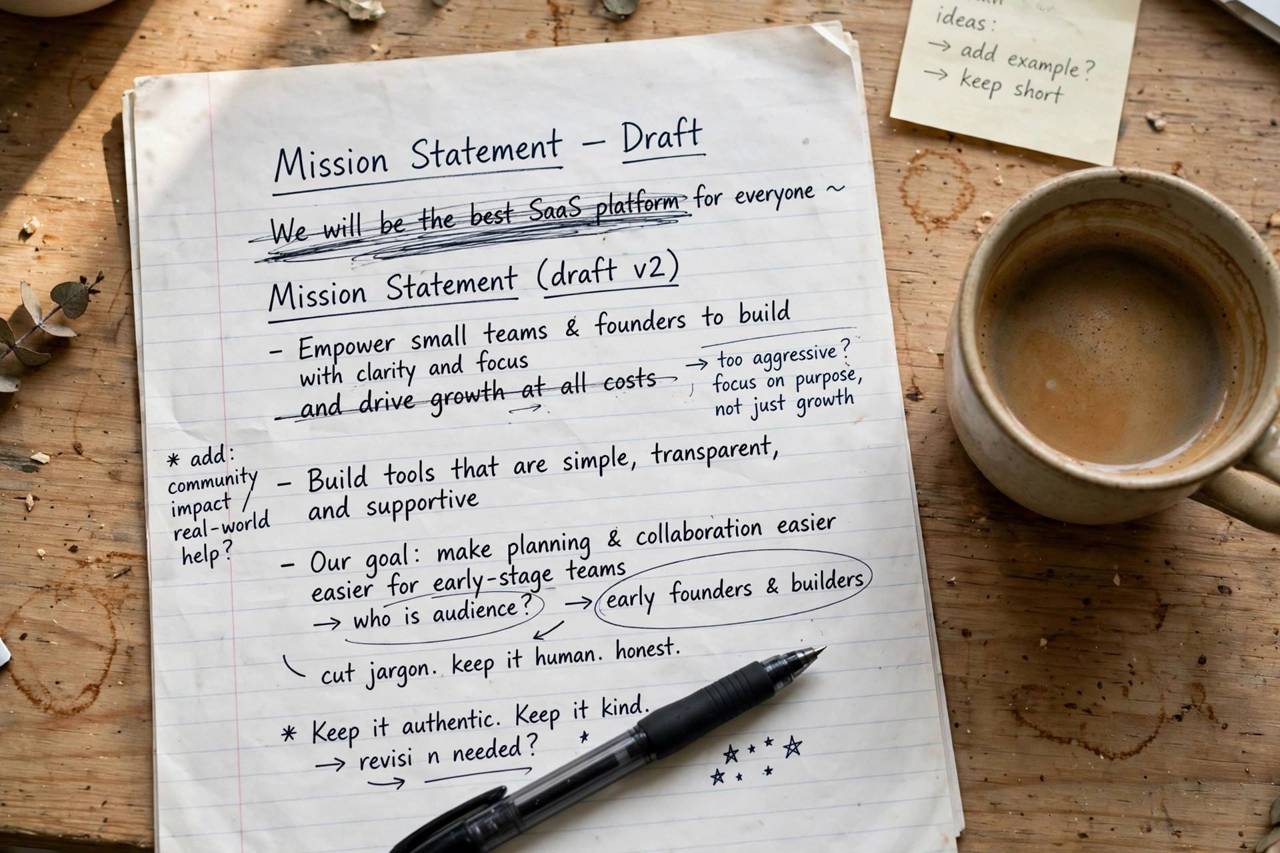
Minutes 0–15: Brain dump. Answer four questions on paper, no editing: Who do we serve? What changes for them because of us? What do we actually do all day? Why does that matter beyond money? Write badly — volume beats quality here.
Minutes 15–30: Circle and compress. Circle the most specific phrases from your dump. Cross out every generic word (“solutions,” “excellence,” “passionate”). You’re left with the raw materials — usually 10–15 honest phrases.
Minutes 30–45: Draft three versions. Force each into the template: “We help [audience] [outcome] by [mechanism], so that [reason].” Three versions, each under 30 words. They’ll be clumsy. That’s fine.
Minutes 45–60: Test and pick. Run each through the competitor-name-swap test and the hallway test (say it to someone outside the business — can they repeat it back?). Pick the survivor. Sleep on it, revisit tomorrow with fresh eyes, then commit. Done is better than perfect; a good mission used beats a perfect mission drafted for six months.
Mission Statements for Solo Founders and Freelancers
Everything above scales down — and solo operators need mission clarity more, because there’s no team to absorb fuzzy thinking. The template works identically; just write in first person and be concrete about the mechanism.
Examples: a freelance bookkeeper — “I help six-figure service businesses stay tax-ready year-round through monthly bookkeeping, so owners never dread April.” A solo web designer — “I build fast, no-template websites for trades businesses, so the phone rings instead of the contact form sitting empty.” Notice what’s doing the work: the audience is named, the mechanism is specific, and the outcome is in the customer’s language.
The freelancer’s version of the name-swap test: could any competitor in your niche claim it? If yes, your differentiator isn’t in the statement yet. And the usage test is the same — put it on your about page, your proposals, your LinkedIn headline. A mission statement you never look at is a journal entry, not a compass.
Testing Your Mission Statement in the Wild
A mission statement earns its keep in three real-world tests. The hiring test: read it to a candidate. Do the right people light up and the wrong people look confused? Good — it’s filtering, which is its job. The decision test: next time a tempting-but-off-brand opportunity appears, ask the room “does this fit our mission?” If the statement produces a clear answer, it’s working. If everyone shrugs, it’s decoration.
The customer test: put it on your about page and watch. Do customers quote it back? Do they mention it in reviews? A mission that resonates externally is doing double duty — aligning the team and attracting the right customers. If after six months nobody’s noticed it, the problem usually isn’t placement. It’s that the statement says nothing worth noticing. Rewrite it — you know how now.
Frequently Asked Questions
How do you write a mission statement for a business?
Fill in the template: “We help [specific audience] [achieve what outcome] by [what you do], so that [why it matters].” Keep it to 15–30 words, write in present tense, then run the competitor-name-swap test — if a rival could claim it, it’s too generic.
How long should a mission statement be?
Fifteen to thirty words is the sweet spot — short enough to remember and repeat, long enough to be specific. If it’s under ten words it’s probably vague; over forty and nobody will quote it.
What’s the difference between a mission statement and a vision statement?
Mission is present tense: what you do now and for whom. Vision is future tense: the world you’re working toward. Mission guides daily decisions; vision inspires long-term direction. You need both, but don’t blend them into one sentence.
What’s the difference between a mission statement and a slogan?
A mission statement is an internal compass stated plainly — it guides decisions. A slogan is external marketing — it’s crafted to be catchy. For the full breakdown, see slogan vs tagline vs motto and how to write a catchy tagline. “Just Do It” is a slogan; a mission statement explains why the company exists.
Should a small business have a mission statement?
Yes — arguably small businesses need them more, because every hire and every pivot is high-stakes. A clear mission keeps a small team aligned without bureaucracy. Keep it plain-spoken; small businesses earn no points for corporate grandeur.
How often should you update a mission statement?
Review it annually, change it only when the business genuinely changes — new audience, new core offering, new reason for existing. A mission that changes every year wasn’t a mission; it was a mood.
Learning how to write a mission statement for a business is really learning to say the true thing briefly. Fill in the template, survive the name-swap test, and put the result where your team will actually see it. The best mission statement isn’t the cleverest one — it’s the one people use.