How to Tell If Eggs Are Bad: 5 Tests Ranked Best to Worst

We have all stood in front of the open refrigerator, holding an egg past its date, wondering if it is still good. Throwing away perfectly fine eggs wastes money; using a bad one ruins breakfast and risks food poisoning. Here is how I actually think about how to tell if eggs are bad: five tests, ranked from most to least reliable, plus the shelf-life rules that make most of this unnecessary. I use these in my own kitchen, and they have never steered me wrong.
Quick context first: in the US, eggs are washed and must be refrigerated; in much of Europe, they are not washed and are stored at room temperature. The tests below assume refrigerated eggs, which is the US standard. If your eggs have been properly refrigerated the whole time, the date on the carton is conservative; eggs often stay good 3 to 5 weeks past the pack date.
Test 1: The Sniff Test (Most Reliable)
Crack the egg into a separate bowl (never directly into your batter or pan) and smell it. A fresh egg has almost no smell. A bad egg smells unmistakably of sulfur, rotten, wrong in a way your nose identifies instantly. This is the gold standard because the smell comes from the actual bacterial breakdown you are trying to detect. If it smells off in any way, discard it, no second opinions needed.
The separate bowl matters: one bad egg cracked directly into a bowl of cake batter ruins the whole batch. Always crack questionable eggs solo.
Test 2: The Float Test (Good, With Caveats)
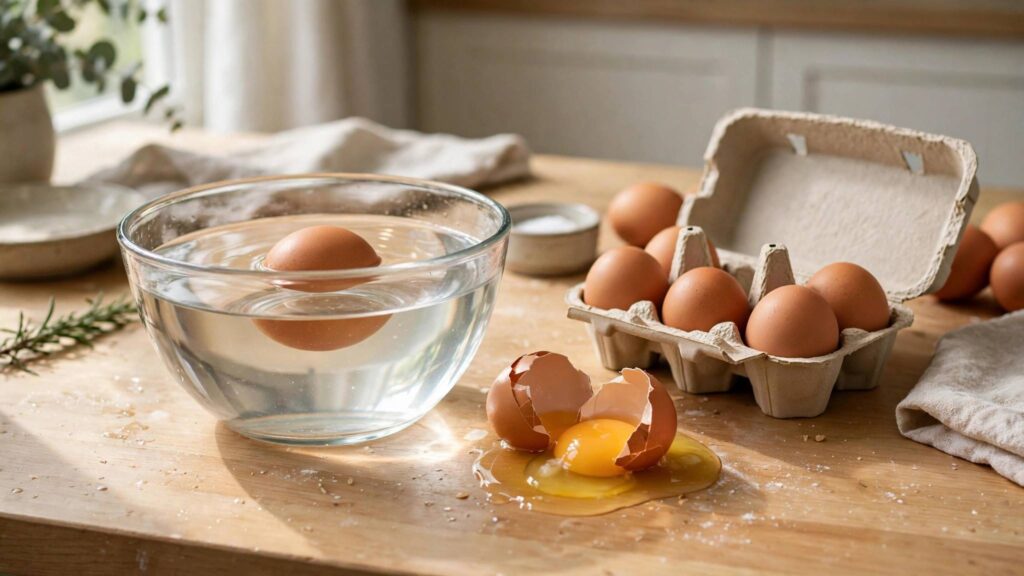
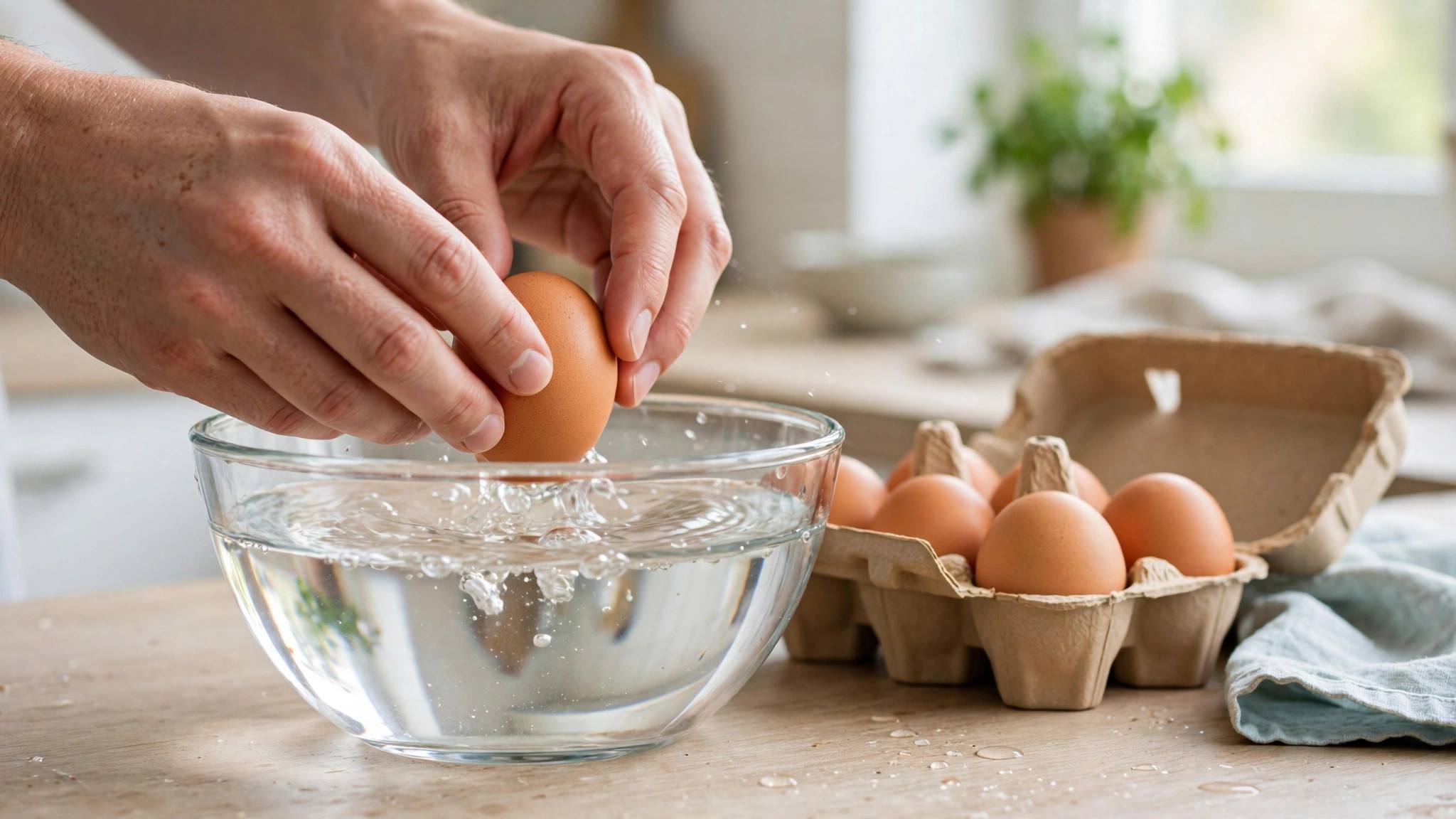
Fill a bowl with cold water and gently place the egg in it. A fresh egg sinks and lies flat on the bottom. A slightly older but still good egg sinks but stands upright or tilts. An egg that floats to the surface should be discarded.
Here is the science: eggshells are porous, and over time moisture evaporates out and air seeps in, enlarging the air cell inside. More air means more buoyancy. The test measures age, not safety directly; a floating egg is old, and old eggs are more likely to have bacterial issues, but float alone does not prove spoilage. That is why it ranks second: useful as a screening tool, but confirm with the sniff test.
Test 3: The Visual and Crack Inspection
Before cracking, check the shell: cracks, sliminess, or powdery spots suggest contamination or mishandling; discard cracked eggs unless you are certain the crack is fresh and the egg was refrigerated. After cracking into a bowl, look at the white and yolk. A fresh egg has a thick white that holds together and a yolk that sits high and round. An older egg has a thinner, runnier white and a flatter yolk, still safe if it smells fine, just less ideal for poaching or frying. Any pink, green, or iridescent discoloration in the white means bacterial contamination; discard immediately.
Blood spots, those small red dots occasionally found in yolks, are not a sign of spoilage. They are harmless and can be removed with a knife tip if they bother you.
Test 4: The Shake Test (Weakest, Use With Others)
Hold the egg to your ear and shake gently. A fresh egg makes almost no sound because the contents fill the shell. An old egg sloshes because the air cell has grown and the white has thinned. This test is quick but imprecise; it tells you the egg is old, not whether it is bad. Use it only as a rough screen alongside the other tests.
Test 5: The Date Check (Context, Not Verdict)
The date on the carton is usually a “sell-by” or “pack date,” not an expiration date. In the US, the pack date appears as a Julian date (the day of the year, 001-365) and eggs are typically good 3 to 5 weeks beyond it when continuously refrigerated. The date is useful context: an egg two weeks past pack date deserves the float and sniff tests; an egg two days past does not need interrogation. But the date alone never proves an egg is bad or good; storage conditions matter more.
How to Tell If Eggs Are Bad: Shelf-Life Table and Storage Rules
Keep this as your reference. All assume continuous refrigeration at 40°F or below:
Raw eggs in shell: 3 to 5 weeks from purchase (often past the carton date).
Raw egg whites: 2 to 4 days in a sealed container.
Raw egg yolks: 2 to 4 days, covered with a little water to prevent drying.
Hard-boiled eggs (in shell): up to 1 week.
Hard-boiled eggs (peeled): use the same day for best quality.
Egg dishes and casseroles: 3 to 4 days, following standard leftover rules.
Frozen beaten eggs: up to 1 year at 0°F (freeze whites and yolks separately; yolks need a pinch of salt or sugar to prevent gelling).
Note: do not freeze eggs in their shells; they expand and crack.
When to Throw Eggs Out (No Debate)
Discard eggs that: smell of sulfur or rot when cracked; show pink, green, or iridescent whites; have cracked shells with unknown history; were left at room temperature for more than 2 hours (US washed eggs); or float and smell off. When any single hard signal appears, do not negotiate with it. Eggs are cheap; food poisoning is not.
Storage Habits That Keep Eggs Fresh Longer
Store eggs in their original carton, not in the fridge door’s egg tray. The carton protects against odor absorption and moisture loss, and the door is the warmest, most temperature-variable spot in the fridge. Keep them on a middle shelf toward the back. Do not wash farm-fresh unwashed eggs until just before use; washing removes the protective bloom. And never leave eggs sitting out during a long brunch prep; the 2-hour room-temperature rule applies to eggs too.
Farm-Fresh, Unwashed, and Specialty Eggs
Not all eggs follow supermarket rules. Farm-fresh unwashed eggs still have their natural protective coating, called the bloom, which seals the shell’s pores. Unwashed eggs can be stored at cool room temperature for one to two weeks, or refrigerated for three months or more, but once you wash them, the bloom is gone and they must be refrigerated like store eggs, so do not wash farm eggs until just before use. Pasture-raised, organic, and free-range labels describe how the hens lived, not how long the eggs last; the same tests and timelines apply.
Duck, quail, and other specialty eggs follow the same principles with slightly different timelines: duck eggs have thicker shells and often keep a bit longer than chicken eggs, while tiny quail eggs are more perishable once cracked. Whatever the species, the sniff test remains the final judge, and continuous refrigeration remains the safest storage.
Egg Safety for Pregnancy, Kids, and Older Adults
For most healthy adults, a properly stored egg that passes the tests is fine. But for pregnant women, young children, older adults, and anyone immunocompromised, the stakes of foodborne illness are higher and the guidance is stricter. These groups should avoid raw or undercooked eggs entirely: no runny yolks, no homemade mayo or hollandaise with raw eggs, no raw cookie dough. Cook eggs until both yolk and white are firm, and cook egg dishes to 160 degrees Fahrenheit.
Pasteurized eggs, available in most supermarkets, are heat-treated to kill bacteria without cooking the egg, making them the safer choice for recipes that call for raw or lightly cooked eggs, from Caesar dressing to soft meringues. When cooking for vulnerable groups, pasteurized is the simple upgrade that removes the worry.
What Those Carton Labels Actually Mean
Egg cartons are covered in dates and claims, and most of them are not safety information. The Julian pack date (a three-digit number showing the day of the year) tells you when the eggs were packed; the sell-by date tells stores when to pull them, typically within 30 days of packing. Neither is an expiration date. “Grade A” and “Grade AA” describe quality (firmness of white, roundness of yolk), not safety or freshness timeline. “Farm fresh” is unregulated marketing. The only date that matters for safety is how long the eggs have been continuously refrigerated, which is why the float and sniff tests beat label-reading every time. When in doubt, remember the hierarchy: storage conditions first, tests second, labels last.
Frequently Asked Questions
Do eggs go bad if not refrigerated?
In the US, yes, relatively quickly: washed eggs must stay refrigerated and should not sit out more than 2 hours. In countries where eggs are sold unwashed with the protective bloom intact, room-temperature storage is normal and safe for a week or two.
Can you eat eggs past the expiration date?
Often, yes. The carton date is a sell-by or pack date, not a safety deadline. Properly refrigerated eggs are typically good 3 to 5 weeks past the pack date. Use the float and sniff tests to verify.
What does a bad egg smell like?
Distinctly sulfurous and rotten, unmistakable once you have smelled it. A fresh egg has virtually no odor. If you have to wonder whether the smell is bad, it probably is not; truly bad eggs announce themselves.
Is the float test accurate?
It accurately measures age (air cell size), which correlates with but does not prove spoilage. A floating egg is old and should be discarded as a precaution, but a sinking egg should still pass the sniff test. Use float as a screen, sniff as the verdict.
Can you freeze eggs?
Yes, beaten whole eggs, whites, and yolks (with a pinch of salt or sugar for yolks) freeze well for up to a year. Do not freeze eggs in their shells. Thaw in the refrigerator before use.
Are blood spots in eggs safe?
Yes. Blood spots are harmless and do not indicate fertilization or spoilage. Remove them with a knife tip if you like; the egg is perfectly safe to eat.
Final Thoughts
The egg decision tree is simple: check the date for context, float for age, crack into a separate bowl, look, and sniff. Five minutes of caution saves a ruined recipe and, more importantly, keeps your kitchen safe. When in doubt, throw it out; the hen will make more.