How to Prepare for a Spelling Bee: A Parent’s Guide That Works


Your child just qualified for the spelling bee, and now your kitchen table is buried under word lists. Take a breath — preparing for a spelling bee is a skill with a real method, not a vocabulary lottery. The parents whose kids go far share a secret: they do not try to memorize the dictionary. They study patterns, build systems, and treat preparation like athletic training — short, regular, and strategic.
This parent’s guide covers the full system: why you study spelling patterns instead of individual words, the index-card 3-pile method, how to run practice sessions in short bursts, how to hold mock bees, and the critical final-week rules (including why you learn no new words in the last three days). Whether it is a classroom bee or a regional competition, the method scales.
How to Prepare for a Spelling Bee: Study Patterns, Not Words
English spelling looks chaotic, but it is pattern-dense. The same roots, prefixes, and suffixes recur across thousands of words: ‘phon’ (sound) appears in telephone, symphony, phonics; ‘-tion’ ends countless nouns; Greek roots like ‘chron’ (time) unlock chronology, chronic, synchronize. A child who learns 50 roots effectively learns thousands of words — a child memorizing 500 random words learns 500 words.
Start with the highest-yield patterns. Latin and Greek roots (dict, scrib/script, port, ject, tract), common prefixes (un-, re-, pre-, dis-, mis-, anti-), and suffixes (-tion, -sion, -able, -ible, -ous, -ence/-ance). Then the notorious spelling demons as pattern groups: ie/ei words, silent letters (kn-, wr-, -mb), double consonants, and words where pronunciation lies (Wednesday, colonel, choir).
Etymology is the secret weapon of champion spellers. Knowing that ‘pneumonia’ comes from Greek pneuma (breath) makes the silent p logical instead of arbitrary. When studying a word, always learn three things: how it is spelled, what language it came from, and what it means. In competition, spellers may ask for language of origin and definition — and that information often unlocks the spelling. A word studied with its story is remembered; a word studied as letter soup is not.
The Index-Card 3-Pile System
Here is the study engine: write each study word on an index card (word on front, pronunciation + origin + definition on back). Sort cards into three piles. Pile 1 — Know Cold: spelled correctly twice in a row without hesitation. Pile 2 — Shaky: correct but slow, or missed once. Pile 3 — Unknown: missed or never seen.
The session rule: spend 70 percent of time on Piles 2 and 3, 30 percent reviewing Pile 1. Most families do the opposite — drilling words the child already knows because it feels good. It feels good and accomplishes nothing. The piles make the allocation visible and honest. Review Pile 1 weekly to prevent decay; promote and demote cards ruthlessly based on performance, not feelings.
Make the cards well: large clear print, syllable breaks marked (in·de·pend·ent), tricky letters highlighted or underlined, and the origin noted. The physical act of writing the card is itself a study repetition. Digital flashcard apps work too — and the Leitner flashcard method is essentially this 3-pile system formalized, worth reading if you want the science behind the scheduling.
Short Bursts, Not Marathons: The Practice Schedule
Spelling practice follows the same motor-learning rules as music practice: short, frequent sessions beat long slogs. Aim for 20-30 minutes daily, broken into two 10-15 minute blocks if attention wanders. Six days a week beats a three-hour Sunday session by a wide margin — spaced repetition is the most replicated finding in learning science.
Structure each session the same way. Minutes 1-5: warm-up on Pile 1 (confidence builder). Minutes 5-20: attack Piles 2 and 3 — pronounce, spell aloud, write, check. The multi-sensory loop (hear it, say it, write it, see it) encodes the word through multiple channels. Minutes 20-25: quick retest of the session’s words. End with two or three easy wins — sessions should end with confidence, not tears.
Build the schedule backward from competition day. Eight weeks out: patterns and roots. Six weeks: word lists by difficulty, building the card system. Four weeks: mixed practice plus first mock bees. Two weeks: weak-spot targeting from mock results. Final week: see below — it has its own rules. Adjust for your timeline, but keep the proportions: foundations first, pressure simulation last.
How to Run a Mock Bee (This Is Where Champions Are Made)
Reading words silently is not the skill being tested — spelling aloud under pressure is. Mock bees simulate the real thing, and they are the highest-value preparation you can do. Hold one weekly in the final month, more often in the final two weeks.
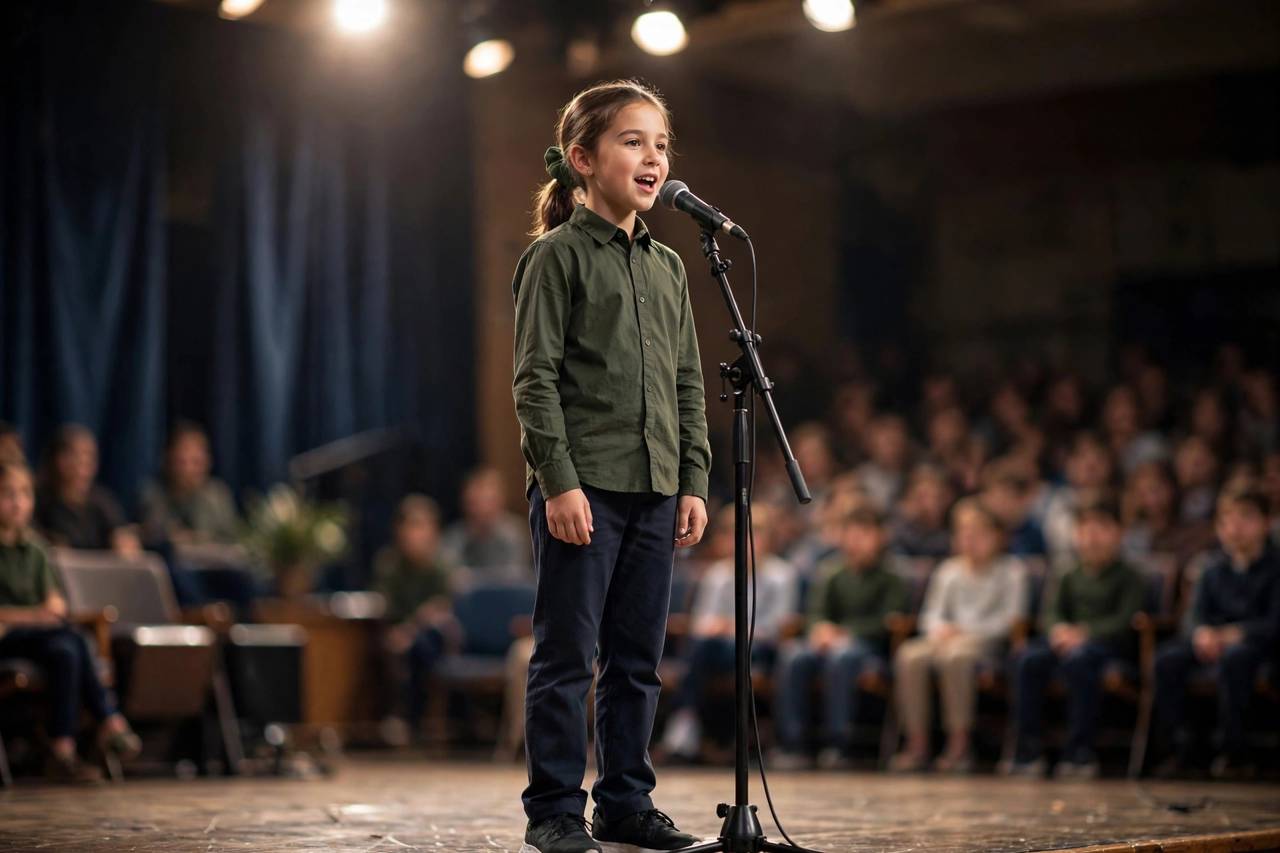
Run it properly: the child stands, you pronounce the word clearly, use it in a sentence, pronounce it again — exactly like competition protocol. Teach the competition routine explicitly: repeat the word, ask for definition/language of origin if unsure (this is allowed and smart), spell slowly and clearly, then say the word again to signal finishing. Many bees are lost on procedural errors — spelling too fast, forgetting to confirm — not on knowledge.
Simulate pressure gradually. Start with just family, then add an audience (grandparents on video call count), then add mild stakes (pick the Friday dinner if you clear the round). Teach the reset ritual for mistakes: one deep breath, shoulders down, next word. Spellers who ruminate on a missed word miss the next three. The skill is not never missing — it is missing and recovering instantly.
Track mock results by pattern, not just score. If your child misses three Greek-origin words, that is a study directive: Greek roots week. The mocks are diagnostic instruments — use them that way.
The Final Week: No New Words, Only Sharpening
The final seven days have strict rules, and the most important one: learn no new words in the final three days. New words learned under pre-competition anxiety do not consolidate — they create confusion and shake confidence in what is already known. The hay is in the barn. Trust the training.
Final week schedule: days 7-4 before — light review of Pile 2, one mock bee, early nights. Days 3-1 — only Pile 1 review and familiar words, short sessions (15 minutes max), no mocks. The goal is arriving confident and rested, not crammed. Sleep matters enormously for recall — protect it fiercely the last three nights.
Pack a ‘calm kit’ the night before: water, a quiet snack, a familiar book for waiting periods, and a sweater — competition rooms are always freezing. Waiting is the hardest part of bee day; having something absorbing to do between rounds keeps nerves from spiraling. Arrive early enough to get comfortable with the room, the microphone height, and the sound of your own amplified voice.
Competition day logistics: arrive early, bring water and a quiet snack, dress comfortably, and have the reset ritual rehearsed. Remind your child of the only two goals that matter: use the full routine on every word, and recover instantly from any miss. Placement is not in their control; process is. Kids who focus on process outperform kids who focus on winning — and enjoy it more, which is rather the point.
What to Do After the Bee (Win or Lose)
Afterward, celebrate the preparation regardless of outcome. A child who studied systematically for eight weeks has built study skills, etymology knowledge, and composure under pressure that transfer to every academic challenge ahead. Name those gains explicitly — kids often cannot see them through disappointment.
Do a gentle debrief a few days later, not that night: what study methods worked, what would you change, which patterns were hardest? Write it down. If there is a next year, this debrief is gold. If not, the study system itself — patterns over lists, spaced short sessions, pressure simulation — is a template for learning anything.
And keep perspective visible. Spelling bees reward a specific, narrow skill. They do not measure intelligence, worth, or future success. The families who enjoy the process — the weird words at dinner, the shared triumph of a mastered list — get the real prize whatever the placement. For broader exam preparation beyond spelling, our guide to studying for final exams applies the same science to every subject.
Frequently Asked Questions
How many words should my child study for a spelling bee?
Quality over quantity: 300-500 well-studied words (with origins and patterns) beats 2,000 skimmed words. For school bees, the provided study list plus pattern work suffices. For regional bees and beyond, expect to work through several hundred words systematically with the 3-pile method.
What age should kids start preparing for spelling bees?
Serious preparation typically starts around 3rd-4th grade (ages 8-10), when reading fluency supports etymology study. Before that, the best preparation is simply reading widely — vocabulary and pattern exposure through books outperforms drilling for young children.
Are spelling bee word lists available online?
Yes — organizations like Scripps publish study resources (their ‘Words of the Champions’ list is the standard starting point for the U.S. National Spelling Bee pathway). School and regional bees usually provide their own lists. Start with the official list for your competition level.
My child freezes on stage. How do I help?
Practice the physical routine until it is automatic: deep breath, repeat the word, ask for information if needed, spell slowly. Gradually increase mock audience size. Teach self-talk (‘I know how to do this — one word at a time’). And normalize missing — champions miss words in practice constantly; composure after a miss is the trained skill.
Is it okay to hire a spelling coach?
For higher competition levels, coaches are common and can help with advanced etymology and strategy. For school-level bees, parent-led preparation with this system is plenty. Do not outsource the fun parts — the shared study time is valuable bonding regardless of who leads it.
The Bottom Line: Patterns, Piles, and Poise
Spelling bee preparation is a system: study word patterns and etymology instead of memorizing lists, run the index-card 3-pile method in short daily bursts, simulate pressure with mock bees, and lock in confidence with a calm final week — no new words in the last three days.
Start tonight: pick twenty words, make the cards, sort the piles. The system does the rest.