How to Do Step Ups Correctly: Form, Height & Mistakes

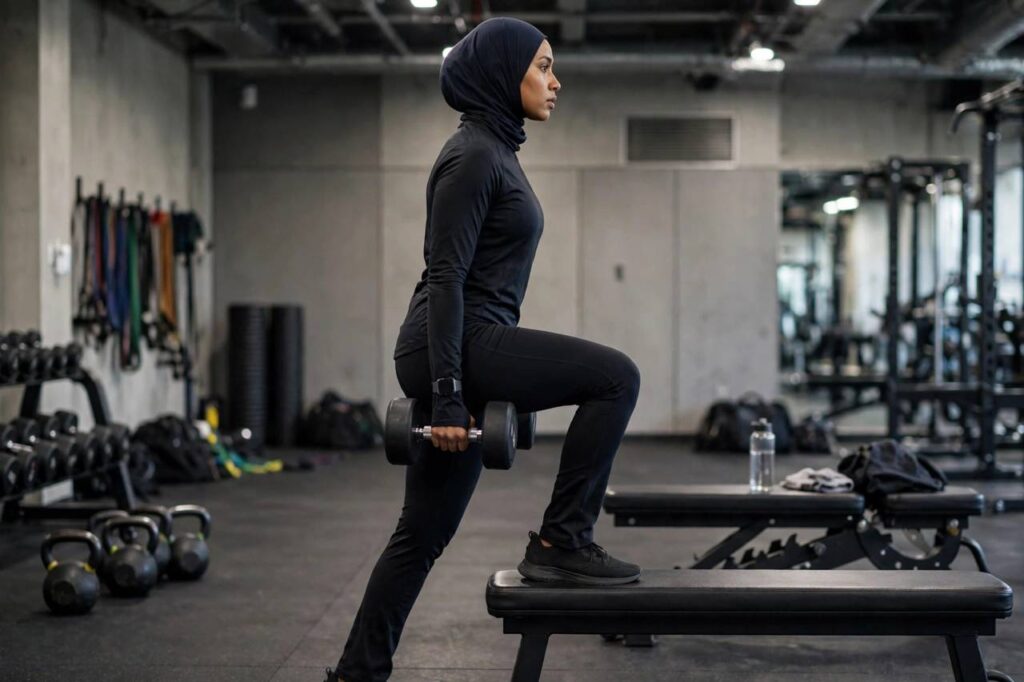
The step up is the most underrated leg exercise in the gym. It builds single-leg strength, torches the glutes, fixes left-right imbalances, and carries over to stairs, hiking, and sports better than almost any machine. But most people do it as a cardio bounce — pushing off the back foot, slamming down, wondering why their quads never feel it. Here’s how to do step ups correctly, from foot placement to step height to the descent nobody talks about.
I’m Jake, and I program step ups for nearly every beginner I train. They’re joint-friendly, self-limiting (you can’t really go too heavy before form breaks down), and they expose weaknesses fast. Let’s make every rep count.
How to Do Step Ups Correctly: The Technique
- Choose your step. A bench, box, or sturdy chair — start with something around knee height (more on height below). It must not wobble.
- Place the whole foot. Put your entire working foot on the step, heel to toe. Hanging the heel off is the classic error — it kills your drive.
- Drive through the heel. Press through the heel of the working leg to stand up. Think about pushing the step down into the floor rather than lifting your body up.
- Don’t push off the back foot. The trailing leg should come up with minimal assistance — it’s along for the ride, not doing the work. A good cue: keep the back toe pointed down and barely touching, or hover it an inch off the floor.
- Stand tall at the top. Fully extend the hip — squeeze the glute at the top. Don’t just stand up; finish the rep.
- Lower with control. Reverse the movement over two to three seconds, hinging slightly at the hip as the back foot reaches for the floor. The descent is half the exercise.
Do all reps on one leg, then switch. Alternating legs each rep turns it into cardio; staying on one side keeps the tension where it belongs.
Choosing the Right Step Height
Height changes everything about this exercise:
- Knee height (beginner): Thigh roughly parallel to the floor at the start. This is the standard — challenging but controllable.
- Below knee (regression): A low step or aerobic platform. Use this if you can’t keep the back foot quiet or your knee caves.
- Above knee (advanced): A higher box shifts more work to the glutes and demands serious single-leg strength. Only progress here when knee-height reps are crisp.
The test: if your knee collapses inward or you have to launch off the back foot, the step is too high. Drop it down and own the lower height first. Ego is the enemy of the step up.
Knee Tracking: The Detail That Protects Your Joints
Watch your working knee in a mirror or film yourself from the front. The knee should track in line with the second and third toes throughout the rep — no caving inward, no wobbling. If it caves:
- Actively think “knees out” on every rep.
- Slow the tempo down — most caving happens when people rush.
- Drop the step height or the weight.
Persistent caving despite these fixes usually means weak glute medius — the muscle that stabilizes the hip. That’s useful information, not a failure. It tells you what to train.
Programming Step Ups
Step ups are a compound lower-body movement — quads, glutes, and hamstrings all working together, which is why they belong in the compound vs isolation exercises category rather than the isolation bucket. Program them accordingly:
- Strength focus: 3–4 sets of 6–8 reps per leg, holding dumbbells, resting 90 seconds between sets.
- Muscle/hypertrophy focus: 3 sets of 10–12 reps per leg, moderate weight, controlled 2–3 second descents.
- Conditioning finish: 2 sets of 15 reps per leg, bodyweight, minimal rest. Your lungs will file a complaint.
Twice a week is plenty. And if you’re assembling a full no-equipment leg day around this movement, bodyweight exercises has the complete exercise library — step ups pair beautifully with split squats and glute bridges.

Common Step Up Mistakes
Pushing off the back foot. The number one cheat. If your back leg is doing calf raises to help, the working leg isn’t working. Lighten the load and fix it.
Slamming the descent. Dropping down fast skips the eccentric phase — where a huge share of muscle-building happens — and hammers the joints. Control it.
Half foot on the step. Toes-only placement kills heel drive and destabilizes the ankle. Whole foot, every rep.
Leaning too far forward. A slight forward torso angle is fine and even shifts work to the glutes, but folding over turns it into a different exercise. Keep the chest proud.
Alternating legs every rep. Fine for warm-ups; suboptimal for building strength. Do one side completely, then the other.
Step Up Variations
- Weighted step ups: Dumbbells at your sides (easiest to bail) or a barbell on your back (advanced).
- Lateral step ups: Step up from the side — hits the glute medius and adductors differently.
- Step up with knee drive: At the top, drive the trailing knee up to hip height and pause. Adds hip flexor work and a balance challenge.
- Deficit reverse step up: Start standing on the box and step down backward slowly — an eccentric overload tool for advanced trainers.
Step Ups vs. Lunges vs. Split Squats
These three get compared constantly, and each wins in different situations:
Step ups are the most knee-friendly of the three for most people, because the working leg stays planted and the movement is purely vertical — no forward knee travel under load like a lunge. They’re also the best at exposing left-right imbalances, since each leg works in total isolation.
Lunges load the quads through a bigger dynamic range and challenge balance more, but the forward step creates shear forces that bother sensitive knees. They’re the better choice if your goal is athletic, multi-directional leg strength.
Split squats (including Bulgarian split squats) allow the heaviest loading of the three — you can really pile on weight — but they demand more balance and hip flexor mobility.
My programming rule: beginners start with step ups, intermediates rotate all three across the training week, and anyone with cranky knees leans on step ups as the primary unilateral lift. They’re not competing exercises — they’re a toolkit.
Sample Step Up Workouts
Beginner (bodyweight, 15 min): Knee-height step. 3 sets of 10 reps per leg, 2-second lowering phase, 60 seconds rest between legs. Focus on zero back-foot assistance — if you need the push-off, the step is too high.
Intermediate (dumbbells, 25 min): 4 sets of 8 per leg with challenging dumbbells, 90 seconds rest. Superset with Romanian deadlifts (3×10) for a complete lower-body session — quads and glutes from the step ups, hamstrings and glutes from the hinges.
Advanced (heavy, 30 min): Barbell step ups, 5 sets of 5 per leg, full 2-minute rests. Treat it like a primary strength lift: warm up thoroughly, load progressively, and stop the set when the back foot starts helping. Follow with single-leg calf raises and core work.
Conditioning finisher (8 min): Bodyweight step ups with knee drive, 30 seconds per leg, no rest between sides, 4 rounds. Your heart rate will tell you this counts as cardio.
Step Ups for Knee-Friendly Training
Step ups have a well-earned reputation as the unilateral lift for people with knee history. The reasons: no impact (unlike lunges or step-downs), a vertical force path, and complete control over range of motion via step height. You can also unload them precisely — holding a rack for light assistance lets you train the pattern while rebuilding confidence.
Guidelines if your knees are sensitive: start with a low step (well below knee height), keep reps slow and controlled, and prioritize the eccentric — research consistently shows slow lowering builds the tendon resilience that protects joints. Mild muscular discomfort around the knee is normal; sharp pain inside the joint is a stop signal. As always, this is general fitness information, not medical advice — persistent issues deserve a professional assessment.
Advanced Overload Methods
Once dumbbell step ups get easy, you have options beyond just heavier dumbbells:
- Front-rack loading: Kettlebells or dumbbells held at the shoulders shift your center of mass forward, increasing quad demand and torching the core.
- Tempo manipulation: Try a 4-second lowering phase with a 2-second pause at the bottom. Time under tension skyrockets without adding a pound.
- 1.5 reps: Step up fully, lower halfway, step back up, then lower completely — that’s one rep. The extended time in the hardest range is brutal.
- Deficit step ups: Stand on a low platform and step up to a higher box, increasing the range of motion and the stretch on the glutes.
FAQ
Are step ups better than lunges?
Neither is universally better. Step ups emphasize the glutes and are easier on the knees for many people; lunges load the quads more dynamically. Both deserve a place in a complete program.
How high should the step be for step ups?
Start at roughly knee height — your thigh should be about parallel to the floor when your foot is on the step. Go lower if your form breaks down, higher only when knee-height reps are perfect.
Should step ups be done with weights?
Start with bodyweight until the movement is clean, then add dumbbells. The exercise scales beautifully with load — many strong lifters do heavy weighted step ups as a primary lift.
Do step ups work glutes or quads more?
Both, with the emphasis shifting by step height: higher steps bias the glutes, lower steps bias the quads. Either way, it’s a compound movement hitting the whole lower body.
Why does my knee hurt during step ups?
Most often it’s the step being too high, the knee caving inward, or uncontrolled descents. Fix those three things first. Persistent pain deserves professional assessment — this is general fitness information, not medical advice.
Master the heel drive, own the descent, and pick a height your form can handle. Do that, and the step up goes from forgettable filler to one of the best exercises in your program — the unilateral lift your knees will thank you for, week after consistent training week.