Due Diligence Checklist When Buying a Business: 2026 Guide


Due diligence is where acquisitions are won or lost. I’ve seen buyers uncover $200,000 in hidden liabilities during diligence and renegotiate the price accordingly — that’s a $200,000 return on a few weeks of work. I’ve also seen buyers skip diligence to ‘move fast’ and inherit problems that cost ten times what proper review would have.
The misconception is that due diligence is about finding reasons to kill deals. It’s not. It’s about pricing risk accurately. Almost every issue you find has a price — the question is whether the seller’s price reflects it. Diligence gives you the information to answer that.
Here’s the complete framework: what to check, in what order, and the deal-killers hiding in each category.
Financial Due Diligence: Follow the Money
Start with three years of tax returns, profit & loss statements, and balance sheets — then reconcile them against each other. Discrepancies between tax filings and management accounts are the single most informative finding in financial diligence: they reveal either aggressive tax positions or inflated selling numbers, and you need to know which.
Normalize earnings by adjusting for owner perks: add back personal vehicles, family salaries above market, one-time expenses, and below-market rent (if the seller owns the building). Then subtract what a real operator would pay. The normalized seller’s discretionary earnings (SDE) is the number you’re actually valuing — everything else is presentation.
Verify cash flow with bank statements. Twelve months of statements, matched to reported revenue month by month. Cash is the hardest thing to fake consistently, which makes it the most reliable verification tool you have. If deposits don’t match claimed revenue, stop everything until it’s explained.
Examine revenue quality, not just quantity. Break revenue by customer, product line, and month. Look for: customer concentration (top 3 customers over 40% of revenue is fragile), declining trends masked by one good quarter, and one-time spikes presented as recurring growth. A business doing $1M with 50 diverse customers is worth more than one doing $1.2M with three — and the multiple should reflect it. business broker guide
Legal Due Diligence: The Paper Trail
Confirm clean ownership first: no undisclosed partners, no liens on assets (run UCC searches), no pending ownership disputes. You’d be amazed how often ‘100% ownership’ turns out to be 70% with a silent partner who disagrees with the sale.
Review every material contract: customer agreements (are they assignable to a new owner, or do key customers have termination-on-change-of-control clauses?), supplier contracts, the commercial lease (remaining term, renewal options, assignment provisions — for location-dependent businesses, the lease IS the business), loan agreements, and equipment leases.
Check litigation, regulatory, and tax standing: pending lawsuits, threatened claims, regulatory violations, tax liens, and environmental exposure (non-negotiable for manufacturing, automotive, dry cleaning, or any business with underground tanks — get a Phase I environmental assessment). One undisclosed liability can exceed the entire purchase price.
Verify licenses and permits are current and transferable. Some — liquor licenses, certain professional certifications, government contracts — don’t transfer automatically. Factor reapplication timelines into your closing schedule, or you might own a business you can’t legally operate for months. For the acquisition overview, my buying guide puts legal diligence in the full process context.

Operational Due Diligence: How It Really Runs
Spend real time in the business before closing. Work alongside the team for several days — with the seller’s permission, framed as transition planning. You’ll learn more in three days of observation than three weeks of document review: who actually runs things, where the bottlenecks are, what the culture feels like, and what employees won’t say in front of the owner.
Map the key-person dependencies. If the business collapses when two specific people leave, you’re not buying a business — you’re buying two employees’ goodwill. Your retention plan (bonuses, contracts, equity participation) for key staff should be drafted before closing, not after they resign.
Audit the systems: what software runs operations, is it licensed and transferable, how current is it, and what happens if it goes down? I’ve seen acquisitions where the ‘proprietary system’ was an Excel file on the seller’s laptop and the ‘CRM’ was a notebook. Technology gaps aren’t deal-killers, but they must be priced into your first-year investment plan.
Evaluate the supplier base: concentration risk (single supplier = single point of failure), relationship stability, pricing trends, and whether terms will continue under new ownership. Call key suppliers directly — their candor about the business is invaluable diligence you can’t get from documents.
Commercial Due Diligence: The Market Reality
Interview 8–12 customers directly. Ask: why do you buy from this business? What would make you leave? How do we compare to alternatives? Customers tell buyers things they’d never tell sellers — use that information asymmetry while you have it. If customers are loyal to the seller personally rather than the business, that’s a transition risk you must manage.
Size the market honestly. Is the business growing with its market, or extracting the last value from a declining one? Check industry trends, local demographics, and competitive dynamics. A well-run business in a dying market is still a dying business — price it accordingly or walk away.
Assess the competitive moat with skepticism. ‘We’ve been here 20 years’ is not a moat. ‘Long-term contracts,’ ‘proprietary process,’ ‘exclusive territory,’ ‘deep customer integration’ — those are moats. If you can’t articulate why customers can’t easily switch, assume they can, and discount the valuation for that fragility.

The Deal-Killers: When to Walk Away
Some findings don’t adjust the price — they kill the deal. Walk away from: fraud or material misrepresentation in financials (if they lied about this, what else?); customer concentration above 60% with no mitigation; a lease expiring within 2 years with no renewal option in a location-dependent business; environmental liability that can’t be quantified; and key-person dependence with no retention path.
Also walk away from seller behavior red flags: rushing you to skip diligence, refusing document requests, getting defensive about standard questions, or changing the story between conversations. The diligence process is itself a test — of the business and of the seller. How they handle scrutiny predicts how the transition will go.
The hardest walk-away is the emotional one: you’ve spent $15K on diligence and two months of weekends, and the deal is marginal. Walk anyway. Sunk costs are sunk. A mediocre deal you close is worse than a good deal you never find, because the mediocre one consumes the time and capital you needed for the good one.
Diligence Timeline and Team
Realistic timeline: 4–8 weeks for most small business acquisitions. Week 1–2: document collection and initial financial review. Week 3–4: deep financial analysis, legal review begins, site visits. Week 5–6: customer/supplier interviews, operational assessment. Week 7–8: findings synthesis, renegotiation, final decision.
Your team: a CPA experienced in acquisitions (not just tax preparation), a business acquisition attorney (not a generalist), and ideally an industry advisor who knows the business type. Total professional cost: $10K–$30K for most deals under $2M. That’s 1–3% of the purchase price to avoid a 100% mistake — the best ROI in the entire transaction.
Manage the process actively. Set document deadlines, hold weekly check-ins with your team, and keep a running issues list with severity ratings. Diligence without project management becomes an expensive drift. You’re the CEO of this process — act like it. And structure the resulting entity properly from day one with my LLC formation guide.
Key Takeaways
Due diligence is profit-generating work: every issue found before closing is either a price reduction or a reason to walk away. Cover financial (reconcile everything, verify cash), legal (contracts, liens, licenses), operational (key people, systems, suppliers), and commercial (customers, market, moat) dimensions.
Budget 4–8 weeks and $10K–$30K in professional fees. Walk away from fraud, extreme concentration, and seller evasiveness — no deal is better than a bad deal.
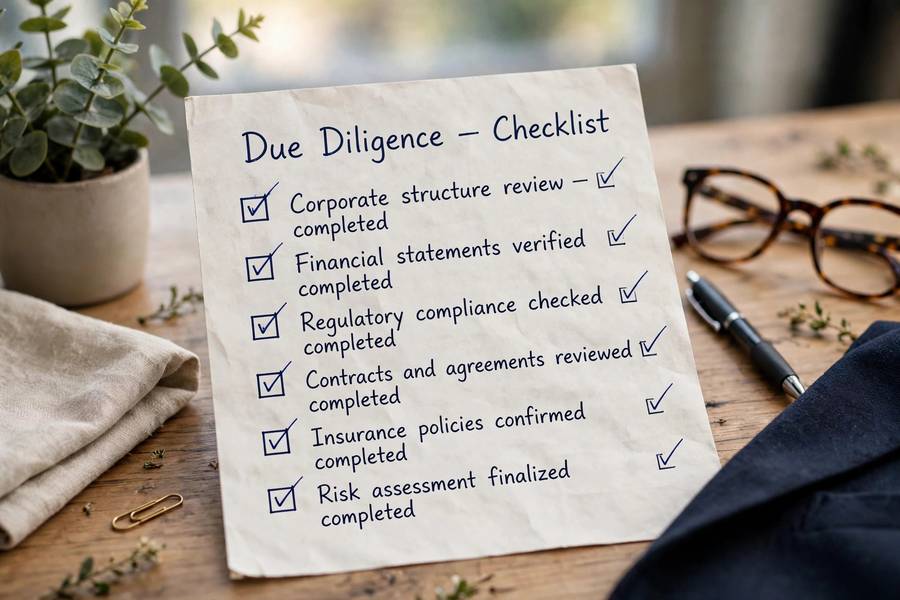
How to Organize Your Diligence Findings
Findings without organization are just anxiety. Here’s the system I use to turn diligence output into decisions.
The issues log. Every finding goes into a single log with four columns: issue description, severity (deal-killer / price adjustment / watch item / resolved), financial impact estimate, and owner (who’s resolving it). Review it weekly with your team. A 40-item log with 35 resolved items and 5 price adjustments is a healthy diligence process — it means the system is working.
Severity discipline. Most buyers miscategorize: they treat watch items as deal-killers (killing good deals) or price adjustments as watch items (overpaying for problems). The test: ‘Would I still buy if this issue is exactly as bad as it looks, at the current price?’ If yes, it’s a watch item. If only at a lower price, it’s an adjustment. If no at any price, it’s a killer. Be honest — the categories only work if you don’t cheat.
The renegotiation package. When diligence reveals issues worth pricing, present them as a package, not a drip-feed. One comprehensive adjustment request with documentation carries weight; five sequential complaints feel like bad-faith haggling. Quantify each item, propose specific adjustments (price reduction, seller note, escrow holdback, or warranty), and frame it as ‘making the deal work’ rather than ‘punishing the seller.’ Sellers respond to professionalism; they dig in against nickel-and-diming.
The investigation process before acquiring: verifying financials, legal standing, operations, and market position. Its purpose is pricing risk accurately — every issue found pre-closing is leverage for price adjustment or a reason to walk away.
4–8 weeks for most small business acquisitions: document review, financial analysis, legal checks, site visits, and customer interviews. Rushing it to ‘save the deal’ is how buyers inherit expensive problems.
Fraud in financials, customer concentration above 60%, expiring leases with no renewal, unquantifiable environmental liability, key-person dependence, and seller evasiveness about standard document requests.
$10K–$30K in professional fees (CPA, attorney, specialists) for deals under $2M — roughly 1–3% of purchase price. It’s the highest-ROI spending in the entire acquisition.