
The context window arms race suggests a simple story: bigger is better, limits are temporary, and eventually AI will just remember everything. The reality is more interesting — and more limiting. Big windows have fundamental constraints that don’t disappear with scale: how attention works, what comprehension means, what things cost, and what problems are simply different problems. Understanding these limitations matters more than celebrating the growing numbers, because the limitations shape what you can actually accomplish.
This guide covers the real constraints: technical, cognitive, economic, and conceptual. For the basics, see what a context window is.
Table of Contents
- Limitation 1: The Comprehension Gap
- Limitation 2: Lost in the Middle
- Limitation 3: Attention Dilution
- Limitation 4: The Cost Wall
- Limitation 5: Reasoning Doesn’t Scale With Memory
- Limitation 6: Garbage In, Garbage Everywhere
- Limitation 7: The Freshness Problem
- Limitation 8: What Windows Can’t Represent
- Working Within the Limitations
- Frequently Asked Questions
Limitation 1: The Comprehension Gap
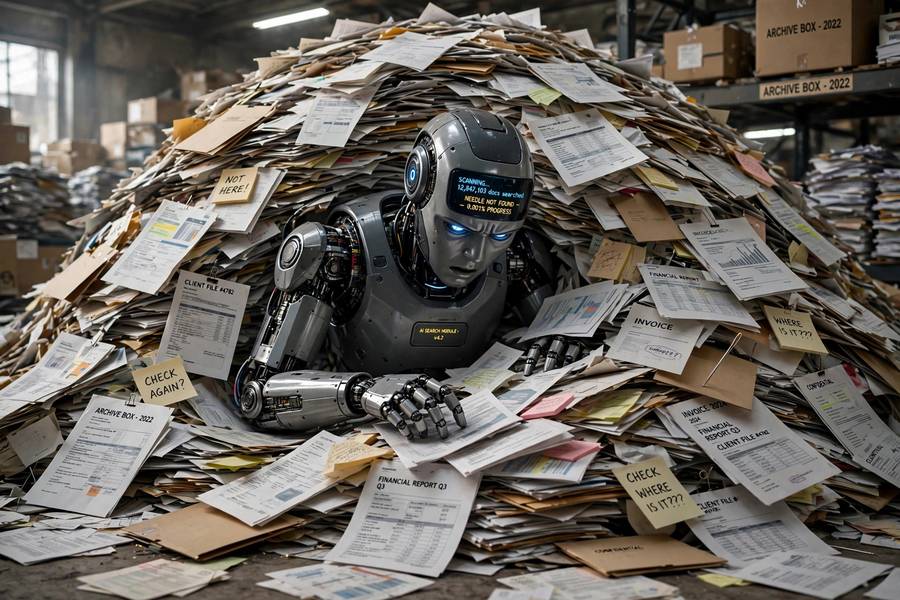
The most important limitation: accepting tokens isn’t understanding them. A model with a 1M-token window can process a million tokens — but “process” spans a spectrum from “technically attended” to “deeply comprehended,” and performance degrades along it.
The evidence: – Retrieval accuracy drops as context grows — finding specific facts gets harder in longer inputs. – Multi-hop reasoning (connecting A→B→C across the span) degrades faster than simple retrieval. – Instruction following weakens — the model forgets what you asked by page 200.
The gap between advertised window and effective comprehension is the single most misunderstood aspect of context windows. Users assume “fits” means “works well.” It doesn’t — it means “won’t error.” The distance between those is where expectations die.
Implication: test effective comprehension at your lengths with your content. Benchmarks and spec sheets don’t substitute for empirical verification.
Limitation 2: Lost in the Middle
The best-documented cognitive limitation: models systematically underuse information positioned in the middle of long contexts. Performance forms a U-shape — strong at the beginning (primacy), strong at the end (recency), weak in the middle.
Why it matters disproportionately: – It’s invisible. The model doesn’t warn you it’s ignoring the middle. It generates confidently from partial attention. – It scales with size. Bigger windows mean bigger middles — more territory where information goes to die. – It affects real tasks. The crucial clause on page 47 of the contract, the key finding in the middle of the report — exactly where important things hide in real documents.
Mitigations exist (strategic positioning, retrieval preprocessing, verification), but the limitation is architectural — a tendency of attention mechanisms, not a bug to patch. It improves with newer models but doesn’t disappear.
The deeper point: human cognition has the same primacy/recency pattern (serial position effect). The models mirror our biases — which is either comforting or concerning, depending on your perspective.
Limitation 3: Attention Dilution
Attention is finite. More tokens in the window means less attention per token — a straightforward resource constraint with real consequences:
Simple tasks get worse with unnecessary context. Asking a quick question with a 500K-token document attached often produces worse answers than asking with a focused excerpt — the model drowns in irrelevance.
The relevance imperative. Every irrelevant token isn’t neutral — it’s actively harmful, competing for attention the relevant tokens need. This is why curation beats accumulation.
The paradox of plenty. Having room for everything tempts including everything. But the best context is the minimal sufficient context — enough to ground the task, not so much it dilutes focus.
What this means: window size is a maximum, not a target. The discipline of using less than you could is counterintuitive but essential. Bigger windows require MORE discipline, not less — the temptation to stuff scales with capacity.
Limitation 4: The Cost Wall
The economic limitation is brutally simple: tokens cost money, linearly.
The arithmetic: a 1M-token query costs ~100x a 10K query. At production volumes, this dominates budgets. The “just include everything” approach that big windows enable is also the most expensive approach.
The hidden multipliers: output tokens cost more than input; repeated queries re-pay input costs (mitigated by caching, but never eliminated); development and testing multiply everything.
The organizational impact: teams discover that their impressive long-context prototypes are economically unviable at scale. The prototype-to-production gap is largely a cost gap — what works in demo bankrupts in deployment.
The consequence: cost forces the discipline that quality alone might not. RAG, careful curation, right-sizing — these aren’t just good practice, they’re economic necessities. The cost wall is why the “bigger is better” narrative meets reality.
Understanding how ChatGPT works as a business helps frame this — the pricing reflects genuine computational costs, not arbitrary markup.

Limitation 5: Reasoning Doesn’t Scale With Memory
A bigger workbench doesn’t make a better craftsman. The model’s reasoning capability — its ability to draw inferences, catch contradictions, think through implications — is largely independent of window size.
What this means: a model that can’t do multi-step reasoning with 10K tokens won’t suddenly reason well with 1M. It’ll just have more material to reason poorly about.
The confusion: demos conflate memory and intelligence. “It analyzed 500 documents!” impresses — but the analysis quality depends on reasoning ability, not just access. A brilliant analyst with 10 documents outperforms a mediocre one with 500.
The practical takeaway: evaluate models on reasoning benchmarks separately from context specs. The two axes are independent, and the reasoning axis usually matters more for task success.
The frontier: improving reasoning over long contexts — actually USING massive windows well — is harder than building the windows. It’s where the real research challenge lives.
Limitation 6: Garbage In, Garbage Everywhere
Big windows amplify input quality problems:
Contradictions scale. More documents mean more contradictions. The model must resolve them — usually silently, sometimes wrongly.
Noise scales. Irrelevant content doesn’t just waste money; it degrades outputs through attention dilution and spurious pattern-matching.
Bias amplifies. A large corpus with systematic biases gives the model more biased evidence to draw on — confidently wrong answers with extensive (biased) support.
Errors propagate. One wrong document in a large set can poison conclusions drawn across the whole set — and the model’s confidence doesn’t discount for source reliability unless instructed.
The implication: curation matters MORE with big windows, not less. The ability to include everything makes selecting what to include a critical skill. Data quality — the unglamorous foundation — becomes the binding constraint as windows grow.
Limitation 7: The Freshness Problem
Windows are snapshots, not live connections:
Static content. What’s in the window is fixed at request time. The world moves on; the context doesn’t.
Update costs. Refreshing large contexts means reprocessing — expensive and slow. Frequently-changing knowledge fights the window model.
The RAG advantage. Retrieval systems update by re-indexing — surgical and cheap. Windows update by re-stuffing — blunt and expensive. For dynamic knowledge, this is decisive.
Temporal confusion. Models can mix time periods from different documents — treating 2020 and 2025 information as equally current. Large windows with mixed-vintage content need explicit temporal framing.
What this means: windows suit stable knowledge; retrieval suits dynamic knowledge. Most real knowledge bases are dynamic — which is why pure window-stuffing rarely suffices in production.
Limitation 8: What Windows Can’t Represent
Some things don’t fit the window paradigm at all:
Procedural knowledge. The window holds declarative content (text); it doesn’t naturally represent procedures, skills, or tacit knowledge.
Interactive exploration. The window is provided upfront; real investigation is iterative — look, hypothesize, look deeper. Agentic patterns address this, but the window itself is static.
Uncertainty about what’s relevant. You must decide what to include before knowing what matters. This chicken-and-egg problem is fundamental — retrieval and agents exist largely to solve it.
The model’s own reasoning process. Chain-of-thought helps, but the window doesn’t naturally represent the model’s uncertainty, alternatives considered, or confidence — the meta-information that would help you evaluate outputs.
Social and contextual knowledge. What’s appropriate, what’s expected, the unwritten rules — the window holds text, not culture.
These aren’t fixable by making windows bigger. They’re different kinds of limitations — representational, not capacitative. The next breakthroughs may come from new paradigms, not larger windows.
Working Within the Limitations
The practical synthesis:
- Test effective comprehension, not just fit. Verify with your content at your lengths.
- Position strategically. Critical info at beginning/end; never trust the middle.
- Curate ruthlessly. Relevance beats volume; every token earns its place.
- Budget economically. Cost-per-task thinking; right-size always.
- Separate reasoning from memory. Evaluate and choose models on both axes independently.
- Maintain data quality. Curation matters more as windows grow, not less.
- Use retrieval for dynamic knowledge. Windows for stable; RAG for changing.
- Design for the limitations. They’re constraints to work with, not problems awaiting bigger numbers.
The limitations aren’t arguments against large windows — they’re arguments for using them wisely. The most capable AI users I know aren’t the ones with the biggest windows; they’re the ones who understand the constraints and design around them. That’s the real skill, and it transfers across every model and every window size.

Frequently Asked Questions
The comprehension gap (accepting ≠ understanding), lost-in-the-middle effects, attention dilution, linear cost scaling, reasoning not scaling with memory, garbage-in amplification, freshness problems, and representational limits. Bigger windows help with capacity but don’t solve these.
Because many limitations aren’t about capacity: attention is finite (dilution), comprehension degrades with length (lost in the middle), costs scale linearly, reasoning ability is independent of memory size, and some knowledge types don’t fit the window paradigm. Scale addresses quantity; quality needs different solutions.
Advertised is tokens the model accepts; effective is tokens it actually uses well, measured by benchmarks. The gap is real and significant — retrieval degrades with length, middle content gets lost, multi-hop reasoning suffers most. Always test with your content at your lengths.
Yes — attention is finite, so more tokens means less per token. Simple tasks often get worse with unnecessary context. The best context is minimal sufficient: enough to ground the task, not so much it dilutes focus. Curation beats accumulation.
Test effective comprehension empirically, position critical info at beginning/end, curate ruthlessly for relevance, budget cost-per-task, use RAG for dynamic knowledge, maintain input data quality, and design workflows around the constraints. Understanding limitations is the foundation of effective use.