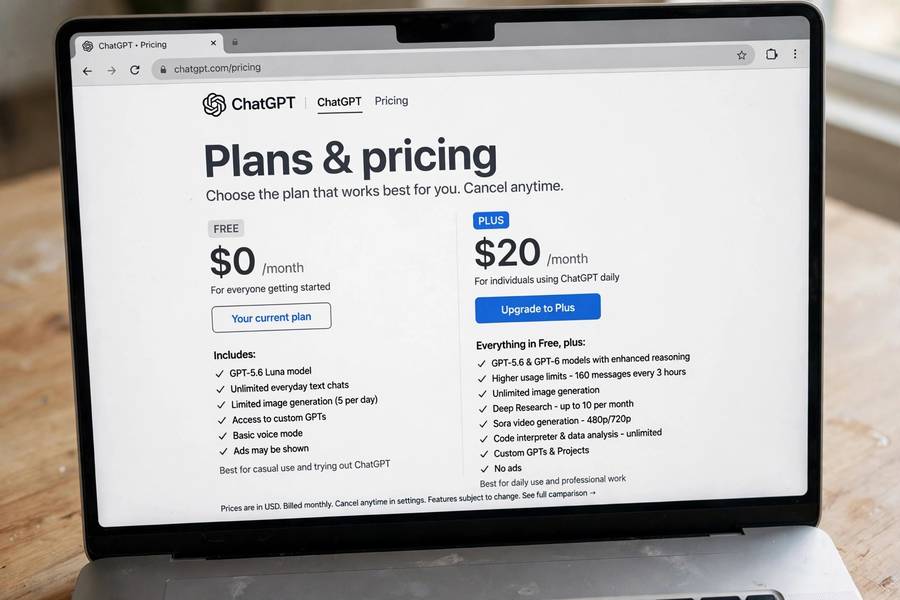
Twenty dollars a month. That’s the question, really — is ChatGPT Plus worth $20/month when the free version exists? The answer depends entirely on how you use it, and most comparisons either hype the paid tier or dismiss it. Let me give you the honest breakdown: exactly what differs, who benefits, and the decision framework I’d use.
Pricing and features shift over time, so treat specific limits as approximate — but the structure of the difference has been stable. For context on what’s under the hood of both tiers, see my guide on how does ChatGPT work.
In This Guide
- The Quick Comparison
- Model Access: The Core Difference
- Usage Limits: Where Free Hits the Wall
- Features: What’s Plus-Only
- Speed and Reliability
- Who Should Pay for Plus
- Who Should Stay Free
- The Alternatives Worth Knowing
- Frequently Asked Questions

The Quick Comparison
| Free | Plus ($20/month) | |
|---|---|---|
| Flagship model (GPT-4o class) | Limited messages | Much higher limits |
| Reasoning models (o-series) | Very limited / none | Included with good limits |
| Mini models | Unlimited-ish | Unlimited |
| Priority access | No (queues at peak) | Yes |
| Advanced voice | Limited | Extended |
| Image generation | Limited | Higher limits |
| Custom GPTs (use) | Yes | Yes |
| Custom GPTs (create) | No | Yes |
| Projects, canvas | Limited | Full |
The pattern: free is genuinely useful but throttled; Plus removes the throttles that matter for serious use. Whether that matters depends on your usage intensity.
Model Access: The Core Difference
This is what you’re really paying for: access to the best models, when you need them.
Free tier: You get the flagship model (GPT-4o class) but with a message cap per time period — enough for casual use, frustrating for deep work. When you hit the cap, you drop to mini models automatically. The quality difference is real but subtle for simple tasks, significant for complex ones. Reasoning models (o-series) are largely out of reach.
Plus: Dramatically higher flagship limits — enough that most users never hit them. Plus meaningful access to o-series reasoning models for hard problems. The experience is “the best model, basically whenever.”
Why it matters: model quality isn’t linear — it’s thresholded. For easy tasks, free and Plus feel identical. For hard tasks (complex analysis, difficult coding, nuanced writing), the flagship-plus-reasoning combination that Plus provides is qualitatively better. The $20 question is really: how often do you do hard tasks?
Under the hood, these are all large language models — the difference is scale, training, and capability tier.
Usage Limits: Where Free Hits the Wall
Free limits are designed to be just enough for casual users and just frustrating enough for heavy ones. You’ll hit the wall when:
- You’re in a deep work session — long back-and-forth on a complex task burns through the flagship allocation fast
- You’re using advanced features (image generation, voice, browsing) which consume quota faster
- It’s peak hours — free users get deprioritized, so even basic access can queue
- You’re building something that needs many iterations — each “try again” costs quota
The psychological effect: free users unconsciously ration — shorter prompts, fewer follow-ups, avoiding the tool for marginal tasks. This rationing reduces the value you get beyond the raw limits. Plus users, freed from counting, use the tool more fluidly and get disproportionately more value.
My test: if you’ve ever thought “I wish I could ask more but I’ve hit the limit” more than twice in a month, you’re a Plus candidate. The frustration is the signal.
Features: What’s Plus-Only
Beyond raw model access:
Creating custom GPTs. Free users can use custom GPTs others made; Plus users can build their own — specialized assistants with custom instructions, knowledge files, and actions. If you want a personalized AI trained on your documents, this is the feature.
Extended voice and image. The multimodal features (voice conversations, image generation) have meaningful free tiers but much higher Plus limits. Heavy multimodal users feel this quickly.
Projects and Canvas. Organizational and collaborative features — project folders, the Canvas writing/coding workspace — are fuller-featured on Plus.
Priority and new features. Plus users get new capabilities first (beta access) and skip the queues during high-demand periods. When a big launch happens, free users wait.
API note: Plus is the chat subscription. API usage (for developers) is billed separately by usage. Don’t confuse them — they’re different products with different pricing.

Speed and Reliability
An underrated difference: Plus is faster and more available.
- Peak hours: when demand spikes, free users wait; Plus users get priority compute. During major launches or outages, this is the difference between working and waiting.
- Response speed: Plus requests often process faster (priority queuing), especially for the larger models.
- Consistency: fewer “capacity” errors, fewer forced fallbacks to smaller models mid-session.
For casual evening use, you’ll barely notice. For “I need this for work at 2 PM on a Tuesday,” reliability is worth real money. Downtime during your productive hours has a cost — measure Plus against that, not against zero.
Who Should Pay for Plus
Pay if you are:
- A professional heavy user — writers, developers, analysts, researchers using ChatGPT hours daily. $20/month against your hourly rate is trivial math.
- A builder — creating custom GPTs, developing AI workflows, prototyping products. You need the limits and the features.
- A student in a demanding program — if AI tutoring meaningfully improves your learning, $20 is the cheapest tutor in history.
- Hitting free limits regularly — the frustration test from above. Your usage has already answered the question.
- Using it for income — freelancers, consultants, creators whose output improves with better AI access. It’s a business expense with obvious ROI.
The ROI frame: don’t ask “is it worth $20?” Ask “does it save me one hour a month, or earn me $20 of value?” For most serious users, the answer is laughably yes. One avoided hour of frustrating work pays for the month.
Who Should Stay Free
Stay free if you are:
- A casual user — a few questions a day, drafting help, curiosity-driven chats. Free handles this comfortably.
- Just exploring — new to AI and figuring out if it’s useful for you. Use free until you hit walls; the walls will tell you when to upgrade.
- Budget-constrained — $20/month is real money. Free ChatGPT plus good prompting skills (see my guide on how to get better answers from ChatGPT) covers enormous ground.
- A light multimodal user — if you rarely generate images or use voice, you’re not missing much.
- Able to wait — if peak-hour queues don’t bother you and you never hit message caps, Plus buys you nothing.
No shame in free. The free tier is genuinely excellent — better than what $20/month bought two years ago. It’s not a crippled demo; it’s a real product with limits. Most people overestimate how much they need Plus.
The Alternatives Worth Knowing
Before paying, know the landscape:
- Other AI assistants’ free tiers — Claude, Gemini, Copilot all have capable free versions. Some users find a competitor’s free tier suits them better than ChatGPT’s.
- API pay-as-you-go — if you’re a developer with spiky usage, API billing (pennies per thousand tokens) can be cheaper than $20/month flat.
- Team/Enterprise — for organizations, these offer admin controls and different economics than individual Plus seats.
- Annual consideration — watch for annual billing options or promotions; the monthly price isn’t always the best deal.
My contrarian take: many users would benefit more from learning prompting well on free than from paying for Plus with bad prompting. A skilled free user outperforms a careless Plus user. Upgrade your skills first, your tier second.
The $20 question has a $20 answer: Plus is worth it if your usage makes free frustrating, and it isn’t if free feels fine. Trust the frustration signal — it’s the most honest review. And whichever tier you’re on, the skills matter more than the subscription: a sharp prompter on free will always beat a vague one on Plus.

Frequently Asked Questions
Plus ($20/month) offers much higher limits on the flagship GPT-4o model, access to o-series reasoning models, priority access during peak times, custom GPT creation, and higher limits on voice/image features. Free provides capable access with throttled limits.
For heavy professional users, builders, and anyone regularly hitting free limits: yes — the ROI in saved time is clear. For casual users who never hit caps: no, free is genuinely excellent. The frustration test applies: if limits annoy you twice a month, upgrade.
$20 per month for individual Plus subscriptions. Team and Enterprise plans have different pricing. API usage for developers is billed separately based on tokens consumed, not included in Plus.
Yes, subscriptions can be cancelled anytime and remain active until the end of the billing period. There’s no long-term commitment, so trying Plus for a month to evaluate it is low-risk.
Yes — Plus provides much higher usage limits on the flagship model and access to o-series reasoning models for complex tasks, which free users largely can’t access. For difficult problems, the model difference is qualitatively significant.