
If you’re reading this at midnight, laptop glowing, wondering whether an online MBA is worth it — hi. I’ve been the person students call when a big decision feels overwhelming, and this is one of the biggest. A good online MBA can change your career trajectory. A bad one can cost you two years and six figures with nothing to show for it.
So let’s talk about the best online MBA programs the way I’d talk about them if you were sitting across from me: honestly, practically, and with zero interest in selling you anything. No rankings worship, no brochure language. Just how to choose well.
Table of Contents
- First: Is an Online MBA Right for You?
- What “Best” Actually Means (It’s Not the Ranking)
- The Non-Negotiables: Accreditation and Outcomes
- The Big Decision: Format and Flexibility
- Cost: The Real Math
- What Top Programs Have in Common
- Red Flags: Programs to Avoid
- How to Compare Programs Like a Pro
- Frequently Asked Questions
First: Is an Online MBA Right for You?
Before comparing programs, answer this honestly: what do you want the MBA for?
- Career switch? An MBA is one of the most reliable pivot tools in business — consulting, tech, finance all recruit from MBA programs. Online works here if the program has real career services and recruiting access.
- Promotion where you are? If your company promotes MBAs and you need the credential while working full-time, online is arguably better than full-time — you keep earning and applying lessons in real time.
- Entrepreneurship? The network and the structured thinking help; the credential itself matters less. Don’t overpay for a brand name if you’re starting a company.
- “I feel stuck”? Pause. An MBA is an expensive answer to “stuck.” Talk to people in roles you want first. Sometimes the answer is a certificate, a new job, or a conversation — not a degree.
Also be honest about your life: online MBAs demand 15–25 hours a week for 2–3 years. If you’re already drowning, adding a degree won’t fix the drowning. It’ll just add homework to it. The students who thrive are the ones who clear the runway first.
What “Best” Actually Means (It’s Not the Ranking)
Rankings measure things like selectivity, GMAT averages, and recruiter opinions. Useful signals — but they’re measuring prestige, not fit. The “best” program for you is the one that:
- Is properly accredited (non-negotiable — see below)
- Fits your schedule and learning style
- Costs an amount you can justify with real ROI math
- Has alumni working where you want to work
- Offers the specialization or format you actually need
A top-10 program you can’t attend consistently is worse than a top-50 program you finish strong. Completion beats prestige every time. The degree on your wall doesn’t list your class rank — it just says you finished.
The Non-Negotiables: Accreditation and Outcomes
Accreditation first, everything else second. In the US, look for AACSB accreditation — it’s the gold standard for business schools. Regional institutional accreditation matters too. An MBA from an unaccredited school is, bluntly, an expensive piece of paper that many employers will discount or disregard.
How to check: the school’s website should state its accreditation clearly. If you have to hunt for it, that’s a red flag. You can verify through the AACSB’s own directory or the Department of Education’s database.
Outcomes data second. Good programs publish employment reports: what percentage of graduates are employed within three months, at what salaries, in which industries. If a program won’t show you outcomes data, assume the data is bad. This is the single most revealing document a program produces — more honest than any brochure.
Ask admissions directly: “Can I see your most recent employment report?” Their reaction tells you everything. Pride means good numbers. Evasion means the opposite.
The Big Decision: Format and Flexibility
Online MBAs come in flavors, and the flavor matters more than most people realize:
Asynchronous (learn on your schedule). Lectures recorded, deadlines weekly, no live class times. Maximum flexibility — ideal if you work irregular hours or travel. The trade-off: less spontaneous interaction, and it demands serious self-discipline. If you struggled with studying consistently, be honest about whether this format suits you.
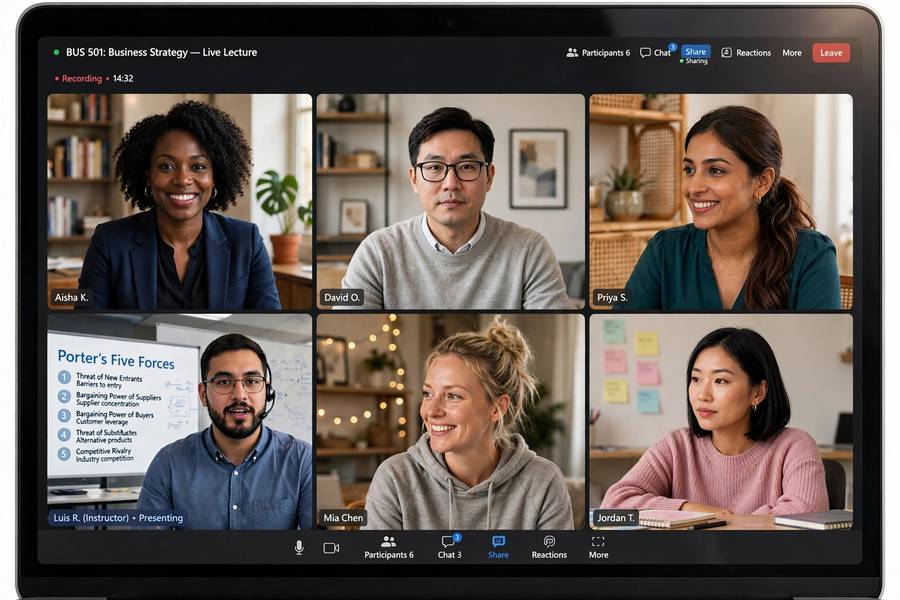
Synchronous (live virtual classes). Scheduled video sessions, real-time discussion, closer to a classroom feel. Better for network-building and accountability. The trade-off: you’re back on someone else’s schedule, which can clash with work and time zones.
Hybrid (mostly online, some in-person). Periodic residencies or weekend intensives on campus. Many students say the in-person components are where the real networking happens — there’s no virtual substitute for three days of case competitions and late-night conversations.
My advice: match the format to your weakness, not your preference. If you need accountability, choose synchronous or hybrid even if async sounds easier. “Easier” is how degrees go unfinished.

Cost: The Real Math
Online MBA tuition ranges wildly — from under $20,000 to over $150,000. Here’s how to think about it:
Calculate total cost, not just tuition: fees, books, residency travel, and the opportunity cost of your time. Then compare against expected salary uplift: research what graduates in your target role and market actually earn (the employment report helps here).
The ROI rule of thumb: if the total cost exceeds roughly one year of your expected post-MBA salary increase sustained over a few years, think hard. A $120,000 program that lifts you from $90k to $130k pays for itself in three years. A $120,000 program with no clear salary path is a very expensive hobby.
Don’t forget employer tuition assistance. Many companies offer $5,000–$10,000+ per year. Some cover far more for programs they value. Ask HR before you assume you’re paying full price — this single conversation has saved my students tens of thousands.
Debt discipline: federal student loans for graduate school are available, but borrow like someone who’ll have to pay it back — because you will. Don’t choose the priciest program “for the brand” with no plan for the payments.
What Top Programs Have in Common
Across the programs that consistently produce satisfied graduates, I see the same traits:
- Real career services — dedicated MBA career coaches, on-campus (virtual) recruiting, and active employer relationships. Not a generic career center shared with undergrads.
- Engaged alumni networks — alumni who actually respond to current students. Ask to speak with recent grads before enrolling; their candor is worth more than any info session.
- Cohort structure — you progress with the same group, building real relationships. The network is half the value of an MBA, and cohorts manufacture it deliberately.
- Faculty who’ve worked in industry — professors with real operating experience teach differently (and more usefully) than pure academics.
- Reasonable class sizes — if your “discussion section” has 200 people, you’re watching content, not participating in a class.
Notice: none of these are about the ranking number. They’re about what your Tuesday nights will actually feel like for two years.
Red Flags: Programs to Avoid
- No AACSB (or equivalent) accreditation, or vague claims about being “accredited” without naming the body.
- No published employment outcomes. Ever. For any reason.
- Admissions with no selectivity at all — a program that accepts everyone is selling credentials, not education.
- Pressure tactics — “enroll this week or lose your spot” is sales, not admissions.
- Faculty with no accessible bios — you should be able to see who’d teach you.
- All async, no community — some programs are essentially expensive video libraries. Check for live interaction, group work, and cohort elements.
- Wildly out-of-market pricing — either suspiciously cheap (quality costs money) or priced like an elite program without elite outcomes.
Trust your gut in the admissions process. If it feels like a sales funnel, it is one.
How to Compare Programs Like a Pro
Here’s the comparison process I walk students through:
- Shortlist 4–6 programs that meet the accreditation bar and fit your budget range.
- Build a simple spreadsheet: total cost, format, duration, specializations, employment rate, average starting salary, class size, residency requirements.
- Attend a live class (many programs allow prospective students to sit in virtually). This is the single best evaluation tool — you’ll feel the quality in twenty minutes.
- Talk to 2–3 recent alumni from each finalist — not the ones admissions introduces you to; find them on LinkedIn yourself.
- Ask about the hard parts: dropout rate, average time to completion, what students complain about. Every program has weaknesses; honest ones admit them.
- Sleep on it. This is a two-year, five-to-six-figure decision. Anyone rushing you is not on your side.
And remember: the goal isn’t the “best” program in the abstract. It’s the best program for your career, your schedule, your budget, and your life. That’s a personal answer, and you now have the tools to find it.
If you’re weighing an MBA against further academic research instead, it’s worth understanding what a doctoral dissertation involves — the PhD path is a very different commitment. And whatever you choose, the study skills in our guide to learning faster transfer directly to surviving b-school.

Frequently Asked Questions
The best online MBA for you is an AACSB-accredited program that fits your schedule, budget, and career goals, with strong published employment outcomes. Accreditation, career services, and alumni networks matter more than prestige.
Yes — when they’re from accredited, reputable schools. Most employers care about the school’s reputation and your skills, not the delivery format. The diploma typically doesn’t say “online.”
Tuition ranges from under $20,000 to over $150,000. Calculate total cost including fees and residencies, compare it against the program’s employment report salary data, and check employer tuition assistance first.
Most take 2–3 years part-time while working, with 15–25 hours of coursework weekly. Accelerated options can finish in 12–18 months — but faster isn’t always better, since burnout is the top reason students don’t finish.
Many online programs have waived the GMAT/GRE or made it optional, especially for applicants with strong work experience. Requirements vary widely — check each program, but don’t let test anxiety drive your shortlist.
Look for AACSB accreditation, the gold standard for business schools, plus regional institutional accreditation. Avoid programs that can’t clearly name their accrediting bodies — unaccredited MBAs may not be recognized by employers.