
How you end your day shapes how you sleep, and how you sleep shapes everything else. I learned this the hard way — years of scrolling in bed, falling asleep to true crime podcasts, wondering why I woke up tired. The fix wasn’t complicated. It was a routine: a gentle, repeatable wind-down that tells your body the day is over.
Your brain doesn’t have an off switch, but it does respond to signals. Light, activity, temperature, and ritual all tell your nervous system whether to stay alert or power down. A good night routine is just a sequence of “power down” signals, delivered consistently.
Here’s how to build one that actually helps you sleep — and makes your evenings genuinely pleasant, not just productive.
Table of Contents
- Why Evenings Matter More Than Mornings
- The Science in Plain English
- Step 1: Close the Day (Work Ends Here)
- Step 2: Dim Everything
- Step 3: Screens Down
- Step 4: Body Wind-Down
- Step 5: Mind Wind-Down
- Step 6: Prepare Tomorrow
- What About Weekends?
- Troubleshooting: When Sleep Won’t Come
- Frequently Asked Questions

Why Evenings Matter More Than Mornings
Everyone obsesses over morning routines, but mornings are downstream of nights. You can’t 5 AM your way out of a 1 AM bedtime — you’ll just be tired earlier. The highest-leverage hours for your energy aren’t morning; they’re the two before sleep.
A chaotic evening — bright screens, stressful news, work email at 11 PM — keeps your nervous system activated for hours. You might fall asleep, but the quality suffers: less deep sleep, more fragmented rest, groggier mornings. Fix the evening and the morning largely fixes itself.
The Science in Plain English
Three mechanisms run your sleep:
- Light. Bright light (especially blue-white) suppresses melatonin, your sleepiness hormone. Dim warm light in the evening lets melatonin rise naturally.
- Temperature. Your body needs to cool ~1°C to fall asleep. A warm bath or shower paradoxically helps — the post-bath cooldown accelerates sleepiness.
- Cortisol curve. Stress hormones should be lowest at night. Evening stress (arguments, intense work, alarming news) keeps them elevated and delays sleep.
A night routine works by cooperating with these mechanisms instead of fighting them. No hacks — just alignment.
Step 1: Close the Day (Work Ends Here)
Pick a consistent end-of-work time and ritualize it:
- Write tomorrow’s top three tasks (empties the mental loop)
- Close the laptop — physically shut it, don’t just minimize
- Change clothes, even if you worked from home in loungewear
- Take a short walk or step outside — the transition matters
Without a shutdown ritual, work thoughts follow you into the evening like an uninvited guest. This boundary is one of the most important parts of balancing work and personal life — the day needs an ending for the night to begin.
Step 2: Dim Everything
Starting 1–2 hours before bed:
- Switch overhead lights to lamps, or dim them
- Use warm-toned bulbs in the evening (2700K or lower)
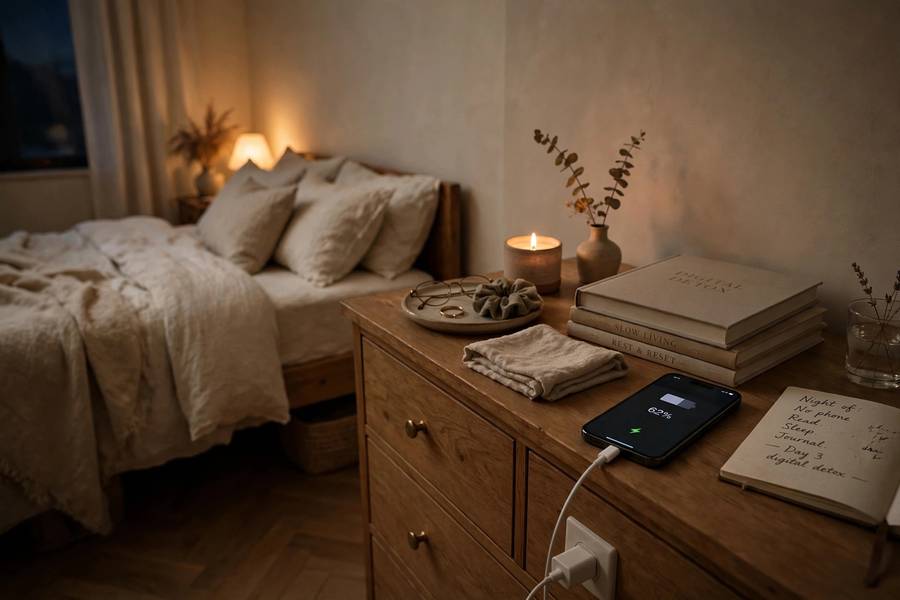
- Light a candle or two — the flicker is naturally calming
- If you must use screens, enable night mode (it’s a partial fix, not a full one)
This isn’t just ambiance — it’s biochemistry. Dim warm light is the strongest “evening is coming” signal you can give your brain. There’s a reason the hygge lifestyle centers candlelight: our nervous systems are ancient, and firelight means rest.
Step 3: Screens Down
The hardest step and the most impactful. Screens deliver the triple threat: bright light, engaging content, and infinite novelty — all sleep killers.
Realistic approach (not “throw away your phone”):
- Set a screen curfew: 30–60 minutes before bed, screens go away. Start with 30; it’s enough to matter.
- Charge outside the bedroom. Removes the temptation entirely. An alarm clock costs $10.
- Replace, don’t just remove. Have the book, the tea, the stretch routine ready. A void gets filled by the phone; a plan doesn’t.
- If you must scroll: no news, no arguments, no work. Boring content only.
Step 4: Body Wind-Down
Help your body cool down and release the day’s tension:
- Warm shower or bath 60–90 minutes before bed — the cooldown afterward triggers sleepiness
- Gentle stretching — 5–10 minutes, focusing on hips, shoulders, neck where the day stores tension
- Herbal tea — chamomile, valerian, or just something warm and caffeine-free. The ritual matters more than the herb.
- Comfortable sleep clothes and a cool room (65–68°F / 18–20°C is ideal for most)

Step 5: Mind Wind-Down
A racing mind is the #1 sleep complaint. Give your thoughts somewhere to go:
- Brain dump journaling: write everything on your mind — tasks, worries, ideas. Externalized thoughts stop looping.
- Gratitude practice: three specific good things from today. It shifts the nervous system measurably.
- Reading fiction: the best pre-sleep activity found in study after study. Engaging enough to displace worry, not so stimulating it wakes you.
- Breathing: slow exhales (in for 4, out for 6–8) activate the parasympathetic nervous system directly.
Step 6: Prepare Tomorrow
Five minutes that transform mornings:
- Lay out clothes
- Pack bag / prep lunch
- Write the top three priorities
- Tidy one surface (waking to order calms the mind)
Morning-you is essentially a different, groggier person. Be kind to them. Everything you decide tonight is one less decision tomorrow.
What About Weekends?
Keep the skeleton — dim lights, screens down, consistent bedtime within an hour. You can shift everything later; just keep the sequence. The routine’s power is in its consistency, and weekend chaos undoes weekday gains faster than you’d think.
That said: one late night won’t ruin anything. The goal is a pattern, not perfection. Enjoy your life; return to the rhythm after.
Troubleshooting: When Sleep Won’t Come
- Mind racing: get up, go to another dim room, read something boring until drowsy. Don’t toss and turn — it trains your brain to associate bed with wakefulness.
- Too hot: cool the room, lighter blanket, cool shower. Temperature is the most underrated sleep factor.
- Anxious thoughts: the brain dump journal, done earlier in the routine, prevents most of this. If worry persists regularly, it’s worth addressing directly (journaling, talking, professional support).
- Inconsistent schedule: the single biggest fixable factor. Same wake time daily — including weekends — stabilizes everything within two weeks.
If sleep problems persist for weeks despite good habits, talk to a doctor. Sleep disorders are common and treatable; suffering through them isn’t noble.
The 10-Minute Version (For Exhausted Days)
Some nights you have nothing left. That’s fine — the routine scales down:
- Screens off, lights dim (2 min)
- Quick tidy of one surface (2 min)
- Lay out tomorrow’s clothes (2 min)
- Brush teeth, wash face (3 min)
- One minute of slow breathing in bed (1 min)
Ten minutes, five steps, still counts. The goal on hard days isn’t optimization — it’s maintaining the thread. A routine you can do exhausted is a routine you’ll keep. Perfection is the enemy; the thread is everything.
Making It Yours: Personalization
The best night routine is one you actually enjoy — so personalize it:
- Scent: lavender pillow spray, eucalyptus in the shower, a favorite candle. Scent is powerfully tied to sleep onset.
- Sound: silence, white noise, rain sounds, or calm music — whatever signals “safe to sleep” to your brain.
- Texture: good sheets matter more than thread count marketing suggests — breathable, comfortable, clean.
- Temperature: most people sleep best slightly cool. Experiment between 65–68°F (18–20°C).
- A personal ritual: the same cup of tea, the same three stretches, the same page of journaling. Repetition is what turns actions into sleep signals.
There’s no universal perfect routine — only the one that consistently helps you drift off. Build yours over a few weeks, keep what works, drop what doesn’t.
Frequently Asked Questions
Dim lights 1–2 hours before bed, screens off 30–60 minutes before, a calming activity (reading, stretching, tea), and a consistent bedtime. The sequence matters more than any single element.
30–60 minutes is the practical target. The light suppresses melatonin and the content keeps your mind activated. Charging it outside the bedroom removes the temptation entirely.
Dim the lights, put screens away, do something calming (read, stretch, take a warm shower), prepare for tomorrow, and let your body cool down. Think “powering down,” not “one more productive hour.”
Yes — consistent wind-down routines improve both sleep onset and quality by aligning with your body’s light, temperature, and stress mechanisms. Most people notice a difference within 1–2 weeks.
Work backward from your wake time: 7–9 hours of sleep means starting your wind-down 60–90 minutes before bed. If you wake at 6:30 AM, begin dimming lights around 9:00–9:30 PM.