Computer vision is AI’s most mature subfield — and paradoxically one of the trickiest to learn well right now, because it’s mid-transition. The CNN era’s wisdom (a decade of hard-won knowledge) meets the transformer era’s disruption (vision transformers rewriting the playbook). A course teaching only CNNs is dated; a course teaching only transformers skips foundations you’ll need when things break. The good courses navigate both.
This guide covers what computer vision courses should teach, the prerequisites, and how to evaluate them. For the broader landscape, see the best AI courses online.
Table of Contents
- What Computer Vision Courses Cover
- Prerequisites: What You Need First
- The CNN Foundation: Still Essential
- The Transformer Disruption: What Changed
- Core Tasks: Classification to Segmentation
- Classical Vision: The Underrated Prerequisite
- Evaluating a Computer Vision Course
- Compute and Data: Practical Realities
- The Mistakes Most Beginners Make
- How Much Time This Really Takes
- Frequently Asked Questions
What Computer Vision Courses Cover
A complete computer vision education spans: image fundamentals (how digital images work as data), classical techniques (edges, features, transforms — the pre-deep-learning toolkit), convolutional neural networks (the deep learning workhorse), core tasks (classification, detection, segmentation), vision transformers (the modern architecture), generative vision (diffusion models, GANs), and applied topics (tracking, 3D vision, video).
That’s a lot — which is why course scope matters enormously. A course covering all of this is either very long or very shallow. The good ones pick a coherent slice: “deep learning for vision” (CNNs through transformers, applied) is the most useful scope for most learners. Be wary of courses promising the full span in a few weeks.
Prerequisites: What You Need First
Python fluency — non-negotiable. You’ll manipulate image data, write training code, and debug constantly.
Deep learning basics — how neural networks train. You don’t need to be a deep learning expert, but backprop, optimizers, and overfitting should be familiar. Vision courses that reteach all of deep learning from scratch are usually too rushed at both.
Linear algebra intuition — images are matrices; convolutions are operations on them. The intuition matters more here than in most ML topics because the data is so geometric.
A GPU — vision models are compute-hungry. Image data is large; training even modest CNNs on CPU is painful. 8GB+ VRAM or cloud access.
The common failure: jumping into vision without deep learning comfort. The architectures are the interesting part, but the training craft underneath is what makes them work — and that craft transfers from general deep learning.
The CNN Foundation: Still Essential
Convolutional Neural Networks dominated vision for a decade, and their concepts remain essential even as transformers advance:
Why CNNs matter still: they’re efficient, well-understood, and still competitive or superior for many tasks (especially with limited data or compute). Most deployed vision systems are still CNN-based. Understanding them is understanding the field’s recent history and much of its present.
What to learn: convolution operations (intuitively — filters detecting features), architectures (the classic progression: LeNet to ResNet to EfficientNet — each taught something), transfer learning (the single most practical vision skill — adapting pretrained CNNs), and data augmentation (vision-specific techniques that dramatically improve results).
A course skipping CNNs to jump straight to transformers is like learning to run before walking — you’ll miss the intuitions (translation invariance, hierarchical features, receptive fields) that explain WHY vision architectures look the way they do. The concepts transfer even where the architectures don’t.
The Transformer Disruption: What Changed
Vision Transformers (ViTs) treat images as sequences of patches and apply attention — no convolutions. Initially data-hungry and finicky, they’ve matured into state-of-the-art for many tasks, especially at scale.
What a current course must cover: how ViTs work (patch embedding, attention over patches — the conceptual leap from CNNs), when they win (large data, large compute — the scaling story), hybrid approaches (the pragmatic middle — convolutional stems with transformer bodies, and similar fusions), and pretrained vision transformers (CLIP and friends — the models powering modern multimodal AI).
The honest current state: transformers lead at the frontier; CNNs remain the practical workhorse. Learn both, understand the trade-offs, and you’ll be equipped regardless of which way the field tilts next. This duality is the same scaling narrative behind how AI models are trained — architectures that scale with data and compute win.
Core Tasks: Classification to Segmentation
Vision courses organize around tasks — ensure coverage of the ones relevant to you:
Classification — what’s in this image? The foundation; every course covers it.
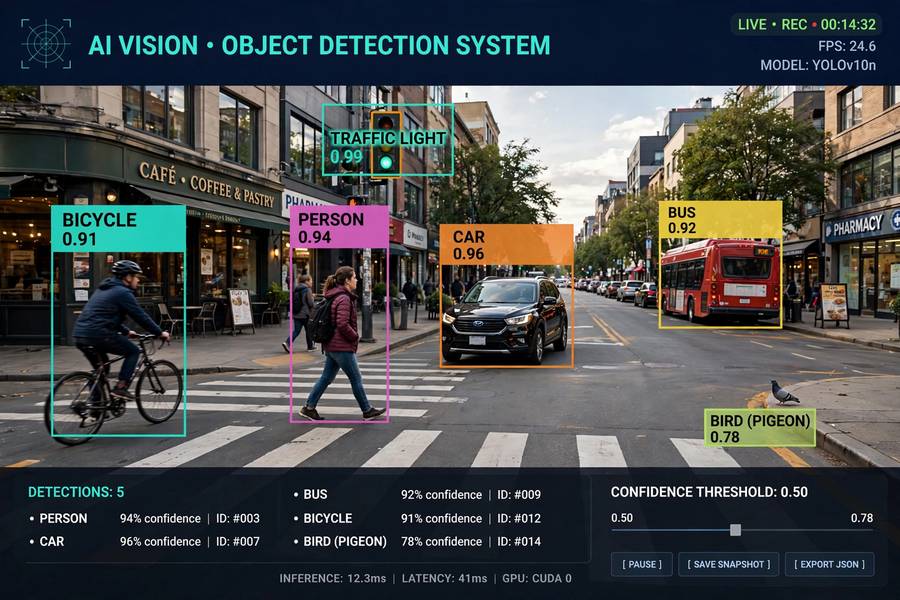
Object detection — where are the things? Bounding boxes around objects. The workhorse of applied vision (surveillance, retail, autonomous driving). Architectures evolved rapidly (R-CNN family to YOLO to DETR) — a good course covers the evolution, not just the latest.
Semantic segmentation — which pixels belong to what? Dense prediction, essential for medical imaging, autonomous driving, photo editing.
Instance segmentation — which pixels belong to which object instance? The combination, and the hardest of the core tasks.
Beyond: pose estimation, tracking, depth estimation, image generation — specialized topics for deeper courses.
Each task has its own architectures, metrics, and practical gotchas. A course covering “computer vision” through classification alone is an introduction, not an education. Check the task coverage against your goals.
Classical Vision: The Underrated Prerequisite
The pre-deep-learning toolkit — edge detection, feature descriptors (SIFT/SURF/ORB), geometric transforms, camera models — gets skipped by most modern courses. That’s mostly fine, but a little classical vision pays off disproportionately:
- It teaches you what images are as data — the intuition that pure deep learning sometimes skips.
- Some problems are still solved classically — or hybrid. Not everything needs a neural network.
- It makes you a better debugger — understanding image processing helps when deep models misbehave on image data.
You don’t need a full classical vision course — a good modern course weaves in the essential concepts as needed. But if a course treats images as magic tensors with no discussion of what pixels mean, it’s skipping something valuable.
Evaluating a Computer Vision Course
Recency is critical. The transformer shift means pre-2022 courses miss the modern story. Prefer 2023+ for anything beyond CNN foundations.
Project realism. Vision is intensely practical — the course should have you training on real image datasets, not just MNIST. Detection or segmentation projects (not just classification) signal seriousness.
Pretrained model fluency. Modern vision work is mostly adapting pretrained models. Courses teaching transfer learning and fine-tuning deeply (not as an afterthought) reflect real practice.
Framework currency. PyTorch dominates vision education and research. Dated TensorFlow 1.x code is a museum piece.
Metrics and evaluation. Vision has task-specific metrics (mAP for detection, IoU for segmentation) that are genuinely tricky. Courses glossing over evaluation produce practitioners who can’t tell if their models work.
Instructor’s applied experience. Vision is where theory meets messy reality (lighting, occlusion, weird data). Instructors with deployed-system experience teach the gotchas that pure academics miss.
Compute and Data: Practical Realities
Compute: vision needs GPUs more than most ML topics — image batches are memory-hungry. 8GB VRAM minimum for coursework; 12GB+ comfortable. Cloud notebooks work but image datasets make I/O a consideration.
Data: vision courses need image datasets, which are large downloads. Check the course’s data requirements and your bandwidth/storage. The standard datasets (CIFAR, ImageNet subsets, COCO) are free but bulky.
Time: training vision models takes longer than tabular ML — even small CNNs need real training time. Budget for it; the waiting is part of the education (and teaches patience with experiment cycles).
The Mistakes Most Beginners Make
Computer vision has its own characteristic failure modes:
Skipping straight to transformers. The current hype makes vision transformers tempting as a starting point. Resist — without CNN intuitions (translation invariance, hierarchical features), transformer architectures are just incantations. The foundations make everything after them learnable.
Training on toy data too long. MNIST is fine for week one. If you’re still on toy datasets in month two, you’re avoiding the real education — messy, large, badly-labeled image data, where all the practical lessons live.
Ignoring data work. Beginners want to tune architectures; professionals know data quality dominates. Learning augmentation, cleaning, and labeling strategy matters more than knowing the latest model variant. The unglamorous stuff wins.
No GPU plan. Starting a vision course on a CPU-only laptop, then stalling when training takes hours per epoch. Sort compute before enrolling — it’s a prerequisite, not a detail.
Evaluation blindness. “My model gets 94% accuracy” on a badly-split dataset. Vision metrics (mAP, IoU) have subtleties that bite the careless. Learn evaluation properly or your results are fiction.
How Much Time This Really Takes
Honest vision timelines:
Prerequisites: 2–4 months if starting from general Python — deep learning basics plus the linear algebra intuition. Non-negotiable; vision punishes weak foundations harder than most topics.
Core course: 3–5 months at part-time pace. CNNs through transformers with real projects. The projects are where the time goes — training, debugging, iterating.
Task depth: 2–4 months more to go deep on the tasks relevant to you (detection, segmentation). Each task has its own architectures and gotchas; real competence is per-task.
Total: 9–15 months to genuinely capable. Vision is slower than some AI topics because training cycles are long and data work is heavy — budget for the waiting as well as the learning. The practitioners who last are the ones who made peace with slow experiment cycles early.
Frequently Asked Questions
CNNs first. They teach the core visual intuitions (translation invariance, hierarchical features, receptive fields) that explain why vision architectures work. Transformers build on this understanding — jumping straight to ViTs skips the conceptual foundation.
Python fluency, deep learning basics (backprop, optimizers, overfitting), linear algebra intuition, and GPU access (8GB+ VRAM or cloud). Classical ML comfort helps; the training craft underneath vision architectures transfers from general deep learning.
Very — it’s AI’s most mature and most deployed subfield. Transformers changed the architectures, not the relevance. Vision powers autonomous vehicles, medical imaging, retail, manufacturing, and the visual side of multimodal AI. The field is evolving, not shrinking.
8GB VRAM minimum for coursework (small CNNs, fine-tuning), 12GB+ for comfort. Image batches are memory-hungry. Cloud notebooks work but watch I/O with large image datasets. Training takes longer than tabular ML — budget time as well as hardware.
At minimum: classification, object detection, and semantic segmentation — each with its architectures, metrics, and practical gotchas. Classification-only coverage is an introduction, not an education. Match task coverage to your goals (medical imaging needs segmentation; retail needs detection).