Arm Workout for Beginners: The 30-Minute Starter Session


The biggest mistake beginners make with arm training is copying an advanced bodybuilder’s workout: 20 sets, 6 exercises, arms so sore they cannot straighten them for a week. Then they do it once and never again. I have started dozens of clients on arm training, and the ones who stuck with it all began the same way: a simple session, moderate effort, in and out in 30 minutes, twice a week. This is that session. Six exercises, exact sets and reps, form cues for each, and a progression plan for the first 12 weeks. The full exercise library is in my best arm exercises guide when you are ready for more.
The 4 Principles of Beginner Arm Training
1. Learn the movement before chasing the pump. Your first month is about grooving clean patterns, not about feeling a burn. Light weights, perfect reps. 2. Train biceps and triceps equally. Beginners always favor biceps because they can see them. Your triceps are two-thirds of your arm; neglecting them is leaving most of your growth on the table. 3. Two sessions a week is plenty. More is not better when you are new; your recovery capacity is the limiter, not your effort. 4. Track your weights. Write down every weight and rep. Progressive overload only works if you know what you did last time. A notes app is fine; memory is not.
The 30-Minute Workout
You need a pair of light dumbbells (start with something you can curl 15 times) and optionally a resistance band. Warm up 3 minutes: arm circles, 10 band pull-aparts, 10 light curls. Then: 1. Dumbbell bicep curls: 3×12. 2. Overhead dumbbell tricep extensions: 3×12. 3. Hammer curls: 3×10. 4. Chair dips: 3×10. 5. Concentration curls: 2×12 per arm. 6. Band pushdowns or diamond push-ups: 2×15. Rest 60 seconds between sets, 90 seconds between exercises. That is 16 sets total, about 27 minutes including the warm-up. Twice a week, at least two days apart. If you want dumbbell variety beyond this session, my best dumbbell exercises article has the full menu.
Form Cues for Each Exercise
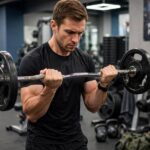
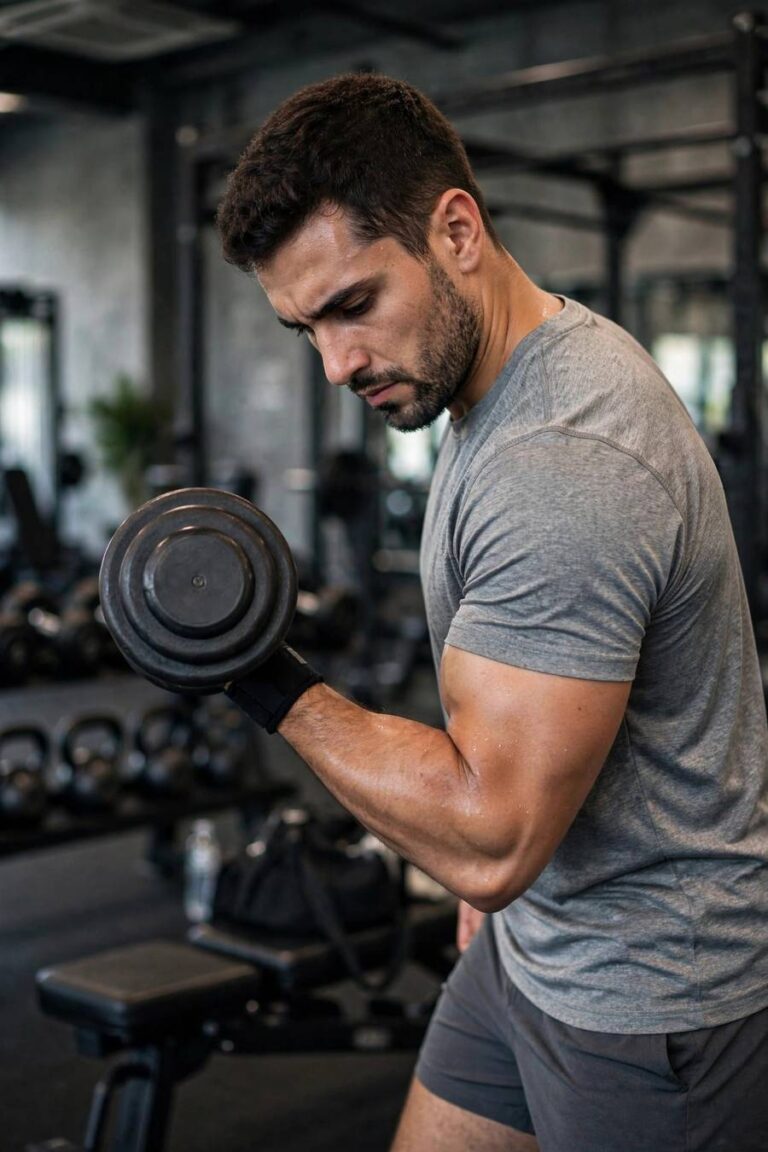
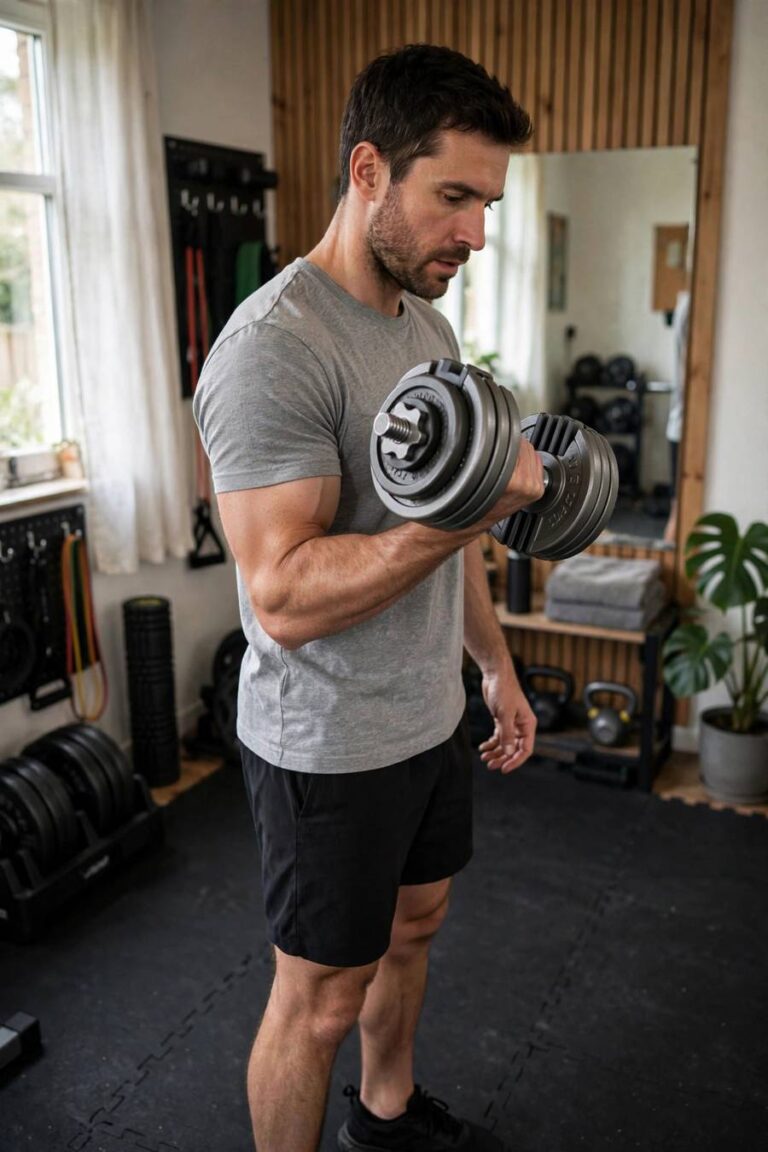
Bicep curls: elbows pinned to your ribs, no swinging. If your elbows drift forward, the weight is too heavy. Lower over 2 seconds; the lowering half builds more muscle than the lifting half.
Overhead tricep extensions: one dumbbell held with both hands overhead, lower it behind your head by bending the elbows, keeping upper arms vertical. You should feel a deep stretch in the triceps at the bottom.
Hammer curls: palms facing each other, like holding hammers. This hits the brachialis and forearms along with the biceps, building arm thickness.
Chair dips: hands on a sturdy chair, lower until elbows reach 90 degrees, keep your back close to the chair. Do not shrug your shoulders to your ears.
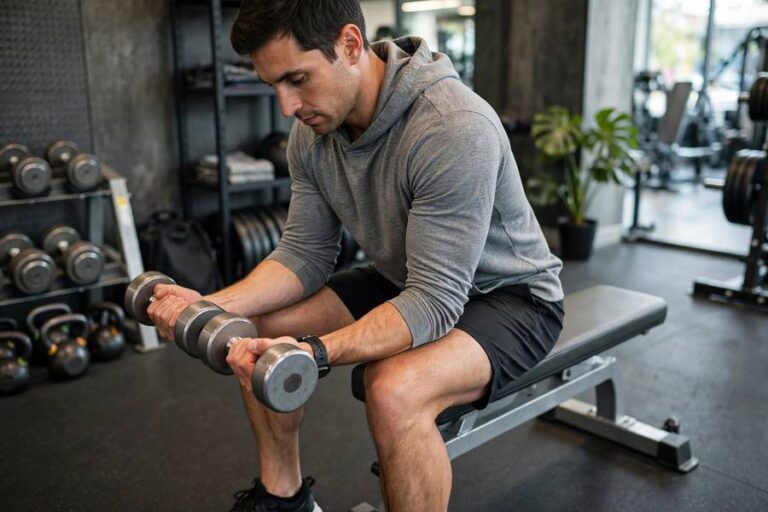
Concentration curls: seated, elbow braced against your inner thigh, curl with total focus on the bicep. Light weight, perfect squeeze at the top.
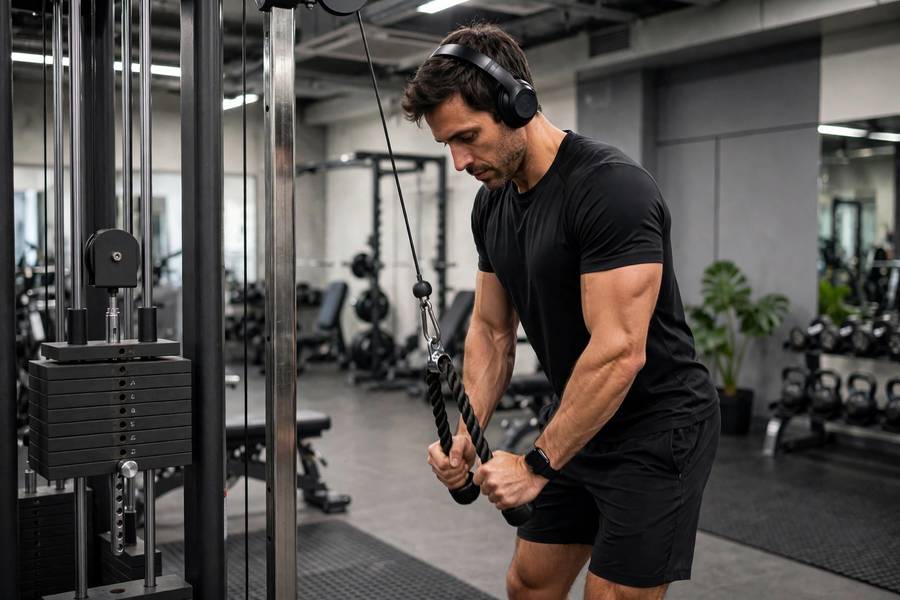
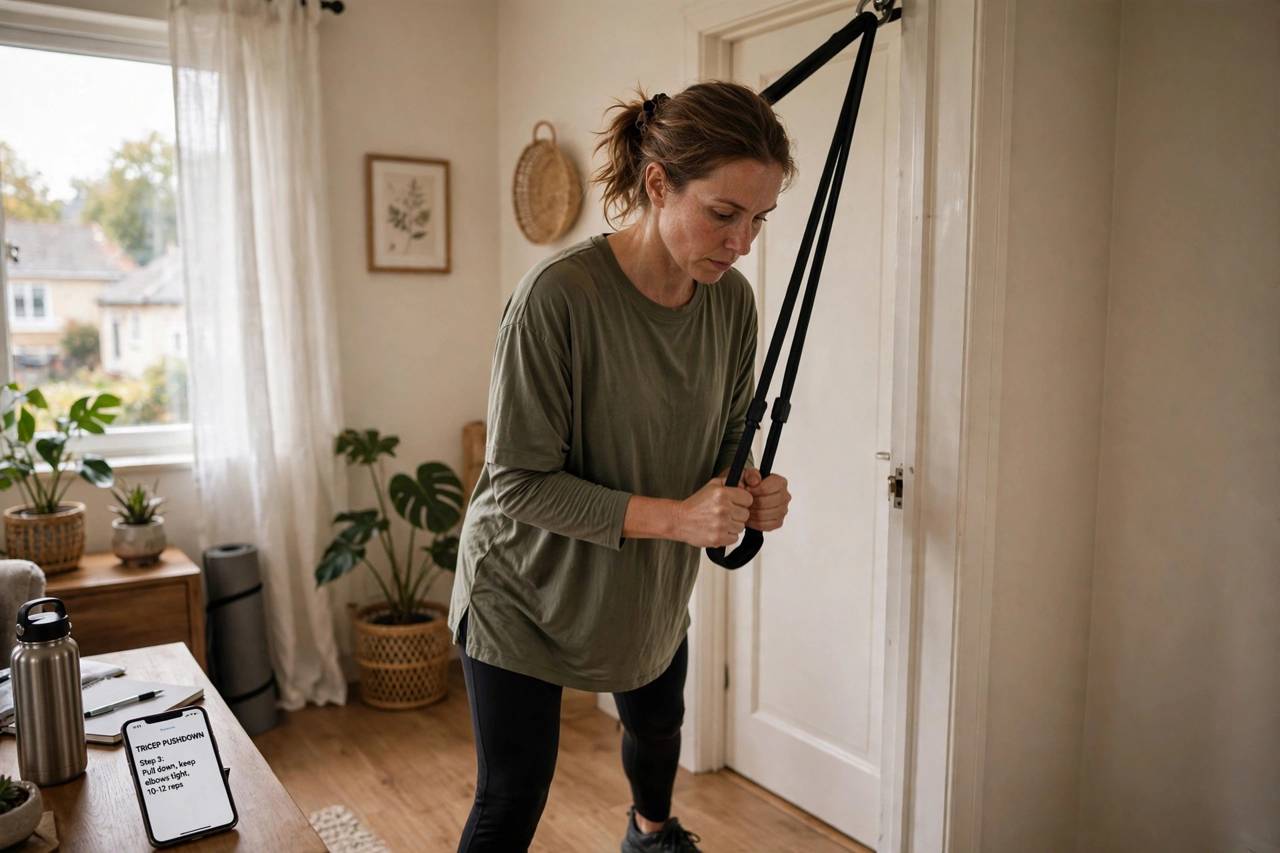
Band pushdowns: elbows pinned at your sides, press the band down until arms are straight, squeeze the triceps for one second. If using diamond push-ups instead: hands in a diamond, 2 sets of as many clean reps as you can.
The 12-Week Progression
Weeks 1-4: Learn. Same weights, focus on form. Add one rep per set per week where you can. The goal is owning every movement pattern.
Weeks 5-8: Build. When you hit the top of every rep range with clean form for two sessions in a row, increase the dumbbell weight by the smallest increment available. Chair dips: elevate your feet. This is progressive overload in its simplest form.
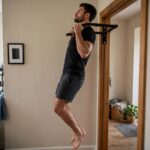
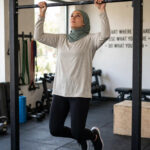
Weeks 9-12: Push. Add a fourth set to curls and extensions. Introduce one harder variation: incline dumbbell curls instead of standing curls, or close-grip push-ups instead of band pushdowns. By week 12, most beginners have added visible size and meaningful strength; I typically see curl weights double from the starting point. After 12 weeks, graduate to a dedicated arm day or an upper-body split, and consider adding how to do pull-ups work for back and biceps together.
Eating for Arm Growth (Simple Version)
You do not need a bodybuilder diet, but you do need enough protein and enough food. The simple version: eat 1.6 grams of protein per kilo of bodyweight daily, spread across 3-4 meals. For a 70kg beginner, that is about 110g: a palm-sized portion of meat, fish, eggs, or Greek yogurt at each meal gets you there without counting anything. Do not train arms in a steep calorie deficit and expect growth; maintenance calories or a small surplus is where beginners build best. Carbs around training help: a banana or some rice an hour before the session keeps energy up. Hydrate; even mild dehydration drops strength noticeably. Supplements are optional and mostly unnecessary at this stage; creatine monohydrate (3-5g daily) is the only one with enough evidence to mention, and even that is a 5-percent helper, not a requirement. Food, sleep, consistency: in that order.
Soreness, Recovery, and Rest Days
Expect real soreness after the first two sessions; that is normal and it fades as your body adapts. What is not normal: soreness so bad you cannot straighten your arms for three days (you went too hard; cut volume by a third next time), or joint pain in the elbows (check your form, especially on extensions; never lock out violently). Sleep and protein do more for your arm growth than any supplement: aim for 7+ hours and roughly 1.6g of protein per kilo of bodyweight daily. Rest days are when the growth happens; training is just the signal. Two arm sessions a week with good recovery beats four sessions with poor recovery every single time. If your arms are still notably sore after 72 hours, push the next session back a day. The schedule serves the recovery, not the other way around.
When to Add a Third Day
After 3-4 months of consistent twice-weekly training, progress on the same weights will slow; that is your signal, not the calendar, to consider a third day. The third day should be light: half the volume, easy variations, focused on pump and technique rather than progression. Think band work and light curls, 15-20 minutes. Alternatively, keep two days and add volume to them: a fourth set on the main lifts. Both work; the third light day suits people who recover well and enjoy frequency, while added volume suits people with tight schedules. Do not add the third day before month 3. Beginners who jump to high frequency early just accumulate fatigue that masks itself as a plateau, then quit. Earn the third day with 12 consistent weeks first.
Beginner Mistakes Hall of Fame
The marathon first session. Doing 25 sets because motivation is high, then being unable to train for 10 days. Start with the session as written; enthusiasm is not a program. Changing the workout weekly. New exercises every session means no exercise gets practiced enough to progress. Run the same 6 for 8 weeks minimum. Chasing the pump over progression. The pump feels productive but fades in an hour; the weight going up over months is what builds arms. Skipping triceps. Mentioned before, worth repeating: two-thirds of your arm is behind you. Comparing to month six of someone else’s year two. Social media shows highlights, not timelines. Your only competition is your logbook from last month.
Frequently Asked Questions
A weight you can curl with perfect form for 15 reps. For most adult beginners, that is 3-5kg per hand for curls. Start lighter than your ego wants; the first month is about learning movements, and you will progress fast enough that the starting weight barely matters.
No. Twice a week is the sweet spot for beginners. Daily arm training exceeds your recovery capacity and stalls progress; the soreness compounds until every session is worse than the last. More frequency becomes useful after 6+ months of consistent training.
Strength gains in 3-4 weeks, visible size in 8-12 weeks, assuming consistent twice-weekly training and adequate protein. Beginners grow fastest in the first 6 months; enjoy it, because progress never comes this easily again.
No. A pair of adjustable dumbbells and a sturdy chair cover the entire workout at home. A resistance band adds variety for pushdowns. Total equipment cost is less than two months of most gym memberships.
Alternate which goes first each session, or start with whichever is weaker. Most beginners should start with triceps for the first month, simply because they have been neglecting them and the extra freshness accelerates the catch-up.