
“Make the AI fair.” It sounds simple. It’s one of the hardest problems in technology — not because engineers are lazy, but because fairness itself turns out to be mathematically slippery. There are multiple competing definitions, they conflict with each other, and choosing between them is a values judgment no algorithm can make.
This article is the measurement-and-practice companion to what AI bias is and why it matters. If bias is the disease, fairness is the treatment protocol — and like real medicine, it requires diagnosis before prescription.
Table of Contents
- The Short Version
- Why “Fair” Is Hard to Define
- The Main Fairness Definitions
- The Impossibility Results
- How Teams Measure Fairness
- Fairness Through the ML Lifecycle
- What Good Practice Looks Like
- Frequently Asked Questions

The Short Version
AI fairness means ensuring automated systems don’t systematically disadvantage protected groups — but there are multiple incompatible mathematical definitions (demographic parity, equalized odds, calibration), and you generally can’t satisfy them all at once. Serious teams measure fairness with disaggregated metrics across the ML lifecycle, document their trade-offs, and audit continuously. Regulation increasingly requires it. The rest of this guide walks through why “fair” is harder to pin down than it sounds, the main definitions in use, and what good practice actually looks like.
Why “Fair” Is Hard to Define
Ask ten people what a “fair” hiring algorithm looks like and you’ll get real disagreement:
- “It should hire equal numbers of men and women.” (Demographic parity)
- “It should hire the best candidates regardless of gender.” (Merit — but measured how?)
- “Equally qualified candidates should have equal chances.” (Equalized odds)
- “A score of 80 should mean the same thing for everyone.” (Calibration)
Each sounds reasonable. The problem, proven mathematically, is that they conflict. When groups have different base rates — different average qualifications in the training data, reflecting real or historical inequality — you cannot satisfy all these definitions simultaneously. Choosing is unavoidable, and the choice encodes values.
This is why “just make it fair” fails as an engineering requirement. Fair by which definition? The answer determines the design. A team that doesn’t explicitly choose is implicitly choosing — usually the definition that’s easiest to compute, which is rarely the one that’s most just.
There’s a second difficulty: fairness is contextual. A fair spam filter and a fair sentencing algorithm are different problems with different stakes. The definitions that matter, the groups that matter, and the acceptable trade-offs all depend on the domain. Fairness isn’t a property of a model — it’s a property of a model in a context.
The Main Fairness Definitions
The definitions the field actually uses:
Demographic parity. The model’s positive decisions occur at equal rates across groups. Equal hiring rates for men and women. Simple, intuitive — and often the wrong target, because it ignores genuine differences in qualifications or needs.
Equalized odds. The model’s error rates are equal across groups — equal true-positive and false-positive rates. A qualified candidate has the same chance regardless of group; an unqualified one faces the same rejection rate. This is ProPublica’s standard in the COMPAS debate.
Equal opportunity. A weaker version: equal true-positive rates only. Qualified candidates from each group are selected at equal rates. Ignores the false-positive side.
Calibration. A score means the same thing across groups — defendants scored “7” reoffend at the same rate whether Black or white. This was Northpointe’s defense in the COMPAS case.
Counterfactual fairness. The model’s decision for an individual would be the same if their protected attributes were different, holding everything else fixed. Philosophically appealing, practically hard to test.
Individual fairness. Similar individuals should receive similar decisions. Requires defining “similar” — which smuggles in all the hard questions about what matters.
Each definition captures something real about fairness, and each misses something. The field’s mature position: there’s no single correct definition. The responsible move is to choose explicitly, justify the choice, and measure compliance continuously.
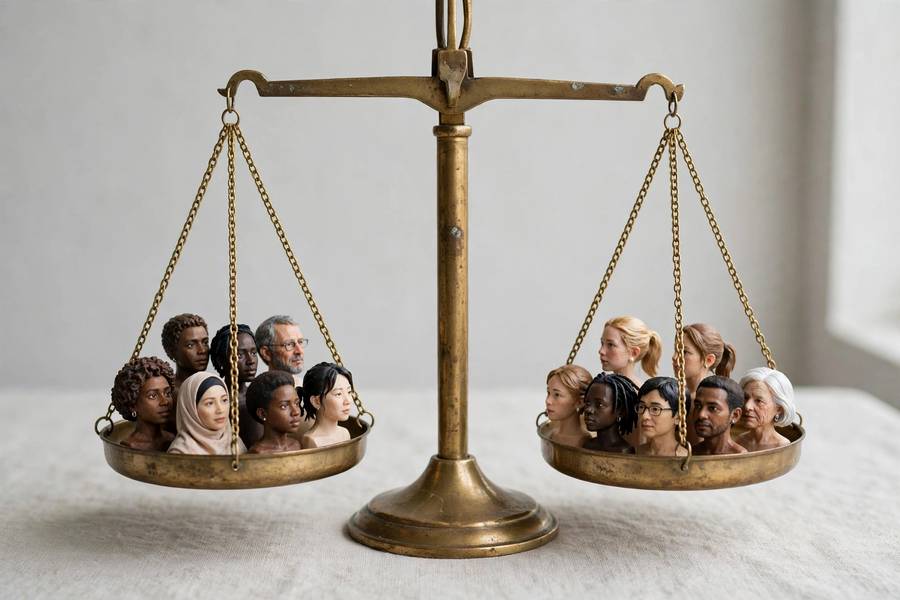
The Impossibility Results
The results that ended the debate over whether perfect fairness is achievable:
The COMPAS impossibility. When base rates differ between groups, you cannot simultaneously achieve equalized odds and calibration. Proven formally after the COMPAS controversy. It’s not a limitation of current methods — it’s mathematics.
The broader trade-off. Kleinberg, Mullainathan, and Raghavan showed that three natural fairness conditions (calibration, balance for the positive class, balance for the negative class) can’t all hold unless base rates are equal or prediction is perfect. Since neither condition holds in practice, trade-offs are mandatory.
What this means practically. Every fairness effort involves choosing which unfairness to accept. A hiring tool can have equal selection rates or equal accuracy per group, but generally not both. The ethical work is in the choosing — and in being transparent about what was chosen.
This is why serious fairness work now centers on documentation and governance, not just math. The EU AI Act doesn’t demand perfect fairness; it demands that high-risk systems document their fairness approach, test it, and maintain human oversight. The regulation absorbed the impossibility results: process, not perfection.
How Teams Measure Fairness
Measurement is where fairness gets operational. The standard toolkit:
Disaggregated evaluation. The foundation: slice every performance metric by demographic group. Never trust aggregate numbers. A model that’s 95% accurate overall and 78% for one group has a fairness problem the headline hides.
Fairness dashboards. Production systems increasingly ship with dashboards tracking parity metrics, error-rate gaps, and calibration across groups — updated continuously, alerting when gaps widen.
Benchmark suites. Standardized tests like WinoBias (gendered coreference), WinoMT (translation), and the NIST demographic evaluations give comparable, repeatable measurements. What gets measured gets managed.
Adversarial and counterfactual testing. Systematically vary protected attributes in inputs and check whether outputs change. If they do, the model is using group membership — whatever the aggregate metrics say.
Audit trails. Documenting training data composition, fairness metrics at each stage, and the rationale for definition choices. Audits — internal and third-party — verify the documentation against reality.
Stakeholder input. The groups affected by a system often identify fairness failures that metrics miss. Community review boards and affected-group consultations catch what dashboards don’t.
Fairness Through the ML Lifecycle
Fairness isn’t a stage; it’s a dimension of every stage in how AI models are trained and deployed:
Data collection. Audit training data for representation across groups. Document gaps. Where possible, collect more representative data rather than trying to fix skews downstream.
Preprocessing. Reweighting underrepresented groups, resampling, and careful handling of proxy variables. The highest-leverage interventions happen here.
Training. Fairness-aware algorithms: adversarial debiasing, constrained optimization (maximize accuracy subject to fairness constraints), and group-aware loss functions. These work, with varying costs to accuracy.
Evaluation. Disaggregated metrics as gate criteria — the model doesn’t ship unless fairness thresholds are met, not just accuracy thresholds.
Deployment. Shadow deployment comparing the model’s decisions against current processes across groups. Staged rollouts with fairness monitoring.
Monitoring. Continuous production tracking. Models drift; populations shift; fairness degrades. The dashboard never gets turned off.
Incident response. When disparities are found in production — and they will be — there’s a process: investigate, mitigate, disclose, fix. Like security incidents, fairness incidents need runbooks.
What Good Practice Looks Like
The organizations doing this well share patterns:
Explicit fairness requirements. Not “be fair” but “false-positive rates within 5 points across groups, measured quarterly, on these benchmarks.” Specificity is what makes fairness enforceable.
Independent auditing. Internal teams develop blind spots. Third-party audits — increasingly legally required — bring fresh data and fresh eyes.
Diverse teams. The researchers who built the fairness field were disproportionately from affected groups. Homogeneous teams miss failure modes they can’t see; this is mechanical, not ideological.
Transparency. Publishing fairness metrics, audit results, and methodology. Transparency creates accountability and lets the field learn from each deployment.
Humility about limits. The best practitioners are explicit about what their fairness measures don’t cover — unmeasured groups, proxy risks, definition trade-offs. Honesty about limits is part of the practice.
Integration with product. Fairness as a launch gate, not a post-launch audit. The teams that treat it as a shipping requirement ship fairer systems than those that treat it as a compliance checkbox.
If you’re evaluating what AI tools can actually do for your organization, add fairness to the evaluation criteria with the same rigor you’d apply to accuracy or cost. A tool that’s accurate for some users and unfair to others isn’t a good tool — it’s a liability with a demo.

Frequently Asked Questions
AI fairness means ensuring automated systems don’t systematically disadvantage protected groups. It’s measured with specific mathematical definitions — demographic parity, equalized odds, calibration — applied across the machine learning lifecycle, from data collection through production monitoring.
Because the main fairness definitions conflict mathematically: when groups have different base rates, you can’t satisfy them all at once. Choosing which definition wins is a values judgment, not a technical problem — and the choice must be made explicitly and transparently.
Through disaggregated evaluation (metrics sliced by demographic group), fairness dashboards in production, standardized benchmark suites, adversarial testing, audit trails, and input from affected communities. Aggregate accuracy alone is never sufficient.
No — impossibility theorems prove that competing fairness definitions can’t all be satisfied simultaneously when base rates differ. The realistic goal is explicit trade-offs, continuous measurement, and governance: process, not perfection.
The EU AI Act requires bias testing and documentation for high-risk AI. NYC mandates annual bias audits for hiring tools. US regulators apply disparate-impact doctrine to algorithms. The trend is uniform: audit, document, disclose, and keep humans in the loop.