
Most advice about mitigating AI bias is either uselessly vague (“be fair!”) or uselessly technical (a paper full of Greek letters). Neither helps when you are the person who actually has to ship a model on Friday and not discriminate against anyone while doing it.
I have spent years digging through biased systems — hiring tools that downranked women, loan models that punished certain zip codes, vision systems that could not see dark skin. The uncomfortable truth: there is no single fix. Bias mitigation is a discipline, a set of habits spread across data, modeling, and operations. This guide covers the techniques that genuinely move the needle, and the limits of each.
If you need the basics first, my guide to what AI bias is explains how bias creeps into systems in the first place.
Table of Contents
- Why Bias Is Hard to Remove
- Fix the Data
- Fix the Model
- Fix the Decisions Around the Model
- Measure Fairness Properly
- Audit Before and After Launch
- Monitor Bias After Deployment
- What Mitigation Can’t Do
- A Practical Starting Checklist
- Frequently Asked Questions

Why Bias Is Hard to Remove
Bias is hard to remove for three boring, stubborn reasons.
The data reflects the world. Training data is a photograph of reality, and reality is biased. A hiring dataset built from ten years of promotion decisions will encode every prejudice those decisions contained. You cannot “clean” this away without deciding what the data should have looked like — and that decision is a judgment call, not a math problem.
Proxies are everywhere. Remove the obvious fields — gender, race, age — and the model finds stand-ins. Zip code predicts race. Purchase history predicts gender. Gaps in employment predict childcare, which predicts being a mother. Deleting protected attributes from the data is the first thing everyone tries, and it is the least effective thing you can do. The signal survives in everything else.
Fairness has no single definition. “Treat groups equally” sounds simple until you pick a metric. Should each group get approved at the same rate? Should the model be equally accurate for each group? Should qualified individuals be approved at the same rate regardless of group? These definitions conflict — a famous result in fairness research proves you cannot satisfy all of them at once except in trivial cases. So mitigation always involves choosing which fairness you want, and defending the choice.
Accepting these three facts makes you better at mitigation than most teams I have seen. The people who struggle are the ones chasing a bias-free model. It does not exist. The goal is a model whose biases are understood, measured, and kept within bounds you can defend.
Fix the Data
Most bias enters through data, so mitigation usually starts there. These are the techniques that hold up in practice:
Representation analysis. Before training, measure who is in your dataset and in what proportions. Not just overall — slice by the protected characteristics that matter for your use case, and by intersections (e.g., older women, young men from rural areas). I have seen teams shocked to learn their “balanced” dataset had 4% of samples from the group their product would serve most. You cannot fix what you never counted.
Targeted data collection. The blunt fix for underrepresentation is more data from the missing group. This is expensive and slow, but it is also the only fix that addresses the root cause. Synthetic data can supplement — generated examples of underrepresented groups — but be careful: synthetic data generated by a biased model just clones the bias at higher resolution.
Label auditing. Models learn to copy the labels they are trained on. If human annotators labeled loan applications, their own biases live in the labels. Audit a sample of labels across groups. I once saw a resume-screening dataset where annotators had systematically rated identical resumes lower when the name suggested a woman. The model was never the problem; the labels were.
Reweighting and resampling. Give underrepresented or mislabeled groups more influence during training — either by duplicating their samples or by increasing their weight in the loss function. This is a solid, cheap technique. It does not fix bad labels, but it forces the model to pay attention to groups it would otherwise ignore.
Causal review of features. For each important feature, ask: why does this predict the outcome? If “number of traffic tickets” predicts loan default, fine. If “first name” predicts loan default, your model found a proxy for ethnicity and you need to remove or transform that feature. Feature-importance plots, sliced by group, make these discoveries mechanical rather than lucky.
Fix the Model
When data fixes are not enough — or not possible — you intervene in the training itself.
Fairness-constrained training. Add a penalty term so the model loses accuracy points when it treats groups differently. Libraries like Fairlearn and AI Fairness 360 implement this out of the box. Expect a small accuracy cost: that is the price of fairness, and teams should budget for it honestly instead of discovering it in a metrics review.
Adversarial debiasing. Train a second model alongside yours whose job is to predict the protected attribute from your model’s internal representations — and penalize your model whenever the adversary succeeds. The result: internal representations that carry no usable signal about, say, gender. It is elegant and genuinely effective for representation bias, though harder to tune than simpler methods.
Fix the Decisions Around the Model
Here is the technique with the best cost-to-impact ratio, and the one teams skip most often: change how the model’s output gets used.
Human review for high-stakes decisions. If a model rejects a mortgage application, a person should look at the rejection before it goes out — at least for borderline cases. The reviewer needs training, authority to override, and time. A reviewer who rubber-stamps 400 cases an hour is decoration, not oversight.
Confidence gating. Only let the model decide when it is confident. Low-confidence predictions — which cluster disproportionately around underrepresented groups — get routed to humans or to a more expensive, more careful pipeline. This single trick has rescued more deployments than any fairness algorithm I know.
Appeals and recourse. Every automated decision that matters should come with a way to challenge it. Appeals do two things: they fix individual harms, and they generate a feedback signal — patterns in appeals tell you exactly where your model is biased.

Measure Fairness Properly
You cannot mitigate what you do not measure. Pick metrics that match your stakes:
- Demographic parity: each group receives the positive outcome at the same rate. Use when the decision itself is the benefit — job interviews, loan approvals, admissions.
- Equal opportunity: qualified members of each group succeed at the same rate. Use when you care about not missing good candidates — this is usually the more defensible metric.
- Equalized odds: both the true-positive and false-positive rates match across groups. The strictest common standard; use for high-stakes decisions like fraud flags or medical triage.
- Counterfactual fairness: flipping a person’s protected attribute (in a causal model of the world) would not change the decision. The most rigorous and the hardest to compute; use when you have a defensible causal model.
Measure on slices, not just overall. Overall accuracy can be 95% while accuracy on one group is 60%. I have seen this exact pattern in production systems more than once. Slice by every group that matters, and by intersections where your user base concentrates.
Audit Before and After Launch
Measurement is internal; auditing is adversarial. An audit asks: if someone tried to prove this system is biased, what would they find?
Pre-deployment audits should include a structured fairness review: the metrics above, red-team testing (deliberately feeding the model edge cases and adversarial inputs), and a review of the training data’s provenance. For the full playbook, see my guide to AI bias audits.
Post-deployment audits matter more, because the world changes. Data drifts. User behavior shifts. A model that was fair at launch can become unfair within months as the population it serves changes. Schedule audits quarterly for high-stakes systems, annually for everything else, and immediately after any incident.
Monitor Bias After Deployment
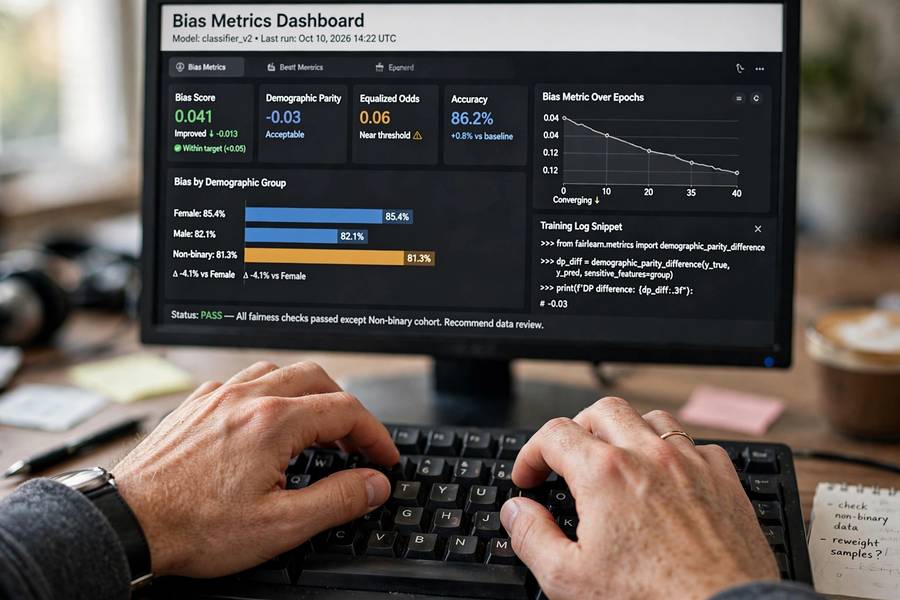
Between audits, monitor. Set up dashboards that track your fairness metrics continuously, with alerts when a metric drifts past a threshold. This is standard MLOps hygiene that most teams somehow never build for fairness specifically.
What to watch:
- Input drift by group. If the demographics of your users shift, your fairness metrics will move even if the model is unchanged.
- Outcome rates by group. The simplest, most important dashboard: what fraction of each group gets the positive outcome, over time.
- Appeal and complaint patterns. Spikes in appeals from one group are an early warning system. Build the pipeline from complaints to model review before you need it.
- Override rates. If human reviewers override the model far more often for one group, either the model is biased against that group or the reviewers are. Either way, investigate.
What Mitigation Can’t Do
Honesty requires the limits. Mitigation cannot:
Fix an unfair process. If the underlying human process is discriminatory — biased interviewers, redlining, unequal policing — an AI trained on its outputs will launder that bias into math. Sometimes the right answer is not a fairer model but a different process, or no model at all. I have told clients this. It is never the answer they wanted, and it is sometimes the only honest one.
Resolve competing definitions of fairness. As noted: you cannot satisfy every fairness metric simultaneously. Someone must choose which matters, and that choice is political and contextual, not technical. Mitigation implements the choice; it cannot make it for you.
A Practical Starting Checklist
If you are starting from zero, do these in order:
- Count your data. Representation analysis across the groups that matter for your use case. (One afternoon.)
- Audit your labels. Sample and review labels by group. Fix what you find. (A few days.)
- Pick one fairness metric that matches your stakes and compute it on slices. (An afternoon.)
- Add confidence gating so low-confidence predictions go to humans. (A week of engineering.)
- Write a model card documenting data, metrics, and limitations. (A day.)
None of this requires a research team. It requires someone who cares enough to measure. Most biased systems I have examined were not built by villains — they were built by competent people who never looked. Looking is the whole game. For a deeper treatment of the fairness concepts behind these steps, see my piece on AI fairness.
Frequently Asked Questions
Start with the data: measure representation across groups, audit labels for human prejudice, and collect more data from underrepresented groups. Then add fairness-constrained training, human review for high-stakes decisions, and continuous monitoring. No single technique works alone.
No. Training data reflects a biased world, proxies for protected attributes are everywhere, and different fairness definitions conflict mathematically. The realistic goal is a model whose biases are measured, understood, and kept within defensible bounds.
No — this is the most common failed fix. The model finds proxies: zip codes, names, purchase history, and employment gaps carry the same signal. Removing protected attributes while leaving proxies creates bias you can no longer measure, which is worse.
Mitigation is the set of techniques that reduce bias: better data, fairness constraints, human review, monitoring. An audit is an adversarial evaluation that checks whether those techniques worked — measuring fairness metrics, red-teaming edge cases, and documenting findings.
Choose a fairness metric that matches your stakes — demographic parity, equal opportunity, or equalized odds — and compute it on slices of your user base, not just overall. Track it continuously after deployment, with confidence intervals for small groups.