Discipline vs. Motivation: Which One Actually Works?


Every January, I was the most motivated person alive. New planner, new goals, new workout clothes — and by February, the planner was a coaster and the workout clothes were pajamas. For years I thought the problem was me: I just needed more motivation, more inspiration, more wanting-it-bad-enough. Then I read a line that rearranged my brain: “Motivation gets you started; discipline keeps you going” — and more importantly, I learned that discipline isn’t a personality trait. It’s a set of systems. That changed everything.
This is the honest breakdown of discipline vs. motivation: what each one actually is, why motivation reliably fails, how discipline is really built (spoiler: not through suffering), and the practical systems that make good behavior automatic. No hustle-culture hype, no “just be more disciplined” lectures — just what works.
In this guide:
- What Motivation and Discipline Actually Are
- Why Motivation Reliably Fails
- The Discipline Myth (It’s Not What You Think)
- Systems Beat Both: The Real Answer
- How to Actually Build Discipline
- When Motivation Is Genuinely Useful
- Putting It Together: Your Operating System
What Motivation and Discipline Actually Are
Motivation is the emotional desire to do something — the spark. It’s fueled by inspiration, urgency, novelty, and mood. It feels great: the burst of energy after a documentary, the January resolve, the “I’m going to change my life” Sunday night. Motivation is real and valuable, but it’s weather — it changes with sleep, stress, hormones, and whether Mercury is in retrograde (kidding — mostly).
Discipline is doing the thing regardless of mood — the engine. But here’s what the hustle gurus get wrong: discipline isn’t white-knuckling through misery on willpower. Research on “disciplined” people (notably Angela Duckworth’s work on grit and studies of high self-control individuals) found something surprising: people with high self-control don’t actually resist more temptations. They face fewer temptations because they’ve structured their lives to avoid them. Discipline, it turns out, is mostly good design.
The reframe that matters: motivation is unreliable by nature (it’s an emotion), willpower is a depletable resource (the research debates the details, but everyone agrees it fluctuates), and discipline-as-systems is buildable and stable. You’re not choosing between two traits — you’re choosing between riding the weather and building a climate-controlled house.
Why Motivation Reliably Fails
Motivation fails for predictable, structural reasons — not character flaws. It’s emotion-based: you can’t feel inspired on demand, and waiting to “feel like it” means the gym happens only on good-mood days. It’s novelty-driven: new goals excite; week-six routines don’t. The motivation curve always decays — that’s not failure, that’s neuroscience. It’s fragile under stress: exactly when you most need good habits (hard weeks, bad sleep, life chaos), motivation is lowest. The tool deserts you at the critical moment.
It confuses feeling with doing: motivation makes you feel productive (watching workout videos, buying the planner, researching the perfect routine) without any actual doing. I call this “motivation theater” — I was its star performer for years. If this is you, read how to stop being lazy next. And it’s all-or-nothing prone: high motivation sets heroic standards (“work out 6 days a week!”), the inevitable miss feels like failure, and the whole project collapses. Moderate consistency beats heroic intensity every time — but motivation doesn’t do moderate.
None of this means motivation is useless (more on that later). It means motivation is a terrible foundation. Build on it and you’re building on weather.
The Discipline Myth (It’s Not What You Think)
The cultural image of discipline — the 5 a.m. ice baths, the grim determination, the “no excuses” grind — is mostly performance. Real discipline, the kind that sustains over decades, looks boring: the person who exercises at the same time daily because it’s just what happens then. Who eats well because the kitchen is stocked accordingly. Who works deeply because the phone lives in another room. No drama, no heroics — just defaults.
This is the crucial insight from behavioral science: disciplined people rely less on willpower, not more. They use implementation intentions (“when X happens, I do Y”), environment design (friction for bad habits, ease for good ones), and identity (“I’m a person who exercises” beats “I should exercise”). The “disciplined” runner is not fighting herself every morning — she has a best morning routine for success that runs itself — she’s just following a groove worn deep by repetition.
So stop asking “how do I become more disciplished?” and start asking “how do I make the right thing the easy thing?” That’s not a character question — it’s a design question. And design questions have actionable answers.
Systems Beat Both: The Real Answer
The discipline-vs-motivation debate has a winner, and it’s neither: systems. A system is a structure that produces the behavior without requiring daily decisions. Meal planning beats “eating healthy” (no 6 p.m. willpower needed). Laying out workout clothes beats “being motivated to exercise.” Automatic savings transfers beat “spending discipline.” The system does the disciplining so you don’t have to.
Systems work because they attack the real enemy: decision fatigue and friction. Every behavior has a friction cost — and humans reliably follow the path of least resistance. Want to read more? Put a book on your pillow (low friction) and delete the social apps (high friction for scrolling). The behavior follows the design. This is why environment beats intention roughly 100% of the time.
My own systems, for reference: workout clothes laid out nightly (morning exercise happens 90% of planned days vs. 30% before); phone charges outside the bedroom (mornings start calm); a weekly 20-minute planning session every Sunday (the week runs itself — see how to create a daily routine for the full method); one “admin hour” Fridays for all life paperwork (nothing slips). None required motivation after week two. They just… run.
The 2-minute rule
James Clear’s famous rule: scale any habit down until it takes two minutes — “read before bed” becomes “read one page.” The tiny version is motivation-proof (anyone can do two minutes), and starting is the hard part — once you’ve read one page, you usually keep going. I used this to build a meditation habit: “sit on the cushion” was the whole requirement. Two years later, it’s twenty minutes daily. It started with sitting down.
How to Actually Build Discipline
Step one: shrink the behavior. Whatever you’re trying to do, make the daily version embarrassingly small. Not “work out an hour” — “put on workout clothes and walk outside.” Small enough that motivation is irrelevant. You can scale up later; you can’t scale up a habit that never starts.
Step two: anchor it. Attach the new behavior to an existing one: “after I pour morning coffee, I open the journal.” Existing habits are rivers — new ones just need to join the flow. This is habit stacking, and it’s the most reliable habit-formation technique in the literature.
Step three: design the environment. Make good behaviors frictionless and bad ones effortful: fruit on the counter, junk out of the house; guitar on a stand in the living room, not in a case in the closet; phone in another room during work. Every unit of friction you add to a bad habit (or remove from a good one) is discipline you don’t have to manufacture.
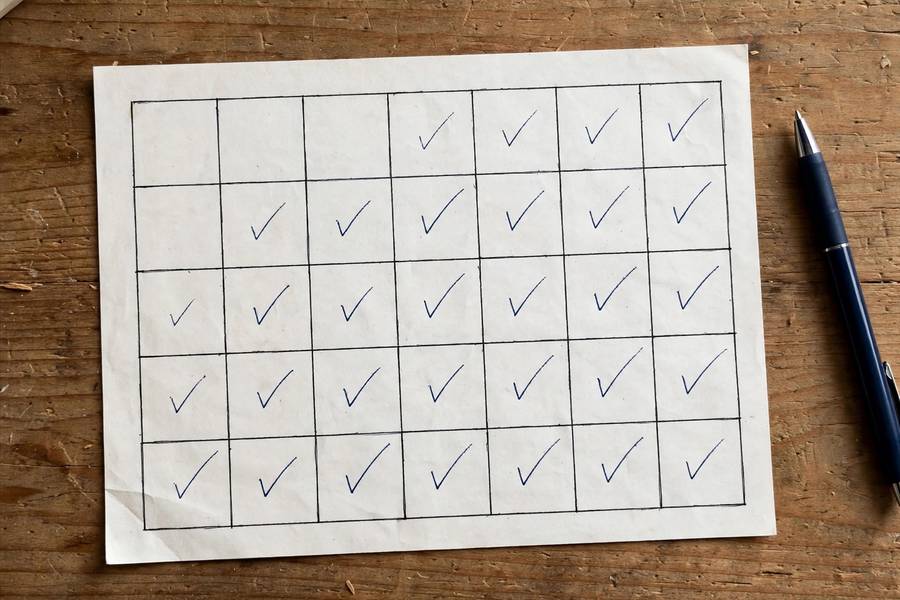
Step four: track simply. A wall calendar with X’s, a habit app, a notebook — the method doesn’t matter, the visibility does. Don’t break the chain (Seinfeld’s famous advice) works because loss aversion is powerful: after 20 X’s, skipping feels like wasting 20 days. Track the behavior, not the outcome — you control showing up, not the scale.
Step five: plan for failure. Decide in advance what happens when you miss: “if I miss a workout, I do a 10-minute walk the same day” — never zero, always something. The “never miss twice” rule (also Clear’s) prevents the real killer: not the single miss, but the spiral where one miss becomes quitting. Missing once is an accident; missing twice is the start of a new (bad) habit.

When Motivation Is Genuinely Useful
Motivation isn’t the enemy — it’s just miscast as the foundation when it’s really the spark. Use it for what it’s good at: starting. That burst of January energy? Channel it into building systems, not setting heroic goals. Motivated Sunday night you should be laying out the week’s workout clothes and planning meals, not vowing to “be different this time.”
Motivation is also great for the hard middle: the inspiring book, the workout partner, the progress photos — these are motivation top-ups that keep systems running through rough patches. Think of motivation as the maintenance crew, not the foundation. And it’s essential for direction: discipline without motivation is efficient motion in possibly the wrong direction. Check in quarterly: are these habits serving the life I want? That is how to do a life audit in one question. Motivation asks the “why”; systems handle the “how.”
Putting It Together: Your Operating System
The final synthesis, the thing I wish someone had told me at 25: use motivation to start, systems to continue, and discipline-as-identity to sustain. Motivation picks the direction and lights the fire. Systems (environment, anchors, tiny habits, tracking) carry you through the 90% of days when motivation is absent. And over time, repetition becomes identity — “I’m someone who exercises” — which is the most durable form of discipline there is, because it no longer requires deciding.
Start this week with one habit, shrunk to two minutes, anchored to an existing routine, with the environment redesigned around it. Not five habits — one. Let it run for a month. Then add the next. In a year, you’ll have a dozen systems running on autopilot, and someone will call you “so disciplined.” You’ll smile, because you’ll know the secret: you’re not more disciplined than anyone. You just stopped relying on motivation and built something better.
The tortoise was right all along. Slow, small, systematic — and still moving when everyone else’s motivation ran out in February.
Systems beat both — but between the two, discipline (as well-designed systems, not willpower) wins for long-term results. Motivation is emotion-based and reliably fades; discipline-as-systems (environment design, tiny habits, anchors, tracking) works regardless of mood. Use motivation to start and set direction; use systems to continue.
Motivation is novelty-driven emotion: it spikes with new goals and decays as routine sets in — that’s neuroscience, not character flaw. It’s also fragile under stress (lowest exactly when you need habits most) and prone to ‘motivation theater’ (feeling productive without acting). It’s weather, not climate — great spark, terrible foundation.
Design it: shrink the behavior to two minutes (motivation-proof), anchor it to an existing habit, redesign your environment (friction for bad, ease for good), track visibly (don’t break the chain), and plan for misses (never miss twice). Research shows ‘disciplined’ people face fewer temptations through good design — they don’t white-knuckle more.
Scale any habit down until the starting version takes two minutes or less — ‘read before bed’ becomes ‘read one page.’ Starting is the hardest part; once begun, you usually continue. The tiny version is immune to low motivation, and consistency at small scale builds the identity (‘I’m a reader’) that sustains larger versions later.
Don’t rely on feeling — rely on structure: the behavior should be tiny, anchored, and environmentally easy, so it happens on autopilot. Track it visibly so skipping has a cost. And use the ‘never miss twice’ rule: one miss is an accident, two is a new habit. Consistency is a design outcome, not a mood outcome.