What Is the Asteroid Spin Barrier? Why Fast Asteroids Should Fly Apart

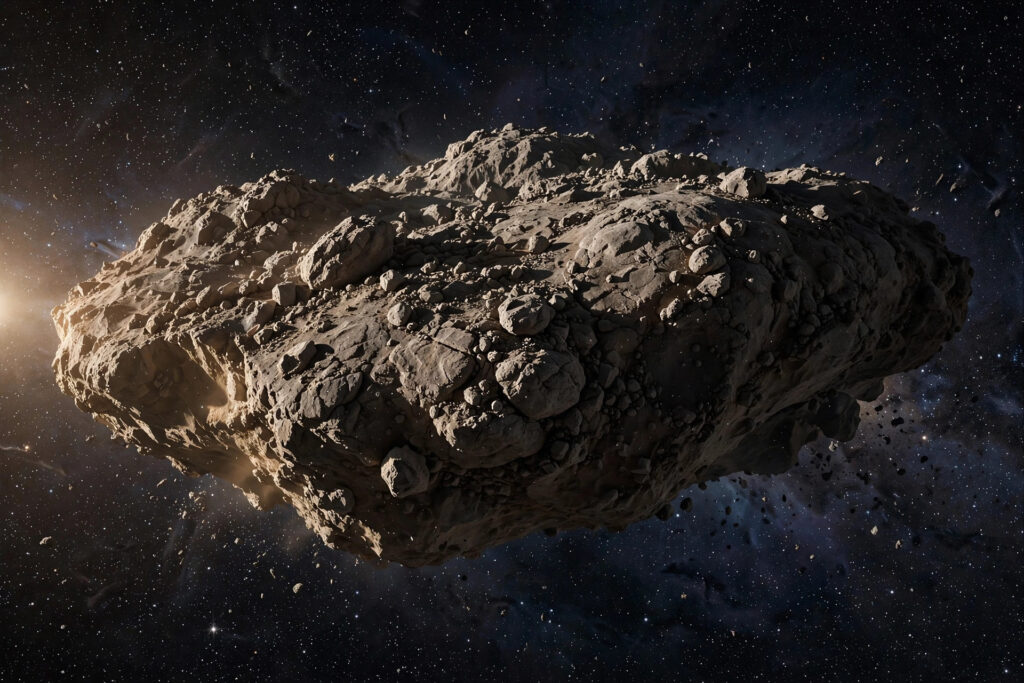
Every so often, space hands us a puzzle wrapped in a rock. In October 2026, astronomers combing through early observations from the Vera Rubin Observatory found an asteroid about 2.5 kilometers wide — roughly the length of 25 football fields — spinning once every four minutes. Here is the problem: according to a decades-old rule of asteroid physics, a rock that big should not be able to spin that fast. Centrifugal force should have ripped it apart long ago. Yet there it is, holding together.
So what is this rule — and why do a few asteroids keep breaking it? That rule has a name: the asteroid spin barrier. Here is how I think about it.
What Is the Asteroid Spin Barrier?
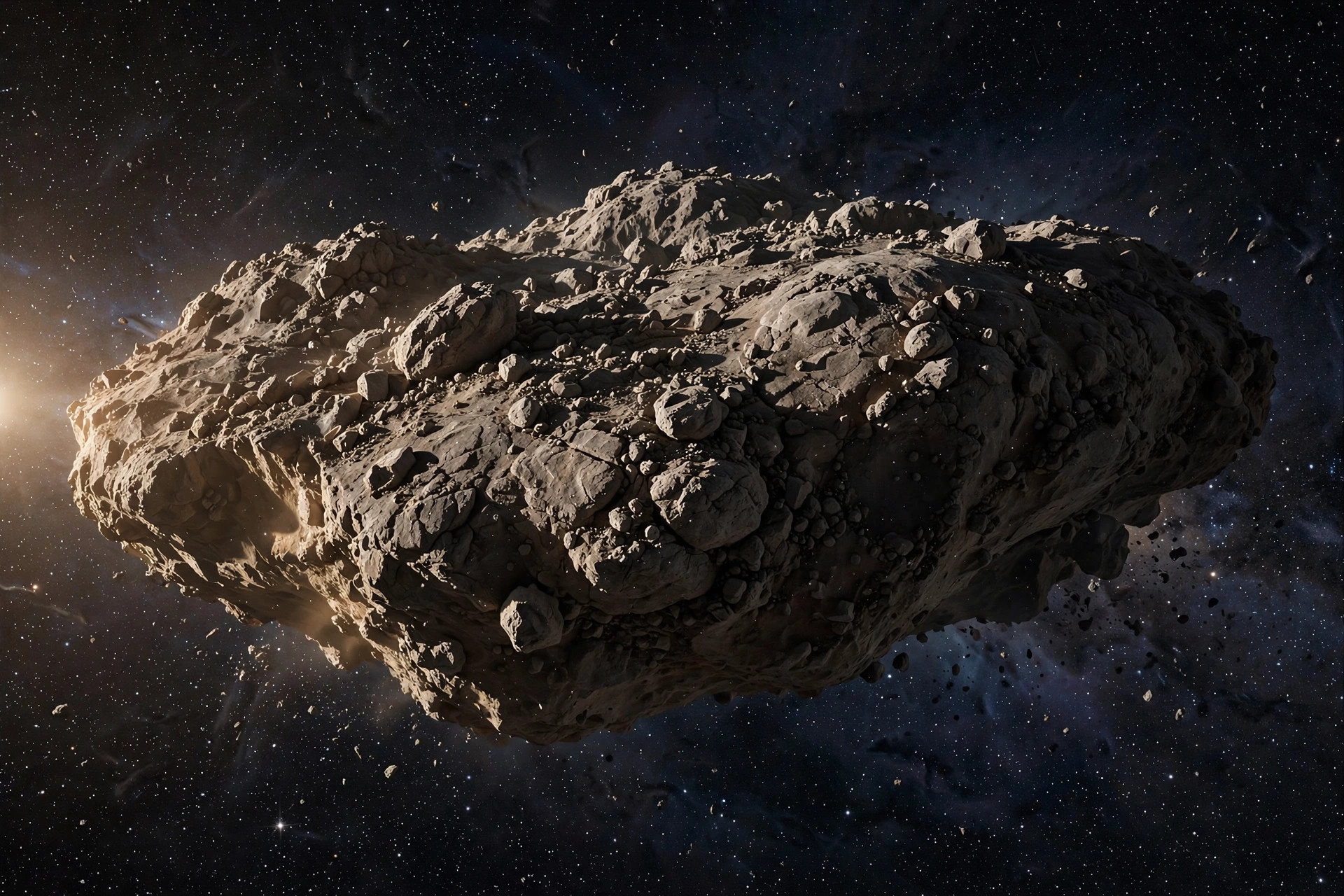
The asteroid spin barrier is a speed limit written into the data. If you plot thousands of asteroids by size and rotation period, a striking pattern appears: asteroids larger than about 150 meters almost never complete a full rotation in less than about 2.2 hours. Faster than that, and the corner of the graph is essentially empty.
Astronomers first noticed this wall in the 1990s, and larger surveys in the early 2000s confirmed it. It is sometimes quoted as roughly two hours rather than 2.2, but the idea is the same: for big asteroids, there is a fastest safe spin, and almost nothing crosses it.
Notice what I said — *almost* nothing. The barrier is not a law of physics carved in stone. It is an observed pattern, and like most patterns in astronomy, the exceptions are where things get interesting. To understand why the barrier exists at all, though, we need to talk about what most big asteroids are actually made of.
Why a Loose Pile of Rocks Has a Speed Limit
Here is the part that surprised me when I first learned it: most asteroids bigger than about 150 meters are not solid rocks. They are rubble piles — loose collections of boulders, gravel, and dust held together by nothing but their own feeble gravity. Billions of years of collisions have shattered larger bodies again and again, and gravity has gathered the fragments back into wobbly heaps.
We know this is not just a theory. NASA’s OSIRIS-REx mission visited the asteroid Bennu and found a spinning top of loosely packed rubble. Japan’s Hayabusa2 found the same kind of structure at Ryugu. And the asteroid Didymos — the target of NASA’s DART impact and now ESA’s Hera mission — spins once every 2.2 hours, sitting almost exactly on the barrier, at the very edge of what a rubble pile can survive.
Here is how I think about the speed limit itself. Remember standing on a merry-go-round as a kid? The faster it spun, the harder you had to grip the bars, because something was trying to fling you off. An asteroid feels the same outward push — centrifugal force. For a rubble pile, the only “grip” is the asteroid’s own weak gravity pulling every pebble inward.
Spin the pile slowly, and gravity wins; the rocks stay put. Spin it faster, and the outward push at the equator grows. At a rotation period of about 2.2 hours, the two forces balance for a strengthless body: centrifugal force at the equator equals the pull of self-gravity. Spin any faster, and pebbles at the equator simply drift off into space. The asteroid sheds itself apart.
So the barrier is really a confession. It tells us that most large asteroids have essentially no internal strength — they are gravel held together by a whisper of gravity, and physics will not let them spin any faster.
How Do We Know How Fast an Asteroid Spins?
I love this measurement, because nobody has ever visited the vast majority of asteroids. We measure their spin from Earth using nothing but their light.
Most asteroids are lumpy and irregular. As one turns, it shows us a wider face, then a narrower one, so the amount of sunlight it reflects rises and falls in a steady rhythm. Astronomers record this flickering — called a light curve — and the rhythm of the brightening and dimming gives away the rotation period. A four-hour rhythm means a four-hour day.
Wide-field surveys have now measured light curves for tens of thousands of asteroids, and the Vera Rubin Observatory is expected to measure millions more. But there is a catch I find genuinely humbling: telescopes like Rubin can only catch an asteroid at scattered, irregular moments, and those gaps can easily produce a wrong spin rate. A team at the University of Washington, led by Dmitrii Vavilov, built new software that automatically weeds out unreliable measurements. When they applied it to early Rubin data, the record-breaking fast spinners emerged from the noise. It is a good reminder that in astronomy, better data is only half the battle — you also need to know which measurements to trust.
The Rule-Breakers: Super-Fast and Ultra-Fast Rotators
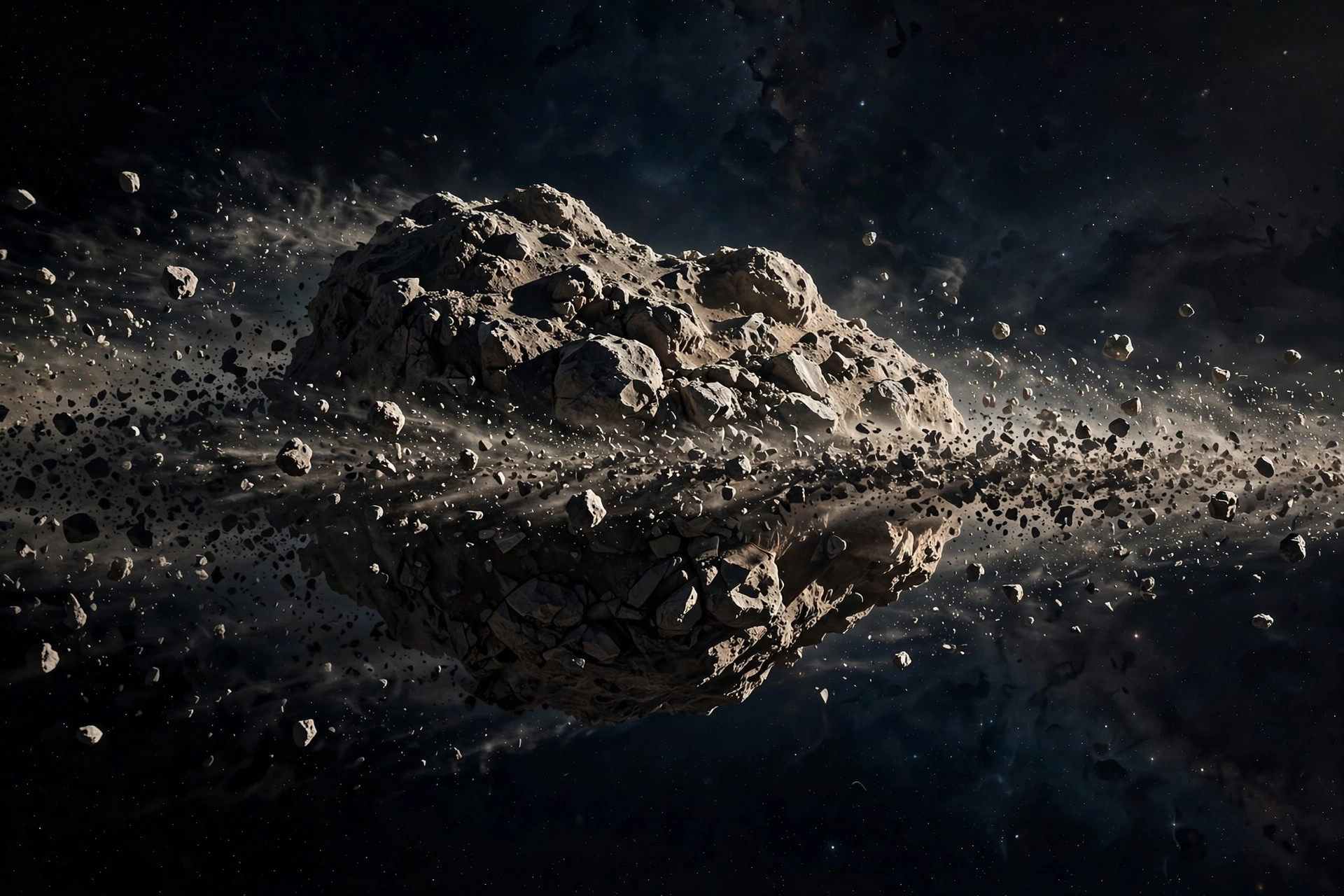
Now for the rebels. In that early Rubin data, Vavilov’s team identified 66 asteroids spinning faster than the 2.2-hour barrier — “super-fast rotators” — and five spinning once in under five minutes, the “ultra-fast rotators.” Two of them were larger than two kilometers wide, something never seen before at that size.
The current record-holder is asteroid 491384: roughly 2.5 kilometers across, completing one full rotation in about 4.18 minutes. A second object, 566130, is about 2 kilometers wide and spins every 5.34 minutes. (These findings were reported as a preprint in October 2026, so they are still awaiting independent confirmation — but even as candidates, they are extraordinary.) For the full story of the discovery, see the fastest-spinning asteroid ever found.
They are not the first exceptions, either. Back in 2016, astronomers reported that asteroid (60716) 2000 GD65 — about 2.3 kilometers wide — spins once every 1.95 hours. The most likely explanation was a weak internal stickiness, comparable to lunar soil, holding its rubble together.
So how do the rule-breakers survive? There are really two answers, depending on size. Small asteroids — smaller than about 150 meters — break the barrier all the time, and that is expected: they are usually single solid fragments, monoliths, chipped off larger bodies. Collisions and a subtle effect called YORP (sunlight gradually nudging an asteroid’s spin over millions of years) can wind these little rocks up to dizzying speeds, and solid rock can take it.
But a 2.5-kilometer rubble pile spinning every four minutes is a different beast entirely. As the researchers put it, neither of the two giant ultra-fast rotators could survive such rapid spin without substantial internal cohesion. Vavilov’s team suggests they are monolithic bodies at least 30 times stronger than clay — possibly pristine objects dating back to the early solar system, never shattered into rubble at all. Even among small fast spinners, scientists have found that a tiny bit of stickiness between grains — a van der Waals “glue” worth only about 25 pascals of strength — can be enough to hold a spinning pile together.
What the Exceptions Teach Us About Asteroid Interiors
Here is the part I keep coming back to: an asteroid’s spin is like an X-ray of its interior. We cannot crack these rocks open, but their rotation tells us what they are made of. Obey the barrier, and you are probably a loose rubble pile. Break it, and you must have real internal strength — you are solid, or at least sticky.
That matters for more than curiosity. If humanity ever needs to deflect an asteroid headed our way, its internal structure changes everything. A rubble pile absorbs an impact like a beanbag; a monolith shatters or shifts like a billiard ball. Missions like DART and Hera are teaching us how rubble piles respond to a push — and the fast-spinning exceptions remind us that not every asteroid will behave the same way.
So the asteroid spin barrier is not really a wall. It is a diagnostic tool: a line in the data that separates the gravel heaps from the solid rocks, and every object that crosses it is a clue about what the early solar system was built from.
It is the observed limit that asteroids larger than about 150 meters almost never rotate faster than once every 2.2 hours. Faster-spinning large asteroids are extraordinarily rare, and each one demands an explanation.
It is the rotation period at which centrifugal force at an asteroid’s equator balances the pull of its own gravity, assuming the body has no internal strength. The exact value depends on the asteroid’s density, which is why some sources quote roughly two hours instead.
No. Small asteroids under about 150 meters break it routinely because they tend to be solid monoliths rather than rubble piles. A handful of large asteroids also break it — the “super-fast rotators” — and those must have real internal cohesion holding them together.
By recording its light curve: the rhythmic brightening and dimming caused by its irregular shape turning in sunlight. The period of that rhythm equals the rotation period. Large sky surveys can measure thousands of these at once.
A loose collection of boulders, gravel, and dust held together only by weak mutual gravity — the expected result of billions of years of collisions shattering and re-gathering larger bodies. Bennu and Ryugu, visited by spacecraft, are classic examples.
Spin itself is not the danger — size and orbit are. But a fast spinner’s internal structure matters for planetary defense: deflecting a solid monolith requires a different approach than nudging a loose rubble pile, so understanding these objects helps us prepare. —