8 Best Shoulder Exercises at Home (No Gym Required)

You do not need a gym to build real shoulders. I know, because I spent eight months training in a garage with a pull-up bar, one pair of adjustable dumbbells, and a set of bands, and my shoulders did not shrink. They got better, because I stopped skipping the boring high-rep work that machines make easy to avoid. Home shoulder training is not a compromise. It is a different set of tools, and if you use them right, the results are the same.
This guide covers the best shoulder exercises you can do at home, what minimal equipment actually matters, and two complete workouts: one with just your bodyweight and bands, one with dumbbells. No fluff, no “just do push-ups” filler. Real programming you can start today.
In this guide:
- What You Actually Need (Less Than You Think)
- The 8 Best At-Home Shoulder Exercises
- Two Complete Home Shoulder Workouts
- How to Progress Without Heavy Weights
- Mistakes That Waste Home Workouts
- Frequently Asked Questions
What You Actually Need (Less Than You Think)
Let us be honest about equipment. You can build shoulders with zero equipment. But a small investment makes everything easier and faster. Here is my honest ranking:
- Nothing: Pike push-ups, handstand holds, and Y-T-W raises cover all three delt heads. Free, effective, and enough for beginners for months.
- Resistance bands ($20 to $30): The single best home shoulder investment. Lateral raises, presses, face pulls, pull-aparts: bands do all of it, and the tension curve suits delts perfectly.
- Adjustable dumbbells: The full gym experience for shoulders in a corner of your room. If you buy one thing after bands, make it these.
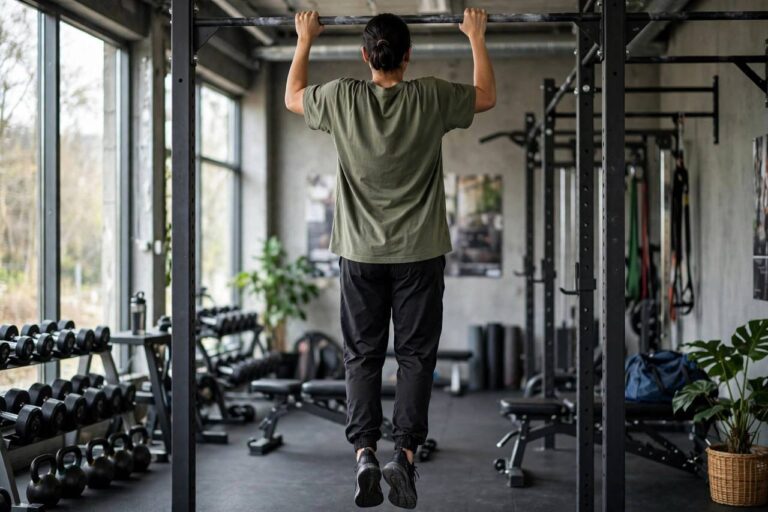
- Doorway pull-up bar: Not strictly a shoulder tool, but hanging and pulling builds the upper back that supports healthy shoulders.
If you are setting up a dedicated space, our best home gym setup guide covers the full equipment list beyond shoulders. For a broader home training plan, the how to build muscle at home guide lays out the programming principles that apply to every muscle group.
The 8 Best At-Home Shoulder Exercises
1. Pike Push-Up
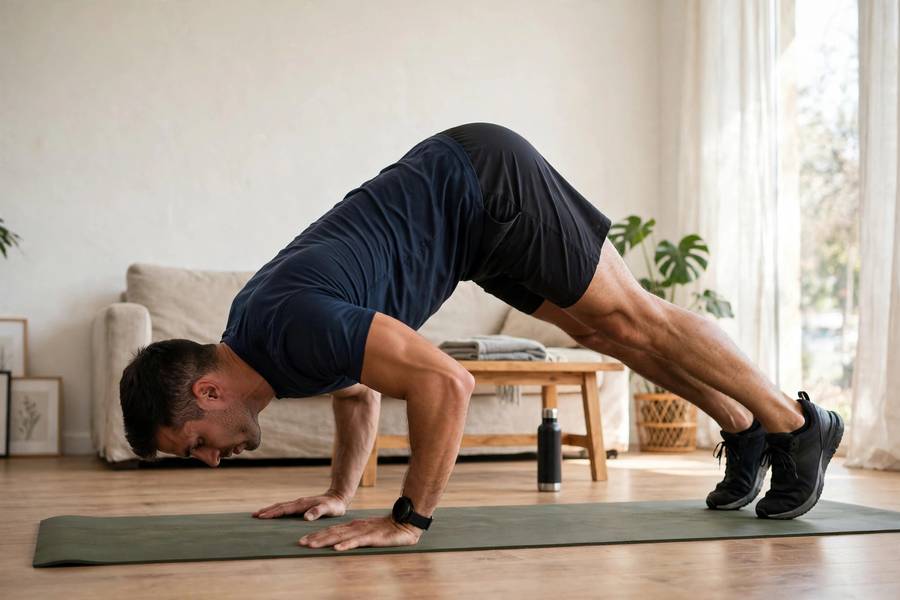
The home overhead press. Bend at the hips into an inverted V, hands shoulder-width, and lower the top of your head toward the floor between your hands, then press back up. The more vertical your torso, the more it becomes a true overhead press. Elevate your feet on a chair or couch to increase the load. I have clients work from 3 sets of 8 up to 3 sets of 20 before moving to harder variations. Form cue: keep the elbows tucked at roughly 45 degrees, not flared wide. Flared elbows on pike push-ups are a shoulder impingement waiting to happen.
2. Band Lateral Raise
Stand on the middle of a band, hold the ends at your sides, and raise your arms out to shoulder height. Bands keep tension through the whole rep, which is exactly what the side delt needs. Step wider on the band to increase resistance. Do 3 to 4 sets of 15 to 20 with a one-second pause at the top. If your traps are doing the work, the band is too heavy: go lighter and keep your shoulders down.
3. Band Overhead Press
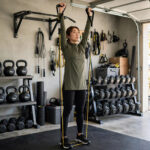
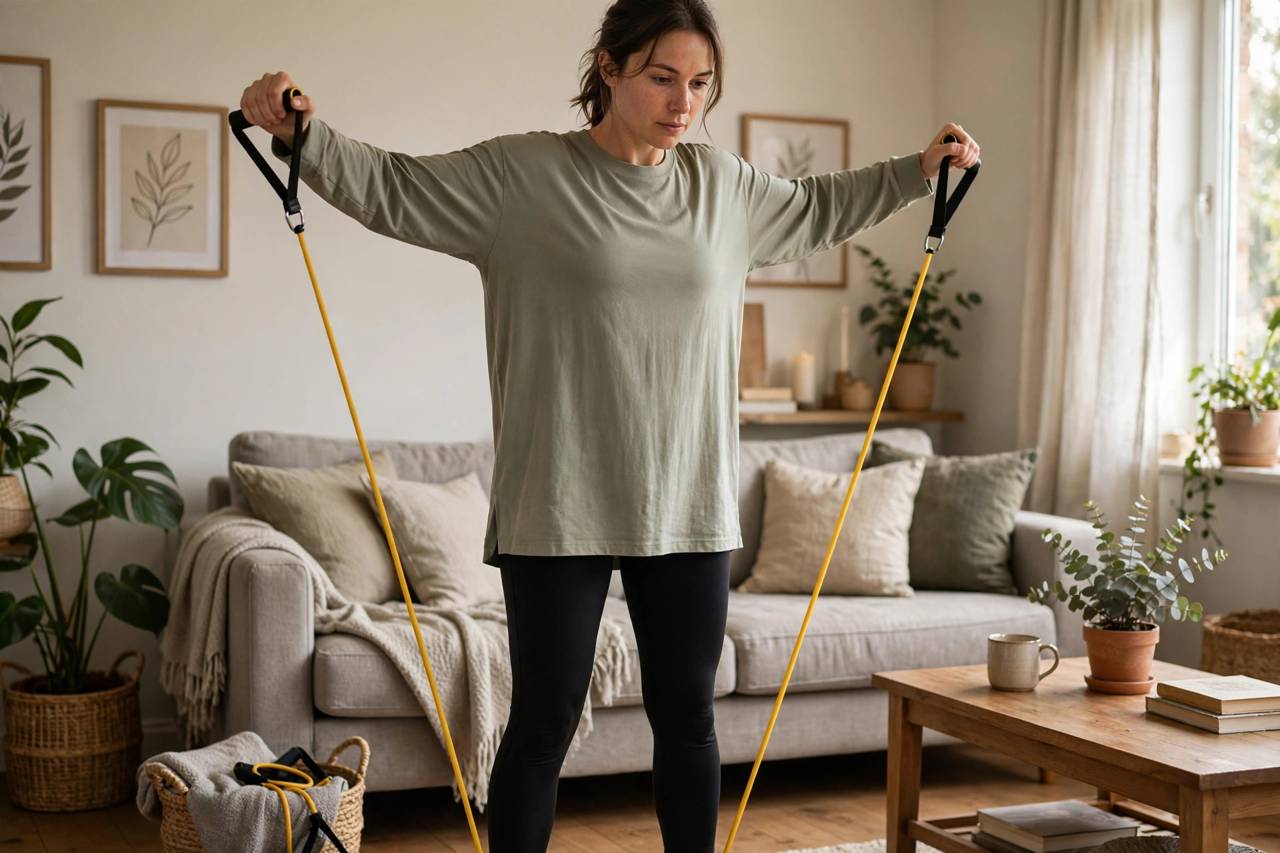
Stand on the band with feet shoulder-width, bring the handles to shoulder height, and press overhead. The band’s resistance increases as you press, which overloads the lockout where the delts work hardest. This is a legitimate overhead press substitute, not a consolation prize. Four sets of 10 to 15, controlled tempo, full lockout.
4. Band Face Pull
Anchor the band at face height (a door anchor or a sturdy post), grab it with a neutral grip, and pull to your forehead with external rotation, exactly like the cable version. Rear delts and upper back get the work. This is the single most important at-home shoulder exercise for posture and shoulder health, and it is the one people skip. Do not skip it. Three sets of 15 to 20.
5. Wall Handstand Hold (or Pike Hold)
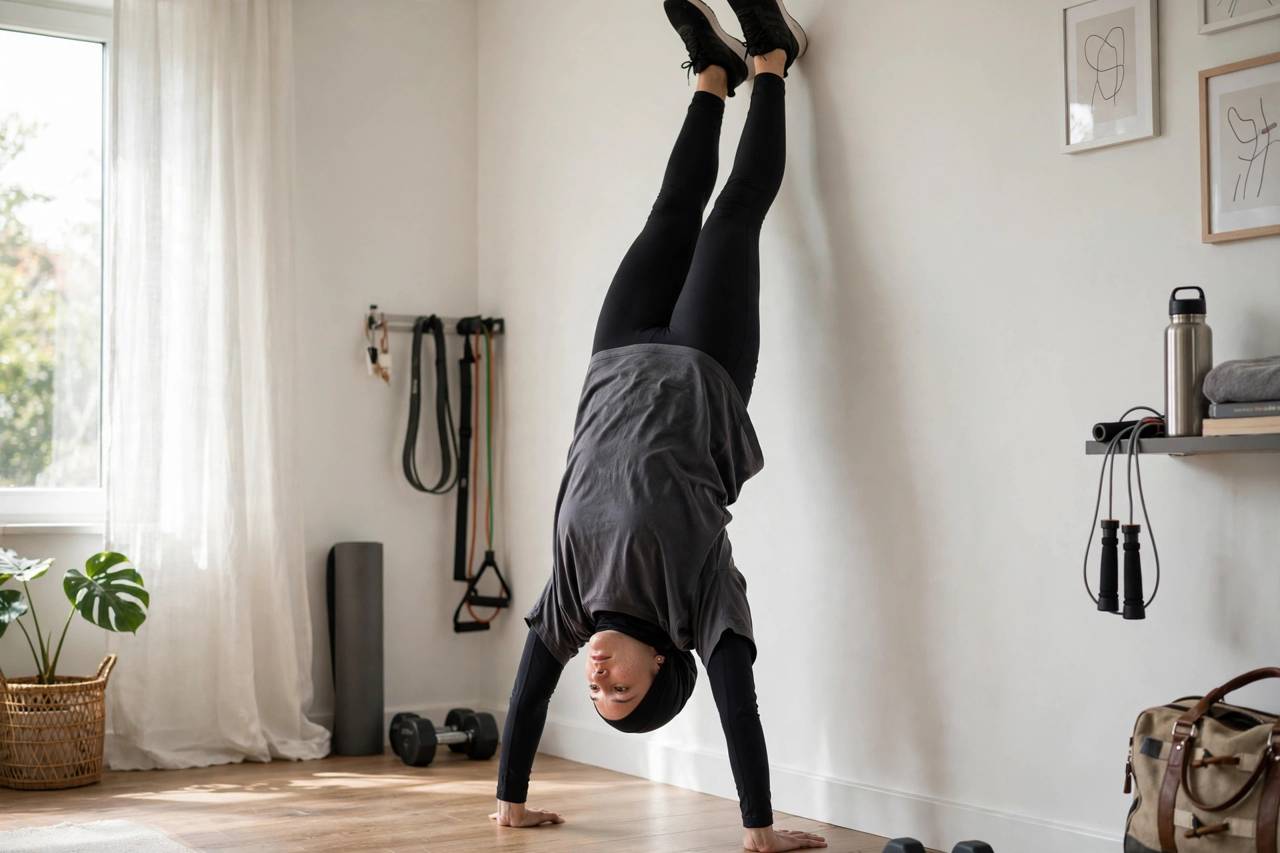
Kick up against a wall and hold. Start with 3 sets of 20 to 30 seconds and build toward 60 seconds. The handstand hold builds rock-solid shoulder stability and teaches your body to support load overhead, which carries over to every press you will ever do. Not ready to kick up? Hold the top of a pike push-up with feet elevated. Same benefits, less fear.
6. Y-T-W Raises (Prone)
Lie face-down on the floor, arms overhead in a Y, and lift them off the floor. Then arms out to a T. Then bent to a W. These hit the rear delts, mid-traps, and lower traps: the entire posterior shoulder complex that desk life destroys. No weight needed at first; your arms are heavy enough. Two to three rounds of 8 reps per position. Slow. If this feels easy, you are going too fast.
7. Dumbbell Lateral Raise
If you have dumbbells, this is the side-delt staple. Stand tall, slight bend in the elbows, raise to shoulder height, lower over two to three seconds. The home advantage: no waiting for equipment, no mirrors full of people, just you and the work. Lean forward very slightly (a few degrees) to keep tension on the delt instead of the joint. Four sets of 12 to 15.
8. Water Jug / Backpack Lateral Raise
No dumbbells? A gallon water jug weighs about 8 pounds, and a loaded backpack works for presses and rows. I am not romanticizing poverty equipment here; I am telling you that 8 pounds done for 20 perfect reps builds more delt than 25 pounds heaved for 6 ugly ones. Use what you have. The muscle does not know the brand of the implement.
Two Complete Home Shoulder Workouts
Workout A: Bodyweight + Bands (35 minutes)
- Pike push-ups: 4 sets of 8 to 15 (elevate feet when 15 gets easy)
- Band overhead press: 3 sets of 12 to 15
- Band lateral raise: 4 sets of 15 to 20
- Band face pull: 3 sets of 15 to 20
- Band pull-apart: 2 sets of 25 (finisher)
- Y-T-W raises: 2 rounds of 8 per position
Workout B: Dumbbells (30 minutes)
- Dumbbell overhead press: 4 sets of 8 to 12
- Dumbbell lateral raise: 4 sets of 12 to 15
- Arnold press: 3 sets of 10 to 12
- Bent-over reverse fly: 3 sets of 12 to 15
- Front raise: 2 sets of 12 to 15
Run one of these twice a week with at least two days between sessions. Alternate A and B if you have both bands and dumbbells. Add a set or a few reps each week. That is the whole program. For exercise ideas beyond shoulders, browse our bodyweight exercises collection and the full best dumbbell exercises list to build complete home sessions.

How to Progress Without Heavy Weights
The number one worry about home training is “what happens when it gets easy?” Progressive overload does not require heavier plates. It requires more total challenge over time. Here are the levers, in order of usefulness:
- More reps. Take a movement from 3×10 to 3×20 before changing anything else.
- More sets. Add a set per week until you hit 5 or 6, then reset with a harder variation.
- Slower tempo. A 3-second lowering phase doubles the difficulty of any delt exercise without adding a pound.
- Harder variations. Pike push-up to feet-elevated pike to handstand push-up negatives. Band lateral raise to a thicker band. The ladder is long.
- Shorter rests. Cutting rest from 90 seconds to 45 increases density and metabolic stress.
- Pre-exhaustion. Do lateral raises before overhead press so the delts fail first. Advanced, but effective.
Track your workouts in a notebook or an app. Home training fails when it becomes casual: “I did some push-ups” is not a program. “4×12 pike push-ups, feet elevated 18 inches, 60 seconds rest” is a program, and it is one you can beat next week.
Mistakes That Waste Home Workouts
Training shoulders daily because “it’s light.” Bands and bodyweight still create fatigue and microdamage. Shoulders need 48 hours between hard sessions, same as in a gym.
Skipping rear delts. Home trainees love pressing and lateral raises and forget the back of the shoulder entirely. Face pulls and pull-aparts take five minutes. Do them.
No warm-up. At home there is no commute to the gym to get blood flowing. Spend three minutes on arm circles, band pull-aparts, and light presses before the real work. Cold shoulders and overhead work do not mix.
Never progressing. Doing the same 3×10 with the same band for six months maintains, not builds. Pick one progression lever from the list above and use it every week.
And when you are ready to think bigger than one muscle group, our best shoulder exercises guide puts home work in the context of a complete shoulder program.
Yes, especially as a beginner or intermediate. Pike push-ups, handstand progressions, and high-rep band work provide enough stimulus for real growth. Progress by adding reps, sets, slower tempos, and harder variations. Eventually, bands or adjustable dumbbells make progression easier, but they are not required to start.
Pike push-ups (4 sets of 8 to 15) for front delts, handstand holds against a wall for stability, Y-T-W raises for rear delts and traps, and doorway or table rows for the upper back. Train this twice a week with at least two rest days between sessions, adding reps each week.
Yes. Bands provide lateral raises, overhead presses, face pulls, and pull-aparts with a resistance curve that suits the delts well. A set of bands with multiple resistance levels covers everything a home shoulder program needs, and they cost a fraction of dumbbells.
Twice per week with at least 48 hours between sessions. Home workouts with bands and bodyweight still fatigue the muscles and joints, so daily shoulder training leads to overuse and stalled progress. Two focused sessions beat five casual ones.
Not strictly, but it helps. Pull-ups build the lats and upper back that support healthy shoulders, and dead hangs improve grip and shoulder stability. A doorway bar is inexpensive and adds a lot to a home setup, but you can train shoulders effectively without one.