Leg Strength Exercises for Runners: Build Powerful, Durable Legs

Your legs are your engine, your suspension, and your shock absorbers all in one, and running alone only trains them in one narrow way. I assess runners’ leg strength for a living, and the pattern is always the same: strong enough to run, too weak to stay healthy or get faster. The gap is always in the same places.
This guide targets every link in the leg chain: quads, hamstrings, glutes, calves, and the stabilizers nobody trains. Form cues, sets, reps, and programming included. It is the leg-day chapter of our strength training for runners system.

Why Running Alone Does Not Build Complete Leg Strength
Running is thousands of submaximal repetitions in one plane of motion. It builds endurance in the exact pattern you run, but it neglects lateral stability, maximal force production, and the posterior chain. The result is the classic runner’s profile: decent quads, sleepy glutes, fragile hamstrings, and calves doing heroic overtime.
Strength training fills these gaps with higher forces, different angles, and single-leg challenges. I think of it as completing the leg: running builds the endurance layer, lifting builds the strength and armor layers. You need all three to run fast for years without breaking.
Quads: Bulgarian Split Squat and Step-Up
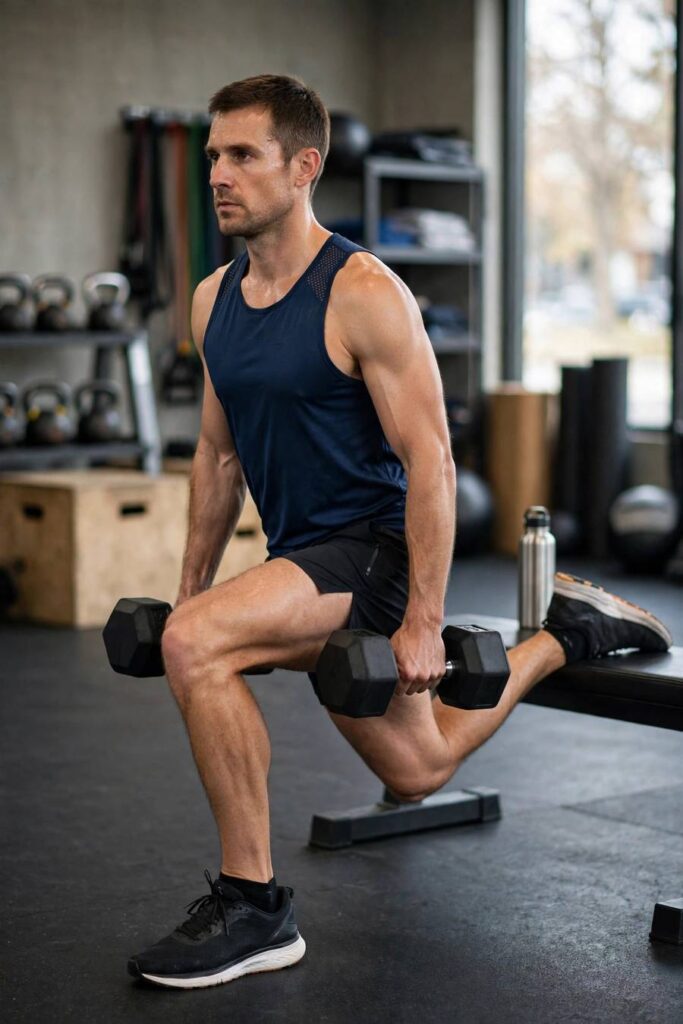
The Bulgarian split squat is my number one quad builder for runners: rear foot elevated, lower until the front thigh is parallel, drive through the heel. Three sets of 8 to 10 per leg. It builds single-leg strength in the exact stance running demands, and it exposes left-right imbalances immediately.
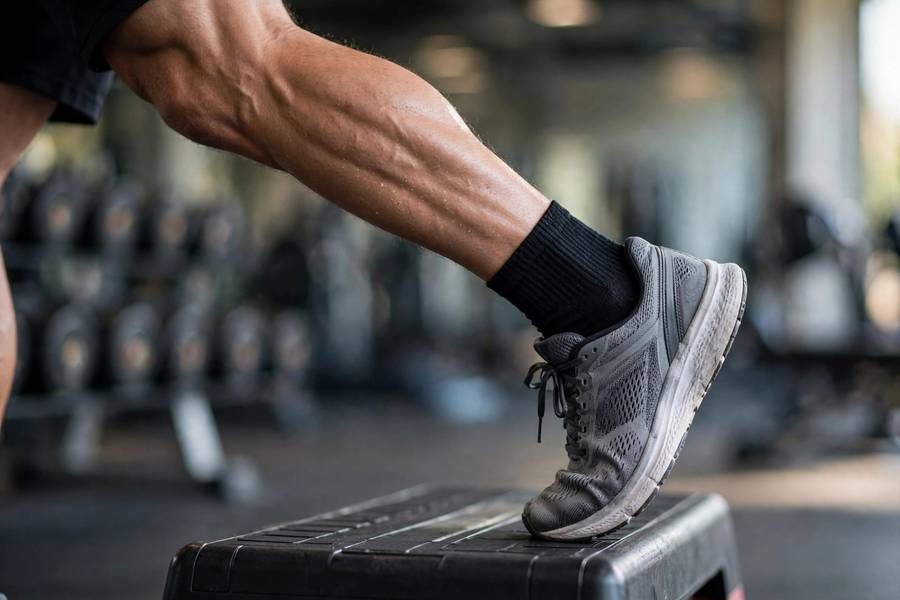
The step-up is its functional partner: drive up onto a knee-high box, stand tall, lower with control. Three sets of 10 per leg. Together they cover the quad through full range under load. Coaching cue for both: tall torso, knee tracking over the second toe. When runners build real quad strength, downhills stop destroying them.
Hamstrings: Romanian Deadlift and Nordic Curl
The Romanian deadlift is the hamstring foundation: hinge at the hips, flat back, lower until a deep stretch, drive the hips forward. Three sets of 8 to 12. It builds the hip-extension power that drives your stride and the eccentric strength that protects against strains.
The Nordic curl is the advanced weapon: kneel, anchor your feet, lower your torso toward the floor as slowly as possible. Most runners cannot do one full rep at first, and that is fine; start with partial ranges. Research consistently shows Nordic curls slash hamstring injury rates. I progress runners to 3 sets of 5 slow eccentrics over two months.
Glutes: Hip Thrust and Single-Leg Glute Bridge
The barbell hip thrust is the heaviest glute loader: shoulders on a bench, drive the hips up, squeeze hard at the top. Three sets of 8 to 10. Strong glutes extend the hip powerfully, which is literally the propulsion phase of running.
The single-leg glute bridge is the activation and balance version: one leg up, drive through the heel, keep hips level. Three sets of 12 per leg. I use these as the warm-up before every leg session and before runs. The cue that changes everything: initiate by squeezing the glute, not by arching the back.

Calves: Straight-Knee and Bent-Knee Raises
Your calves need two exercises because they have two key muscles. Straight-knee calf raises target the gastrocnemius, the big visible muscle: 3 sets of 12 to 15 per leg off a step. Bent-knee raises (seated or in a slight squat) target the deeper soleus, the endurance workhorse: 3 sets of 15 per leg.
The soleus is the unsung hero of distance running, absorbing enormous load with every stride. I program bent-knee work religiously for marathoners because soleus strength is directly linked to Achilles resilience. Slow tempos, full range, no bouncing: calves respond to discipline, not momentum.
Hip Stabilizers: Clamshell and Lateral Band Walk
The glute medius keeps your pelvis level and your knees tracking straight, and it is weak in most runners. The clamshell, lying on your side with knees bent and opening the top knee like a book, is the classic activator: 3 sets of 15 per side. The lateral band walk with a mini-band is the functional version: 3 sets of 15 steps each way.
I prescribe these as pre-run activation, not just gym work. Two minutes before you head out. Runners with chronic IT band or knee issues almost always test weak here, and consistent stabilizer work is the fix that actually lasts.
Ankles and Feet: The Forgotten Foundation
Everything starts at the foot. Weak ankles and lazy arches let the whole chain collapse: overpronation, shin splints, plantar fascia complaints. Simple work fixes it: single-leg balance drills, towel scrunches with the toes, and short-foot exercises where you dome the arch without curling the toes.
Do 3 sets of 30-second single-leg balances per leg, progressing to eyes closed, and 2 sets of 15 towel scrunches. I add these to warm-ups rather than gym sessions because they take five minutes. Feet are the only part of you that touches the ground; train them like it matters.
Putting It Together: The Runner’s Leg Day
Here is the session I program twice weekly. Warm-up: glute bridges and lateral band walks, 5 minutes. Main: Bulgarian split squats 3×8 per leg, Romanian deadlifts 3×8, step-ups 3×10 per leg. Finishers: calf raises 3×12 per leg, side-lying clamshells 2×15 per side, dead bugs 2×8 per side.
Forty-five minutes, complete leg coverage, zero fluff. Alternate this with an upper-body and core day for the full program in our strength training for runners guide, and keep the dedicated core strength routine running alongside. Your legs will feel different within a month: springier on uphills, steadier on downhills, and quiet where they used to complain.
Eccentric Training: The Secret Weapon for Downhills
Eccentric means the lowering phase, and it is where running does its damage: every downhill stride is an eccentric quad contraction absorbing impact. Training eccentrics specifically builds the exact resilience downhills demand. The method is simple: lower slowly, lift normally.
My prescription: take your Bulgarian split squats and step-downs and stretch the lowering to four or five seconds. Three sets of 6 to 8 per leg, once a week, is enough to transform downhill running within two months. The slow lowering builds tendon stiffness and muscle control that fast reps never touch.
Start conservatively because eccentric work causes serious soreness at first. One session, moderate effort, then assess. The soreness fades as the tissue adapts, and that adaptation is precisely the armor you want. Runners who do eccentric work stop fearing downhills; they start attacking them.
Testing Leg Strength: Benchmarks Worth Chasing
Here are the standards I use with my runners. Bulgarian split squat: 8 clean reps per leg with dumbbells totaling 25 percent of bodyweight. Single-leg calf raise: 20 full-range reps per leg. Nordic curl: 5 controlled eccentrics. Step-up: 10 reps per leg onto a knee-high box with 15 percent of bodyweight.
These are not elite numbers; they are durability baselines. If you clear them, your legs have the basic armor for serious training. If you fall short somewhere, you have found your priority. I retest quarterly, and the runners who chase these benchmarks systematically are the ones who stop getting injured.
Do not rush the benchmarks. Build toward them over months, adding load gradually. The goal was never the number itself; it is the resilient, balanced legs the number represents. Hit the standards, maintain them with two weekly sessions, and your legs will carry you through seasons that used to break you.
Warm-Up Drills That Prime the Legs
A leg session deserves better than walking into it cold. My five-minute leg-day primer: 30 seconds of marching high knees, 10 bodyweight squats, 10 alternating reverse lunges, 10 glute bridges, and 10 lateral band walks per direction. It raises tissue temperature, wakes up the glutes, and rehearses the movement patterns you are about to load.
Use the same primer before hard running workouts, not just lifting days. Primed glutes and warm tendons handle the first hard interval far better than cold ones, and I credit this routine with preventing more injuries than any single exercise. Five minutes of preparation protects the other forty-five; skip it and you are borrowing against your joints.
Bulgarian split squats, step-ups, Romanian deadlifts, Nordic curls, hip thrusts, single-leg glute bridges, straight and bent-knee calf raises, clamshells, and lateral band walks cover the complete leg chain.
Two leg-focused sessions per week is ideal, typically as part of two full-body strength sessions. Keep them 48 hours apart and away from hard running days.
Yes. Calves absorb 2-3x bodyweight per stride. Both straight-knee (gastrocnemius) and bent-knee (soleus) raises are needed for complete lower-leg durability.
The Romanian deadlift for foundational strength and the Nordic curl for eccentric injury prevention. Together they are the gold standard for runner hamstrings.
No, but they complement each other. Strength builds the force capacity; hills train you to apply it at running-specific speeds. Do both for the best results.