What Is the B2B2C Business Model? How It Works in 2026

Most business advice pretends there are two models: sell to businesses or sell to consumers. But some of the biggest companies in the world do neither, exactly — they sell to businesses who sell to consumers. Insurance sold through employers. Food brands sold through grocery stores. Software sold through resellers who bundle it for end users.
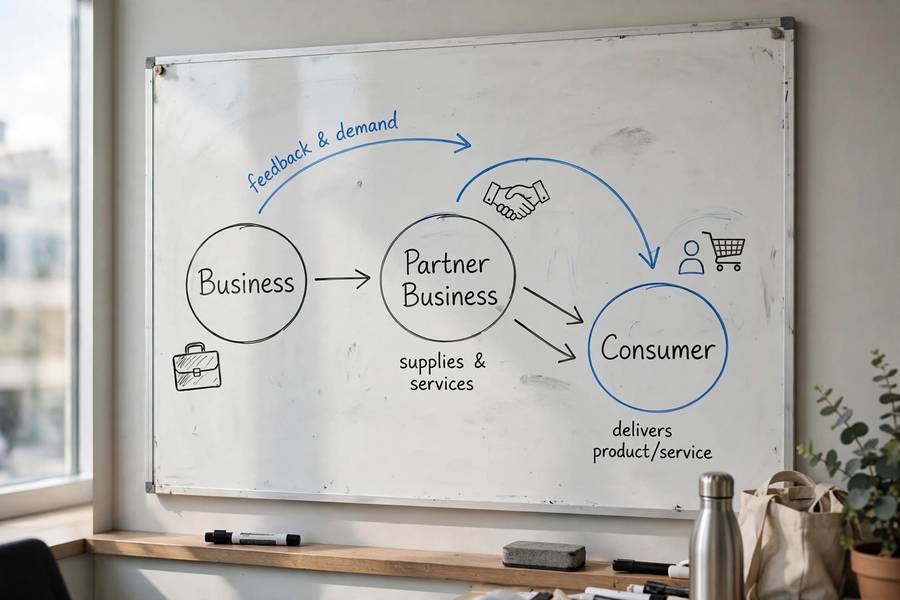
This is B2B2C: business-to-business-to-consumer. You acquire business partners as customers, and those partners deliver your product to the end consumer. It’s a powerful model with a specific catch — you’re one step removed from the person actually using what you sell. starting a business
I’ve advised companies on all three models, and B2B2C is the one founders misunderstand most. They see the scale potential and miss the control trade-offs. This guide covers how B2B2C actually works, where it wins, where it breaks, and how to know if it fits your business.
B2B2C Defined: The Three-Party Structure
In a B2B2C model, three parties interact: you (the provider), your business partner (the distributor or intermediary), and the end consumer. You sell to or through the partner; the partner delivers to the consumer. The consumer may never know your company exists — or may know you well while buying exclusively through partners.
Contrast this with pure B2B, where the business customer IS the end user (a company buying software its employees use), and pure B2C, where you sell directly to the consumer. B2B2C sits between: the business is a channel, not the destination.
The classic example is consumer packaged goods. Kraft doesn’t sell cheese directly to you — it sells to Walmart, which sells to you. Kraft’s ‘customer’ in the commercial relationship is the retailer; the consumer is the ultimate user. Every slotting negotiation, trade promotion, and packaging decision serves this two-step chain.
Digital versions work the same way. An insurance tech company sells policies through employers who offer them as benefits. A fintech provides the rails while a neobank owns the customer relationship. The pattern is identical: partner owns distribution, you own the underlying product.
Real B2B2C Examples You Already Use
Insurance through employers. Most Americans get health insurance through work. The insurer’s sales team courts HR departments and benefits brokers (B2B motion), while the employee experiences it as a consumer product (B2C experience). The insurer optimizes for two buyers simultaneously.
App stores. Apple sells iPhones to consumers, but the App Store is B2B2C: developers (businesses) build apps, Apple distributes them to iPhone owners. Apple takes 15–30% for owning the consumer relationship — which is exactly what the ‘2C’ is worth.
Franchised food brands. McDonald’s corporation doesn’t sell you a Big Mac — a franchisee does. Corporate sells the system, brand, and supply chain to franchisees (B2B), who serve consumers (B2C). This is B2B2C at massive scale, and it explains why franchise relations matter as much as customer marketing.
White-label software. A payments company powers checkout for thousands of online stores. Shoppers see the store’s brand; the payments company is invisible infrastructure. The B2B sale is to the merchant; the B2C experience is the seamless checkout.

Why Companies Choose B2B2C: The Advantages
Distribution leverage. This is the big one. Instead of acquiring consumers one by one, you acquire partners who bring thousands. One enterprise deal with a retailer can put your product in front of millions. Your customer acquisition cost per end user plummets — you’re amortizing one B2B sale across a partner’s entire customer base.
Lower consumer marketing spend. You don’t need Super Bowl ads when your partners do the consumer marketing. The trade-off is dependence, but the economics are compelling: B2B2C companies often spend a fraction on marketing what pure B2C competitors spend.
Built-in trust transfer. Consumers trust the partner they already buy from. When your product arrives through a trusted channel, you inherit that credibility. This is why fintech startups partner with established banks instead of building consumer brands from scratch.
Predictable B2B revenue. While consumer demand fluctuates, B2B contracts provide base revenue stability. You get the scale of consumer markets with the contract structure of B2B — the best of both, when it works.
The Downsides Nobody Warns You About
You don’t own the customer relationship. This is the fundamental cost. Your partner controls pricing presentation, customer service, and the data. When something goes wrong for the consumer, they blame the partner — and you can’t fix it directly. When the partner changes strategy, your distribution evaporates.
Margin stacking. Every party in the chain takes a cut. If the consumer pays $100, the retailer might keep $40, leaving you $60 before your own costs. Pure B2C companies keep the full margin. B2B2C trades margin for reach — make sure the math works at your scale.
Partner concentration risk. If 60% of your revenue flows through two partners, you don’t have a business — you have two clients with veto power over your existence. I’ve seen companies gutted overnight when a major partner brought the function in-house or switched to a competitor. Diversify partners the way investors diversify portfolios.
Slower feedback loops. Consumer complaints filter through your partner’s support team, sanitized and delayed. You lose the direct signal that pure B2C companies use to iterate quickly. Building direct feedback channels (in-product surveys, user communities) is essential compensation.
B2B2C vs B2B vs B2C: Choosing Your Model
The choice usually comes down to three questions. First: where is your unfair advantage? If you’re world-class at enterprise sales but terrible at consumer marketing, B2B2C lets you play to your strength. If you have a beloved consumer brand, going direct (B2C) captures more margin.
Second: how much control do you need? Regulated industries often prefer B2B2C because partners handle compliance complexity. But if the end-user experience IS your differentiator, giving up control to a partner is strategic suicide.
Third: what’s the unit economics at each step? Model the full chain — your price to the partner, the partner’s markup, the final consumer price, and whether the consumer will actually pay it. Many B2B2C ideas die here: by the time everyone takes their cut, the consumer price is uncompetitive.
For the foundational comparison of the two simpler models, my B2B vs B2C guide is the right starting point before you add the third party.

Making B2B2C Work: Operating Principles
Treat partners as customers, not channels. The companies that win at B2B2C invest in partner success the way B2C companies invest in user experience: dedicated support, co-marketing funds, training, and a genuine feedback loop. Partners who feel like an afterthought will treat your product like one.
Negotiate data access up front. Before signing any partner agreement, secure rights to anonymized end-user data and feedback. Once the contract is signed without it, you’ll never get it. This data is your early warning system and your product roadmap — don’t give it away.
Build a direct relationship layer. Even in B2B2C, create touchpoints with end users: product registration, user communities, in-product messaging. You’re not going around your partner — you’re building the brand equity that makes partners need you as much as you need them.
Plan the breakup. Every partner agreement should have clear terms for data portability, transition periods, and non-compete boundaries. Hope for a long partnership; contract for a clean exit. The companies that survive partner churn are the ones who planned for it on day one.
Is B2B2C Right for Your Business?
B2B2C fits when distribution is your bottleneck and partners have what you lack — shelf space, enterprise relationships, regulatory licenses, or consumer trust at scale. It’s the model of leverage: do what you’re best at, let partners do the rest.
It fails when the end-user experience is your core differentiator, when margins can’t survive two markups, or when you’d be dependent on a single partner. Be brutally honest about which situation you’re in.
My practical test: can you name three potential partners today, and would the economics work if the largest one represented 40% of your volume? If yes to both, B2B2C deserves serious consideration. If not, you’re probably better served by a cleaner B2B or B2C motion — at least until you’ve proven the product directly.
If you’re still in the formation stage, getting the business entity right matters even more in multi-party models, where liability and contracts get complex fast.
Key Takeaways
B2B2C means selling through business partners to reach consumers — you get distribution leverage but give up direct customer control. It works brilliantly when partners have reach you can’t build yourself, and fails when margins can’t survive the chain or when one partner becomes a single point of failure.
The operating rules are simple: treat partners as customers, secure data rights before signing, build a direct user relationship layer, and always plan the breakup. Get these right and B2B2C gives you consumer scale with B2B economics — the rarest combination in business.

Business-to-business-to-consumer. It’s a model where a company sells to business partners who then deliver the product to end consumers — like insurance sold through employers or apps sold through app stores.
Health insurance through employers, McDonald’s franchises, app stores, and white-label payment processors are all B2B2C: the provider sells to a partner business that serves the consumer.
You don’t own the customer relationship, margins get split across the chain, partner concentration creates existential risk, and consumer feedback reaches you slowly through intermediaries.
Neither is universally better. B2B2C offers distribution leverage and lower marketing costs; B2C offers full margin and direct customer control. Choose based on your strengths and unit economics.