How to Retain Customers in a Small Business (Cheaper Than Finding New Ones)


Here’s a number that should change how you run your business: acquiring a new customer costs five to seven times more than keeping an existing one. And yet I watch small businesses spend 90% of their marketing effort chasing strangers while their existing customers quietly drift away.
Customer retention isn’t a loyalty program or a punch card — though those can help. It’s a system: the set of things you do between purchases that makes leaving feel unnecessary. This is the highest-ROI work in your business, and most founders barely think about it. For the acquisition side of the equation, see our guide on how to grow a small business — this article covers keeping what you’ve won.
Contents
- The Retention Math
- Why Customers Actually Leave
- The Eight Retention Levers
- Onboarding Your First 30 Days
- The Follow Up Cadence
- Loyalty Programs That Work Small
- Win Back Campaigns
- Measuring Retention Honestly

The Retention Math
Let me make this concrete. Say you have 100 customers, each worth $500 a year. That’s $50,000 in revenue.
With 70% annual retention (typical for businesses that ignore retention), you keep 70 customers and must find 30 new ones just to stay flat — at 5–7x the cost of keeping them.
With 90% retention, you keep 90 and only need 10 new customers to grow. Same starting point, radically different business: lower marketing costs, more predictable revenue, and customers who buy more over time (existing customers spend more per transaction than new ones, consistently).
Now compound it. A 5% improvement in retention reliably produces 25–95% improvement in profits across industries — that’s not my number, it’s one of the most replicated findings in business research. The mechanism is simple: retained customers cost nothing to re-acquire, buy more frequently, and refer others.
The takeaway: retention isn’t a “nice to have” alongside acquisition. For most small businesses, improving retention 10 points outperforms doubling the marketing budget. Do the cheaper, more effective thing first.
Why Customers Actually Leave
You can’t fix retention without understanding defection. When researchers ask customers why they left a business, the answers are remarkably consistent — and price is rarely number one:
1. They felt unappreciated or ignored (the top reason). Not angry — just indifferent. Nobody said thank you, nobody checked in, nobody noticed they’d been away. The relationship faded from neglect, not conflict.
2. Poor service experience. One bad interaction undoes ten good ones. Rude staff, broken promises, problems handled badly. The incident itself matters less than how it was handled — customers forgive mistakes; they don’t forgive indifference.
3. They forgot about you. Out of sight, out of mind. No contact between purchases, no reminders, no reason to return. They didn’t choose a competitor — they just drifted.
4. A competitor offered something better. Sometimes genuinely better — lower price, better product, more convenient. You can’t win every comparison, but you can make switching feel like a loss by deepening the relationship.
5. Their needs changed. They moved, their business evolved, their situation shifted. Some churn is unavoidable — the goal is minimizing avoidable churn, not achieving zero.
Notice that three of the five are about attention, not product. Most retention problems are relationship problems wearing a business disguise. That’s good news — relationships are fixable without redesigning your offering.
The Eight Retention Levers
1. Deliver consistently. The foundation everything else stands on. Retention marketing can’t save an inconsistent product or unreliable service. Fix the core experience first — then layer the rest.
2. Say thank you — specifically. Not a generic “thanks for your business” but specific acknowledgment: “Thanks for trusting us with your third project this year.” Specificity signals that you actually notice. A handwritten note after a first purchase still works absurdly well in a digital world.
3. Remember details. Names, preferences, past purchases, the kid’s graduation they mentioned. Small businesses have a structural advantage here over corporations — use it. A simple customer notes field (in any system) turns forgetfulness into thoughtfulness.
4. Solve problems fast and generously. When something goes wrong, speed and generosity beat process. Empower anyone customer-facing to fix problems on the spot up to a defined dollar amount. The customer you rescue after a failure is often more loyal than one who never had a problem.
5. Stay in contact between purchases. The monthly email, the quarterly check-in, the holiday card. Light, genuine, non-salesy contact prevents the “forgot about you” churn. Consistency matters more than brilliance.
6. Make the next purchase obvious. Don’t make customers figure out what to buy next — tell them. “It’s been six months since your service — time for a check-up?” The reminder is the retention strategy for many businesses.
7. Reward loyalty visibly. Not necessarily discounts — recognition works too. Early access, a loyalty tier, a “founding customer” status. People stay where they feel their loyalty is seen.
8. Ask for feedback and act on it. “How are we doing?” asked genuinely — then visibly fixing what you hear. Nothing retains like a customer who complained, was heard, and saw change. The feedback loop turns critics into advocates.
Onboarding Your First 30 Days
Retention starts at purchase, not six months later. The first 30 days determine whether a customer becomes a regular or a one-timer:
Day 0: Confirm and thank. Immediate confirmation of the purchase with genuine thanks and clear next steps. Set expectations: what happens now, when, and how to reach you.
Day 3–7: Check in. “How’s everything going?” — before problems fester. This single touchpoint catches issues while they’re small and signals that you care after the money changed hands (which is exactly when most businesses go silent).
Day 14: Add value. A tip related to their purchase, a useful resource, an invitation — something that makes the purchase better. You’re deepening the relationship beyond the transaction.
Day 30: Review and next step. Ask for feedback or a review, and suggest the natural next purchase or visit. The 30-day mark is when the buying glow fades — replace it with forward momentum.
For service businesses, onboarding might be a welcome call and a clear project roadmap. For retail, it might be a thank-you email with care instructions. For subscriptions, it’s the critical activation sequence. The format varies; the principle doesn’t: the first month is when loyalty is built or lost.
The Follow Up Cadence
Between purchases, run a simple contact cadence. Not campaigns — cadence. The difference: campaigns are occasional blasts; cadence is reliable rhythm.
Monthly: one email to your customer list. Useful content, a business update, an offer — rotate the purpose, keep the quality high. Monthly is frequent enough to stay remembered, infrequent enough to avoid annoyance.
Quarterly: a personal touch for your best customers. A call, a handwritten note, a small gift. Your top 20% of customers deserve direct attention — they produce most of your profit.
Trigger-based: automated contacts on customer behavior — 30 days since last purchase (“we miss you”), anniversary of first purchase (“a year together”), birthday if you have the data. These feel personal at scale because they’re timed personally.
The rule: every contact should give value or genuine warmth, never just “buy more.” The moment your cadence feels like nagging, it backfires. If you wouldn’t be glad to receive it, don’t send it.
Loyalty Programs That Work Small
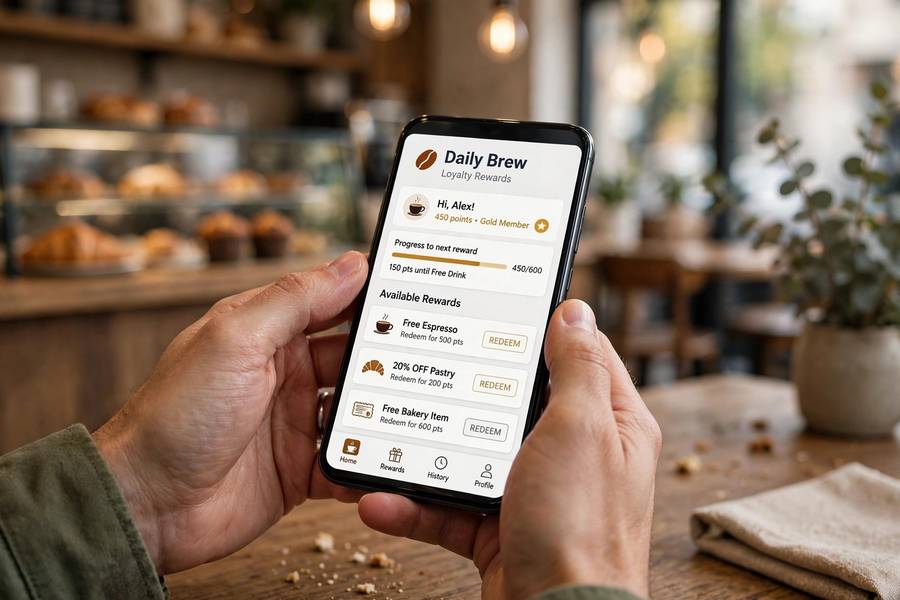
You don’t need enterprise software. Effective small-business loyalty programs share three traits:
Simple to understand. “Buy 9, get the 10th free” beats points-per-dollar-per-tier complexity. If customers need a manual to understand the program, it’s too complicated.
Attainable rewards. The reward must feel reachable — ideally within 3–6 months of normal purchasing. Programs where nobody ever earns anything breed cynicism, not loyalty.
Valuable enough to matter. A free coffee after ten purchases works because coffee is the product. A 2% rebate doesn’t move behavior. The reward should feel like a genuine thank-you, not a rounding error.
Low-tech options that work: the physical punch card (still effective, still cheap), a simple “regulars list” with surprise perks, a VIP early-access group for new products, or a straightforward referral reward. Fancy isn’t the point — recognition is.
What to avoid: programs that discount your core offering into unprofitability, programs so complex they need staff training to explain, and programs you launch enthusiastically then abandon (a dead loyalty program is worse than none).
Win Back Campaigns
Some customers will go quiet. A structured win-back effort recovers a meaningful percentage of them:
Identify the lapsed. Define “lapsed” for your business: 90 days without purchase? 6 months? Pull the list quarterly. These are warm leads — they bought from you before, which means they trusted you once.
Reach out personally. Not a mass “we miss you” blast (though that works as a first pass) — a genuine personal note for high-value lapsed customers. “Hi Sarah, noticed we haven’t seen you in a while — everything okay? Is there anything we could do better?” The honesty disarms.
Offer a reason, not just a discount. “We’ve added X since you were last in” or “I wanted you to be the first to know about Y” outperforms “20% off, please come back.” Give them something new to return to.
Ask why they left. The lapsed customer who tells you the truth is giving you a gift — fix what you hear, and apply the lesson to current customers before they lapse too.
Know when to let go. After two or three genuine attempts with no response, stop. Persistent re-engagement becomes harassment. Some churn is permanent; your energy belongs with customers who want to stay.
Typical win-back results: 5–15% of lapsed customers return with a good campaign. On a list of 200 lapsed customers worth $500 each, that’s $5,000–15,000 in recovered revenue for the cost of some emails and calls. Run it quarterly.
Measuring Retention Honestly
Track these three numbers monthly:
Repeat purchase rate: what percentage of customers buy again within a defined period (6 or 12 months)? This is your headline retention metric. Trend matters more than absolute level — is it improving?
Customer lifespan: on average, how long does a customer stay active? Even a rough estimate (total customers ÷ customers lost per year) gives you the number. Longer lifespan = more lifetime value = more you can afford to spend acquiring.
Revenue from existing vs. new customers: what share of revenue comes from repeat business? Healthy small businesses trend toward 60–80% from existing customers. If you’re below 50%, you’re on an acquisition treadmill.
Cohort check (the honest one): take customers acquired in January — how many bought again by July? Cohorts prevent the “total customers growing” illusion from hiding churn. Growth in totals can mask a leaky bucket; cohorts reveal it.
Review quarterly, alongside your acquisition numbers. The goal isn’t perfection — it’s direction. Retention improving 5 points a year transforms a business within three years. Start measuring, start improving, and let compounding do the rest.
Retention compounds fastest when it’s written into the plan, not bolted on — how to write a marketing plan covers the full framework.

Frequently Asked Questions
Acquiring a new customer costs 5–7x more than keeping an existing one, and existing customers spend more per transaction and refer others. Even a 5% retention improvement can boost profits 25–95% through lower costs and higher lifetime value.
It varies by industry, but 70–90% annual retention is a reasonable range for most small businesses. More important than the absolute number is the trend — improving 5 points a year transforms profitability within a few years.
The top reasons are feeling unappreciated or ignored, a poor service experience, simply forgetting about the business, a better competitor offer, or changed needs. Most defection is about attention and relationship, not price.
Identify lapsed customers quarterly, reach out personally (especially high-value ones), offer a genuine reason to return beyond discounts, and ask why they left. Well-run win-back campaigns typically recover 5–15% of lapsed customers.
Yes, when kept simple: easy to understand, attainable rewards within months, and genuinely valuable perks. A physical punch card or regulars list often outperforms complex points systems. Avoid programs so complicated they need explaining.