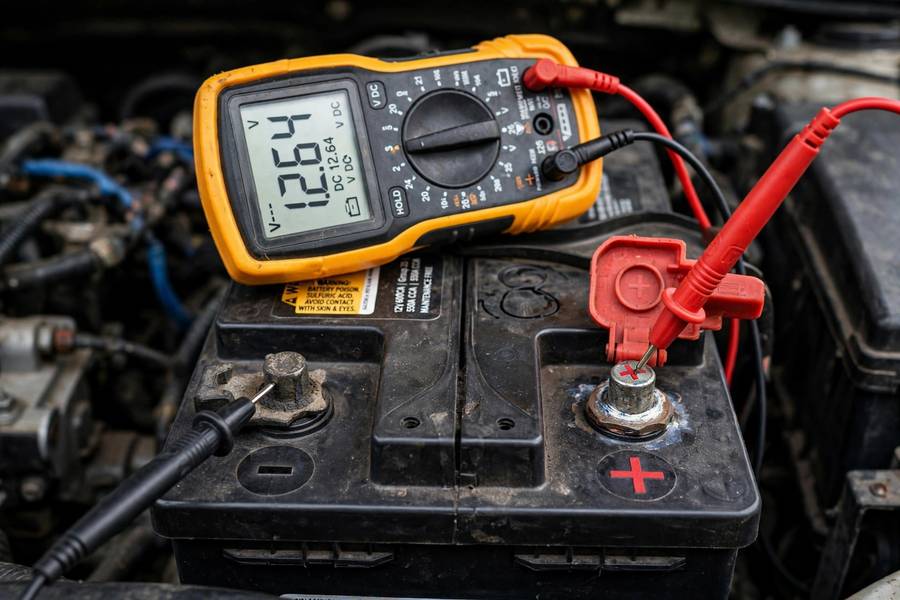
Voltage numbers are the vital signs of your car’s electrical system — but a number without context is just a number. Is 12.2 volts good? (No.) Is 14.8 volts while running bad? (Yes, actually.) After twenty years of reading meters, I can diagnose most battery and charging problems from three voltage readings. This guide gives you the complete chart — resting, cranking, and charging voltages — plus what each reading means and what to do about it. For the full testing procedure, see my multimeter guide; for lifespan context, how long car batteries last.
Table of Contents
- The Resting Voltage Chart (Engine Off)
- How to Take an Accurate Resting Reading
- The Cranking Voltage Chart (During Start)
- The Charging Voltage Chart (Engine Running)
- Surface Charge: The Reading That Lies
- Temperature Effects on Voltage
- Voltage vs Actual Battery Health
- What to Do for Each Reading
- Frequently Asked Questions
The Resting Voltage Chart (Engine Off)
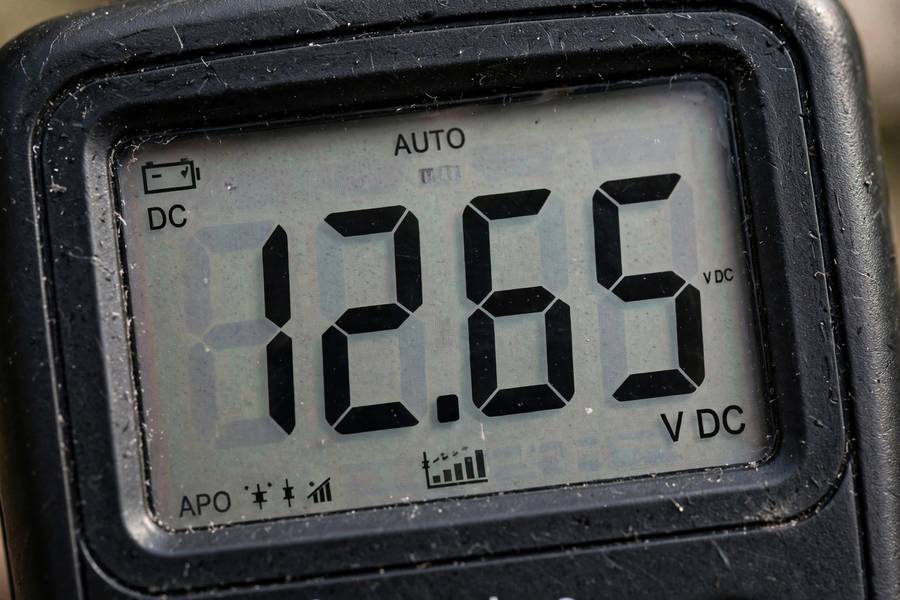
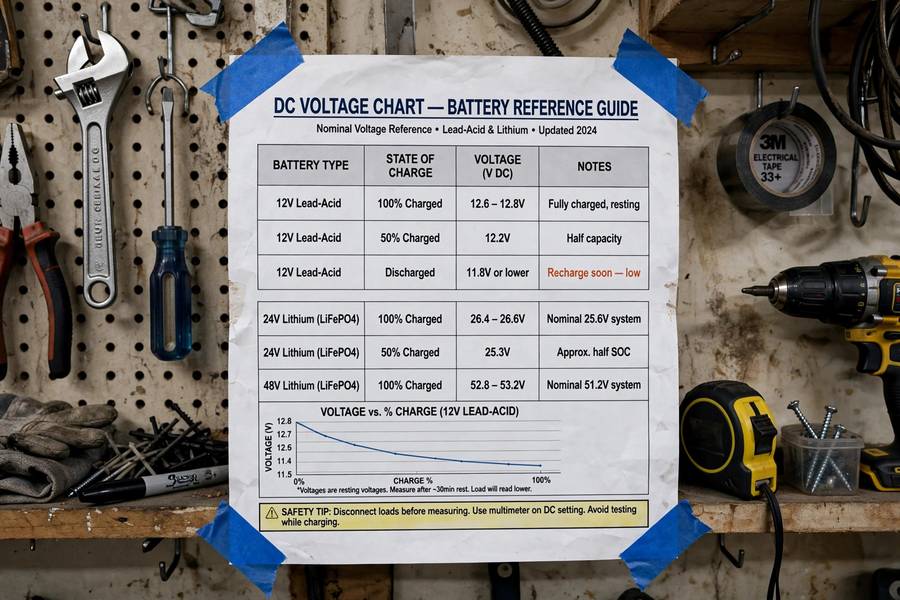
This is the chart you’ll use most. Taken with the engine off and the battery rested (more on that below), resting voltage maps directly to state of charge for a healthy 12V lead-acid battery:
| Voltage | State of Charge | What It Means |
|---|---|---|
| 12.6–12.8V | 100% | Fully charged, healthy |
| 12.4V | ~75% | Good, but not full — needs a drive or charge |
| 12.2V | ~50% | Half discharged — charge soon; if it won’t hold higher, capacity is declining |
| 12.0V | ~25% | Discharged — charge immediately; sulfation risk |
| 11.8V or below | ~0% | Deeply discharged — slow-charge and test; may not recover |
| ~10.5V | N/A | Likely one shorted cell (5 of 6 cells alive) — replace |
| Below 10V | N/A | Severely damaged or deeply discharged — attempt slow charge once, then replace if it won’t hold |
Memorize the anchor points: 12.6 is full, 12.0 is effectively empty, 10.5 is a dead cell. Everything else is interpolation. Note these figures are for conventional 12V lead-acid (flooded and AGM) — the chemistry is the same for voltage purposes.
One critical nuance: this chart shows state of charge, not battery health. A worn-out battery can read 12.6V (fully charged) yet fail to start the car — because voltage measures charge level, not capacity. That’s why the cranking test exists.
How to Take an Accurate Resting Reading
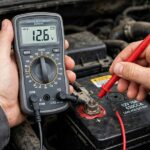
The reading is only as good as the method. Engine off, all accessories off, doors closed (dome lights draw current). Ideally the car has sat for several hours — overnight is perfect. Touch the red probe to the positive terminal post (not the cable clamp) and black to the negative post. Read the meter.
Why the waiting period: right after driving, the battery holds a “surface charge” — a temporary elevated voltage (13V+) that dissipates over hours. Testing too soon reads high and masks problems. If you can’t wait: turn the headlights on for 30 seconds with the engine off (burns off surface charge), wait 2 minutes, then test. Less accurate than overnight rest, but honest.
Probe placement matters: corrosion between the cable clamp and the terminal post creates resistance that skews readings. Probing the lead posts directly bypasses that. If post and clamp readings differ significantly, you’ve found corrosion worth cleaning — and the post reading is the true one.
Meter accuracy: a cheap digital multimeter is fine (±0.05V is plenty for these decisions). Just ensure it’s set to DC volts (V with a straight line), 20V range if manual. And check your meter’s battery — a dying 9V in the meter gives drifting readings, which is a special kind of irony.
The Cranking Voltage Chart (During Start)
Resting voltage is the report card; cranking voltage is the stress test. Have a helper crank the engine while you watch the meter (or use a min/max hold function). The voltage dip under the starter’s massive current draw reveals the battery’s true condition:
| Cranking Voltage | Verdict |
|---|---|
| Above 10.5V | Strong — battery delivers current well |
| 9.6–10.5V | Marginal — starts, but capacity declining; test soon |
| Below 9.6V | Failing — cannot deliver adequate starting current; replace |
| Drops to near zero then recovers | Possible bad connection — clean terminals and retest before condemning battery |
The 9.6V threshold is the industry standard (measured at 70°F) — below it, the battery fails the load test regardless of what its resting voltage said. This is the “reads 12.4V but won’t start” scenario: adequate charge, inadequate capacity.
Watch the recovery after cranking stops: voltage should bounce back above 12V within seconds. Slow recovery (a minute or more to climb back) indicates high internal resistance — aging, sulfated plates. And keep cranks short: 10-15 seconds maximum per attempt, with rest between. Extended cranking overheats the starter and drains the battery while teaching you nothing new.
The Charging Voltage Chart (Engine Running)
With the engine running, you’re reading the charging system, not just the battery. Normal charging voltage at the battery terminals:
| Voltage (Running) | Verdict |
|---|---|
| 13.7–14.7V | Normal — alternator charging correctly |
| 13.0–13.6V | Low-normal — acceptable at idle with loads on; recheck at 1,500 rpm |
| Below 13.0V (at 1,500 rpm) | Undercharging — alternator, belt, or cable issue |
| 14.8–15.0V | High — voltage regulator suspect; monitor closely |
| Above 15.0V | Overcharging — regulator failure; fix promptly (cooks battery, stresses electronics) |
The loaded test: at ~1,500 rpm with headlights, blower on high, and defroster on, voltage should hold above 13.0V. If it sags below that under load, the alternator is weak — charges at idle but can’t keep up with demand. This catches the intermittent failures that idle-only testing misses.
Interpreting combinations: low charging voltage + repeatedly dead battery = charging system fault (the battery is a victim). Normal charging voltage + dead battery = battery fault (it can’t hold what it’s given). High charging voltage + short battery life = regulator overcharging, cooking batteries — fix the regulator or you’ll keep replacing batteries annually.
Surface Charge: The Reading That Lies
Surface charge deserves its own section because it’s the number one cause of false “my battery is fine” readings. After driving or charging, a thin layer of concentrated charge sits on the battery plates, elevating terminal voltage 0.5-1.0V above the battery’s true state. A half-dead battery can read 13.1V right after a drive — looking healthier than it is.
The dissipation timeline: surface charge bleeds off over 2-4 hours naturally, faster with a small load. The headlight method (30 seconds of headlights, engine off, then 2-minute wait) removes most of it. Overnight rest removes all of it.
The diagnostic trap: testing a “dead” battery immediately after a jump start and drive, reading 12.9V, and concluding it’s fine — then it won’t start the next morning. The surface charge masked a battery that can’t hold real charge. Always retest after rest before declaring a battery healthy. I’ve seen this exact sequence strand people who “just tested it and it was fine.” It wasn’t fine; it was freshly driven.
Temperature Effects on Voltage
Voltage readings shift with temperature, and knowing the direction prevents misdiagnosis. Cold batteries read slightly lower: at 32°F, a fully charged battery reads about 12.55V instead of 12.65V — a 0.1V difference that doesn’t change any verdict. Don’t chase temperature compensation on resting readings; the thresholds have enough margin.
What temperature really affects is performance, not the chart: cold thickens engine oil (starter works harder, voltage dips further during cranking) and slows battery chemistry (less current available). So the same battery that cranks at 10.2V in summer might dip to 9.4V in winter — crossing the failure threshold without any actual battery degradation. That’s why marginal batteries die on the first cold morning: winter didn’t break them, it just applied the test they were already failing.
Hot batteries read slightly higher and perform better in the moment — which is why heat-damaged batteries test “fine” all summer. Temperature compensation matters for precision work; for driveway diagnosis, the standard chart plus awareness of the direction is enough.
Voltage vs Actual Battery Health
The limitation I keep returning to: voltage measures charge state, not health. A battery’s health is its capacity — how many amp-hours it can actually deliver — and voltage alone can’t measure that. The full diagnostic picture needs three readings plus one test:
- Resting voltage → state of charge (is it charged?)
- Cranking voltage → current delivery (can it start the car?)
- Charging voltage → system health (is the alternator working?)
- Load test → true capacity (how much life is left?)
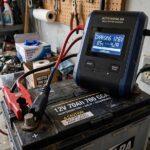
A battery can pass 1-3 and fail 4 — that’s the worn-out battery with good voltage. It cannot fail 1-3 and pass 4 — if the voltages are bad, the battery is bad (or the charging system is). The load test is the final arbiter because it’s the only one that measures capacity directly: a calibrated load (half the CCA rating, 15 seconds) with voltage monitored throughout.
My shop rule: voltage readings diagnose the problem category (battery vs charging system vs connections); the load test confirms the battery’s remaining life. Use both, in that order. The voltage chart gets you 90 percent of the way; the load test closes the last 10 percent — which is where the expensive surprises hide.
What to Do for Each Reading
The action summary. Resting 12.6V+, cranking above 9.6V, charging 13.7-14.7V: all healthy — look elsewhere for your issue (starter, parasitic drain, connections). Resting below 12.4V, charging normal: recharge fully, retest after rest; if it won’t hold 12.4V+, replace.
Cranking below 9.6V with decent resting voltage: failing battery — replace (it’s lost capacity). Charging below 13.0V at rpm: diagnose charging system first (alternator, belt, cables) — don’t replace the battery until charging is fixed, or you’ll kill the new one too. Charging above 15V: fix the voltage regulator promptly, then assess battery damage.
Resting ~10.5V: shorted cell — replace immediately, don’t bother charging. Any reading with a swollen, cracked, or leaking battery: replace, don’t test further — the physical condition overrides all numbers. And when in doubt: free load test at the parts store. Numbers guide you; the load test decides.

Frequently Asked Questions
12.6-12.8V resting (engine off, rested overnight) is fully charged and healthy. 13.7-14.7V with the engine running is normal charging. Above 9.6V during cranking means the battery delivers adequate starting current.
No — 12.2V is about 50% charged. A healthy rested battery reads 12.6V+. At 12.2V, charge the battery fully and retest after resting; if it won’t hold above 12.4V, its capacity is declining and replacement is approaching.
Below 12.0V resting is deeply discharged (charge immediately). Around 10.5V usually indicates a shorted cell — replace, don’t charge. Below 9.6V during cranking means the battery fails the load test regardless of resting voltage.
13.7-14.7V at the battery terminals. Below 13.0V at 1,500 rpm indicates undercharging (alternator/belt/cable issue). Above 15.0V indicates overcharging from a failed voltage regulator — fix promptly as it damages the battery and electronics.
Yes — voltage measures charge state, not capacity. A worn battery can read 12.6V yet fail to crank the engine because its plates can’t deliver current. That’s why the cranking voltage test (must stay above 9.6V) and a proper load test matter: they measure what voltage alone cannot.