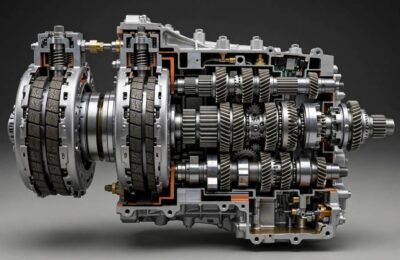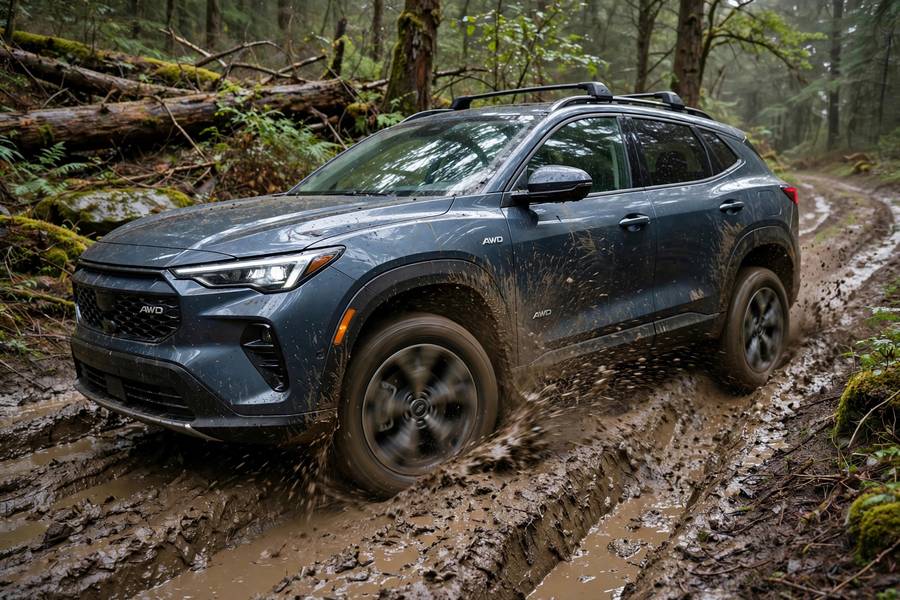
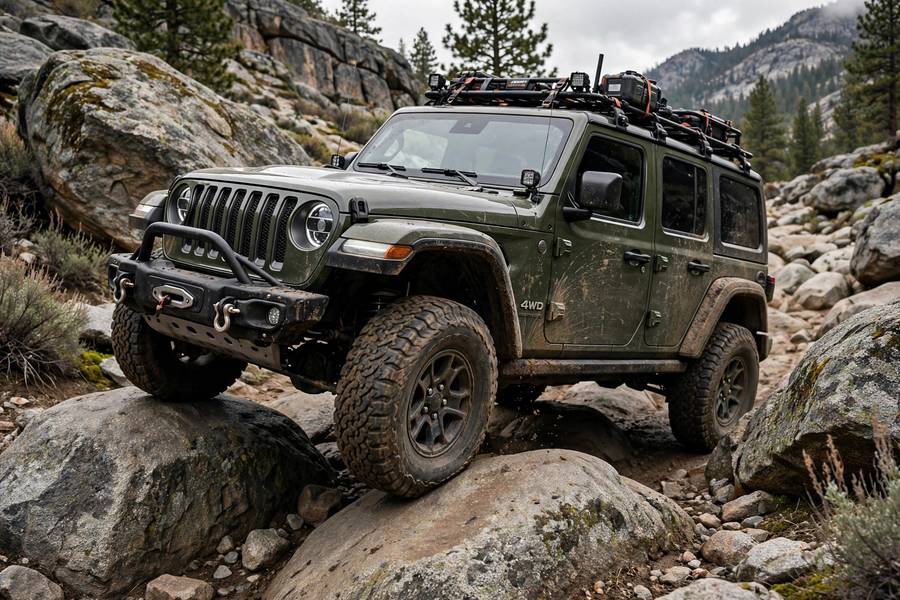
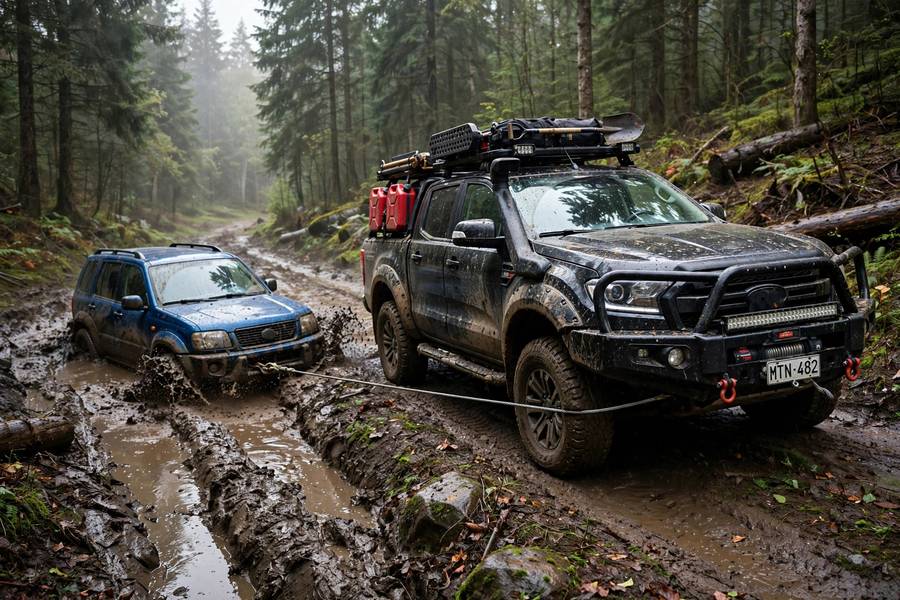
I have pulled both AWD crossovers and 4WD trucks out of the same mud hole, sometimes on the same weekend. The trail doesn’t care about marketing brochures — it cares about torque, clearance, tires, and whether the driver knows what their drivetrain can actually do. Off-road is where the AWD-versus-4WD debate gets settled with mud on the fenders instead of opinions. Here’s the honest breakdown by terrain, with the strengths and hard limits of each system. For the mechanical fundamentals behind both, see my full AWD vs 4WD breakdown.
Table of Contents
- What Off-Road Driving Actually Demands
- AWD Off Road: The Strengths
- AWD Off Road: The Hard Limits
- 4WD Off Road: The Strengths
- 4WD Off Road: The Hard Limits
- Clearance and Angles: The Specs That Decide Trails
- Tires: The Great Off-Road Equalizer
- My Verdict, Terrain by Terrain
- Frequently Asked Questions
What Off-Road Driving Actually Demands
Off-road driving asks a vehicle for four things, in order of importance: traction (grip at the contact patch), clearance (not dragging the belly), articulation (keeping wheels on the ground over uneven terrain), and torque control (moving slowly without spinning). The drivetrain badge addresses mainly the first and fourth. The other two are about the vehicle’s design — and they decide more trails than the badge does.
This is why the debate needs grounding. A 4WD truck with street tires and 8 inches of clearance will embarrass itself next to an AWD crossover with all-terrains and a lift. Drivetrain matters, but it’s one variable in a four-variable equation. Keep that in mind every time someone declares one system universally superior off-road.
AWD Off Road: The Strengths
Modern AWD is genuinely capable on light to moderate trails, and it’s better than its reputation suggests. The electronic brain that shuffles torque in milliseconds is excellent at maintaining momentum on loose gravel, wet grass, muddy two-tracks, and forest roads. Momentum is the currency of easy off-roading, and AWD’s seamless power distribution preserves it beautifully.
Hill descent control — standard on most AWD crossovers now — is a legitimately great off-road tool. It holds the vehicle at a walking-pace crawl downhill using individual wheel braking, doing the job that used to require 4WD Low and a skilled left foot. I’ve watched nervous drivers descend grades they’d never have attempted manually, the electronics handling it smoothly.
AWD also wins on mixed-surface days: the trail that alternates between dirt, gravel, and paved sections. No stopping to shift modes, no binding worries on the hard-packed parts, no driver decisions at every surface change. For the “soft-roader” reality — fire roads, beach access tracks, muddy farm lanes — AWD with decent tires is all most people will ever need, and it’s more pleasant getting there.
AWD Off Road: The Hard Limits
Now the limits, because they’re real and they bite. First: no low range. AWD has no gear reduction for crawling, which means on steep, technical terrain you’re forced to use momentum and throttle — exactly the wrong technique for rocks, where slow and controlled wins. Trying to crawl a rock garden in an AWD crossover means riding the brakes and throttle against each other, cooking the brakes and the clutch packs simultaneously.
Second: heat. Clutch-pack AWD systems that engage the rear axle can overheat under sustained slip. Deep mud, soft sand, and long climbs at low speed with spinning wheels will push the coupling past its thermal limit, and then the system derates or disengages — sometimes with a warning light, sometimes silently. I’ve seen crossovers arrive on a flatbed after a beach day, rear drive cooked, owner bewildered. The system didn’t fail; it was used outside its design envelope.
Third: clearance and articulation. Most AWD vehicles are car-based unibodies with 6 to 8 inches of clearance and independent suspension tuned for road comfort. They high-center on modest obstacles and lift wheels easily on uneven ground — and a lifted wheel on an open-diff AWD is a spinning wheel doing nothing.
Know your hardware’s limits before you test them: what all-wheel drive is explains what the system can and can’t do for you.
4WD Off Road: The Strengths
4WD’s off-road strengths are the stuff of legend because they’re mechanical and absolute. 4WD Low’s torque multiplication — typically 2.5:1 to 4:1 — lets you crawl at walking pace with enormous pulling force. On rocks, that means placing each tire deliberately instead of bouncing through. On steep grades, it means climbing without wheelspin. Engine braking in low range holds you on descents without touching the brakes.
The locked transfer case means power distribution isn’t a suggestion — it’s a guarantee. Front and rear axles turn together, period. Add locking differentials and you have true four-wheel drive: every wheel turning at the same speed, the wheel with grip getting everything. A locked 4WD on 35-inch tires will walk through terrain that stops everything else, and it does it with a mechanical certainty that no software can replicate.
Then there’s the hardware around the drivetrain: body-on-frame construction, solid axles with massive articulation, skid plates, 10-plus inches of clearance. A proper 4WD truck is designed from the frame up for the trail. The drivetrain is the headline, but the chassis is the story.
4WD Off Road: The Hard Limits
4WD isn’t magic either. Its biggest off-road limit is the driver: part-time 4WD demands correct mode selection, and wrong choices break things. Engaging 4WD Low on a surface with too much grip, forgetting lockers engaged before a paved section, shifting at the wrong speed — the system assumes competence and punishes the lack of it expensively.
Weight is the quiet penalty. A 4WD truck weighs 5,000 to 6,000 pounds; in soft sand and deep mud, weight is the enemy. I’ve watched lighter AWD vehicles float across sand where heavy trucks dug themselves to the frame. Momentum and flotation beat locked axles in the soft stuff — which is why experienced sand drivers air down their tires and keep speed up rather than relying on low range.
And 4WD’s trail manners on mixed surfaces are worse. The locked system binds on hard-packed sections, forcing constant mode changes on trails that alternate surfaces. On a trail that’s half dirt and half rock, you’re shifting in and out of 4WD all day while the AWD vehicle just drives. Capability has a convenience cost.
Clearance and Angles: The Specs That Decide Trails
Two specs decide more off-road outcomes than the drivetrain: ground clearance and the approach/departure angles. Clearance is obvious — it’s how tall an obstacle you can straddle. Approach angle is how steep a slope you can climb onto without the front bumper hitting; departure angle is the same for the rear leaving an obstacle; breakover angle is whether your middle clears a crest.
Typical numbers tell the story: an AWD crossover might offer 7 inches of clearance with a 20-degree approach angle. A 4WD truck offers 10 to 12 inches with a 30-plus-degree approach angle. That gap decides whether you drive over the rock or drag your oil pan across it. I have replaced more cracked oil pans and torn-off bumpers on crossovers taken “off-roading” than I care to count — the drivetrain was willing, the geometry wasn’t.
Before any trail, check these numbers for your vehicle and walk the obstacle. The five minutes you spend looking at the rock will save you five hours waiting for a tow.
Tires: The Great Off-Road Equalizer
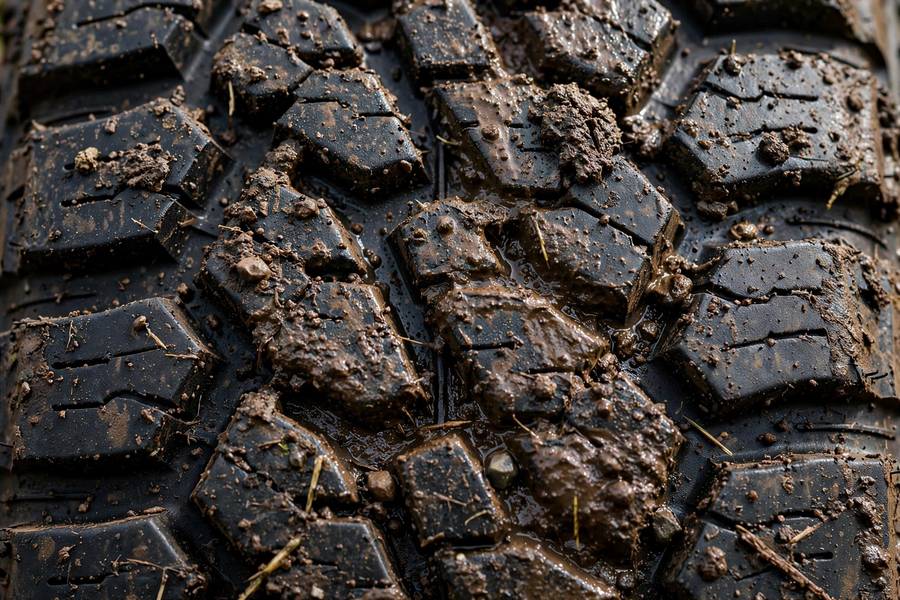
If I could only change one thing on any off-road vehicle, it wouldn’t be the drivetrain — it would be the tires. All-terrain tires with an aggressive tread, strong sidewalls, and the ability to air down transform both AWD and 4WD vehicles. Airing down to 15 to 20 psi (from a typical 35 psi street pressure) lengthens the contact patch dramatically, and on sand and loose dirt it’s the difference between floating and digging.
Mud-terrain tires go further with paddle-like lugs that self-clean, but they’re loud and wear fast on pavement. The all-terrain is the sweet spot for most: quiet enough for the highway, capable enough for real trails. Whatever you choose, make sure the spare matches and you actually know how to change it — the trail is a terrible place for your first tire lesson.
And the recovery gear matters as much as the tires: a tow strap (not a chain — chains snap and kill), rated recovery points on the vehicle, a shovel, and a portable air compressor to re-inflate after airing down. The best-prepared driver I know runs an AWD crossover with all-terrains and full recovery gear, and he goes places that humble stock 4WD trucks. Preparation beats hardware.
My Verdict, Terrain by Terrain
Gravel and forest roads: AWD wins on comfort and convenience; 4WD is overkill. Muddy two-tracks and wet fields: toss-up — AWD’s electronics versus 4WD’s lock, decided by tires and driver skill. Deep mud and bogs: 4WD with lockers, no contest, provided you have the clearance. Rocks and technical crawling: 4WD Low, absolutely — AWD has no answer for true crawling. Sand: AWD often surprises here; lighter weight and momentum matter more than lockers, though 4WD with aired-down tires is excellent too. Steep grades: 4WD Low for climbing and engine-braking descents. Snow-covered trails: covered in my snow comparison, but the short version is AWD for plowed, 4WD for unplowed.
The through-line: match the tool to the job, invest in tires before drivetrain envy, and never let the badge write checks your clearance can’t cash.
Frequently Asked Questions
For light trails, gravel, and mixed surfaces, AWD is excellent and more convenient. For serious off-roading — rocks, deep mud, steep grades — 4WD wins decisively thanks to 4WD Low’s torque multiplication and locking differentials. Most recreational trail driving falls in AWD’s comfort zone.
Yes, on light to moderate trails — forest roads, muddy tracks, and gravel are all fine, especially with all-terrain tires. The limits are ground clearance, no low-range gearing for crawling, and clutch-pack overheating under sustained wheel slip in deep mud or sand.
4WD Low multiplies engine torque through reduction gears (typically 2.5:1 to 4:1), letting the vehicle crawl at walking pace with enormous pulling force. This allows precise tire placement on rocks without the wheelspin and momentum that AWD systems must rely on without a low range.
For moderate trails, no — modern traction control handles most situations. For serious rock crawling, deep mud, or uneven terrain that lifts wheels off the ground, lockers are transformative: they force both wheels on an axle to turn together so the wheel with grip gets full power.
Tires, by a wide margin. All-terrain tires — especially aired down to 15-20 psi — transform both AWD and 4WD vehicles. A 4WD truck on street tires will struggle where an AWD crossover on all-terrains walks through. Invest in tires and recovery gear before worrying about the drivetrain badge.