The angriest conversation in AI art isn’t about whether it’s “real art” — it’s about where the art comes from. Image models learned from billions of pictures scraped from the internet, including copyrighted work by living artists who never consented, weren’t credited, and weren’t paid. Artists call it theft at scale. AI companies call it learning, like a student studying paintings in a museum. Both descriptions contain truth, which is why the fight is so bitter and so unresolved. This guide lays out how training actually works, what the lawsuits allege, and where things stand — as neutrally as I can manage on a topic where I have genuine sympathies on both sides. The creative-philosophy angle lives at can AI make art; this is the data-and-law angle.
Table of Contents
- How AI Image Models Actually Learn
- What “Training Data” Means in Practice
- The Core Accusation: Plagiarism at Scale
- The Defense: Learning Isn’t Copying
- The Lawsuits That Matter
- Memorization: When Models Actually Copy
- Style Mimicry: The Grayest Zone
- What This Means for You (Artist or User)
- Frequently Asked Questions
How AI Image Models Actually Learn
To judge the plagiarism question, you need the mechanics. Image models (diffusion models like those behind Midjourney, DALL-E, and Stable Diffusion) train in roughly three phases:
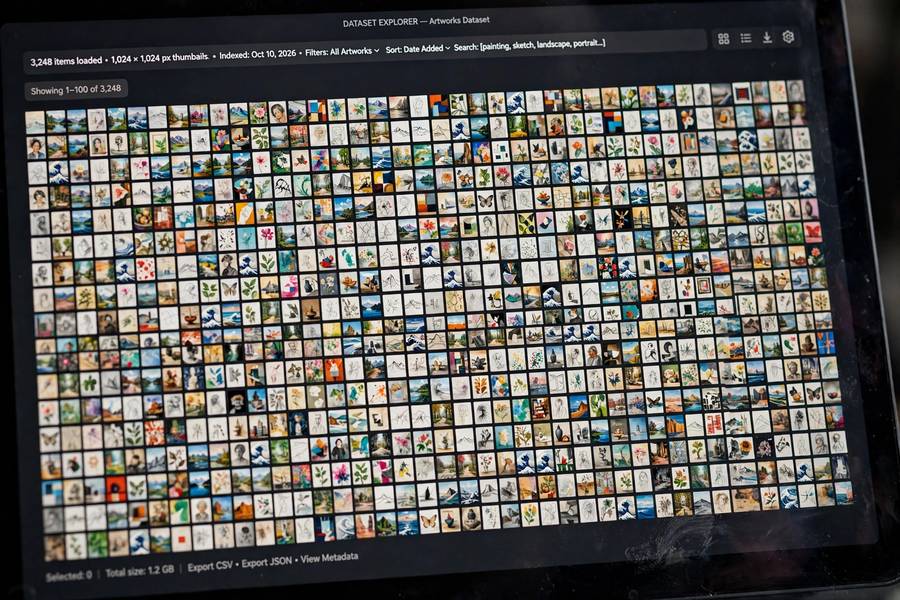
- Collection. Billions of image-text pairs are gathered from the web — photos, illustrations, paintings, memes, product shots, everything publicly accessible. The famous LAION datasets, used to train Stable Diffusion, contain around 5 billion such pairs.
- Training. The model studies these pairs, learning statistical relationships between words and visual patterns. It doesn’t store the images like a photo album; it adjusts billions of internal parameters — “weights” — to get better at predicting what images match what descriptions. The training images are the textbook; the weights are what the student remembers after closing the book.
- Generation. Given a new prompt, the model synthesizes a new image from its learned patterns, starting from random noise. It doesn’t retrieve and remix stored pictures — it constructs pixels guided by everything it absorbed.
The crucial technical fact: after training, the original images are gone. The model keeps only statistical patterns — how light falls on faces, what “impressionist” looks like as a texture distribution, the geometry of a cat’s ear. This is why AI companies insist the model is more like a learned skill than a collage machine.
The crucial counter-fact: the textbook was assembled without asking the authors. Whether “learning patterns” from someone’s work without permission is fair use or infringement is exactly what the courts are now deciding.
What “Training Data” Means in Practice
“Training data” sounds abstract. Concretely, it means: your ArtStation portfolio, your Instagram illustrations, your DeviantArt gallery from 2014, stock photos, news images, medical diagrams, copyrighted comic panels — anything crawlable, captioned, and useful. If it was on the public web with descriptive text nearby (alt text, captions, surrounding words), it was probably ingestible.
A few specifics that surprise people:
- Opt-out barely existed at first. Early datasets were scraped indiscriminately. Opt-out mechanisms (like “Do Not Train” registries and robots.txt respect) came later, partially, and retroactively can’t untrain a model.
- Living artists are heavily represented. Prompts like “in the style of [living illustrator]” work precisely because that illustrator’s work is densely represented in training. The model’s fluency in a style is proportional to how much of that artist’s work it absorbed.
- Consent was not sought. This is undisputed. The question is whether consent was required — which is a legal question, not a factual one.
Understanding this composition matters because every position in the debate — artist outrage, company defense, legal theory — starts from these facts and interprets them differently.
The Core Accusation: Plagiarism at Scale
The artists’ case, stated at full strength:
It’s unauthorized use of copyrighted work for commercial gain. Companies built multi-billion-dollar products on creative labor they didn’t license. If a human traced thousands of paintings to sell a “style,” we’d call it infringement; doing it with math doesn’t change the moral structure. Scale doesn’t launder consent.
“Learning” is a misleading metaphor. A human student studying paintings transforms understanding through lived experience and produces original work through struggle. A model performs statistical compression at industrial scale for commercial deployment. Calling both “learning” smuggles in a false equivalence that excuses extraction.
Style mimicry enables direct economic harm. When anyone can generate “a [your name]-style illustration” in seconds, working illustrators lose commissions to imitations of themselves. This isn’t theoretical — illustrators report clients bringing AI images “in their style” as references or replacements. The harm is specific, personal, and ongoing.
Opt-out puts the burden on victims. Telling artists to individually opt out of datasets — after the scraping, across multiple registries, with no enforcement — reverses the normal consent logic. In every other context, you ask permission first.
The benefits flow one way. Artists’ work made the models valuable; artists received nothing — no payment, no credit, no control. Whatever the legal outcome, the distributive shape of this looks like extraction.
This case resonates because it’s not really about technology — it’s about power: large companies converting collective creative labor into private product without negotiation.
The Defense: Learning Isn’t Copying
The AI companies’ and supporters’ case, also at full strength:
Copyright protects expression, not style or ideas. This is foundational law: you can’t copyright “impressionism” or “painting sad clowns.” Models learn styles, techniques, and visual concepts — the unprotectable layer — not specific copyrighted expressions. Every artist learns the same way from predecessors.
Training is fair use (arguably). The legal claim: ingesting copyrighted works to train a model is transformative — it creates a new tool with a different purpose than the originals, doesn’t substitute for them in the market, and uses them as raw material for learning rather than reproducing them. Courts have protected similar technical copying (search-engine thumbnails, book-scanning for search indexes) as fair use.
No individual work is reproduced. The model doesn’t contain your painting; it contains statistical generalizations across billions of images. Demanding licensing for training is like demanding every art student pay every artist whose work they studied. The transaction costs would make the technology impossible — which critics say is the point, and supporters say proves the demand is unreasonable.
Human artists do exactly this. Every illustrator studied others’ work, absorbed styles, and produces work “in conversation with” predecessors. If human influence-chains are legitimate, the mechanism of influence (biological vs. statistical) shouldn’t determine legality.
The alternative is corporate enclosure. If training requires licensing everything, only the largest companies — those that can afford massive licensing deals — can build models. Strict consent regimes could entrench Big Tech dominance rather than empowering artists. Open models trained on openly licensed data are the counter-proposal, and they exist.
Both cases are serious. Neither is frivolous. The courts get to decide which one the law supports.
The Lawsuits That Matter
The legal landscape, as it stands:
Artists v. Stability AI / Midjourney / DeviantArt (2023-). A class action by artists alleging their copyrighted works were used to train Stable Diffusion without consent. Early rulings trimmed some claims but allowed core copyright claims to proceed — the case continues, and its outcome on the fair-use question could set the template for everything else.
Getty Images v. Stability AI. Getty sued over training on its watermarked stock library — a particularly clean case for the plaintiff, since the model’s outputs sometimes reproduced distorted Getty watermarks, visibly demonstrating the training source. Filed in both the US and UK; closely watched because Getty’s evidence of direct ingestion is unusually concrete.
The New York Times v. Microsoft/OpenAI (text, but relevant). About text models, not images — but the fair-use reasoning will echo across modalities. The Times showed its articles reproduced nearly verbatim, attacking the “transformative” defense with memorization evidence.
What to watch: whether courts treat training as fair use (the industry’s existential question), whether opt-out regimes gain legal teeth, and whether legislatures create new licensing frameworks. My honest assessment: some form of compensation framework eventually emerges, but the models already trained aren’t going away.
Memorization: When Models Actually Copy
The “models don’t copy” defense has an documented exception: memorization. Sometimes models reproduce training images — or near-copies — rather than synthesizing new ones. This happens most with images repeated many times in training data (famous photos, widely-shared memes, popular stock images): repetition burns them into the weights.
Researchers have demonstrated extracting near-duplicates of training images from models via targeted prompting. The companies’ response: memorization is a bug being mitigated (deduplication of training data, output filters), it affects a tiny fraction of outputs, and it doesn’t represent how the model normally works.
The critics’ response: “tiny fraction of billions of generations” is still a lot of copies, and the existence of memorization proves the model can function as a retrieval system for its training data — which undermines the clean “learning, not copying” story.
My take: memorization is real and legally significant (it’s key evidence in Getty’s case), but it’s genuinely atypical of normal use. The everyday question is about style and pattern learning, not verbatim reproduction — though the edge cases keep the “it’s just learning” framing honest.
Style Mimicry: The Grayest Zone
The hardest question sits between verbatim copying (clearly problematic) and general influence (clearly fine): style mimicry — generating new images “in the style of” a specific living artist.
Why it’s gray:
- Style isn’t copyrightable. Legally, no one owns “painterly fantasy portraits with dramatic lighting.” An artist can’t monopolize their aesthetic.
- But scale changes the nature. A human imitating your style is flattery and competition; a machine letting millions imitate your style instantly is market displacement. Same legal category, vastly different economic effect.
- Name-based prompting is the flashpoint. “In the style of Greg Rutkowski” became shorthand for the whole issue after the fantasy illustrator found his name among the most-used style prompts. Using a living artist’s name as a prompt modifier feels personal in a way generic style descriptions don’t.
- Some platforms responded. Certain tools now block or discourage living-artist names in prompts. It’s a voluntary, partial measure — the underlying capability remains.
Where I land: style mimicry of living artists for commercial purposes, without consent, is ethically uncomfortable even where it’s legally permitted. If you’re using AI art commercially, avoiding “[living artist]” style prompts is cheap protection for both conscience and reputation.
What This Means for You (Artist or User)
If you’re an artist worried about your work:
- Check opt-out registries (like “Do Not Train” initiatives) and set robots.txt directives — partial protection, better than none.
- Consider watermarking and lower-resolution posting — raises the cost of scraping, doesn’t prevent it.
- Follow the lawsuits; class actions may eventually create compensation mechanisms you can join.
- Know that style itself remains yours in the ways that matter: your vision, your client relationships, your evolving voice. The model can mimic your past; it can’t preempt your future.
If you’re an AI art user:
- Avoid “[living artist name]” style prompts for commercial work — it’s the clearest ethical line in the whole debate.
- Prefer tools trained on licensed data (like Adobe Firefly) when the choice is available and the use is commercial.
- Disclose AI use where platforms or clients require it.
- Understand that “the model made it” doesn’t fully settle the ethics — your choices about how you use it are still yours.
If you’re just watching: both sides have legitimate claims and the resolution will be legal and legislative, not rhetorical. Anyone selling certainty either way is selling something the courts haven’t bought yet.
For the mechanics of the tools themselves, how Midjourney works and what Stable Diffusion is cover the technology without the controversy.
Frequently Asked Questions
It depends on the definition. AI models don’t typically reproduce specific works, but they were trained on billions of copyrighted images without consent. Critics call this plagiarism at scale; defenders call it learning patterns, like a human artist studying predecessors. Courts are still deciding the legal question.
Image models were trained on massive datasets scraped from the public web, including copyrighted works by living artists who never consented, weren’t credited, and weren’t paid. The concern is unauthorized commercial use of creative labor, plus economic harm when AI imitates specific artists’ styles.
Normally they synthesize new images from learned patterns rather than copying. However, researchers have documented “memorization” — models reproducing near-duplicates of images repeated often in training data. It’s atypical but real, and it’s key evidence in lawsuits like Getty Images v. Stability AI.
Unresolved. AI companies claim fair use — transformative purpose, no market substitution. Artists and rights holders claim infringement. Major lawsuits (artists v. Stability AI/Midjourney, Getty v. Stability AI) are working through courts now, with no final universal ruling yet.
Some tools allow it, some block it. Legally, style isn’t copyrightable, so it’s generally permitted — but using living artists’ names in prompts for commercial work is ethically contentious and reputationally risky. Avoiding it is the safer choice.