
Everyone has a chatbot horror story. Mine involves forty minutes trapped in a loop with a telecom bot that kept asking me to “describe my issue in a few words” while steadfastly ignoring every few words I typed. So let’s start with the uncomfortable truth: AI in customer service has produced some of the worst customer experiences of the last decade — and also some of the best. The difference isn’t the technology; it’s the design decisions around it. Here’s the full picture of how AI is actually used in customer service, including where it goes wrong. The broader business context is how AI is used in business.
Table of Contents
- Chatbots: The Front Door
- Agent Assist: AI Behind the Human
- Routing: Getting the Right Ticket to the Right Human
- Sentiment Analysis: Reading the Room at Scale
- Voice AI: The Phone Call Gets Smarter
- Self Service That Actually Serves
- Proactive Support: Fixing Problems Before the Ticket
- Quality Assurance on Every Interaction
- Where It Goes Wrong: The Hall of Shame
- Frequently Asked Questions
Chatbots: The Front Door
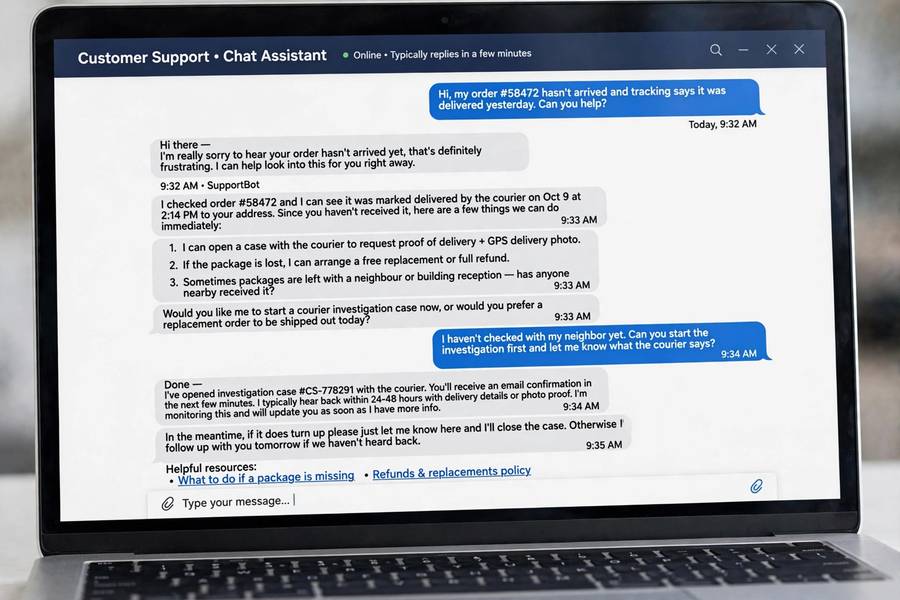
Chatbots are the most visible AI in customer service, handling the front door: answering FAQs, tracking orders, processing returns, booking appointments, resetting passwords. The good ones resolve 40 to 70 percent of conversations without human involvement — the routine, repetitive, well-defined stuff that used to clog queues.
The design principles that separate good from terrible are now well understood. Good bots: declare themselves as bots immediately, handle a narrow set of tasks excellently, escalate gracefully at the first sign of trouble, and pass full conversation context to the human (nothing infuriates like repeating everything to the agent). Terrible bots: pretend to be human, attempt everything, trap users in loops, and escalate to a queue with no context transfer. My telecom nightmare violated all four principles. The technology was fine; the design was hostile.
The economics drove adoption: a chatbot conversation costs a fraction of a human one, and it scales infinitely at 3am. But the smartest companies measure the bot on resolution and satisfaction, not just deflection. A bot that deflects 80 percent of chats but infuriates the other 20 percent is a reputation fire, not a savings.
Agent Assist: AI Behind the Human
The less visible but arguably more valuable application: AI that helps human agents instead of replacing them. Agent assist tools suggest responses in real time, surface relevant knowledge base articles as the conversation unfolds, summarize long ticket histories so the agent doesn’t read forty messages, draft the follow-up email, and flag compliance risks before the agent hits send.
The productivity numbers are striking — studies consistently show 15 to 35 percent faster resolution times — but the interesting effect is on agent quality. New agents perform closer to experienced ones because the AI whispers the institutional knowledge in their ear. Turnover, the chronic disease of support organizations, hurts less when the knowledge lives in the system rather than in senior agents’ heads. How to use AI at work covers the broader pattern; support is where it’s most mature.
There’s a subtlety worth naming: agent assist works best when it’s genuinely assistive — suggestions the agent can accept, edit, or ignore — rather than scripted. Agents who feel puppeted by the AI deliver worse service than agents who feel supported by it. The human psychology of the tool matters as much as its accuracy.
Routing: Getting the Right Ticket to the Right Human
Before a human ever sees a ticket, AI increasingly decides which human should see it. Intelligent routing classifies incoming requests by topic, urgency, sentiment, and complexity, then assigns them to the agent or team best equipped to handle them — by skill, language, workload, and past performance on similar issues.
This sounds mundane and it’s transformative. Misrouted tickets are one of support’s biggest hidden costs: the billing question that lands with technical support, gets bounced twice, and takes a week to resolve. Good routing kills the bounce. Urgency detection pulls the furious customer out of the FIFO queue before they churn. Complexity scoring sends the easy stuff to newer agents and the hard stuff to specialists, which is better for everyone — customers get competence, agents get appropriate challenges.
The failure mode is overconfidence: routing models that are 90 percent accurate still misroute 10 percent, and a misrouted urgent ticket is worse than a slow queue. The fix is humility in the design — confidence thresholds, easy re-routing, and human override. Routing AI should be a smart traffic cop, not an infallible oracle.
Sentiment Analysis: Reading the Room at Scale
AI reads emotional tone across support interactions — chat transcripts, call recordings, emails, reviews — and turns it into operational signal. A spike in negative sentiment about a specific feature flags a product problem before the metrics do. An individual conversation trending negative triggers a supervisor alert or an automatic de-escalation offer. Aggregate sentiment by topic tells product teams what’s actually bothering customers, unfiltered by survey bias.
The individual-level use is the delicate one. Real-time sentiment monitoring that prompts an agent mid-conversation (“this customer is getting frustrated — consider offering X”) is powerful and slightly dystopian, and the line depends on implementation. Used transparently — to help the agent help the customer — it’s a genuine service improvement. Used punitively — to score and punish agents — it becomes surveillance, and agents rightly hate it. The technology is neutral; the management philosophy isn’t.

Voice AI: The Phone Call Gets Smarter
The phone channel, long considered AI-resistant, is yielding. Voice AI now handles: IVR that understands natural speech instead of “press 1 for billing” menus; call summarization that writes the ticket notes automatically (agents consistently name this their favorite AI feature — nobody misses typing call notes); real-time transcription with suggested responses; and fully automated voice agents for narrow tasks like appointment confirmations and payment reminders.
The automated voice agent is the frontier with the most controversy. The technology — natural-sounding speech, real-time understanding — is genuinely good now. The question is whether customers accept it. Early data says: for simple transactional calls, yes, especially when the bot identifies itself and the alternative is a twenty-minute hold. For anything emotional or complex, no — and forcing it breeds the kind of resentment that shows up in churn numbers months later. The wise deployments keep voice AI narrow and always offer the human exit.
Self Service That Actually Serves
The best customer service interaction is the one that never happens — the customer who finds the answer themselves in thirty seconds. AI upgraded self-service from “search the FAQ and good luck” to genuinely helpful: conversational help centers that answer in natural language, troubleshooting flows that adapt to the user’s situation, video and article recommendations tuned to the specific problem, and community forums with AI-summarized solutions.
The metric that matters is deflection with satisfaction — customers who solved it themselves and feel good about it. The old knowledge base deflected some tickets and frustrated everyone else. The AI-assisted version resolves more and frustrates fewer, because it meets the customer at their actual question instead of making them translate it into the company’s taxonomy. “My screen is flickering” gets an answer; it doesn’t require knowing the article is filed under “display anomalies.”
Proactive Support: Fixing Problems Before the Ticket
The most advanced application flips the model entirely: instead of waiting for customers to report problems, AI predicts and prevents them. Usage pattern analysis spots the customer about to hit a limit and offers an upgrade before the error. Anomaly detection catches the service degradation affecting a segment and triggers outreach before the tickets arrive. Churn models identify at-risk accounts for human save attempts.
This is where AI moves customer service from cost center toward value driver. A proactive outreach — “we noticed your integration is failing, here’s the fix” — doesn’t just prevent a ticket; it builds the kind of loyalty that marketing can’t buy. The companies doing this well treat support data as a product input, not just an operational exhaust. Every ticket is a signal about what to fix upstream, and AI makes the signal legible at scale.
Quality Assurance on Every Interaction
Traditional QA sampled 2 percent of interactions — a supervisor listening to random calls, hoping they were representative. AI QA reviews 100 percent: every chat, every call transcript, every email scored against quality criteria — resolution, tone, compliance, process adherence. The outliers surface automatically: the brilliant save, the compliance violation, the agent struggling with a new product.
The effect on coaching is profound. Instead of generic feedback from a random sample, agents get specific feedback on their actual difficult conversations. Training targets real gaps. And the aggregate view reveals systemic issues — the policy nobody can explain clearly, the product area generating confusion — that no sampling regime would catch. It’s the difference between navigating by occasional landmarks and having GPS.
Where It Goes Wrong: The Hall of Shame
The failures deserve their catalog, because they’re all avoidable. The deflection trap: optimizing for keeping humans away from customers, producing bots that refuse to escalate — the single most hated pattern in customer service. The context amnesia: bots that forget everything between sessions, forcing repeat explanations. The fake human: bots designed to deceive, which customers detect instantly and resent permanently. The cost-center mindset: treating support AI as a way to cut headcount rather than improve service, which produces worse service with fewer people to fix it.
Every one of these is a choice, not a technical limitation. The technology to escalate gracefully, remember context, identify as a bot, and augment humans all exists and works. Companies that ship the bad versions chose to — usually by optimizing the wrong metric. If there’s one rule for AI in customer service, it’s this: optimize for the customer’s problem getting solved, and the economics follow. Optimize for the economics directly, and the customers leave. How to start a business is hard enough without building churn into your support operation.
Frequently Asked Questions
AI powers chatbots, agent assist tools, intelligent ticket routing, sentiment analysis, voice AI, self-service help centers, proactive support, and automated quality assurance. The best implementations combine AI efficiency with human judgment for complex or emotional issues.
AI handles routine inquiries well but cannot replace humans for complex, emotional, or novel problems. The most effective model is hybrid: AI resolves the routine 40-70% and assists agents with the rest, making humans faster and more effective rather than eliminating them.
Bad chatbots trap users in loops, refuse to escalate, pretend to be human, and lose context when handing off. These are design choices, not technical limits. Good bots declare themselves, handle narrow tasks well, escalate gracefully, and pass full context to human agents.
Agent assist AI helps human support agents in real time by suggesting responses, surfacing knowledge base articles, summarizing ticket histories, drafting follow-ups, and flagging compliance risks. It typically improves resolution times by 15-35% and helps new agents perform closer to experienced ones.
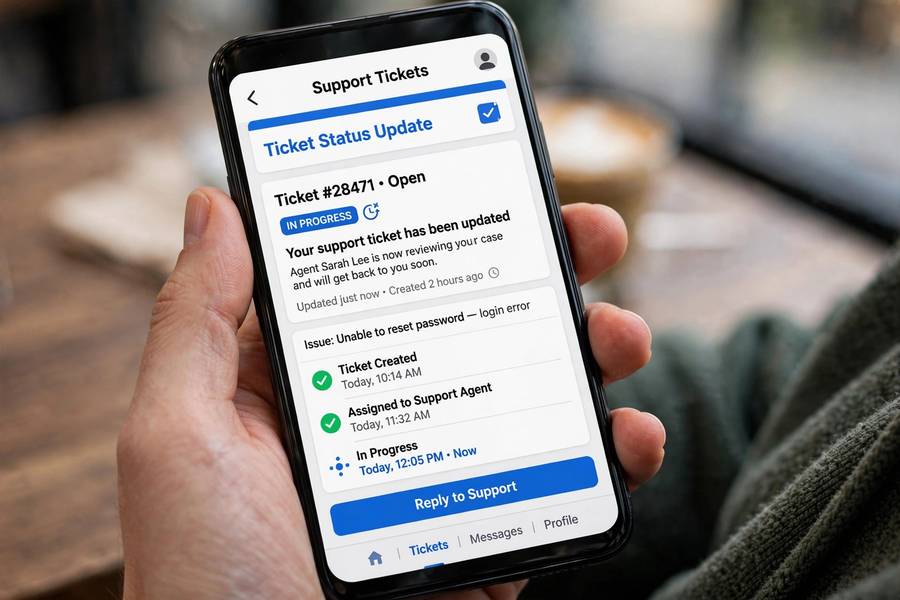
Proactive support uses AI to predict and prevent problems before customers report them: spotting usage issues, detecting service degradations, and identifying at-risk accounts for outreach. It shifts support from reactive cost center toward loyalty-building value driver.
Keep reading: