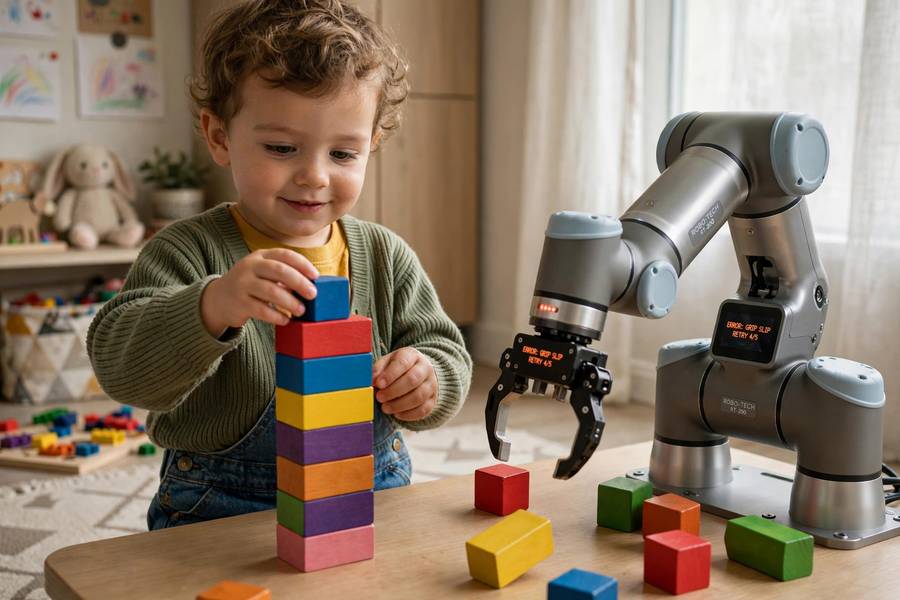
Here’s a puzzle that humiliated an entire field: by the late 1980s, computers could beat chess masters and prove mathematical theorems — tasks that require years of human training — but couldn’t walk across a cluttered room or recognize a coffee cup without heroic effort. Tasks we find hard turned out to be easy for machines. Tasks we find trivially easy turned out to be brutally hard. This is Moravec’s paradox, and it’s one of the deep reasons the AI winters happened — and one of the best tools for calibrating your expectations of AI today.
Hans Moravec, the roboticist who articulated it most clearly, put it this way: it is comparatively easy to make computers exhibit adult-level performance on intelligence tests or checkers, and difficult or impossible to give them the skills of a one-year-old when it comes to perception and mobility. I’ve thought about this observation for years, and I keep finding new implications in it. Let’s unpack it fully — the paradox, its role in the freezes, and what it tells us about the current boom. For the freezes themselves, see my guide to the AI winter.
Table of Contents
- The Paradox, Stated Simply
- Why Evolution Explains It
- How the Paradox Broke the Promises
- The Checkers Champion Who Couldn’t See
- Moravec’s Paradox in the First Winter
- Moravec’s Paradox in the Second Winter
- What Modern AI Did About It
- Where the Paradox Still Bites Today
- Using the Paradox as an Expectation Filter
- Frequently Asked Questions
The Paradox, Stated Simply
Our intuitions about difficulty are backwards. We assume that tasks requiring conscious effort — calculus, chess, logical reasoning — are the hard ones, and tasks we do unconsciously are easy. For machines, it’s inverted.
Think about what “recognizing a coffee cup” actually requires: segmenting it from a cluttered background, handling any lighting, any angle, any occlusion, any style of cup, distinguishing it from lookalikes, tracking it as it moves. Your visual system does this effortlessly using billions of neurons refined over hundreds of millions of years. A 1970s computer had kilobytes of memory and no idea where to start.
Why Evolution Explains It
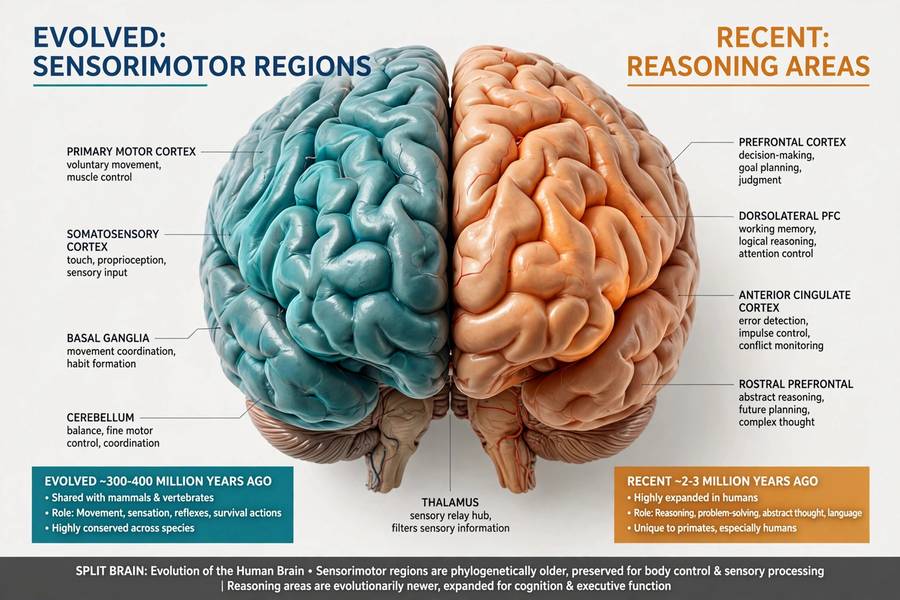
Moravec’s own explanation is evolutionary, and it’s elegant. The skills we find effortless — perception, locomotion, sensorimotor coordination — are ancient. They’ve been optimized by natural selection for over a billion years, since long before there were brains as we know them. They’re implemented in massive, specialized neural machinery that operates below conscious awareness. We don’t experience the computation; we experience the result.
Abstract reasoning, by contrast, is brand new — maybe a hundred thousand years old, a thin veneer on top of the ancient machinery. It’s the part of cognition we’re conscious of, so we mistake it for the hard part. But evolutionarily, it’s the recent hack, the kludge, the thing bolted on last. Of course it’s easier to replicate — it’s simpler machinery doing less optimized work.
This is why the paradox is so robust: it’s not about computers, it’s about us. Any intelligence built differently from ours will have a different difficulty profile, and we keep being surprised because we assume ours is universal.
How the Paradox Broke the Promises
Now connect this to the winters, because the connection is direct and devastating.
The early AI pioneers — brilliant people, working in good faith — estimated difficulty using human introspection. Chess felt hard, so chess-playing programs felt like major progress toward general intelligence. Language felt natural, so they assumed language understanding would follow quickly from the early wins. They were extrapolating from the wrong end of the difficulty spectrum.
The promises that funded the first boom were promises about the “easy” stuff: robots that see and move, machines that understand natural language, systems that perceive the world. These were exactly the tasks Moravec’s paradox says are hardest. The field promised the billion-year-old skills on a ten-year timeline, because nobody understood that the billion years mattered.
When the delivery failed — robots that couldn’t navigate offices, vision systems that couldn’t handle real lighting, language systems that collapsed outside toy domains — it looked like the field had failed. In a sense it had: it had failed to understand its own problem. The paradox wasn’t formulated clearly until the 1980s, but it was operating from day one, silently invalidating every timeline.
The Checkers Champion Who Couldn’t See
Let me make this concrete with the era’s signature contrast.
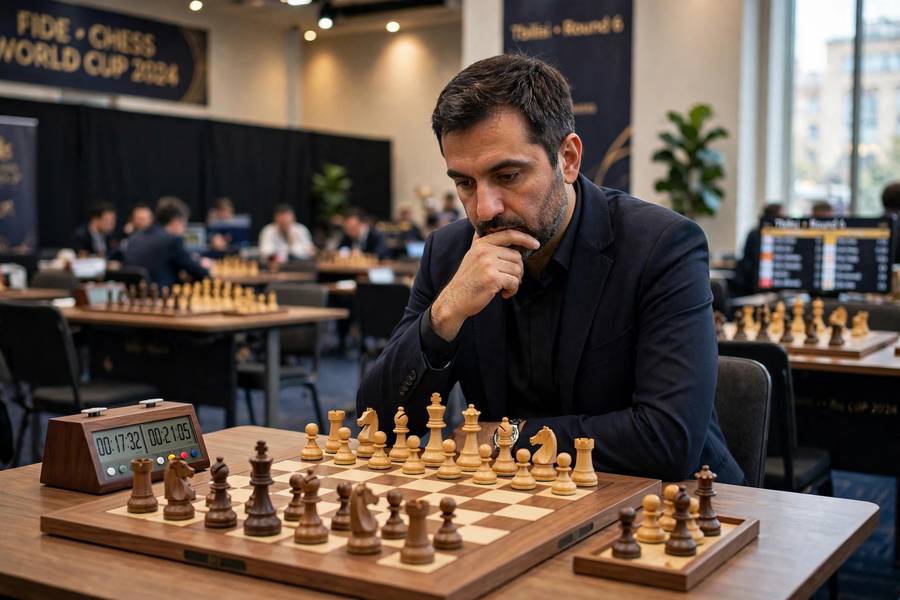
By the early 1990s, Chinook was beating human checkers champions and Deep Blue was on its way to beating Kasparov. These were genuine, historic achievements — the culmination of decades of work on search algorithms, evaluation functions, and game theory. They felt like proof that machine intelligence was nearly here. If a machine can outthink the best human minds at humanity’s hardest games, surely understanding a sentence or walking up stairs is just around the corner?
Meanwhile, the best mobile robots of the era moved at a crawl through carefully prepared environments, got confused by shadows, and couldn’t reliably pick up objects. Computer vision systems worked in the lab and failed in sunlight. Speech recognition handled tiny vocabularies from cooperative speakers and collapsed on real conversation.
The contrast was the paradox made visible: superhuman at the “hard” things, sub-infant at the “easy” things. And because funders and journalists evaluated progress by the impressive demos — the chess victories made headlines; the robot stuck in a doorway didn’t — the field’s public story was systematically misleading. The wins were real but unrepresentative. The failures were representative but invisible. Until the bills came due.
Moravec’s Paradox in the First Winter
The first winter (mid-1970s to ~1980) was Moravec’s paradox in action before anyone had named it. The triggers — the Lighthill report, DARPA’s funding reviews — all circled the same complaint: AI had conquered toy problems and failed at real ones.
Lighthill’s devastating observation about the gap between demonstration and reality was, at its core, an observation about the paradox. The blocks-world programs and theorem provers were triumphs of the “hard” (abstract, formalizable) skills. The promised applications required the “easy” (sensorimotor, unconscious) skills. The field had climbed the foothills and mistaken them for the mountain — a misjudgment the history of artificial intelligence records as the formal start of the first freeze.
What made it a winter rather than a correction was the funding structure’s inability to distinguish. Funders had bought the grand vision; when the grand vision stalled on exactly the problems the paradox predicts are hardest, they didn’t recalibrate — they withdrew. A more paradox-aware funder might have said: “The reasoning work is ahead of schedule; the perception work needs decades; fund accordingly.” Instead: winter.
Moravec’s Paradox in the Second Winter
The expert-systems era looked like it had sidestepped the paradox — and in a way it had. Expert systems didn’t try to see or move; they encoded abstract professional knowledge as rules. Expert judgment, configuration, financial analysis: these are the “hard” skills, the conscious-reasoning skills, the ones machines do relatively well. For a while, it worked.
But the paradox struck back through the maintenance problem. The tacit, unconscious dimension of expertise — the pattern recognition, the judgment calls, the “something feels off” — couldn’t be captured in rules. Knowledge engineers discovered that experts know more than they can say, and the unsayable part was often the most important part. The brittleness of expert systems was Moravec’s paradox wearing a business suit: the easy-for-humans part of expertise resisted formalization.
The second winter, then, was also a paradox story — subtler, but the same shape. The field again promised to capture human capability, again discovered that the capturable part was the smaller part, and again faced funders who’d bought the brochure.
What Modern AI Did About It
Here’s the good news: modern AI finally attacked the paradox directly, and it’s winning — partially.
Deep learning’s great triumph was conquering the “easy” skills. Convolutional networks learned to see. Sequence models learned to hear and handle language’s messy reality. The billion-year-old skills turned out to be learnable after all, given enough data and compute.
This is why the current boom feels different from the old ones: it’s built on solving the problems that broke previous generations. A system that can see, hear, read, and converse is doing the “easy” stuff that was impossible in 1985 — the payoff of the massive-scale training described in how AI models are trained.
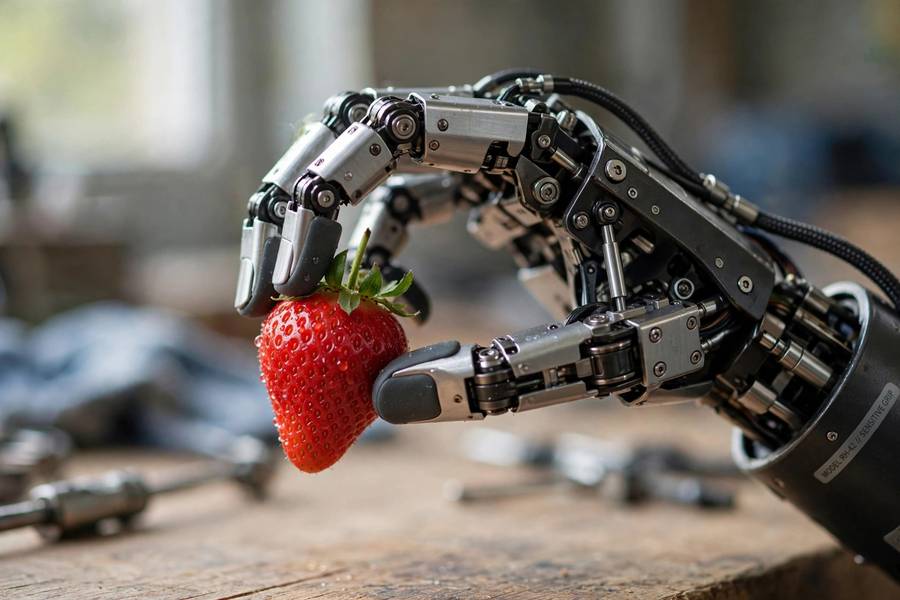
But “partially” matters. Today’s systems still show paradox-shaped weaknesses. Language models that write brilliant essays but can’t reliably count or plan. Vision systems that recognize objects but misunderstand physical scenes. Robots that are clumsy compared to toddlers. The paradox hasn’t been repealed — it’s been pushed back. Each push reveals a new layer where “easy” is still hard.
Where the Paradox Still Bites Today
If you want to find where current AI is weakest, apply the paradox as a lens: look for the skills humans do unconsciously.
Physical common sense. Humans have deep, unconscious models of how the physical world works — object permanence, support, containment, causality. AI systems approximate these from data but lack the robust, grounded understanding. Ask a model to reason about a novel physical situation and watch the confidence outrun the competence.
Social intuition. Reading a room, detecting sarcasm, understanding what’s left unsaid — these are ancient social skills running on unconscious machinery. Language models simulate them from text patterns, sometimes brilliantly, sometimes catastrophically. The failures are paradox-shaped: fluent surface, missing depth.
Robust perception in novel conditions. Modern vision is excellent on familiar distributions and fragile outside them. Adversarial examples, unusual lighting, novel viewpoints — the system that recognizes a thousand dog breeds can be fooled by a few pixels of noise. Human vision degrades gracefully; machine vision degrades weirdly.
Genuine generality. Each current system is brilliant in its training distribution and brittle outside it. The dream of general intelligence is the dream of escaping the paradox entirely. We’re not there, and the paradox suggests it’s the last mile, not the first.
Using the Paradox as an Expectation Filter
Here’s how I use Moravec’s paradox practically, and I recommend it as a standing habit:
When evaluating an AI claim, ask: is this demonstrating a “hard” skill or an “easy” skill? Brilliant essay writing, theorem proving, code generation — these are “hard” skills, the kind machines do well. Treat them as expected, not miraculous. Robust real-world perception, physical manipulation, social judgment — these are “easy” skills. Treat progress here as genuinely significant.
When forecasting timelines, add the paradox tax. Predictions about reasoning capabilities (“AI will do math research”) deserve more credence than predictions about embodied capabilities (“robots will do your housework next year”). The history of missed timelines is overwhelmingly a history of underestimating the “easy” stuff.
When building, respect the asymmetry. If your application depends on robust perception, physical interaction, or social nuance, budget for the paradox — test in real conditions, expect edge cases, and don’t trust the demo. If it depends on pattern recognition in data — like how recommendation algorithms work — you’re on firmer ground.
Moravec’s paradox is ultimately a humility device. It reminds us that our intuitions about intelligence are parochial, that the universe of possible minds is larger than our evolutionary accident, and that the things we do without thinking are the deepest magic we possess. The AI winters happened, in part, because a field forgot that. Let’s not forget it again.
Frequently Asked Questions
Moravec’s paradox is the observation that tasks humans find hard (chess, math, logical reasoning) are relatively easy for computers, while tasks humans find effortless (seeing, walking, recognizing objects) are extremely difficult for machines. High-level reasoning is easier to formalize than unconscious sensorimotor skills.
The evolutionary explanation: sensorimotor skills were optimized by natural selection over a billion years and run on massive unconscious neural machinery, while abstract reasoning is a recent evolutionary addition — a thin, simpler layer. We mistake conscious effort for difficulty, but evolutionarily, reasoning is the kludge and perception is the masterpiece.
Early AI researchers estimated difficulty using human introspection, so they promised the “easy” skills (robot vision, language understanding, mobility) on short timelines. These were actually the hardest problems. When delivery failed on exactly those promises, funders withdrew — the gap between promise and delivery that caused both winters.
Partially. Deep learning conquered many “easy” skills — computer vision, speech recognition, even robot locomotion — using data and compute at unprecedented scale. But paradox-shaped weaknesses remain in physical common sense, social intuition, robust perception in novel conditions, and genuine generality.
Ask whether a claimed capability is a “hard” skill (reasoning, math, code — machines do these well, so treat claims as expected) or an “easy” skill (perception, physical interaction, social judgment — genuinely difficult, so treat progress as significant). Add extra skepticism to timelines for embodied, real-world capabilities.