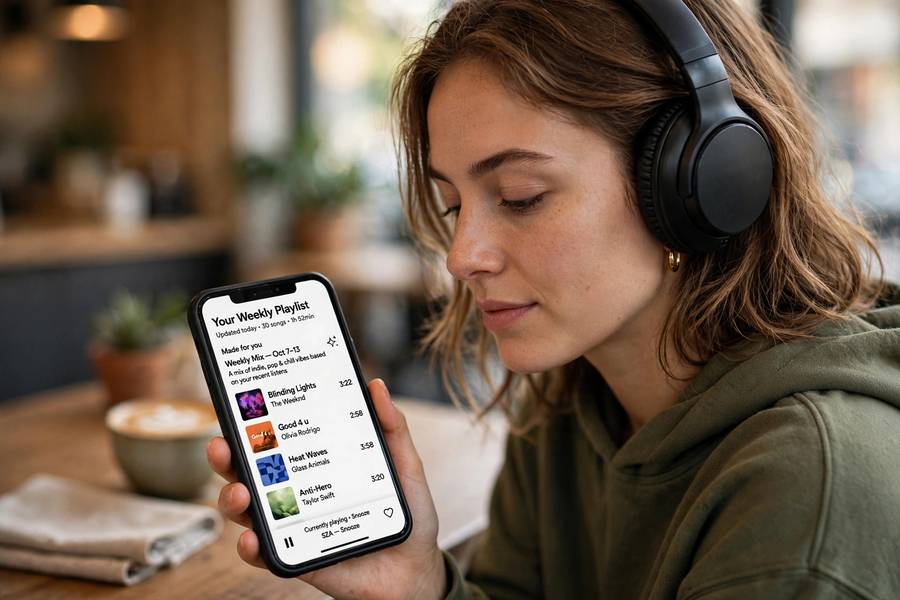
Every Monday morning, Spotify hands me a playlist of thirty songs it thinks I’ll love — and it’s right often enough that Discover Weekly has become a small weekly ritual. Last month it surfaced a 1970s Turkish psych-rock track I’d never have found in a thousand years of browsing, and I’ve played it forty times since. A machine reached across five decades and a language I don’t speak and handed me exactly my taste. How?
Spotify’s recommendation system is one of the most sophisticated in consumer tech, blending three different approaches — what people listen to, what music sounds like, and what people say about music. This guide explains all three, plus the playlists they power. For the general theory, see how recommendation algorithms work.
Table of Contents
- The Three Engines of Spotify Recommendations
- Engine One: Collaborative Filtering
- Engine Two: Listening to the Music Itself
- Engine Three: Reading the Internet’s Opinions
- Discover Weekly: The Famous Playlist
- Release Radar, Daily Mixes, and the Rest
- The Signals: What Counts as a Like
- The Cold Start: New Users and New Songs
- Why It Sometimes Gets You Wrong
- Frequently Asked Questions
The Three Engines of Spotify Recommendations
Most recommendation systems use one main approach. Spotify uses three, in combination — and the combination is the secret.
- Collaborative filtering: what do people with similar taste listen to?
- Audio analysis: what does the music itself sound like?
- Natural language processing: what does the world say about this music?
Each engine compensates for the others’ blind spots. Collaborative filtering is powerful but fails on new songs nobody’s heard. Audio analysis works on any song instantly but can’t capture cultural context. NLP captures context but depends on people writing about the music. Together, they cover nearly everything. Understanding the three separately is the key to understanding why Spotify’s recommendations feel so uncannily right — and where they still stumble.
Engine One: Collaborative Filtering
The first engine is the classic: users who listen to the same things you do probably like things you haven’t heard yet.
Spotify builds taste profiles from listening behavior — not just what you play, but what you play repeatedly, what you save, what you add to playlists, what you skip after ten seconds. It then finds users with overlapping patterns and recommends tracks that are popular in your taste neighborhood but missing from your history.
The scale makes it work: hundreds of millions of users generate enough behavioral data to find genuinely similar listeners even for obscure tastes. My Turkish psych-rock discovery came from this engine — somewhere out there are people whose listening overlaps with mine, and one of them had already found that track. The system just connected the dots.
The limitation is the famous cold start: a brand-new song has no listening data, so collaborative filtering can’t evaluate it. A brand-new user has no history, so the system can’t place them. The other two engines exist largely to fill these gaps.
Engine Two: Listening to the Music Itself
This is my favorite part. Spotify literally analyzes the audio of every track — not the metadata, the sound itself — using machine learning models that extract musical features.
The system examines things like tempo, key, mode (major/minor), energy, danceability, acousticness, speechiness, loudness, and timbre characteristics. It can detect the “shape” of a song: is it a slow-building acoustic ballad, a high-energy electronic track, a speech-heavy hip-hop cut? These features form a sonic fingerprint for every track in the catalog.
This engine powers a crucial capability: recommending songs nobody has heard yet. A track uploaded this morning has no listening data, but the audio analysis works instantly — the system knows it sounds like things you like before a single human has streamed it. It’s also how Spotify handles the long tail: obscure tracks with thin behavioral data can still be matched to listeners by sonic similarity.
The limitation: audio analysis captures how music sounds, not what it means. It can’t tell that two sonically similar songs belong to different cultural moments, or that a track’s lyrics make it perfect (or terrible) for your context. This kind of machine listening also powers how text-to-speech works in reverse — analyzing audio features rather than producing them. Sound is only part of taste — which is where engine three comes in.
Engine Three: Reading the Internet’s Opinions
The third engine uses natural language processing to read what the world says about music — blog posts, reviews, articles, social media, playlist descriptions — and extract meaning.
The system scans text across the web for mentions of artists and tracks, learning the descriptive language around them: “melancholic,” “summer anthem,” “90s revival,” “workout energy.” It builds a semantic profile of each artist from the collective conversation, capturing cultural context that neither listening data nor audio analysis can see.
This is how Spotify knows that a lo-fi acoustic track is “coffee shop music” and that a particular rapper is “lyrical” versus “club-oriented.” Nobody tagged those things in a database — the system inferred them from how humans write about the music. It’s also constantly updating: when a song becomes a TikTok trend or gets associated with a cultural moment, the NLP engine picks up the new context.
The three engines combine in ensemble models that weight each signal by reliability. For a well-established track, collaborative filtering dominates. For a new release, audio and NLP carry the weight. The blend shifts per track, per user, per moment.

Discover Weekly: The Famous Playlist
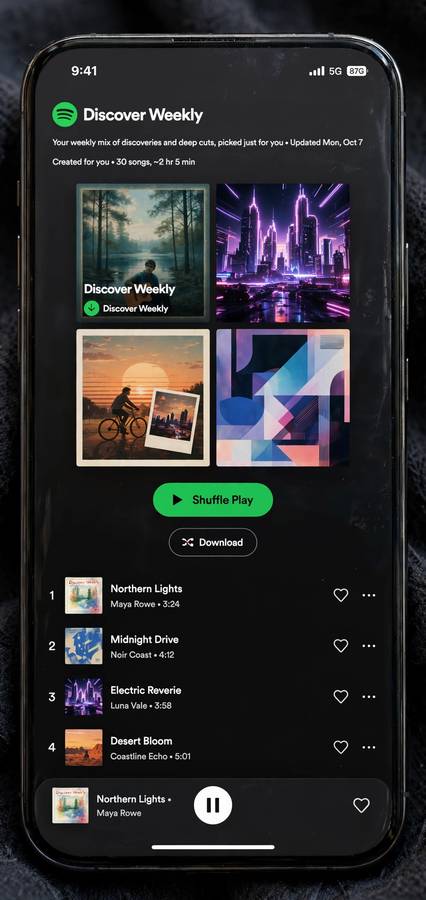
Discover Weekly deserves its own section because it’s the purest expression of the system — and a genuine cultural phenomenon. Every Monday, thirty tracks you’ve never heard, chosen for you.
The playlist leans heavily on collaborative filtering with audio similarity as a filter: it finds tracks popular among your taste neighbors, then checks that they sonically fit your profile. The “never heard” constraint is strict — it only includes tracks outside your listening history, which makes it an exploration engine rather than a comfort engine.
The magic number is thirty: enough to feel substantial, few enough to actually listen through. And the Monday timing is deliberate — fresh music for the week’s listening, a ritual that builds the habit that generates the data that improves the playlist. Another flywheel.
What makes Discover Weekly special technically is how personal it is. Two users’ playlists share almost nothing — it’s not a chart, it’s a fingerprint. The playlist’s success (it became one of Spotify’s most beloved features within months of launch) proved that algorithmic exploration could feel like a gift rather than a feed.
Release Radar, Daily Mixes, and the Rest
The other playlists use the same engines with different objectives:
Release Radar (Fridays): new releases from artists you follow plus artists the system thinks you’ll like, ranked by predicted interest. Heavier on the NLP and audio engines, since new tracks lack listening data.
Daily Mixes: comfort listening — blends of your favorite tracks and artists organized by genre clusters the system detects in your taste. Less exploration, more “your music, organized.” The mixes reveal how the system sees your taste: if you get separate mixes for jazz, metal, and pop, that’s the clustering made visible.
On Repeat / Repeat Rewind: pure behavioral — what you’ve actually been playing. No fancy modeling, just your habits reflected back.
DJ / AI DJ: the newer conversational layer — an AI voice that introduces tracks with commentary about why they were chosen. The recommendations underneath are the same engines; the DJ is presentation, and a hint of where this is all heading.
Each playlist is a different answer to “what should I listen to now?” — explore, discover new releases, comfort, habit, guided. The variety is deliberate: different moments need different modes.
The Signals: What Counts as a Like
What does Spotify actually measure? The signal hierarchy:
Strongest: saves, playlist adds, follows, shares. Explicit actions — you telling the system “more of this.”
Strong: repeat listens, full plays, listening to an artist’s full catalog. Behavioral commitment.
Medium: completed plays, playlist creation including the track, listening sessions themed around it.
Weak but abundant: skips (negative), 30-second plays (the royalty threshold, and roughly the system’s “gave it a chance” marker), time of day and context patterns.
Contextual: what device, whether you’re on a run (workout playlists), time of day, even (reportedly) patterns suggesting mood. Spotify has patented mood-detection approaches, though how much is deployed is unclear.
Skips deserve emphasis: skipping a track within the first 30 seconds is one of the strongest negative signals in the system. It’s also why the first seconds of songs matter so much now — artists know the algorithm is judging the intro.
The Cold Start: New Users and New Songs
Two cold starts, two solutions:
New users get onboarding: Spotify asks about favorite artists and genres during signup, giving the system seed data. It then serves broadly popular tracks within those seeds and refines rapidly from your early skips and saves. Within a few sessions, the profile sharpens dramatically.
New songs get the audio + NLP treatment: sonic fingerprinting works instantly, and the NLP engine picks up early blog/social mentions. The system also gives new releases exploration boosts — showing them to likely-interested users to gather the behavioral data collaborative filtering needs. Artists’ existing audiences get priority in this testing, which is why release-day streaming by fans matters so much.
The system is designed so that no song is truly invisible and no user is truly unknown — just uncertain, with uncertainty that shrinks fast.
Why It Sometimes Gets You Wrong
The failures are instructive:
Context collapse. The system knows what you listen to but not why. Your workout playlist, your sleep sounds, your kid’s favorite songs, your ironic meme listens — all feed one profile. The algorithm can’t tell which “you” is listening, so recommendations blend contexts confusingly.
The exploration trap. Discover Weekly optimizes for “new but similar,” which over time narrows rather than broadens. The system is great at finding more of what you like and mediocre at challenging your taste.
Popularity gravity. Collaborative filtering amplifies the already-popular — more listeners mean more data mean better placement. Great obscure music can stay obscure if it never gets the initial behavioral seed.
Mood blindness. The system is getting better at context, but it still sometimes serves melancholic ballads at your party or high-energy EDM at midnight. Audio features describe the track, not your moment.
None of these are fatal — the system is still remarkably good. But knowing the failure modes helps you use it better: separate playlists by context, use private sessions for out-of-character listening, and remember that the algorithm serves your history, not your aspirations.

Frequently Asked Questions
Spotify combines three approaches: collaborative filtering (what similar listeners enjoy), audio analysis (the sonic features of tracks — tempo, energy, danceability), and natural language processing (what the internet says about the music). Your listening behavior — plays, skips, saves, playlist adds — feeds all three.
Discover Weekly uses collaborative filtering to find tracks popular among listeners with similar taste, filtered by audio similarity to your profile. It strictly includes only songs you’ve never played, making it an exploration engine. A new 30-track playlist is generated every Monday.
Yes. Machine learning models extract musical features from every track’s audio — tempo, key, energy, danceability, acousticness, speechiness, and timbre. This sonic fingerprinting lets Spotify recommend brand-new songs with no listening data yet, purely by how they sound.
Usually context collapse — your workout music, kids’ songs, or ironic listens all feed one profile. Skips within 30 seconds are strong negative signals, so skipping quickly helps. Using separate playlists per context and private sessions for out-of-character listening keeps your profile cleaner.