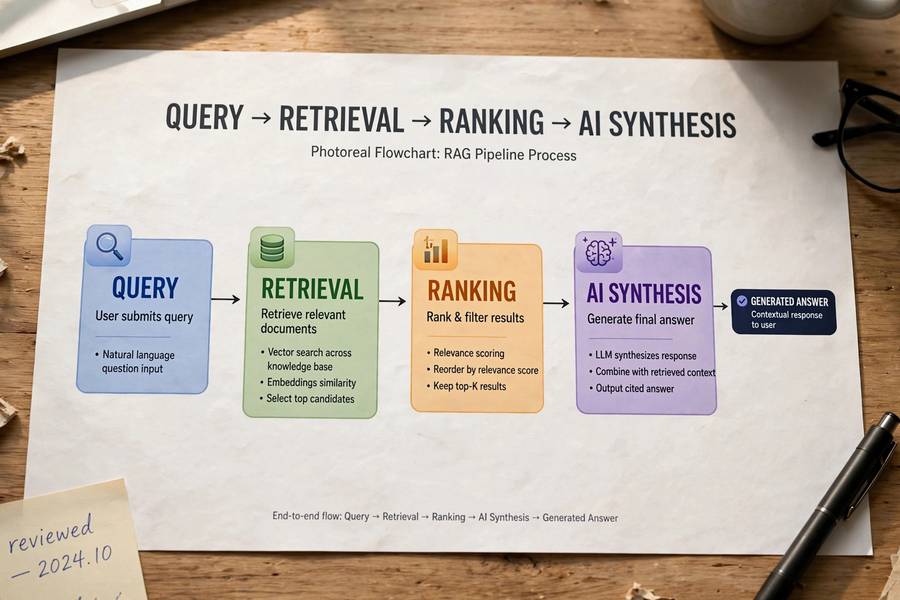
You type a question in plain English. Seconds later, a coherent answer appears — with citations, structured clearly, seemingly read from multiple sources. It feels like asking a brilliant friend. But under the hood, AI search is a pipeline of distinct stages — understanding, retrieval, synthesis — each with its own technology, each with its own failure modes. Understanding the pipeline explains both the magic and the mistakes.
This guide walks through how AI search works, stage by stage. For the concept overview, see what AI search is.
Table of Contents
- The Pipeline at a Glance
- Stage 1: Understanding the Query
- Stage 2: Retrieval — Finding Sources
- Stage 3: Synthesis — Reading and Answering
- Stage 4: Citation and Presentation
- The Models Behind It
- Where It Breaks: Failure at Each Stage
- How It Differs From Chatbots
- A Worked Example: One Question Through the Pipeline
- Frequently Asked Questions

The Pipeline at a Glance
The four stages:
- Understand — parse the natural-language question: intent, entities, what’s actually being asked.
- Retrieve — find relevant sources from the index (like traditional search, often using similar infrastructure).
- Synthesize — read the retrieved sources and generate a direct answer using a language model.
- Cite — link claims to sources, present the answer readably.
Simple to describe, complex to execute. Each stage is a research area; the integration is the product. And each stage can fail independently — which is why tracing AI search errors requires understanding the pipeline.
Stage 1: Understanding the Query
Before searching, the system must understand what you’re asking — harder than it sounds:
Intent classification. Is this a factual question, an opinion request, a how-to, a comparison? The intent determines the retrieval and synthesis strategy.
Entity resolution. “When did Apple release the Vision Pro?” — which Apple (the company, obviously, but the system must determine it), which product, what “release” means. Ambiguity resolved probabilistically.
Query rewriting. Your natural question often becomes multiple search queries behind the scenes — decomposing complex questions into retrievable sub-queries. “What are the trade-offs between X and Y for startups?” might become searches for X’s advantages, Y’s advantages, startup-specific considerations.
Context incorporation. In conversational search, previous turns inform interpretation — “what about for beginners?” inherits the topic from history.
The challenge: misunderstanding here poisons everything downstream. The retrieval finds sources for the wrong question; the synthesis answers confidently and irrelevantly. When AI search gives a great answer to a question you didn’t ask, this stage failed.
Stage 2: Retrieval — Finding Sources
The most traditional-search-like stage — and often literally built on traditional search infrastructure:
The index. AI search needs something to retrieve from — typically a web index (built like how a search engine works describes: crawling, indexing, ranking), sometimes supplemented with curated or licensed sources.
Retrieval methods. Keyword matching (classic), semantic/embedding search (meaning-based), and hybrids. The best systems combine — keywords for precision, semantics for recall.
Ranking for synthesis. Retrieved sources aren’t ranked for human clicking but for machine reading — the system needs sources that are informative, reliable, and complementary. Different ranking objectives than traditional search.
The retrieval depth question. How many sources? Too few misses perspectives; too many dilutes synthesis. Systems tune this — typically 5–20 sources for the synthesis stage.
Freshness handling. For time-sensitive queries, recency weighting — but “freshness” detection is itself hard (publication dates unreliable, content updated silently).
The critical dependency: synthesis quality is bounded by retrieval quality. The best language model can’t synthesize what wasn’t retrieved. “Garbage in, garbage out” applies with full force — the retrieval stage is where many AI search failures originate.
Stage 3: Synthesis — Reading and Answering
The AI-distinctive stage: a large language model reads the retrieved sources and generates the answer.
What the model receives: your question plus the retrieved source contents (or excerpts) — a big prompt containing everything to synthesize.
What it does: reads across sources, identifies relevant information, resolves (or fails to resolve) contradictions, structures the answer, and generates fluent prose. This is reading comprehension at scale — the model’s training in language understanding applied to retrieved documents.
The synthesis challenges: – Contradiction: sources disagree. The model must adjudicate — or present both sides. Handling this well is hard; models often pick one side silently or blend incompatibly. – Weighting: not all sources are equal. The model should weight authoritative sources more — but “authoritative” is a judgment call the model makes imperfectly. – Completeness vs concision: covering the question fully without rambling. The eternal summary tension. – Faithfulness: staying true to sources vs. filling gaps from training knowledge. The line between synthesis and hallucination lives here.
The miracle and the risk: when it works, it’s remarkable — coherent answers from scattered sources in seconds. When it fails, it fails plausibly — which is worse than failing obviously.

Stage 4: Citation and Presentation
The answer isn’t done until it’s presented with provenance:
Citation generation. Linking claims to the sources supporting them — the feature distinguishing AI search from chatbots. Done well, it enables verification; done poorly (mismatched citations), it’s worse than useless (false confidence).
Citation granularity. Sentence-level? Paragraph-level? The finer the granularity, the more verifiable — but also the more cluttered. Systems make different trade-offs.
Presentation structuring. Headers, lists, tables, direct answers first — the UX of synthesized information. Good presentation makes complex answers digestible; it’s a design discipline, not just formatting.
Follow-up facilitation. Related questions, conversational continuation — keeping the interaction going. The product layer atop the pipeline.
The verification contract: citations promise “you can check this.” When the promise holds, AI search is trustworthy-in-principle. When citations don’t support claims, the contract breaks — and users who don’t check won’t notice.
The Models Behind It
What’s actually running:
The understanding model. Often a fine-tuned LLM for query interpretation — sometimes the same model as synthesis, sometimes specialized.
The retrieval system. Embedding models for semantic search, traditional IR for keyword matching, ranking models tuned for synthesis utility.
The synthesis model. A capable LLM — usually a flagship-class model, since synthesis quality determines product quality. This is where the most compute goes.
The orchestration. The unglamorous glue — query routing, parallel retrieval, context assembly, fallback handling, latency management. Often more engineering than the models themselves.
The trend: increasing specialization — different models for different stages, each optimized for its role. The monolithic “one model does everything” approach gives way to pipelines of specialists.
Where It Breaks: Failure at Each Stage
Tracing errors by stage:
Understanding failures: answers the wrong question beautifully. The tell: the answer is coherent but irrelevant to what you meant. Fix: rephrase more specifically.
Retrieval failures: right question, wrong/missing sources. The tell: outdated information, missing obvious sources, thin coverage. Fix: nothing user-side — it’s the system’s index or ranking.
Synthesis failures: good sources, bad answer. The tell: citations don’t support claims, contradictions blended, key source points missed. The most common serious failure.
Citation failures: claims without support, or support that doesn’t match. The tell: clicking citations reveals mismatch. Undermines the verification contract.
The meta-lesson: “AI search was wrong” is analytically useless — WHICH stage failed determines whether rephrasing helps (understanding), whether to try later (retrieval/index), or whether to verify manually (synthesis). Stage-aware troubleshooting beats generic frustration.
How It Differs From Chatbots
AI search vs. chatting with an LLM — related but distinct:
Grounding. AI search retrieves external sources; pure chatbots answer from training knowledge. The retrieval grounding is the defining difference — it’s what makes AI search suitable for factual questions and current events.
Citations. The verification mechanism chatbots lack. (Some chatbots now browse, blurring the line.) In practice, the difference shows up most clearly in current-events questions — ask about last week’s news and the grounded system answers, while the static one confidently guesses or declines.
Query vs conversation. AI search is query-oriented (answer this); chatbots are conversation-oriented (discuss this). The interaction models differ even when the underlying models are similar.
The convergence: chatbots gain browsing/retrieval; AI search gains conversational depth. The distinction is eroding — but the pipeline understanding remains valuable because the failure modes persist regardless of interface.
A Worked Example: One Question Through the Pipeline
Theory is tidy; let’s trace a real question. You ask: “Should my small bakery invest in a delivery app or build its own ordering website?”
Stage 1 (understanding): the system classifies intent — business advice, not a factual lookup. It resolves entities (small bakery = independent food business) and rewrites your question into sub-queries behind the scenes: delivery app commission rates for small restaurants, cost of building a small-business ordering site, customer acquisition via apps versus owned channels.
Stage 2 (retrieval): it pulls industry reports on commission rates, forum threads from bakery owners, a few “delivery app vs own website” comparison articles. Suppose the index missed a commission change announced last week — the retrieval set is now subtly stale, and nothing downstream can fix that.
Stage 3 (synthesis): the model reads across sources and builds the trade-off: apps take 15–30% commission but deliver discovery; an owned site keeps margin but demands marketing spend. It recommends a hybrid — app presence for discovery, owned site for regulars — and hedges on costs.
Stage 4 (presentation): citations attach the commission figures to the industry report, the cost estimates to the articles; follow-ups suggest “what does a bakery ordering site cost in 2026?”
Now you can see exactly where it could fail: the stale commission data produces a confident, cited, wrong recommendation. Stage-aware thinking turns “the AI was wrong” into “retrieval was stale” — and tells you precisely what to double-check.
Frequently Asked Questions
Four stages: understand the natural-language query (intent, entities), retrieve relevant sources from an index, synthesize a direct answer by having an LLM read the sources, and present it with citations. Each stage can fail independently — pinpointing which one determines the fix.
AI search retrieves external sources and grounds answers in them (with citations); pure chatbots answer from training knowledge. AI search is query-oriented (answer this); chatbots are conversation-oriented. The lines are blurring as chatbots gain browsing and search gains conversation.
From retrieval — typically a web index (crawled and indexed like traditional search) plus sometimes curated or licensed sources. The synthesis quality is bounded by retrieval quality: the model can’t synthesize what wasn’t retrieved. Garbage in, garbage out applies fully.
Failures happen at each stage: misunderstanding the query (answers wrong question well), retrieval failures (missing/outdated sources), synthesis failures (misreading sources, blending contradictions), or citation mismatches. Stage-aware troubleshooting — figuring out which failed — beats generic frustration.
Verify, don’t trust — citations promise checkability, but mismatches happen (cited source doesn’t support the claim). Click through on important claims. The citations are the real product; the answer is the index. Treat AI search as a smart brief, not an authority.