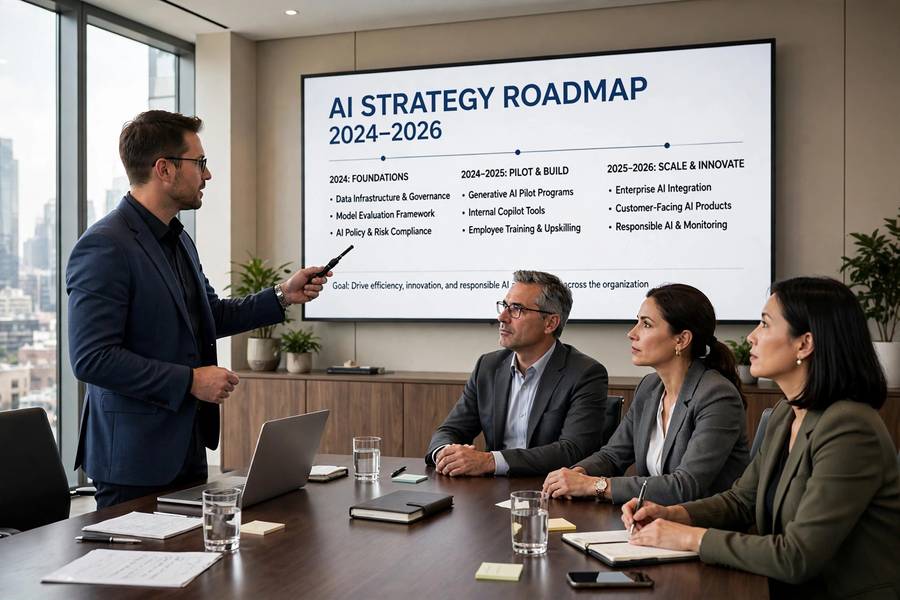
Managers face a peculiar AI challenge: you’re expected to lead AI adoption, evaluate AI investments, and manage AI-augmented teams — usually without being technical yourself, and often with more organizational pressure than actual understanding. The gap between “AI is strategic” (every board deck) and “here’s what we do Monday” (rarely answered) is where managers live. Good courses close that gap.
This guide covers what managers actually need to learn about AI, the course types that deliver it, and how to choose. For the full education landscape, see the best AI courses online.
Table of Contents
- What Managers Need From AI Education (It’s Not Coding)
- The Five Manager AI Competencies
- AI Strategy Courses: The Core Pick
- Leading Adoption: The Change Management Side
- Evaluating AI Tools and Vendors
- Managing AI-Augmented Teams
- AI Governance and Risk for Managers
- Choosing: What to Look For
- What to Do After You Finish
- Frequently Asked Questions
What Managers Need From AI Education (It’s Not Coding)
Let’s kill the anxiety first: you don’t need to code, understand transformers, or do math. What you need is judgment — the ability to make good decisions about AI in your domain. That judgment rests on:
- Literacy — what AI can and can’t do, in practical terms
- Opportunity recognition — spotting where AI creates value in your operations
- Evaluation skill — judging tools, vendors, and proposals critically
- Change leadership — bringing teams along through AI-driven workflow changes
- Risk awareness — knowing where AI creates exposure and how to manage it
Notice: these are management skills applied to AI, not AI skills. The best manager courses teach AI through a management lens — strategy, operations, people — not through a technical lens with the math removed. That framing difference is everything.
The Five Manager AI Competencies
1. Opportunity mapping. Systematically identifying where AI helps your team: which tasks are AI-suitable (repetitive, data-rich, language-heavy), which aren’t (judgment-intensive, relationship-driven, high-stakes-novel), and how to prioritize. This is the highest-ROI skill — most organizations waste AI budgets on the wrong problems.
2. Build-vs-buy-vs-wait. The eternal decision, now with AI flavor. When to buy a tool, when to build on APIs, when to wait for the market to mature. Managers who decide this well save fortunes; those who don’t fund shelfware.
3. ROI thinking. Measuring AI’s actual impact — productivity, quality, cost — versus the hype. Includes knowing what to measure and having the discipline to kill projects that don’t deliver.
4. Team transformation. Redesigning workflows around AI capabilities, reskilling team members, managing the anxiety and resistance that AI change provokes. The human side, and the hardest part.
5. Risk and governance. Data privacy, output reliability, bias, compliance, vendor lock-in — the exposures AI introduces and how to manage them proportionate to the stakes.
A course covering these five produces a manager who can actually lead AI adoption. A course covering “what is machine learning” produces a manager who can nod along in meetings. Demand the former.
AI Strategy Courses: The Core Pick
The central course type for managers: AI strategy — typically 4–12 weeks, often from business schools or executive education providers. What good ones cover:
The AI opportunity landscape — where value is being created across industries, with case studies (and honest discussion of failures, not just successes).
Strategic frameworks — structured approaches to AI strategy: capability assessment, opportunity prioritization, roadmap building. Frameworks you can actually apply Monday.
Organizational readiness — data infrastructure, talent, culture — the unglamorous prerequisites that determine whether AI initiatives succeed.
Competitive dynamics — how AI shifts competitive landscapes in your industry, and the strategic questions it raises.
The best strategy courses use case method — real company situations you analyze and discuss. Passive lectures on strategy don’t build strategic judgment; wrestling with cases does. Check the teaching method, not just the topics.
Leading Adoption: The Change Management Side
The technology is the easy part; the people are hard. Courses (or modules) on leading AI adoption should address:
Resistance honestly. AI provokes fear — of job loss, of incompetence, of change. Good courses don’t dismiss this; they teach you to address it directly: transparent communication, involving teams in design, reskilling commitments.
Workflow redesign. AI doesn’t just speed up existing processes — it enables different processes. Managers need to think in redesign, not just acceleration. The courses teaching this use before/after workflow cases.
Pilot discipline. Starting small, measuring honestly, scaling what works, killing what doesn’t. Most AI adoption failures are pilot failures — too big, poorly measured, or politically impossible to kill.
The productivity paradox. Teams often get slower before faster with new AI tools — learning curves, workflow disruption. Managers need to expect and manage through the dip, not panic at it.
This is where management experience is actually an advantage — change leadership transfers across technologies. The AI-specific parts are smaller than the change-management parts, which should reassure experienced managers.
Evaluating AI Tools and Vendors
Managers constantly face AI purchasing decisions. The evaluation skill set:
Cutting through demos. Every AI demo looks magical. Good courses teach you to ask: what data was that trained on? What happens with MY data? What’s the failure rate? What does it cost at scale? The questions that collapse hype.
Pilot design. How to run a meaningful trial: representative data, clear success criteria, honest measurement, defined kill criteria. Most failed AI purchases trace to pilots that proved nothing.
Total cost thinking. License fees are the tip — integration, training, data preparation, ongoing management, and switching costs dominate. Courses teaching TCO thinking prevent expensive surprises.
Vendor viability. AI startups fail constantly. Evaluating vendor stability, data practices, and lock-in risk is part of the purchase decision.
Security and privacy review. Where does your data go? Who trains on it? What are the contractual protections? Non-negotiable questions that non-technical managers sometimes hesitate to ask — good courses give you the checklist and the confidence.
Managing AI-Augmented Teams
Your team using AI changes management itself:
Output evaluation. When AI drafts the work, your job shifts from reviewing effort to reviewing judgment — did the human direct and verify well? Managing this shift explicitly prevents both over-trust and under-use.
Skill development. Team members need AI skills too — prompting, tool use, verification. Managers should facilitate this learning, not assume it.
The junior question. AI compresses the learning that used to happen through junior tasks. If AI drafts the first version, how do juniors develop judgment? Thoughtful managers address this deliberately — it’s a real long-term risk.
Performance measurement. When AI boosts output, what are you measuring — the human or the tool? Rethinking metrics for AI-augmented work is emerging management craft.
Culture. Norms around AI use: what’s disclosed, what’s verified, what’s acceptable. Teams need explicit norms, not assumptions — and managers set them.
AI Governance and Risk for Managers
You don’t need to be a lawyer, but you need the risk map:
Data exposure. What data flows to AI tools, and under what protections. The number-one enterprise AI risk, and the one managers most directly control.
Output reliability. AI makes things up. Where does that create risk in YOUR operations? Customer-facing content, decisions, advice — each needs verification proportionate to stakes.
Bias and fairness. AI systems can perpetuate biases in hiring, lending, and decisions. Managers deploying AI in people-decisions need to understand this exposure.
Regulatory awareness. AI regulation is evolving fast and varies by jurisdiction and industry. You need awareness of the trajectory and when to involve legal — not legal expertise yourself.
Vendor and model risk. Dependence on specific AI providers, model changes breaking workflows, pricing changes. Operational risks requiring contingency thinking.
Good manager courses cover this proportionately — enough to spot issues and escalate appropriately, not so much you become a quasi-lawyer.
Choosing: What to Look For
Peer level. The best manager courses learn as much from cohort discussion as from content — ensure participants are fellow managers/leaders, not a mixed audience.
Case-based. Strategy and judgment are built through cases, not lectures. Check the teaching method.
Current. AI strategy advice from 2021 is archaeology. Verify recency.
Actionable outputs. You should leave with a draft AI roadmap or assessment for YOUR organization — not just notes.
Instructor credibility. People who’ve led AI adoption in real organizations, not just studied it. Practitioner faculty matters enormously here.
Time-realistic. You’re busy. The best manager courses respect that — focused, high-density, applicable. A 40-hour theory dump isn’t designed for your life.
What to Do After You Finish
The course ends; Monday morning arrives. The post-course playbook for managers:
Write the one-page AI assessment for your team. Where are the opportunities? What are the risks? What would you pilot first? Writing it forces the course concepts into your specific context — and gives you something concrete to discuss with leadership.
Run one small pilot. Not a transformation program — one contained experiment with clear success criteria and a kill date. The pilot teaches your organization more than any course, and a small win builds the credibility for bigger moves.
Set team norms. Explicit expectations about AI use: what’s encouraged, what requires verification, what’s disclosed. Teams without norms develop shadow practices; managers who set norms early avoid the mess.
Keep a decision log. Every AI decision — tool adopted, pilot killed, vendor chosen — with the reasoning. In six months, reviewing it will show you how your judgment evolved, and it’ll be invaluable when similar decisions recur.
Stay literate lightly. The field moves fast; your job isn’t to track everything. A quarterly review of major developments, plus attention to your industry’s AI moves, keeps your judgment current without consuming your calendar.
Frequently Asked Questions
No. Managers need judgment about AI — opportunity recognition, evaluation, change leadership, risk awareness — not technical construction skills. The best manager courses teach AI through a management lens (strategy, operations, people), not a technical one.
Opportunity mapping — systematically identifying where AI creates value in your operations and prioritizing correctly. Most organizations waste AI budgets on wrong problems; managers who choose the right problems create the most value.
Cut through demos with hard questions (your data? failure rates? scale costs?), run disciplined pilots with clear success and kill criteria, think in total cost (integration, training, switching), and always cover data privacy and security contractually.
Address it directly: transparent communication about plans, involving teams in workflow design, concrete reskilling commitments, and honest discussion of what changes and what doesn’t. Resistance usually signals legitimate concerns — treat it as data, not obstinacy.
Data exposure (what flows to AI tools), output reliability (AI hallucinations in your operations), bias in people-decisions, evolving regulation, and vendor dependence. You need enough awareness to spot issues and escalate — not legal expertise.