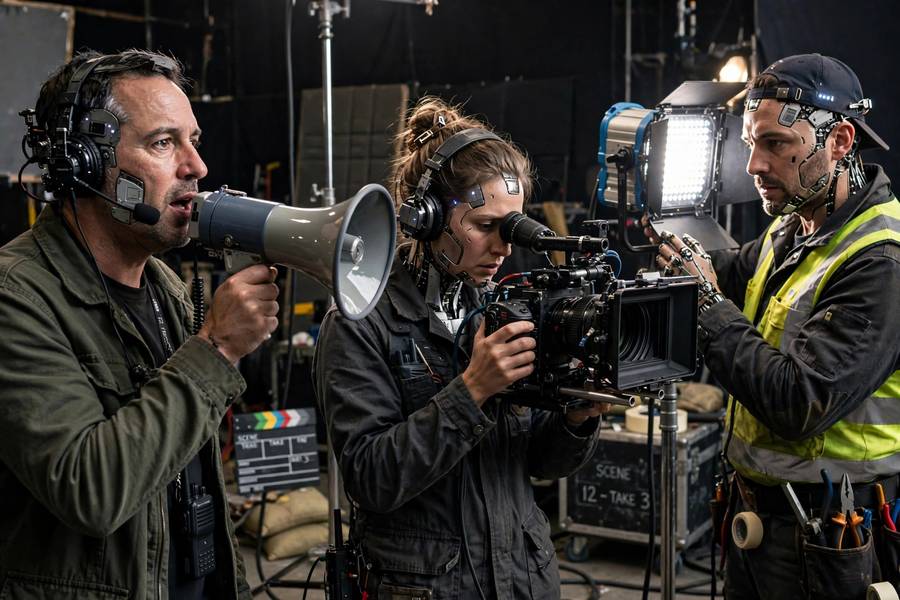
Here’s a thought experiment I keep returning to: if you hired a human team, you wouldn’t hire five identical generalists and hope for the best. You’d hire a researcher, a writer, and an editor — each with a job description, a goal, and the context they need. CrewAI takes this obvious insight and applies it to AI agents, and the result is one of the most intuitively understandable multi-agent frameworks out there.
CrewAI is a framework for orchestrating role-playing AI agents that work together as a “crew” to accomplish tasks. Each agent gets a role, a goal, and a backstory; each task gets a description and an assigned agent; and the crew executes tasks in sequence or hierarchy. This guide explains how it all fits together. For the general mechanics underneath, see my explainer on how AI agents work.
Table of Contents
- The Org Chart Model of AI
- Agents: Role, Goal, Backstory
- Tasks: The Unit of Work
- Crews and Processes: Sequential vs. Hierarchical
- Tools: Giving the Crew Hands
- A Concrete Example: The Content Crew
- CrewAI vs. AutoGen vs. LangGraph
- Where Crews Shine
- The Honest Limitations
- Frequently Asked Questions

The Org Chart Model of AI
Most agent frameworks ask you to think like a programmer: loops, tools, parsers, state machines. CrewAI asks you to think like a manager: who does what, in which order, and what does “done” look like? I find this is why non-technical people grasp CrewAI faster than any other framework — everyone has worked in a team, so the mental model arrives pre-installed.
The framework’s bet is that role-playing improves agent performance: telling a model “you are a senior market researcher” conditions its outputs on everything it has read about how senior researchers write and think. The persona acts as a behavioral prior, steering tone, thoroughness, and method — role-defined agents produce more focused, domain-appropriate work than generic ones.
There’s a second, subtler bet: that decomposing work into roles with handoffs beats one agent doing everything. Each prompt stays simple because each job is narrow, and complexity moves into the structure — which is exactly where you want it, because structure is inspectable and fixable.
Agents: Role, Goal, Backstory
A CrewAI agent is defined by three text fields — writing them well is the core skill of using this framework.
Role is the job title: “Senior Research Analyst,” “Technical Writer,” “QA Specialist.” It tells the model which professional register to adopt — the vocabulary, the thoroughness, the skepticism level. A researcher role produces citations and caveats; a copywriter role produces punch and flow. Choose roles that mirror the human team you’d assemble for the task.
Goal is the agent’s north star: what it’s trying to achieve. “Uncover non-obvious insights about the competitive landscape” beats “do research” the way a sharp brief beats a vague one.
Backstory is the flavor that makes the role stick: a paragraph about the agent’s fictional background and working style. Keep it grounded and relevant.
Beyond these three, agents get practical settings: which model to use (put the expensive one on the hard job), which tools they can access, delegation rights, and memory — agents can retain context across tasks, so the writer remembers what the researcher found.
Tasks: The Unit of Work
If agents are the who, tasks are the what. A CrewAI task has a description (what to do, in natural language), an expected output (what “done” looks like), and an assigned agent. That expected-output field is the unsung hero of the framework — it forces you to define done before running anything, which is precisely the discipline most agent projects lack.
Tasks also declare their context: which earlier tasks’ outputs they depend on. This is how handoffs work. The research task’s output becomes context for the writing task; the writing task’s output becomes context for the editing task. Information flows downstream like an assembly line, and each agent sees what it needs without drowning in the full transcript.
Because tasks are explicit objects, a crew’s plan is readable before anything runs — you can judge whether the plan is sane upfront, which is much harder with emergent conversation frameworks. For teams that need reviewable automation, this upfront legibility matters.
Crews and Processes: Sequential vs. Hierarchical
A crew bundles agents and tasks together and runs them under a process. CrewAI offers two, and choosing between them is the main architectural decision.
Sequential process runs tasks in order: task one completes, its output feeds task two, and so on. It’s a relay race — simple, predictable, debuggable. When something goes wrong, you know exactly which leg failed. Most CrewAI projects should start here, and many never need anything else.
Hierarchical process adds a manager agent that decomposes the goal, delegates tasks to the right agents, and synthesizes results. The manager is itself an LLM making judgment calls about who should do what. This handles tasks where you can’t predefine the steps — the manager adapts the plan as results come in. The cost is predictability: you’re now debugging a manager’s decisions, not just a task list.
My rule: if you can write down the steps in advance, use sequential. The hierarchical process earns its keep only when the task genuinely requires dynamic delegation — and even then, watch it closely: a manager agent with a vague goal can burn through tokens inventing elaborate plans for simple problems.

Tools: Giving the Crew Hands
Roles and tasks define the crew’s brains; tools give it hands. CrewAI agents can use tools for web search, file reading, code execution, API calls, and more — the framework ships with a solid set and supports custom tools.
The design principle that matters: match tools to roles. Your researcher gets search tools; your analyst gets code execution. An agent with twenty irrelevant tools is like an employee with keys to every room — confusing and slightly dangerous. Fewer, role-appropriate tools consistently outperform a giant shared toolbox.
One more practical note: tool descriptions are written for the model, not for you. Write the description you’d give a smart intern using the tool for the first time — “Use this when you need facts from after your training data” beats “Search the web for current information.”
A Concrete Example: The Content Crew
Let me make this concrete with the canonical CrewAI example: a content creation crew. Three agents, three tasks.
Agent 1: Senior Researcher. Goal: uncover key facts, statistics, and expert viewpoints on the topic. Tools: web search, scraping. Task: produce a research brief with cited facts.
Agent 2: Content Writer. Goal: turn research into engaging, accurate prose. Tools: file writing. Task: draft the article from the research brief, in a specified voice, with the facts woven in — not invented.
Agent 3: Editor. Goal: ensure quality, accuracy, and consistency. Task: review the draft against the research brief, flag unsupported claims, tighten prose, produce the final version.
Run sequentially, this crew does genuinely useful work: the researcher’s brief grounds the writer (reducing hallucination), and the editor catches what slips through. It’s dramatically better than asking one generic agent to “write an article” — the structure forces a draft-then-review discipline that single agents skip.
What made it work: narrow roles, explicit handoffs, defined done-states, and a critic at the end. Those four ingredients transfer to almost any knowledge-work pipeline — if your workflow looks like specialists handing work downstream, CrewAI is speaking your language.
CrewAI vs. AutoGen vs. LangGraph
The inevitable comparison. I’ve covered AutoGen’s conversational model in depth — agents as colleagues chatting. CrewAI’s model is agents as employees with job descriptions. LangGraph’s model is agents as nodes in a state machine.
Choose CrewAI when your problem decomposes into roles and sequential handoffs, when you want the plan legible upfront, and when your team thinks in workflows rather than code. It’s the most approachable of the three and the fastest path to a structured multi-agent pipeline.
Choose AutoGen when the work is genuinely conversational — iterative refinement where agents need to react to each other’s intermediate outputs in free-form dialogue, especially around code execution.
Choose LangGraph when you need precise control flow: branching, cycles, human-in-the-loop checkpoints, persistent state across long-running processes. It’s the most powerful and the most demanding.
They’re converging, but the mental models remain distinct — for many teams, the right answer is the framework whose mental model your team already thinks in.
Where Crews Shine
Content pipelines. Research → draft → edit → publish workflows are CrewAI’s home turf. Marketing teams, SEO operations, documentation — anywhere content moves through defined stages with different skills at each stage.
Research synthesis. A researcher agent gathering from multiple sources, an analyst agent finding patterns, a writer agent producing the report. The handoff structure keeps the synthesis grounded in the gathered facts.
Structured analysis. Competitive analysis, due diligence summaries, literature reviews — tasks with a known shape (gather, analyze, conclude) and clear quality bars at each stage.
Anything with a natural critic. The pattern of maker-then-checker is powerful, and CrewAI makes the checker a first-class citizen. My guide to AI agent examples in real life includes several production systems built on exactly this shape.
The Honest Limitations
Now the complaints, because you’d discover them anyway.
Role-playing has ceilings. A backstory doesn’t give a model real expertise. For tasks requiring genuine domain depth — legal analysis, medical reasoning, advanced math — a well-prompted frontier model in a single-agent loop often beats a crew of role-players. Personas steer style more than substance, and style isn’t always the bottleneck.
Sequential crews are brittle. If the researcher’s brief is bad, the writer writes a bad article from it, and the editor polishes a bad article. Errors compound downstream — the assembly line amplifies upstream mistakes rather than correcting them. The editor agent helps, but it’s reviewing prose, not re-doing research. Garbage in, polished garbage out.
Cost scales with crew size. Each agent is a separate model invocation with its own context. A five-agent crew doing a task one agent could do costs roughly five times as much. Sometimes the quality gain justifies it; often it doesn’t. Audit whether each role earns its tokens.
The framework abstracts, until it doesn’t. CrewAI’s simplicity is genuine for standard patterns, but custom behavior — conditional routing, complex state, human approvals mid-crew — pushes you toward workarounds. Know where the abstraction ends before you architect around it.
My verdict: CrewAI is the best-structured on-ramp to multi-agent systems and a legitimate production choice for pipeline-shaped work — judgment about what each role should do remains entirely yours. For the broader design space, my piece on types of AI agents covers the landscape without the framework branding.

Frequently Asked Questions
CrewAI is a framework for orchestrating role-playing AI agents that work together as a crew. Each agent has a role, goal, and backstory; work is organized into tasks with defined expected outputs; and crews run tasks sequentially or under a manager agent.
Agents collaborate through structured task handoffs: one agent’s task output becomes context for the next agent’s task. In sequential processes tasks run in order; in hierarchical processes a manager agent delegates dynamically. Agents can also share memory across tasks.
CrewAI uses an org-chart model: agents with job descriptions executing predefined task sequences. AutoGen uses a conversational model: agents collaborating through free-form dialogue. CrewAI’s plan is legible upfront; AutoGen’s emerges from the conversation.
Use CrewAI when work decomposes into specialist roles with handoffs — content pipelines (research, write, edit), structured analysis, research synthesis. If you can write the steps down in advance, CrewAI’s sequential process is an excellent fit.
No — backstories don’t create real expertise. They condition the model’s outputs on professional patterns it learned in training, which steers style, thoroughness, and method. Role-playing improves focus and consistency but can’t substitute for domain depth the model lacks.