The agent world has split into two camps. One says: build the best single agent you can — focused, reliable, deeply evaluated. The other says: the future is teams — specialized agents collaborating, debating, dividing labor like a well-run company. Both camps have impressive demos. Both have production scars. I’ve worked with both architectures, and the honest answer is that the choice depends on the task’s complexity profile, not on ideology.
This guide compares them head-on: what each does well, where each breaks, what each costs, and the decision framework I use with teams choosing between them. For foundations, see what is an AI agent and the types of AI agents.
Table of Contents
- Definitions: What We’re Comparing
- Where Single Agents Win
- Where Multi-Agent Systems Win
- The Cost Comparison
- Failure Modes: Solo vs Team
- Coordination: The Hidden Overhead
- The Decision Framework
- Hybrid Approaches
- Frequently Asked Questions

Definitions: What We’re Comparing
Single-agent system: one LLM-powered agent handles the entire task. It may use many tools and have sophisticated internal loops (planning, self-correction), but there’s one decision-maker, one context, one locus of responsibility. Think: a senior engineer who does the whole project.
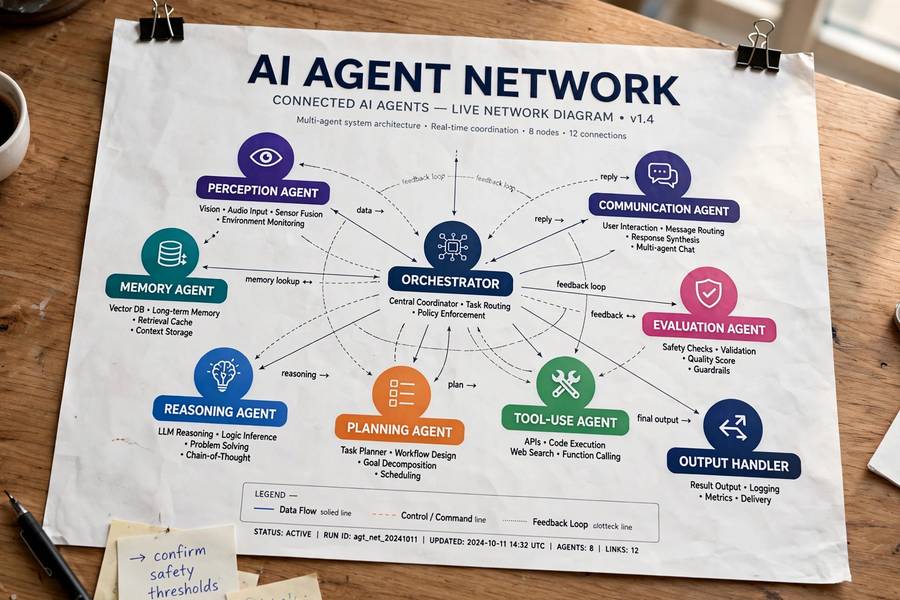
Multi-agent system: multiple specialized agents collaborate — a researcher, a writer, a critic, a coordinator. They communicate (message passing, shared blackboards, hierarchical delegation), divide labor, and combine results. Think: a team with roles.
Note what’s not in this comparison: a “router” that sends requests to different single agents isn’t really multi-agent — there’s no collaboration, just dispatch. True multi-agent means agents interacting with each other toward a shared goal. The types of AI agents span both architectures.
Where Single Agents Win
Reliability. One context, one decision-maker, no handoff failures. Every multi-agent handoff is a point where information degrades — the writer misunderstands the researcher’s notes, the critic’s feedback gets lost. Single agents avoid this entire failure class. For tasks where correctness matters more than capability breadth, this is decisive.
Debuggability. When a single agent fails, you read one trajectory: one sequence of thoughts and actions. When a multi-agent system fails, you’re reconstructing a conversation across agents, figuring out who misunderstood whom. Debugging difficulty scales superlinearly with agent count.
Latency. No inter-agent communication overhead. A single agent’s loop is tight; multi-agent systems spend significant time (and tokens) on coordination messages. For interactive applications where users wait, this matters enormously.
Cost. One model instance doing the work versus several. Multi-agent systems routinely cost 3–10x more per task than single agents on the same underlying models — and that’s before counting the coordination overhead.
Evaluation. Testing one agent’s behavior is tractable. Testing emergent multi-agent behavior — the system doing things no individual agent was designed to do — is genuinely hard. The evals for multi-agent systems are still primitive compared to single-agent evals.
When to choose single-agent: bounded tasks, high reliability requirements, interactive latency needs, cost sensitivity, or when the task doesn’t clearly decompose into specialties. This covers the majority of production agent deployments today — and will for a while.
Where Multi-Agent Systems Win
Specialization depth. A research agent with deep search tools and a writing agent with style constraints each outperform a generalist trying to do both. When subtasks require genuinely different capabilities, tools, or knowledge, specialization wins.
Parallelism. Independent subtasks run simultaneously across agents. A research task split across five search agents finishes in a fifth of the time (roughly — coordination overhead applies). For time-sensitive complex tasks, this is transformative.
Quality through roles. The writer-critic pattern — one agent drafts, another critiques, the first revises — produces measurably better output than single-agent self-correction. Separation of generation and evaluation avoids the blind spots of self-review. It’s the same reason human writing improves with editors.
Scale of complexity. Some tasks are just too big for one context window and one plan. Software projects with dozens of files, research reports synthesizing hundreds of sources, operations coordinating across systems — these decompose naturally, and multi-agent architectures handle the decomposition.
Robustness through redundancy. Multiple agents can cross-check each other. A fact-checker agent verifying a researcher agent’s claims catches errors neither would catch alone. It’s expensive quality assurance, but for high-stakes outputs, it’s worth it.
When to choose multi-agent: tasks that clearly decompose into specialties, quality-critical outputs that benefit from role separation, parallelizable workloads, or complexity exceeding single-agent context and planning limits.
The Cost Comparison
Let’s make this concrete with a representative complex task — say, producing a researched report:
Single agent: ~50 loop iterations, one model instance. Cost: roughly $1–3 in model calls. Time: 10–20 minutes sequential. Reliability: one context to manage, well-understood failure modes.
Multi-agent (researcher + writer + critic + coordinator): ~150 total iterations across four agents, plus coordination messages (~30% overhead). Cost: roughly $5–15. Time: 8–15 minutes with parallelism. Reliability: four contexts, handoff risks, emergent behaviors.
The multi-agent version costs 3–5x more for potentially better quality in less wall-clock time. Whether that trade is worth it depends entirely on the value of the output. For a $10 internal report, no. For a $10,000 client deliverable, absolutely.
There’s also a hidden cost: engineering complexity. Multi-agent systems need orchestration frameworks, communication protocols, conflict resolution, and monitoring across agents. The build cost is 3–5x a single agent, and the maintenance never really ends.
Failure Modes: Solo vs Team
Single-agent failures are legible: the agent misunderstood the task, used the wrong tool, got stuck in a loop, or hallucinated. Each has known mitigations. The failure surface is the agent’s own reasoning.
Multi-agent failures are weirder:
- Handoff degradation. Information loses fidelity at every transfer. The researcher’s nuanced findings become the writer’s oversimplified claims.
- Coordination deadlock. Agents waiting on each other, circular dependencies, nobody empowered to break ties.
- Responsibility diffusion. When the output is wrong, which agent failed? The researcher who found bad data, the writer who misused it, or the coordinator who didn’t check? Diffused responsibility means nobody’s evals catch it.
- Emergent misbehavior. Agents developing counterproductive interaction patterns — excessive deference (“looks good to me!”), unproductive argument loops, or gaming shared metrics.
- Cascading errors. One agent’s mistake propagates through every downstream agent, each amplifying rather than catching it. The critic was supposed to prevent this, but critics have blind spots too.
The pattern: single-agent failures are bugs; multi-agent failures are organizational dysfunctions. Debugging a multi-agent system feels less like fixing code and more like management consulting.
Coordination: The Hidden Overhead
Every multi-agent architecture pays a coordination overhead, and it’s larger than most builders expect:
Communication overhead. Agents exchanging messages consume tokens and time. In systems I’ve measured, 20–40% of total tokens go to inter-agent communication — status updates, clarifications, handoffs — not to the actual task.
Shared state management. Agents need common ground: what have we decided, what’s the current plan, who owns what? Blackboard architectures, shared documents, message histories — all need design and maintenance.
Conflict resolution. When agents disagree, who wins? Hierarchical systems defer to the manager; debate systems use judges; market systems use bidding. Each mechanism adds complexity and its own failure modes.
The overhead grows with team size. Two agents coordinate easily. Five need real infrastructure. Ten need governance. The coordination overhead is superlinear — which is why most successful multi-agent systems stay small (2–5 agents) with clear roles.
The Decision Framework
Here’s how I advise teams:
- Start single-agent. Always. Build the best single agent you can. Evaluate it honestly on real tasks.
- Identify the specific limitation. Is it context limits? Lack of specialization? Need for parallelism? Quality ceiling? Name the bottleneck precisely.
- Check if the bottleneck is fixable within single-agent. Better prompts, better tools, bigger context, self-correction loops, retrieval improvements — most “we need multi-agent” moments are actually “we need a better single agent” moments.
- Go multi-agent only for the proven bottleneck. Add exactly the agents needed, with clear roles and interfaces. Resist the urge to build the full team upfront.
- Measure the trade. Compare quality, cost, latency, and reliability before and after. If multi-agent isn’t clearly better on the metrics that matter, revert.
The teams I see succeeding with multi-agent are the ones who arrived there reluctantly, driven by measured single-agent limitations. The teams struggling are the ones who started with the team because it sounded impressive.
Hybrid Approaches
The most practical architectures blend both:
Single agent with specialist tools. One decision-maker, but tools that encapsulate specialist capabilities (a “research tool” that’s actually a sub-agent, a “code review tool” with its own model). The agent stays simple; the complexity hides in well-designed tools.
Sequential specialists, single coordinator. A thin coordinator runs phases — research phase (one agent), writing phase (one agent), review phase (one agent) — but only one agent is active at a time. You get specialization without concurrent coordination chaos.
Single agent with critic. The 80/20 of multi-agent quality: one primary agent plus one reviewer. Minimal coordination overhead, significant quality gain. If you take one idea from this guide, take this one.
Escalation hierarchies. Single agent handles the routine; difficult cases escalate to a multi-agent panel. Most tasks get single-agent efficiency; hard tasks get team quality.

Frequently Asked Questions
Single-agent systems use one AI agent for the entire task — one decision-maker, one context. Multi-agent systems use multiple specialized agents (researcher, writer, critic, coordinator) that collaborate toward a shared goal. Single-agent wins on reliability, cost, and debuggability; multi-agent wins on specialization, parallelism, and handling extreme complexity.
Not inherently. Multi-agent systems excel at tasks that clearly decompose into specialties, quality-critical outputs benefiting from role separation, and parallelizable workloads. But they cost 3–10x more, fail in weirder ways (handoff degradation, coordination deadlock), and are harder to debug. Start single-agent; go multi-agent only for proven bottlenecks.
When single-agent approaches demonstrably fail: tasks exceeding context and planning limits, clear decomposition into specialties requiring different tools, quality-critical outputs where writer-critic separation measurably helps, or parallelizable workloads where speed matters. Arrive at multi-agent reluctantly, driven by measured limitations.
Handoff degradation (information loss between agents), coordination overhead (20–40% of tokens on inter-agent messages), responsibility diffusion, emergent misbehavior (deference loops, unproductive arguments), cascading errors, and superlinear debugging difficulty. These are organizational dysfunctions, not just bugs.
Single agent plus critic: one primary agent does the work, one reviewer agent checks it. Minimal coordination overhead, significant quality gain — the 80/20 of multi-agent benefits. Other practical hybrids include single agents with specialist tools and sequential specialists under a thin coordinator.