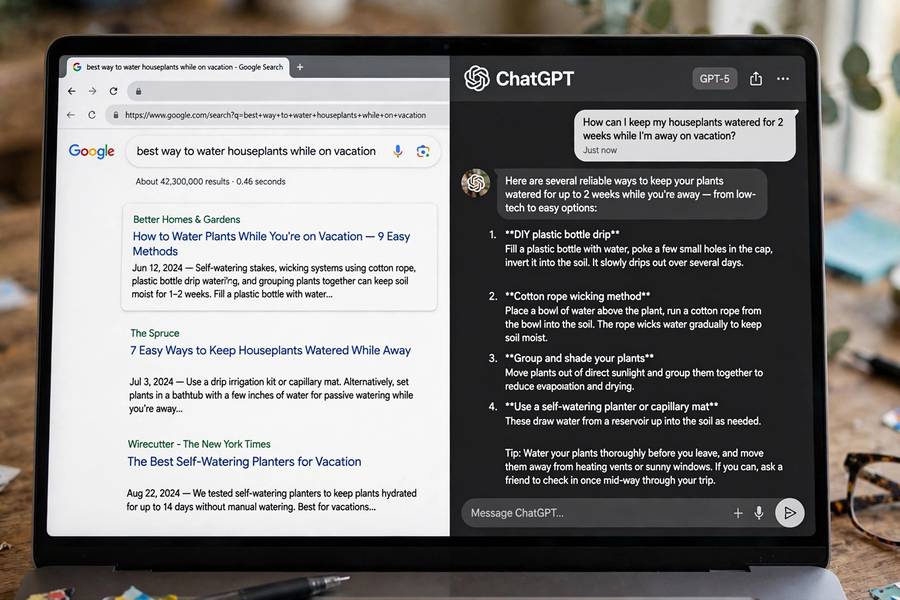
“Should I Google this or ask ChatGPT?” It’s the defining question of how we find information now — and most people answer it by habit rather than strategy. The two tools work in fundamentally different ways, fail in fundamentally different ways, and are optimal for fundamentally different tasks.
I’ve watched people use ChatGPT for things Google does better, and Google for things ChatGPT does better, usually out of sheer inertia. This guide gives you the decision framework: how each works, where each wins, and how to combine them. For the AI side of the equation, see my guide on how does ChatGPT work.
In This Guide
- How They Work: Retrieval vs. Generation
- When Search Wins
- When ChatGPT Wins
- The Failure Modes Are Mirror Images
- The Trust Question
- How to Use Both Like a Pro
- The Convergence: They’re Becoming Each Other
- Frequently Asked Questions

How They Work: Retrieval vs. Generation
The core difference is architectural:
Search engines retrieve. Google indexes billions of web pages, and when you search, it finds the most relevant existing pages and ranks them. You’re reading what humans (or their websites) actually wrote. The information existed before you asked.
ChatGPT generates. It doesn’t look anything up (by default) — it produces an answer from patterns learned during training. The response is newly synthesized for your specific question. Nothing you read was “written” before; it was generated on the spot.
This single distinction explains almost everything else:
- Search gives you sources; ChatGPT gives you an answer
- Search shows you what exists; ChatGPT creates a response
- Search is only as good as what’s published; ChatGPT works even for novel questions
- Search results are verifiable (click through); ChatGPT’s are take-it-or-leave-it prose
Neither is “better” — they’re different instruments. The skill is knowing which to pick up.
When Search Wins
Use a search engine when:
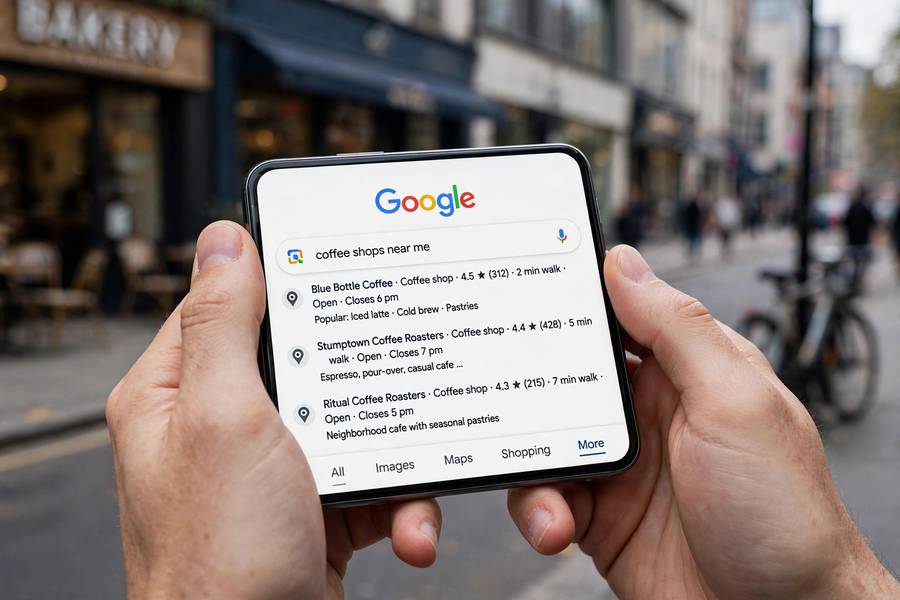
You need current information. What’s the score? Is this restaurant open? What did the Fed announce today? ChatGPT’s training has a cutoff; search is live. (Some ChatGPT versions can browse, but native search is still faster and more comprehensive for fresh info.)
You need sources. Academic work, journalism, anything where provenance matters — search gives you citable pages with authors and dates. ChatGPT gives you confident prose with no trail.
You’re shopping or comparing. Prices, reviews, product options — search (and specialized sites) aggregate real-world data ChatGPT can only approximate from training patterns.
You want diversity of views. Search shows you ten perspectives; ChatGPT synthesizes into one. For contested topics, seeing the disagreement matters more than getting an answer.
You need to verify. Ironically, the best use of search alongside ChatGPT is checking ChatGPT. Any factual claim from AI that matters should be verified via search — I’ll say more on this below.
The query is navigational. “Facebook login,” “IRS forms,” “that article I half-remember” — you want a destination, not an explanation.
When ChatGPT Wins
Use ChatGPT when:
You need synthesis. “Explain the causes of the 2008 financial crisis for a smart teenager” — ChatGPT produces a tailored explanation instantly. Search gives you ten articles to synthesize yourself.
The question is novel or specific. “Help me write a polite but firm email declining this offer while keeping the door open” — no web page has your answer. Generation handles the un-Googleable.
You’re brainstorming. Ideas, angles, variations, creative options — ChatGPT generates dozens in seconds. Search can only show you what others already thought.
You need a tutor. “Explain recursion like I’m five, then like I’m a CS student, then quiz me” — interactive, adaptive explanation is ChatGPT’s home turf. Search can’t converse.
You’re working with your own material. “Summarize this document,” “improve this paragraph,” “find the flaws in my argument” — ChatGPT operates on your input. Search has nothing to say about your draft.
You want it in your format. Tables, bullet points, step-by-step, ELI5 — ChatGPT reshapes information to your needs. Search gives you whatever format the author chose.
The Failure Modes Are Mirror Images
Here’s the elegant part: their weaknesses are inverses.
Search fails by abundance. Too many results, SEO spam, contradictory sources, outdated pages ranking well. The failure is finding signal in noise. You’re drowning in information of uncertain quality.
ChatGPT fails by confident fabrication. Too little friction — a single fluent answer that might contain hallucinations. The failure is unverifiable fluency. You’re handed a smooth answer of uncertain truth.
The implication: they correct each other. Search’s messiness is honest (you can see the sources); ChatGPT’s smoothness is suspicious (you can’t). But ChatGPT’s synthesis saves the hours search wastes. The pro move is using each to cover the other’s weakness.
The Trust Question
Whom do you trust? The honest answer: neither, fully — but differently.
Trust search for existence claims: this page exists, this person said this, this price is listed. What you see is what someone published. But don’t trust rankings blindly — SEO gaming, sponsored content, and algorithmic bias shape what surfaces.
Trust ChatGPT for reasoning and language: explanations, drafts, brainstorming, transformations. But don’t trust factual claims without verification — especially dates, numbers, names, and citations, where hallucinations cluster.
The verification loop: use ChatGPT to understand and explore, then use search to verify anything factual that matters. “ChatGPT says X — let me check” is the defining information-literacy skill of this era. It takes seconds and catches the errors that matter.
A note on AI-generated search results: modern search increasingly includes AI-generated summaries (Google’s AI Overviews, Bing Copilot). These inherit both failure modes — the fluency problem of generation plus the ranking problems of search. Treat AI search summaries with ChatGPT-level skepticishm, not Google-level trust.
How to Use Both Like a Pro
The workflow I recommend:
- Start with ChatGPT for understanding. “Explain X to me” — build your mental model fast.
- Switch to search for facts. Verify key claims, find sources, get current data.
- Return to ChatGPT for synthesis. “Given these sources [paste], help me decide/write/plan…”
- Search again to verify anything the final output asserts factually.
Concrete scenarios:
- Learning a topic: ChatGPT explains → search finds authoritative sources → ChatGPT helps you take notes/synthesize
- Making a decision: ChatGPT lays out the considerations → search gets real prices/reviews → ChatGPT helps weigh trade-offs
- Writing: ChatGPT drafts → search verifies every factual claim → ChatGPT polishes
- Troubleshooting: search for the error message (someone’s solved it) → ChatGPT explains the solution in your context
The 80/20: 80% of people use one tool for everything. Being in the 20% who route deliberately — ChatGPT for thinking, search for verifying — is a genuine competitive advantage in knowledge work.
For the prompting skills that make the ChatGPT half of this workflow sing, see my guide on how to get better answers from ChatGPT.
The Convergence: They’re Becoming Each Other
The honest futurist note: the distinction is blurring.
- Search is adding generation: AI Overviews, Copilot answers, Perplexity’s entire model — search engines now synthesize answers, not just list links.
- ChatGPT is adding retrieval: browsing modes, search integrations, and RAG architectures let it fetch live information.
- New hybrids (Perplexity, You.com, Copilot) are explicitly both: generated answers with cited sources.
The end state is probably a unified interface: ask anything, get a synthesized answer with sources you can check. The “vs.” framing will look quaint within a few years.
But the underlying literacy — knowing when you’re reading generated text vs. retrieved sources, and calibrating trust accordingly — will matter more, not less. The tools converge; the judgment stays yours.
ChatGPT and search aren’t competitors — they’re complements that happen to overlap. Retrieval finds what exists; generation creates what’s needed. The people who thrive in this information environment aren’t the ones who pick a side. They’re the ones who route: generate to understand, retrieve to verify, and never confuse fluency with truth.
Frequently Asked Questions
Search engines retrieve existing web pages matching your query; ChatGPT generates a new synthesized answer from learned patterns. Search gives you sources to evaluate; ChatGPT gives you a direct answer to use — each with different strengths and failure modes.
Use Google (search) for current information, sources, shopping, and verification. Use ChatGPT for explanations, brainstorming, writing help, tutoring, and novel questions. Best practice: use ChatGPT to understand, then search to verify factual claims.
Neither is universally more accurate. Search shows you real published sources (verifiable but noisy); ChatGPT synthesizes fluently (convenient but prone to hallucinations). For factual accuracy, verified search results beat unverified AI output.
Not fully. ChatGPT can’t reliably provide current information, citable sources, or real-world data like prices and reviews. The trend is convergence — search engines add AI answers, ChatGPT adds browsing — but retrieval and generation remain distinct capabilities.
Search for the key factual claims (names, dates, numbers, citations) and check authoritative sources. Be especially skeptical of quotes, statistics, and references — these are where hallucinations cluster. The “ChatGPT says X, let me verify” loop is essential information literacy.